
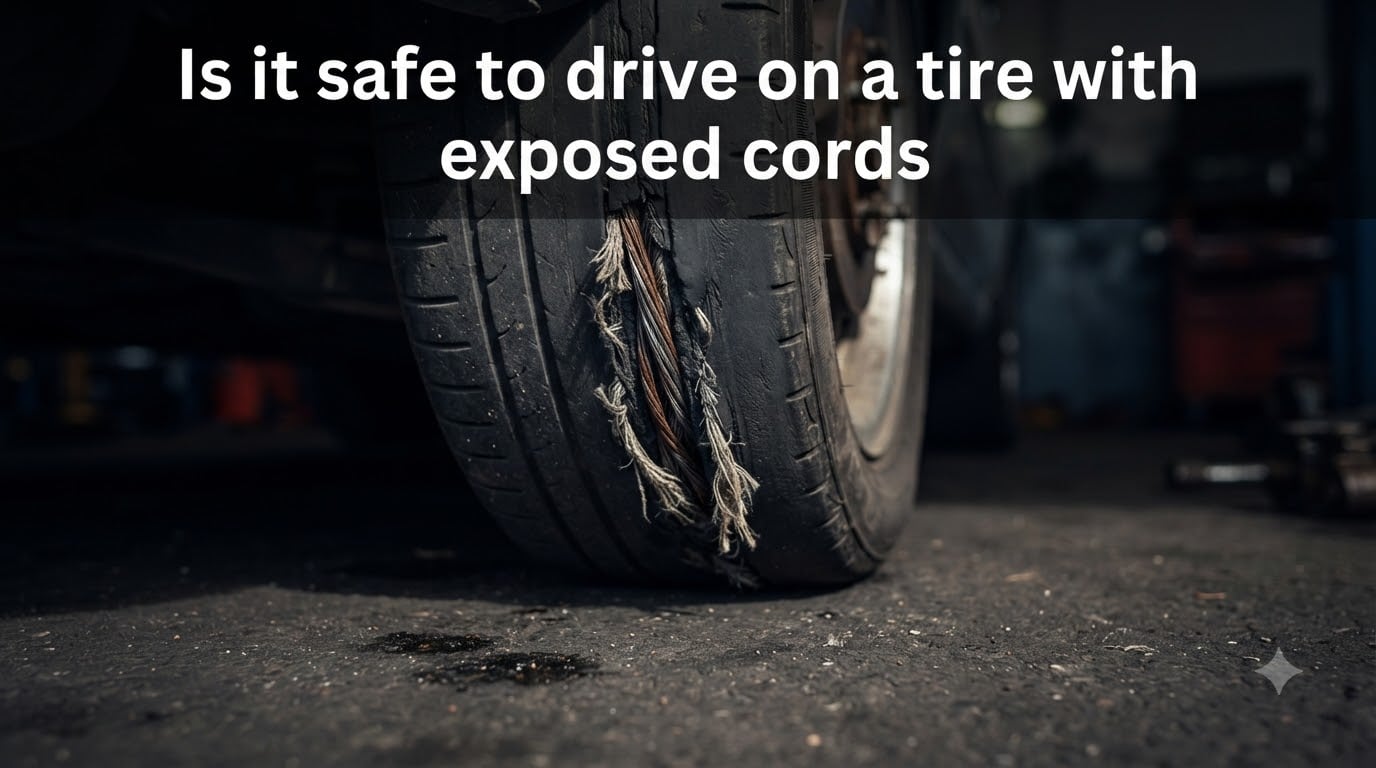
No, it is not safe to drive on a tire with exposed cords. Exposed cords mean the tire’s internal steel belts or fabric plies have become visible because the protective rubber tread has worn away completely. At that point, the tire has lost the structural integrity it needs to contain pressurized air under your vehicle’s weight, and a sudden blowout can happen at any speed, on any road. If you can see wires, threads, or belt edges on your tire, treat it as an emergency. Do not drive on it except to move the car the shortest possible distance at low speed to a safe spot or directly to a tire shop, and even that should be your last option.
I have spent years around service shops and roadside assistance calls, and exposed cords is one of those failure modes drivers underestimate until they see the aftermath. A blown-out front tire at highway speed is not a fender-bender. It can flip a vehicle, send it across multiple lanes, or leave you fighting the steering wheel for control. That is why the question “is it safe to drive on a tire with exposed cords” has only one honest answer: no, and you need to act now.
This 2026 guide covers what tire cords are, how to spot them, why no repair can fix them, the specific dangers you face, the legal and insurance consequences, and a step-by-step emergency plan if you discover cords today. We have also included a FAQ section that mirrors the most-asked questions from drivers who find themselves in this exact situation.
Table of Contents
Quick Answer: Is It Safe to Drive on a Tire With Exposed Cords?
No. A tire with exposed cords is structurally failed and unsafe to drive on. The cords are the internal reinforcement layers (steel belts, polyester, or nylon) that hold the tire together against road forces and internal air pressure. Once they are visible, the tire cannot perform its basic job. Continued driving risks a blowout, loss of control, and liability if you cause a crash.
- Blowout risk: The tire can rupture without warning at any speed, including at highway speeds.
- Loss of traction: The remaining tread surface is gone or failing, so braking, cornering, and wet-weather grip are severely compromised.
- Legal exposure: Most U.S. states will fail you on inspection and can fine you for operating an unsafe vehicle.
If you have exposed cords right now, skip ahead to our What to Do Right Now section. If you want the full breakdown of why this is so dangerous, keep reading.
What Are Tire Cords and Why Do They Matter?
Tire cords are the strong fiber or steel reinforcement layers built into every modern passenger and light-truck tire. They sit beneath the rubber tread and sidewall and are what give a tire its shape, strength, and ability to hold air under load. When you see them on the surface, you are looking at a tire whose outer rubber has been worn or torn away completely.
Modern radial tires are built from several layered components:
- Polyester body plies that run radially across the tire and absorb road shock.
- Steel belt packages that sit just under the tread and resist punctures while stabilizing the contact patch.
- Nylon cap ply on many high-performance and light-truck tires for high-speed stability.
- Tread wear indicators (TWI), which are raised bars of rubber inside the tread grooves that appear flush with the surface when the tire reaches the legal wear limit.
Those reinforcement layers are the reason a tire can carry 1,500 to 3,000 pounds of vehicle weight, deform over bumps, and survive 60,000 miles of hot and cold cycles without failing. They are also the only thing keeping the pressurized air inside the tire when the rubber tread is gone. When you see threads, mesh, or wire poking through, that safety net has been breached.
You will sometimes hear these layers called tire plies, tire belts, or steel belts. All of them are forms of tire cords. The exact term matters less than the fact that none of them should ever be visible on the outside of a tire in service.
How to Tell If Your Tires Have Exposed Cords
Exposed cords are not always dramatic. Sometimes the first sign is a thin wire catching on your sock when you brush the tire. Other times it is a torn strip of tread with a mesh pattern showing through. Knowing what to look for buys you time before a cord-exposed tire strands you on a highway.
Visual signs of exposed tire cords:
- Visible wires or threads: Thin metallic wires, often blackened, poking out of the tread or shoulder.
- Mesh or fabric pattern: A woven texture visible through missing tread rubber.
- Belt edge sticking out: A hard line of steel belt that looks like a razor edge along the shoulder or center of the tread.
- Tread chunks missing: Large pieces of tread torn away, exposing the smooth black layer beneath.
Behavioral signs your tire is failing:
- Vibration at highway speed that did not exist a week ago, especially from one specific wheel.
- Thumping or rhythmic noise that increases with speed.
- Steering pull to one side even after alignment.
- Visible bulges or blisters on the sidewall, often a precursor to blowout.
- Slow air loss that a normal puncture cannot explain.
Check the tread depth while you are at it. Insert a quarter into the tread groove with George Washington’s head facing down. If the top of his head is visible, the tread is at or below 4/32 inch and the tire is at the edge of unsafe. If you can see the top of his head and you also see wires, the tire is already failed.
Track day drivers in our community often notice cords first on the inner edge of the front tires because aggressive alignment settings wear the inside shoulder faster. If you ever see inner-edge wear combined with wires, stop driving the car to the track and replace the tires before the next event.
What Causes Tire Cords to Become Exposed
Tire cords do not fail on their own. They become exposed because something destroyed the protective rubber over them. In our experience, four causes account for nearly every cord-exposure case we see.
1. Driving on bald tires. Once the tread is worn down to the wear bars, the rubber left between the cords and the road is paper-thin. A few hundred miles of normal driving, plus heat cycles, will wear through it.
2. Chronic misalignment. Bad alignment eats the inside or outside shoulder unevenly. The shoulder is the thinnest part of the tread, so it exposes cords there first. This is the most common cause of inner-edge cord exposure.
3. Underinflation. An underinflated tire flexes more than designed. The extra flex generates heat and scrubs the shoulders and tread edges. Underinflation is also a leading cause of blowout even before cords are visible.
4. Impact damage and curbs. Hitting a pothole or curb can cut or chunk the tread, slicing straight through to the belts. Once a chunk is missing, the cords underneath are exposed from day one.
Less common causes include manufacturing defects, aged rubber that hardens and cracks, and aggressive driving in track environments. If your tire is over six years old (check the DOT date code on the sidewall), the rubber itself may be too brittle to protect the cords even if the tread looks deep.
Why Repairs Cannot Fix a Tire With Exposed Cords
This is one of the most common questions we hear, and the answer is hard for budget-strapped drivers to accept. A tire with exposed cords cannot be repaired. Not patched, not plugged, not sealed. It must be replaced.
The reason comes down to what the cords actually do. Once they are exposed, two things have happened at once. First, the rubber tread is gone, which means the structural shell of the tire is breached. Second, the cords themselves have been contaminated by road grime, water, and oil. Even if a plug sealed the air leak, the cords have lost their bond to the surrounding rubber.
The Rubber Manufacturers Association and every major tire manufacturer (Michelin, Goodyear, Bridgestone, Continental) publish the same guidance: cords visible on the tread or sidewall mean the tire is no longer repairable. Industry repair standards (such as the Tire Industry Association guidelines) limit repairs to small punctures in the tread area only, and never to exposed steel belts or fabric.
This is also why a tire shop that offers to repair your cord-exposed tire is one you should not trust with your safety. Reputable shops will refuse the work and quote a replacement. If a shop quotes a patch, walk away.
The Dangers of Driving on Tires With Exposed Cords
The dangers are not abstract. Every mechanic we have talked to has seen the aftermath of a blown-out tire on a highway: shredded sidewalls, bent rims, and vehicles that ended up in ditches or on their roofs. Here is exactly what you risk when you keep driving on a cord-exposed tire.
Sudden blowout at speed. This is the headline risk. The cords are the only thing holding the air in. Once they fray, the tire can rupture with no warning. A front-tire blowout at 65 mph is a documented cause of rollover crashes in SUVs and light trucks.
Loss of vehicle control. A blowout on a steering tire creates an immediate pull to one side. Drivers who are not prepared can over-correct and end up in oncoming traffic or off the road. A rear-tire blowout is more forgiving but still dangerous, especially in wet conditions.
Braking distance collapse. Even before a blowout, exposed cords mean the contact patch is compromised. On wet roads, hydroplaning risk rises sharply. Stopping distances in our team’s experience can grow by 30 to 40 percent once the tread is gone or the cords are showing.
Tread separation. The belts can separate from the carcass at speed, peeling the tread off in long strips. We have seen this leave black streaks across a full lane of highway before the tire finally disintegrates.
Sidewall flex and rim damage. With the structural layers compromised, the sidewall can flex unpredictably. This bends the rim and can damage suspension components, multiplying the repair bill.
Fire risk under the vehicle. A shredded tire throwing rubber onto a hot exhaust can, in rare cases, start a vehicle fire.
Put simply: if a tire has reached the cord-exposure stage, it is no longer a tire. It is a liability on wheels.
Legal and Insurance Implications of Driving With Exposed Cords
The legal consequences of driving on a cord-exposed tire vary by state, but the direction is the same almost everywhere: you can be fined, fail inspection, and lose your insurance coverage if you cause a crash.
State inspection failures. States with safety inspections (such as New York, Texas, Massachusetts, and many others) will fail a vehicle with bald tires or visible tire damage. Driving on a failed inspection can lead to fines and registration suspension.
Unsafe vehicle statutes. Most U.S. states have general “unsafe vehicle” laws that allow officers to cite drivers whose tires are clearly unsafe. A tire with exposed cords is an open-and-shut case for an officer who pulls you over.
Insurance claim denials. This is where the financial pain really hits. If you cause a crash while driving on a tire with visible cord damage, your insurer can argue you were operating an unsafe vehicle. That can mean a denied claim, a cancelled policy, or even an accusation of negligence in civil court. In multi-vehicle crashes, your coverage limits can be exposed personally.
Liability in a crash. If you cause injury or death to another road user and the responding officer notes that your tire had exposed cords, you can be held civilly and even criminally liable. In several states, an at-fault driver can be charged with reckless driving if the vehicle was clearly unsafe.
None of this is theoretical. Insurance carriers publish guidance that explicitly excludes damage caused by vehicles with known unsafe conditions. If you knew the cords were showing and you drove anyway, that is documented in your phone records, repair records, and dashcam footage. Do not put yourself in that position.
What to Do Right Now If Your Tires Have Exposed Cords
If you are reading this because you just saw wires or threads on your tire, this section is your checklist. Work through these steps in order.
Step 1: Stop driving as soon as it is safe. Pull into a parking lot, side street, or any flat, off-road surface. Do not continue to a destination. The tire is on borrowed time.
Step 2: Inspect all four tires, not just the one you noticed. Cord exposure often shows up on more than one tire, especially if the cause was underinflation or alignment.
Step 3: Check your spare tire. Pop the trunk or cargo area and confirm your spare is inflated and in serviceable condition. Many modern cars have a temporary inflator kit instead of a spare. If that is all you have, it is not enough to handle a cord-exposed tire.
Step 4: Decide between slow drive and tow. If you are parked in a safe location and the nearest tire shop is less than a mile away on surface streets, you can drive the car at low speed (under 25 mph), avoiding highways, directly to the shop. If the shop is farther than that, or if you are on a highway shoulder, call for a tow. A tow bill is cheaper than a crash.
Step 5: Replace in pairs (or all four) when possible. Tire shops will tell you that replacing only one tire on an axle creates a handling imbalance. If your budget allows, replace the cord-exposed tire and the one on the opposite side of the same axle, or replace all four.
Step 6: Ask the shop to check alignment and the other tires. If cord exposure was caused by misalignment, replacing the tire without fixing the alignment will burn through the new tire the same way. A good shop will check both.
Step 7: Keep the failed tire for warranty or disposal credit. If the tire is under mileage warranty, the failed tire itself is your proof. Many retailers also credit you for old-tire disposal.
If you do not have a spare, the safest move is to call roadside assistance or a tow truck. Even if the tow costs more than you want to spend, it is a fraction of what an accident costs in insurance, medical bills, and vehicle damage.
How to Prevent Your Tires From Wearing Down to the Cords
Cord exposure is a slow-moving failure until it is not. The good news is that every cause we listed above is preventable with a few habits our team uses personally and recommends to family and friends.
Check tread depth monthly. Use the penny test (Lincoln’s head disappears means more than 2/32 inch of tread) or the quarter test (Washington’s head disappears means more than 4/32 inch). For accurate measurement, buy an inexpensive tread depth gauge.
Maintain cold inflation pressure. Check pressures once a month, before the tires have been driven on that day. The number on the door jamb sticker, not the number on the tire sidewall, is your correct pressure.
Rotate tires every 5,000 to 7,500 miles. Rotation evens out wear across all four tires and lets you catch problems like alignment drift before they expose cords on one shoulder.
Get an alignment check annually. Especially after hitting a pothole, curb, or getting new tires. Many tire shops include free alignment checks with new tire purchases.
Replace tires at 4/32 inch in wet climates and 2/32 inch in dry climates. Waiting until 2/32 inch is legal but risky. Hydroplaning resistance falls off a cliff below 4/32 inch on wet roads.
Inspect tires visually every oil change. Look for uneven wear, sidewall bulges, cracking, and embedded objects. Catching a nail today is a $20 patch. Catching cord exposure tomorrow is a set of new tires.
Watch the DOT date code. Tires older than six years, regardless of tread depth, begin to dry out and crack. The DOT code on the sidewall ends with four digits: the week and year of manufacture. “1225” means the 12th week of 2025.
Budget for tires before you need them. A set of four mid-tier passenger tires can be a manageable expense if you plan for it. The same set purchased in an emergency, plus towing, plus a potential crash, is not.
How Long Can You Drive on Tires With Exposed Cords?
Effectively, you cannot drive on them at all. The honest answer to how many miles you can squeeze out of a cord-exposed tire is measured in single digits, not hundreds. Some drivers have limped a tire with minor shoulder exposure a few miles at low speed to a shop. Many others have had a cord-exposed tire blow out within minutes of leaving their driveway. There is no safe distance figure.
If your tire shop is within one to two miles on surface streets and the cord exposure is limited to a small area, you can drive the car at low speed with hazard lights on. Beyond that, the math changes. The cost of a tow is far less than the cost of a single accident caused by a tire that should not have been on the road.
What Are the Dangers of Driving on Tires With Cords Showing?
The dangers are sudden blowout, loss of steering control, extended braking distance, hydroplaning, tread separation, rim and suspension damage, and full liability for any crash you cause. A tire with cords showing is structurally failed. It can rupture without warning at any speed, on any road, in any weather. The result ranges from a roadside stop with a flat to a multi-vehicle highway crash with injuries.
Is It Illegal to Drive on Tires With Cords Showing?
In most U.S. states, yes. Almost every state has either an inspection requirement that fails bald or damaged tires, or a general unsafe-vehicle statute that lets an officer cite you. Even in states without inspections, an officer can pull over a car with visibly unsafe tires. Driving with exposed cords can also void your insurance coverage if a crash results, leaving you personally responsible for damages and medical bills.
Can a Tire With Exposed Cords Be Repaired?
No. Exposed cords mean the tire’s reinforcement layers have been compromised and contaminated. Industry repair standards (TIA, RMA, and every major tire manufacturer) prohibit repairs on tires with exposed belts, plies, or fabric. The only safe fix is replacement. Any shop that offers to patch or plug a cord-exposed tire is not following industry safety standards.
How Much Does It Cost to Replace Tires With Exposed Cords?
Replacement cost varies by vehicle and tire size, but for most passenger cars a single tire ranges from entry-level all-season tires up through premium touring tires. Replacing in pairs or sets of four often brings the per-tire cost down. Add mounting, balancing, valve stems, and old-tire disposal, and the final bill climbs further. The exact figure depends on your vehicle, your region, and current availability, which is why getting a written quote from a local shop is the only reliable way to know what you will pay.
What Causes Tire Cords to Become Exposed?
The four most common causes are:
- Driving on tires worn past the tread wear indicators until the rubber is gone.
- Chronic wheel misalignment that wears one shoulder faster than the rest.
- Chronic underinflation that overheats the tire and wears the shoulders and edges.
- Impact damage from potholes, curbs, or road debris that cuts or chunks the tread.
Less common causes include aging rubber, manufacturing defects, and aggressive track use without proper inspection afterward.
How Can I Prevent My Tires From Wearing Down to the Cords?
Monthly tread-depth checks, monthly cold inflation checks, rotations every 5,000 to 7,500 miles, annual alignment inspections, replacement at 4/32 inch in wet climates, visual inspections at every oil change, and replacing tires that are more than six years old regardless of tread depth. Budgeting ahead of time so you can replace tires on your schedule, not in an emergency, is the single biggest prevention tool of all.
Frequently Asked Questions
How long can you drive on tires with exposed cords?
Effectively zero miles. A tire with exposed cords can blow out at any moment. Some drivers limp a tire with minor shoulder exposure a mile or two at low speed to a tire shop, but there is no safe driving distance once cords are visible. Beyond a couple of miles on surface streets at low speed, the safer option is a tow truck.
Is it illegal to drive on tires with cords showing?
In most U.S. states, yes. Most states fail cord-exposed tires on safety inspection or cite them under unsafe-vehicle laws. Driving with exposed cords can also void your insurance coverage if a crash results, leaving you personally responsible for damages and injuries.
Can a tire with exposed cords be repaired?
No. Industry repair standards (TIA, RMA, and every major tire manufacturer) prohibit repairs on tires with exposed belts, plies, or fabric. The only safe fix is replacement. If a shop offers to patch a cord-exposed tire, take your business elsewhere.
What are the dangers of driving on tires with cords showing?
Sudden blowout, loss of steering control, extended braking distance, hydroplaning, tread separation, rim and suspension damage, and full liability for any crash you cause. A cord-exposed tire can rupture without warning at any speed, on any road, in any weather.
What causes tire cords to become exposed?
The four most common causes are driving on bald tires, chronic wheel misalignment, chronic underinflation, and impact damage from potholes or curbs. Aging rubber, manufacturing defects, and aggressive track use are less common causes.
How much does it cost to replace tires with exposed cords?
Cost varies by vehicle, tire size, and brand. For most passenger cars, a single tire ranges from budget all-season options through premium touring tires. Replacing in pairs or sets of four usually lowers the per-tire cost. Get a written quote from a local shop for your specific vehicle.
How can I prevent my tires from wearing down to the cords?
Monthly tread-depth checks, monthly cold inflation checks, rotations every 5,000 to 7,500 miles, annual alignment inspections, replacement at 4/32 inch tread depth in wet climates, visual inspections at every oil change, and replacing tires older than six years regardless of tread depth.
Final Verdict on Driving With Exposed Tire Cords
Is it safe to drive on a tire with exposed cords? No, it is not. Exposed cords are the tire telling you its structure has failed. Every additional mile risks a blowout, a crash, and liability you do not want to carry. The right move is to stop in a safe place, check your spare or call for a tow, and replace the tire (and likely its pair) as soon as possible. If cost is the worry, remember that a tow bill today is much smaller than an insurance deductible, a medical bill, or a totaled car tomorrow. Treat this as the urgent safety issue it is, and your tires will get you home safely for many more miles.