
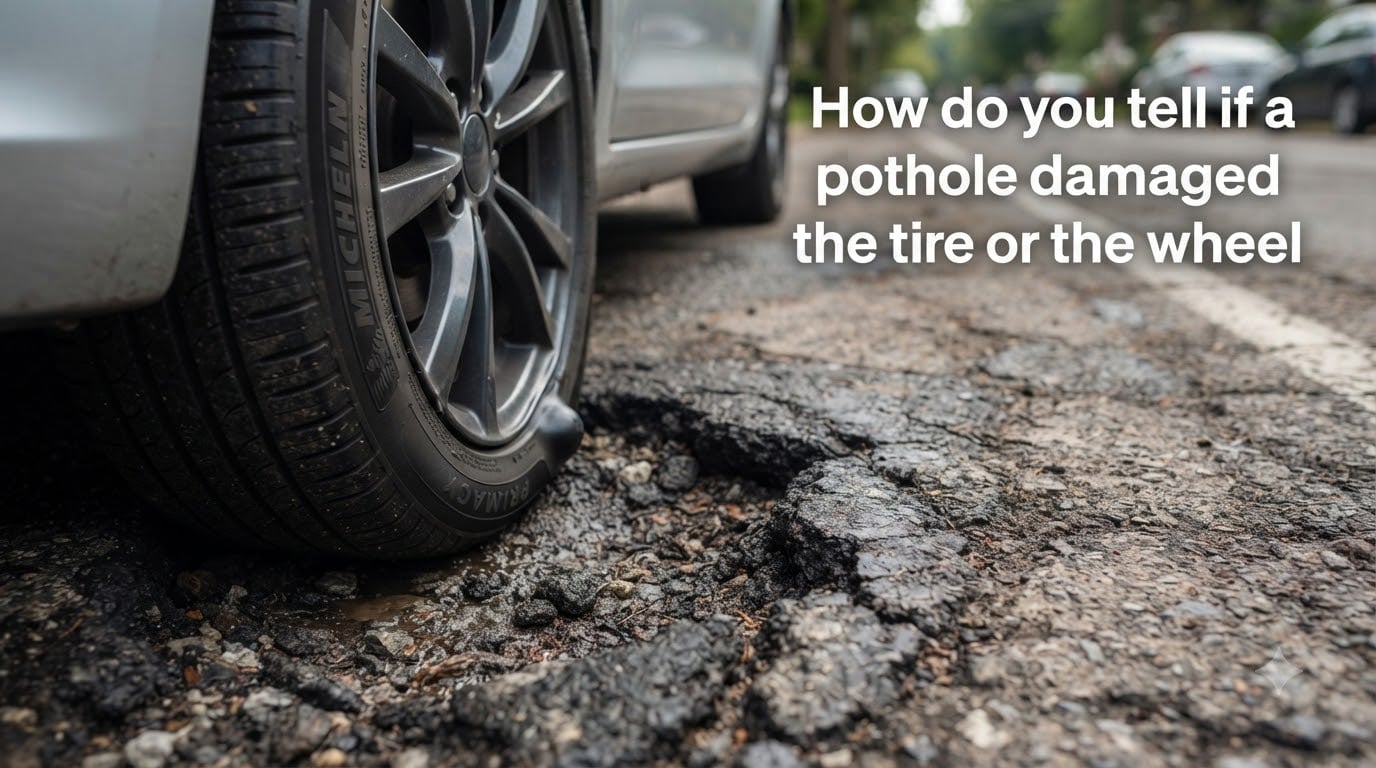
You hit a pothole and heard that sickening thud. Now you’re wondering whether the tire, the wheel, or both took the hit. I’ve been through this exact scenario more times than I’d like, and I know how unsettling that uncertainty feels.
This guide walks you through exactly how to tell if a pothole damaged the tire or the wheel. You’ll learn the visual and tactile signs for each, when to stop driving immediately, and what a tire shop checks that you can’t see at home.
Table of Contents
Tire vs Wheel Damage: Quick Symptom Guide
The fastest way to narrow down pothole damage is to match what you’re feeling or seeing to the likely cause. This table covers the most common symptoms and what each one tells you.
| What You Notice | What It Likely Means | What To Do Next |
|---|---|---|
| Sidewall bulge or bubble | Internal tire cords are broken — tire damage | Stop driving. Replace the tire. This is not repairable. |
| Visible bend or dent on the rim lip | Rim is bent — wheel damage | Get the rim inspected; straightening may be possible. |
| Tire losing air slowly (5-10 PSI per week) | Either bead seal damage or tire puncture | Check pressure daily and visit a shop within 48 hours. |
| Vibration in the steering wheel at highway speed | Bent rim or shifted tire belt | Reduce speed and schedule a shop visit. |
| Car pulls to one side after the hit | Alignment knocked off | Get an alignment check within a week. |
| Rhythmic thumping tied to wheel rotation | Bent rim or flat spot on tire | Inspect the wheel and tire tread face. |
| TPMS warning light came on | Significant pressure drop in one tire | Check pressure immediately — likely tire or bead damage. |
| Fresh cut or gash on sidewall | Sidewall structural damage — tire damage | If cords are visible, stop driving. Replace tire. |
Use this table as your starting point. If the symptom points to tire damage, your next step is the sidewall inspection described below. If it points to wheel damage, jump to the wheel section.
How Do You Tell If a Pothole Damaged the Tire or the Wheel?
The key difference comes down to where the damage appears. Tire damage shows on the sidewall or tread, while wheel damage appears on the rim itself. Here’s how to identify each type.
Signs Your Tire Took Damage From the Pothole
Tire damage from a pothole almost always starts at the sidewall. When the tire gets pinched between the road edge and the wheel rim, the sidewall compresses violently — and that’s where the problems begin.
Sidewall Bulge or Bubble
A sidewall bulge is the most definitive sign of pothole tire damage. It looks like a blister or bubble on the tire’s side wall, usually the size of a golf ball or larger. This happens when the internal fabric cords — the skeleton that gives the sidewall its shape — snap under the impact.
Here’s what most people miss: the bulge may not appear immediately. Forum users on Team-BHP and MechanicAdvice have reported bulges showing up 2 to 7 days after the pothole hit. The internal cord damage is already there — the rubber just hasn’t pushed outward yet.
Run your palm along the sidewall on both sides of the tire. A healthy sidewall feels uniformly firm. A damaged one will have a soft spot that gives under finger pressure, even if no visible bubble has formed yet.
Why Sidewall Damage Cannot Be Repaired
The sidewall flexes constantly as the tire rotates — it’s designed to absorb road shock through controlled deformation. The tread area, by contrast, is reinforced with steel belts and stays relatively rigid against the road surface. When internal cords in the sidewall break, the remaining cords absorb extra load on every rotation, accelerating the failure. A patch cannot restore structural integrity to a flexing surface. This is why every tire manufacturer considers sidewall damage unrepairable — the NHTSA reinforces this position in their tire safety guidelines.
Cuts and Gashes
Check the sidewall for fresh cuts, especially along the area closest to the rim lip. Some cuts look shallow but penetrate deep enough to expose the internal fabric cords. If you can see any white, tan, or metallic threads poking through, the tire’s structural integrity is compromised and it needs replacement.
Tread Chunking or Separation
A hard pothole strike can knock chunks out of the tread or cause the tread to separate from the tire carcass. Look for uneven wear patterns, missing rubber blocks, or raised sections of tread that don’t sit flush. Run your hand across the tread surface — any flap or gap means the tire is failing.
Slow Leak or Pressure Loss
A pothole can break the bead seal — the airtight connection between the tire and the rim — without visibly damaging either component. The result is a slow leak that drops 5 to 10 PSI per week. Multiple forum users have reported losing air 50 or more kilometers after the initial hit, not immediately.
Check your tire pressure with a gauge when the tires are cold (before driving or at least 3 hours after parking). Compare the reading to the pressure listed on the door-jamb sticker — not the maximum pressure on the tire sidewall. A drop of more than 2 PSI from the recommended pressure warrants investigation.
Signs Your Wheel or Rim Took Damage
Wheel damage is usually more visible than tire damage, but it can also hide in plain sight. Alloy wheels are more susceptible than steel because alloy bends and cracks rather than denting and holding shape.
Bent Rim
A bent rim shows as a visible deformation along the rim lip — the outer edge where the tire bead seats. Park on level ground and slowly rotate the steering wheel to full lock so you can see the entire rim face. Look for any section that dips inward or flares outward compared to the rest.
A bent rim doesn’t always cause immediate air loss. Some drivers run bent rims for weeks with no noticeable pressure drop, which makes the damage easy to miss. But the vibration it creates wears the tire unevenly and can eventually break the bead seal.
Cracked Wheel
Cracks are more serious than bends and usually happen on alloy wheels. They tend to form around the hub area or along the spoke bases. Unlike bends, cracks get worse over time — they propagate under the stress of every bump and turn. A cracked wheel can fail suddenly, so if you spot a crack, don’t drive on it.
Flat Spot
A flat spot on the rim is a localized depression where the wheel hit the road edge directly. It creates a rhythmic vibration that matches the wheel’s rotation speed. At highway speeds, it feels like a constant thumping that gets louder as you go faster.
Scraped Rim Lip
Cosmetic scraping along the rim lip is common after pothole contact and usually not dangerous on its own. But deep gouges can compromise the bead seal area, leading to slow air loss. If the scrape is deep enough to catch a fingernail, have the bead seal checked.
Alloy vs Steel: Different Failure Modes
Steel wheels tend to dent and deform but maintain their overall structure. Alloy wheels are stiffer, so they resist small impacts better — but when an alloy wheel does fail, it cracks rather than bends. Cracks are harder to spot during a casual visual inspection, which is why alloy wheels need closer examination after a pothole hit.
How to Check Your Tire and Wheel at Home
You don’t need special tools for a basic post-pothole inspection. A tire pressure gauge, a flashlight, and about 15 minutes are enough to catch most damage.
Step 1: Visual Walkaround
Park on a flat, well-lit surface. Turn the steering wheel to full lock so the front wheels are angled outward — this gives you a clear view of the entire sidewall and rim face on each side. Look for:
- Bulges, bubbles, or soft spots on the sidewall
- Fresh cuts or gashes, especially near the rim lip
- Bends, dents, or cracks on the rim face
- Missing or uneven tread blocks
- Any object embedded in the tire
Compare the damaged tire to the tire on the opposite side. Differences in sidewall profile, rim straightness, or tread pattern become obvious when you see them side by side.
Step 2: Cold Tire Pressure Check
Wait at least 3 hours after driving, or check first thing in the morning before you drive. Remove the valve cap and press a tire gauge firmly onto the valve stem until the hissing stops. Read the gauge. Compare it to the number on the driver’s door-jamb sticker — that’s the manufacturer’s recommended pressure for your specific vehicle and tire combination.
A drop of more than 2 PSI from the recommended pressure after a pothole hit suggests bead seal damage or a slow puncture. Check all four tires, not just the one that hit the pothole — sometimes the opposite side takes equal damage from the suspension rebound.
Step 3: Tactile Bubble Check
Run your palm flat along both sidewalls of the affected tire, pressing moderately. A healthy sidewall feels uniformly firm with consistent give. A damaged sidewall will have a localized soft spot — that’s where the internal cords have broken, even if no visible bubble has surfaced yet.
Pay attention to the inner sidewall (the side facing the car’s undercarriage) — it takes just as much impact as the outer side but is harder to see. You can feel damage there that you’d never spot visually.
Step 4: Test Drive Diagnostic
Take a short, controlled test drive on a straight, flat road at moderate speed (35-45 mph). Pay attention to:
- Steering pull: Does the car drift left or right when you loosen your grip? That indicates alignment damage or uneven tire pressure.
- Vibration: Does the steering wheel shake at a specific speed? Vibration that increases with speed usually points to a bent rim or shifted belt.
- Thumping: A rhythmic thump that matches the wheel rotation speed suggests a flat spot or tread separation.
- Noise: A flapping or slapping sound can indicate tread damage or a tire that’s lost significant air.
If you notice any of these symptoms, reduce speed and head to a tire shop — don’t wait for the problem to get worse.
When to Stop Driving vs When to Monitor
Not every pothole hit requires a tow truck. Here’s how to triage the situation.
Stop Driving Immediately If:
- You can see a sidewall bulge or bubble — this is a blowout risk
- The tire is visibly flat or losing air rapidly
- You see exposed cords, fabric, or metal threads on the sidewall
- The rim has a visible crack
- The TPMS warning light is on and the tire looks visibly deflated
- Steering feels loose, unstable, or the car won’t track straight
In any of these situations, pull over safely and call for a tow or install your spare tire. Driving on a structurally compromised tire or wheel risks a blowout at speed.
Monitor Closely If:
- You notice slight vibration but steering remains stable
- TPMS light came on but the tire looks normal and holds air at the recommended PSI
- There’s a cosmetic scrape on the rim lip with no bead leak
- You hear a faint new noise but the car handles normally
In these cases, check your tire pressure daily for a week and schedule a shop visit within a few days. Some damage — especially delayed sidewall bulges — takes time to reveal itself.
What a Tire Shop Actually Checks
A professional inspection goes beyond what you can do at home. Understanding what the shop looks for helps you ask the right questions and avoid unnecessary replacements.
Inner Liner Inspection
The inner liner is the airtight rubber layer inside the tire that holds the air. Pothole impacts can crack or tear this liner without any visible damage on the outside. A shop removes the tire from the rim and inspects the liner with a light. This is the only way to confirm whether the tire’s air retention is compromised from the inside.
Bead Seal and Rim Runout
The bead seal is where the tire’s edge locks onto the rim. A shop uses a bead sealer solution to check for leaks and measures rim runout — how much the rim wobbles when spun on a balancer. Industry standard allows up to 0.040 inches of lateral runout and 0.030 inches of radial runout. Beyond those numbers, the rim needs straightening or replacement.
Wheel Balance and Alignment
A bent rim throws off the wheel’s balance, creating vibration at speed. The shop checks balance on a spin balancer and measures alignment angles (camber, caster, toe) against manufacturer specs. Even a small alignment shift from a pothole hit can cause uneven tire wear that shortens tire life by thousands of miles.
When Rim Straightening Is Safe
Rim straightening is a viable repair for minor bends on steel and some alloy wheels. A shop uses hydraulic equipment to reshape the rim to within tolerance. However, if the alloy has a crack, or if the bend is near a spoke base, straightening can make the damage worse. Cracked wheels need replacement — there’s no safe way to repair them.
How to Reduce Pothole Damage in the Future
Some pothole hits are unavoidable, but you can minimize the damage with a few habits.
Maintain proper tire pressure. Underinflated tires are more vulnerable to pothole damage because the sidewall flexes more on impact. Check pressure monthly with a reliable gauge and keep tires at the door-jamb sticker pressure — not the maximum on the tire sidewall.
Slow down over visible potholes. Reducing speed from 40 mph to 25 mph over a pothole can cut the impact force significantly. If you can’t avoid the pothole, slow down as much as traffic allows.
Know your tire profile. Low-profile tires (aspect ratio of 45 or below) have shorter sidewalls that absorb less impact energy before the rim contacts the road. If you drive on low-profile tires, pothole damage is more likely and more severe — and extra vigilance after a hit is warranted.
Avoid standing water. Potholes filled with water are impossible to judge by depth. If you can’t see the bottom, slow down or change lanes when safe to do so.
Frequently Asked Questions
How do you tell if a pothole damaged the tire or the wheel?
Tire damage shows as sidewall bulges, slow pressure loss, cuts, or tread chunking. Wheel damage shows as visible rim bends, cracks, or flat spots. Vibration at speed and steering pull can indicate either — a shop inspection with the tire off the rim confirms the source.
Can a pothole damage a tire without causing an immediate flat?
Yes. Pothole damage often causes slow leaks rather than instant flats. Internal cord breaks can weaken the sidewall structurally while the tire still holds air, and bead seal damage may only show as a 5-10 PSI loss per week.
What does a tire sidewall bulge look like after hitting a pothole?
A sidewall bulge appears as a blister or bubble on the tire’s side wall, usually golf-ball-sized or larger. It indicates broken internal cords. Some bulges appear 2-7 days after the impact, not immediately.
How do you check if a wheel rim is bent after hitting a pothole?
Turn the steering wheel to full lock and inspect the entire rim face at eye level. Look for any section that dips inward or flares outward compared to the rest. A bent rim may also cause vibration that increases with speed.
Is it safe to drive on a tire after hitting a pothole?
It depends on the damage. If you see a sidewall bulge, exposed cords, or a cracked wheel, stop driving immediately — these are blowout risks. If the tire holds air and the car drives normally, monitor pressure daily and visit a shop within a few days.
How long does pothole damage take to show?
Some damage is visible immediately — bent rims, cuts, flat tires. But delayed symptoms are common: sidewall bulges can appear 2-7 days after the hit as internal cord damage progresses, and slow leaks may not drop pressure noticeably for a week or more.
What is the difference between a bent rim and a cracked wheel?
A bent rim is a deformation of the rim lip — it can often be straightened by a shop. A cracked wheel has a fracture in the metal, usually near spokes or the hub, and cannot be safely repaired — it needs full replacement.
Can a pothole cause a slow tire leak?
Yes. A pothole can break the bead seal between the tire and rim, causing air to escape gradually. It can also crack the inner liner without visible exterior damage. Either condition causes pressure loss of 5-10 PSI per week.
What does a damaged tire sidewall feel like to drive on?
A damaged sidewall may cause vibration at highway speed, a rhythmic thump matching wheel rotation, or a soft unstable feel in turns. In mild cases there’s no noticeable change — which is why a manual sidewall check is important after any pothole hit.
Should I replace both tires if I hit a pothole?
Not necessarily. If only one tire is damaged, replacing just that tire is fine on most vehicles with a standard differential. On all-wheel-drive vehicles, the replacement tire should be within 2/32 inch tread depth of the others to avoid drivetrain stress.
Conclusion
Pothole damage is one of those problems that gets worse the longer you ignore it. A sidewall bulge that looks minor today can become a blowout tomorrow. A bent rim that vibrates slightly now is wearing your tire unevenly with every mile.
The good news: most pothole damage follows predictable patterns. Use the symptom guide and inspection steps above to figure out how to tell if a pothole damaged the tire or the wheel, then act on what you find. If you see a sidewall bulge, exposed cords, or a cracked wheel, stop driving. If you see vibration or pressure loss, check pressure daily and visit a shop. And if you’re unsure, a professional inspection costs far less than a tire failure at highway speed.