
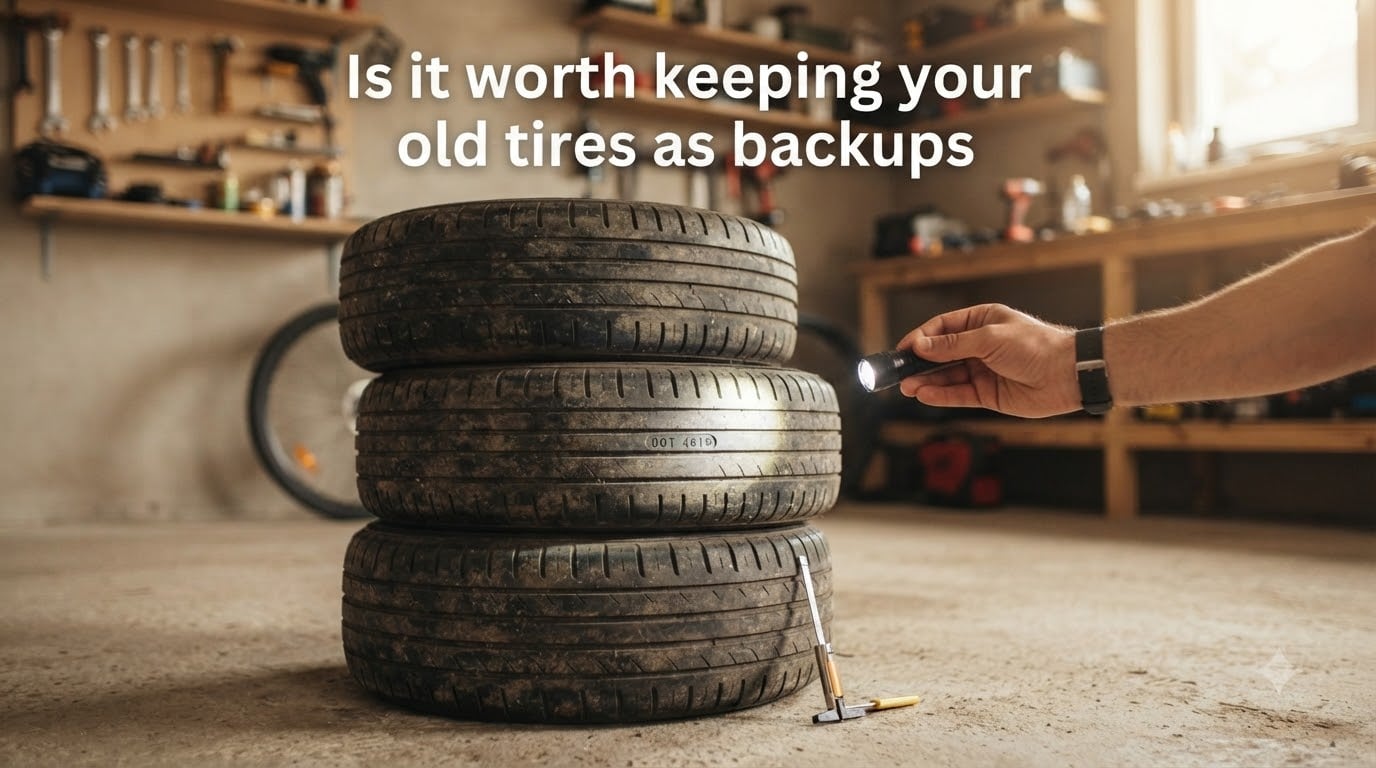
Yes, you can keep old tires as backups, but only if they are under 6 years old from the manufacture date, stored indoors away from sunlight and ozone sources, and show no cracks, bulges, or dry rot. After about 6 to 10 years, the rubber compounds degrade enough that even garage-stored tires can fail unexpectedly. Our team walks through the exact inspection steps and decision framework below so you can decide whether to keep, reuse, recycle, or replace.
I’ll never forget the email we got last fall from a reader in Phoenix. He’d just replaced all four tires on his SUV, wrapped the old set in trash bags, and tucked them in his garage. Eighteen months later, one of those “backup” tires blew out on the I-10 at 75 mph, peeled back like a banana, and totaled his trailer.
The tread had looked fine. The sidewalls had looked fine. What he didn’t know was the DOT date code on those tires read 2014, which made them roughly 7 years old at the time of the blowout, even though they’d only been driven on for about 30,000 miles. So is it worth keeping your old tires as backups? The honest answer is: only sometimes, and only after a real inspection.
In this guide, I’ll walk you through how to check your tires’ age in 60 seconds, the visible warning signs that mean “discard now,” and what to do with old tires you decide not to keep. You’ll also get a clear decision framework so you don’t end up like our reader, saving a few dollars now and paying for it later on the highway.
Table of Contents
How to Tell If Your Old Tires Are Still Safe to Keep
The first question isn’t whether to keep your old tires, it’s whether they’re actually safe to keep. Three things determine that answer: age, visible condition, and storage history. Age is the most important, and it’s printed right on the sidewall.
How to Read the DOT Date Code in 4 Steps
Every tire sold in the U.S. has a DOT (Department of Transportation) code on its sidewall. The last four digits tell you the manufacture week and year. Here’s how to find and read it.
- Find the DOT stamp on the sidewall. Look on both sidewalls. On older tires, only one side has the full DOT code; the other side has just “DOT.”
- Locate the last four digits. The DOT code ends with a four-digit number after a longer alphanumeric string. Example:
DOT ... 2317. - Read the first two digits as the week of the year. In the example “2317,” 23 means the tire was made in the 23rd week of the year (early June).
- Read the last two digits as the year. In “2317,” 17 means 2017. So that tire was manufactured in June 2017.
Tires made before 2000 use a three-digit code, but most of us don’t need to worry about those since they’re well past any safe-use window. If you can’t find the code or it’s worn off, treat the tire as unknown age and replace it.
Visible Signs a Tire Has Aged Out
Even a tire that passes the age test should be inspected physically before you trust it as a backup. Here are the warning signs that mean “do not keep, even as a spare.”
- Sidewall cracking (also called weather checking or ozone cracking). Fine cracks running parallel to the tread or radiating from the bead area.
- Dry rot that makes the sidewall look gray, dusty, or chalky instead of black and supple.
- Bulges or blisters anywhere on the sidewall. These usually mean internal belt damage.
- Discoloration or fading that doesn’t clean off, especially brown or rust-colored streaks.
- Vibration or wobble when mounted, even at low pressure.
- Nails, plugs, or patches in the tread or shoulder from previous damage.
If your tires show any of these, they’re done. No amount of tire dressing or storage improvement will reverse dry rot. The rubber has lost its elasticity, and the next stress event could be a separation or blowout.
Manufacturer Age Limits at a Glance
Major tire makers and the National Highway Traffic Safety Administration (NHTSA) generally agree on the 6-to-10-year window. Here’s a quick comparison so you know where your tires fall.
| Source | Recommended Max Age | Notes |
|---|---|---|
| NHTSA | 6 to 10 years | Replace after 6 years; never use past 10 |
| Bridgestone | 10 years | Manufacturer-stamped date is the controlling factor |
| Michelin | 10 years | Inspect annually after 5 years |
| Continental | 6 to 8 years | More conservative for hot climates |
| Dunlop | 10 years | Storage conditions can shorten usable life |
| Consumer Reports | 6 years | Replace spare at 6 years regardless of tread |
Notice that the consensus is tighter than most people think. A tire that “looks great” at 12 years old is outside every major manufacturer’s recommendation, full stop.
Why Old Tires Age Even When You Never Drive on Them
Here’s the part most drivers miss: a tire doesn’t have to be driven to age out. Rubber degrades even when it’s just sitting in your garage. The technical term is thermo-oxidative aging, and it happens through three main pathways.
Rubber Compound Breakdown Over Time
Modern tires are made of a mix of natural rubber, synthetic polymers, carbon black, anti-aging chemicals, and steel or fabric belts. Over time, oxygen in the air reacts with the polymer chains, slowly breaking them apart and making the rubber stiffer and more brittle. Anti-aging additives slow this down, but they don’t stop it.
Heat speeds the reaction. UV light breaks down the surface rubber. Ozone (the same gas that makes your car’s air smell sharp after a thunderstorm) attacks the double bonds in rubber molecules and creates those characteristic cracks on the sidewall. A tire that never rolls a single mile still ages from these exposures.
How Climate Speeds Up the Aging Process
Where you live matters a lot. In hot, sunny states like Arizona, Texas, and Florida, surface temperatures on a garage floor can hit 130 degrees F in summer. Heat accelerates the chemical breakdown of rubber dramatically. A tire that would last 10 years in a climate-controlled garage in Boston might only last 6 in an unshaded Phoenix garage.
Cold climates are gentler on rubber but bring their own risk: if you store tires outside and they go through freeze-thaw cycles, any existing cracks can deepen. The ideal storage temperature is between 50 and 70 degrees F, with low humidity and no direct sunlight.
The Real Dangers of Using Old Tires as Spares
A failed tire at highway speed can flip a vehicle, total the car, or hurt someone else on the road. The dangers of aged tires aren’t theoretical, and they’re not just about tread depth. Here’s what actually goes wrong.
Tread Separation and Blowout Risk
Tread separation happens when the steel belts inside a tire pull away from the rest of the carcass. When it happens on a moving vehicle, the tire can come apart in a fraction of a second, leaving you with sudden deflation and very little time to react.
According to the National Highway Traffic Safety Administration, tire-related crashes account for roughly 200 fatalities and 11,000 injuries every year in the U.S. While not all of these are age-related, aged tires are disproportionately represented in blowout crashes. We’ve seen Hagerty commenters report finding “softball-sized chunks of rubber powder” inside the carcasses of 12-year-old tires that looked fine from the outside.
Why Good Tread Does Not Mean a Safe Tire
Tread depth and tire age are two separate things. A tire can have 8/32 of tread and still be unsafe if the rubber has hardened from oxidation. Harder rubber grips worse in the wet, breaks loose more suddenly under hard braking, and is more likely to develop separations.
This is one of the most common mistakes we see: drivers assume “the tread is fine, so the tire is fine.” Tread tells you how much rubber is left. Age tells you how much the rubber has degraded. You need both numbers to make a real safety call.
Old Tires in Rain and Snow
Aged tires perform especially poorly in wet conditions. As rubber hardens with age, it loses the ability to flex and conform to road texture. That means less grip, longer stopping distances, and a much higher risk of hydroplaning on wet pavement. In snow, an aged tire simply won’t bite, no matter how much tread it has left.
If you live somewhere with serious rain or winter weather, the case for keeping an old backup tire gets even weaker. We recommend buying a new compact spare instead.
When an Old Tire IS Acceptable as a Backup
There are a few narrow cases where keeping an old tire as a backup makes sense. The key is making sure the tire is recent, properly stored, and physically inspected before each use.
Full-Size Spare vs Compact (Donut) Spare Age Rules
Not all spare tires age the same way. Here’s how to think about the two main types.
| Spare Type | Max Recommended Age | Speed/Distance Limits | Notes |
|---|---|---|---|
| Full-size matching spare | 6 to 8 years | Normal driving | Same age rules as your other tires |
| Compact (donut) spare | 6 years | Under 50 mph, under 50 miles | Meant for short trips to a repair shop |
| Run-flat tire (no spare) | 10 years | Up to 50 miles after puncture | Replace as a normal tire |
| Vintage/classic car spare | Inspect yearly | Low speed only | Often never driven on, still ages |
If your compact spare has never been used, that’s good, but it still ages on the DOT clock. Most compact spares are 5 to 7 years old by the time they’re first pulled out of the trunk, and many drivers don’t realize they’ve passed their safe-use window.
The 60-Second Pre-Use Inspection Checklist
Before you mount any backup tire, run through this quick checklist.
- Check the DOT code and confirm the tire is under 6 years old (or 10 for a full-size, garage-stored spare).
- Look at the sidewalls in good light for cracks, bulges, or dry rot.
- Press your thumbnail into the sidewall. It should leave a slight impression. If the rubber feels hard and doesn’t give at all, the compound is aging out.
- Inflate to the recommended pressure on the door placard and check for slow leaks over 24 hours.
- Spin it slowly on the car and look for any wobble or visible deformation.
If it passes all five, it’s safe to use as an emergency spare to get to a tire shop. Drive slowly and replace it as soon as possible.
How to Store Old Tires If You Decide to Keep Them
If you’ve decided your old tires pass the inspection above and you want to keep them as backups, proper storage will buy you more usable life. Here’s how to do it right.
Storage Conditions That Slow Aging
- Store indoors. A climate-controlled garage or basement is ideal. Outdoor storage dramatically shortens tire life.
- Avoid direct sunlight. UV is one of the fastest rubber degraders. If you must store near a window, cover the tires with opaque bags.
- Keep them away from ozone sources. Electric motors (furnaces, air compressors, some shop tools) generate ozone. Store tires at least 10 feet away.
- Store them upright if unmounted, stacked if mounted. Unmounted tires should stand on the tread. Mounted sets can lie flat or hang on a wall rack.
- Use tire storage bags. Breathable cloth bags block dust and light without trapping moisture. Avoid airtight plastic, which can promote mold.
- Maintain 10 to 15 PSI in mounted spares to prevent sidewall deformation during long storage.
Common Storage Mistakes That Damage Tires
The biggest mistake is storing tires on concrete floors in direct sunlight. We’ve also seen readers store tires next to water heaters, solvents, or welders, all of which create ozone. Stacking unmounted tires too high can deform the bottom ones and create flat spots that are hard to round out again.
If you’re storing winter tires for the summer, clean them thoroughly first. Road salts and brake dust hold moisture against the rubber and can speed up surface cracking.
What to Do With Old Tires You Don’t Keep
Let’s say your old tires failed the inspection, or they’re just too old to safely reuse. You still have options beyond the trash. Many of them don’t cost anything and some even pay you back.
DIY and Garden Uses for Old Tires
Old tires have a long second life as non-driving items. Common uses include raised garden beds, playground borders, swings, sandbox walls, dog beds, and gym equipment bases (sandbags, tractor weights). Some people stack and paint them as planters, or cut the sidewalls into strips for edging.
A quick note on safety: if you’re using old tires in a garden where kids or pets play, line them with landscape fabric to limit direct contact with any residual tire compounds. For playground-style tire swings, drill drainage holes and use a UV-resistant cover to limit further breakdown.
Tire Recycling and Proper Disposal
Most U.S. states ban tires from landfills, but recycling is widely available and often free. Tire retailers, auto shops, and municipal waste facilities usually accept old tires for a small fee (or no fee at all when you buy new tires from them). Recycled tires become playground surfaces, asphalt rubber, athletic tracks, garden mulch, and even fuel for cement kilns.
To find a free drop-off near you, check your state’s Department of Transportation website or call your local solid waste authority. Many recycling events also accept tires seasonally.
The Real Cost of Keeping vs Replacing Old Tires
The financial case for keeping old tires as backups is weaker than most people think. Let’s run the numbers honestly.
Storage vs Replacement Cost Comparison
| Option | Upfront Cost | Lifespan as Backup | Risk Level |
|---|---|---|---|
| Store old tire in garage | Just a bag | 2 to 4 years usable life | Moderate |
| Buy new compact spare | Modest one-time cost | 6 to 8 years | Low |
| Buy used spare from junkyard | Low | Unknown, often less than 6 years | Higher than you think |
| Skip the spare, use roadside service | Annual membership | Unlimited (no spare to age) | Lowest (but service-dependent) |
If you compare a few dollars for a tire bag against the cost of a new compact spare, the spare wins on lifespan, safety, and peace of mind. The “free” backup tire isn’t really free, you’re trading money for risk.
The Hidden Safety Cost
The dollar comparison leaves out the most important number: what happens if the old spare fails. A highway blowout can mean a tow, body damage, a collision, or worse. Our team’s position is that the safety delta between a known-new spare and an old stored one isn’t worth the savings for most drivers.
If money is genuinely tight, a roadside assistance membership is a better backup than an aging spare. You avoid the storage question entirely.
Frequently Asked Questions
How do I know if my car tires are too old to be safe?
Check the DOT date code on the sidewall. If the tire is over 6 years old, or shows any sidewall cracks, bulges, or dry rot, it is too old to keep as a backup. Replace it regardless of how much tread remains.
Can old tires be dangerous even if they have good tread depth?
Yes. Tread depth tells you how much rubber is left, but age tells you how the rubber has degraded. A tire with deep tread can still fail through tread separation or hard-compound loss of grip once the rubber has aged past 6 to 10 years.
What causes tires to age and degrade over time?
Tires age through thermo-oxidative aging: oxygen, heat, UV light, and ozone attack the rubber polymer chains and anti-aging additives. This happens whether or not the tire is driven on, and it speeds up in hot, sunny climates.
How can I extend the life of my tires safely?
Store unmounted tires upright in breathable bags, indoors, away from sunlight and ozone sources. Maintain around 10 PSI in mounted spares and inspect them annually for cracks, bulges, and pressure loss.
What is the maximum safe age for a spare tire?
NHTSA and most major manufacturers recommend replacing any spare after 6 to 10 years, regardless of tread. Consumer Reports recommends 6 years for spares specifically. Never use a spare whose DOT date code is older than 10 years.
Do spare tires expire if they have never been used?
Yes. The DOT date code measures age from the date of manufacture, not from first use. An unused tire stored in a trunk for 8 years is the same age as one that has been driven on for 8 years.
How do I check the age of my tires using the DOT date code?
Find the DOT stamp on the sidewall. Read the last four digits: the first two are the week of the year, the last two are the year of manufacture. For example, 2317 means the 23rd week of 2017.
What should I do with old tires I do not keep?
Recycle them through a tire retailer, auto shop, or municipal waste facility. Most accept old tires for free or a small fee, and they become playground surfaces, asphalt rubber, or fuel for cement kilns. Old tires also work as garden planters, swings, or sandbox borders.
Final Verdict: Should You Keep Your Old Tires as Backups?
So, is it worth keeping your old tires as backups? Here’s our framework in plain language.
- Keep them only if the DOT code shows under 6 years, the sidewalls are crack-free, and you can store them indoors in breathable bags away from sunlight and ozone.
- Use them as a backup spare only if they pass the 60-second inspection every time, and you drive slowly to a tire shop for a permanent replacement.
- Recycle them if they’re over 6 years old, show any signs of dry rot, or have been stored in poor conditions for any length of time.
- Repurpose them as garden planters, swings, or sandbox borders if you want a second life outside the car.
The bottom line: most drivers are better off buying a new compact spare or signing up for roadside assistance than gambling on an aging backup. The dollars you save are small, and the failure mode is severe. If your tires pass the inspection and you commit to checking them every year, keeping them is reasonable. If they don’t, recycling them is the safer, smarter move.
For a complete safety check before your next road trip, walk through our tire age and condition guide and replace anything that’s past the 6-year mark or shows visible aging. Your spare should help you out of a jam, not become one.