
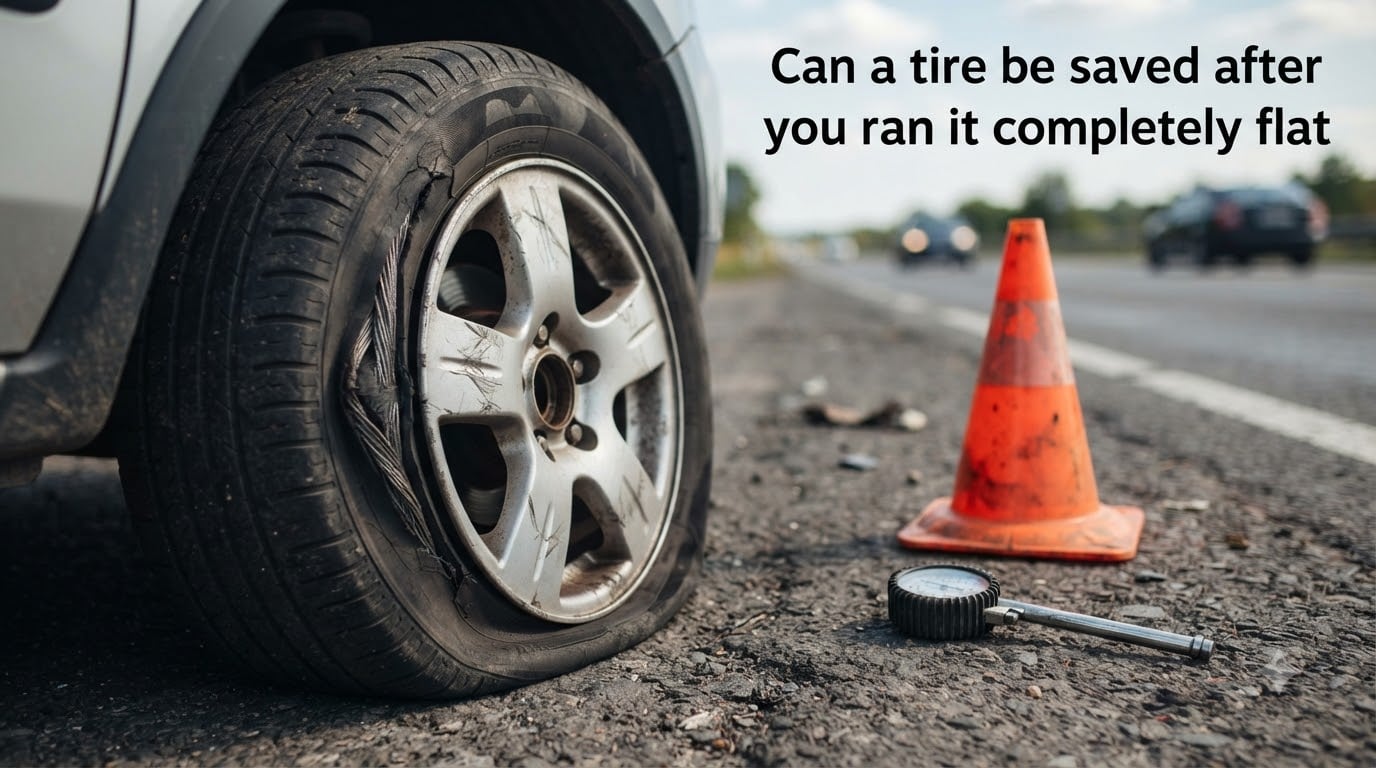
A tire driven while flat is almost never repairable. Driving even a short distance on a flat tire causes internal sidewall damage that compromises the tire’s structural integrity, making safe repair impossible. The tire must be replaced.
I know that’s not the answer most drivers want to hear. After you ran it completely flat, the instinct is to hope for a quick patch and a cheap fix. Our team has looked at industry guidelines, mechanic forums, and repair shop protocols to give you the clearest picture of what’s actually happening inside that tire, and what your real options are.
In this guide, I’ll cover why flat driving destroys tires from the inside out, the specific repair rules technicians follow, how run-flat tires behave differently, and what to do the moment you notice a flat. Let’s get into it.
Table of Contents
What Happens Inside a Tire When You Drive on It Flat
A tire that loses air pressure starts crushing under the vehicle’s weight the moment you keep moving. The sidewall, designed to flex within a narrow range at proper inflation, gets pinched between the rim and the road surface.
Inside every tire are layers of polyester, steel, and nylon cords that give the tire its shape and strength. When the air pressure drops to zero or near zero, those cords grind against each other and the road. Once broken, they do not heal.
Here’s the part that catches drivers off guard: a tire reinflated after being driven flat can look perfectly fine on the outside. The sidewall bulge may flatten back out, the tread still has depth, and the rubber shows no visible tear. Mechanics on r/MechanicAdvice regularly describe customers insisting their tire looks roadworthy, only for dismounting to reveal shredded belts underneath.
Three things happen internally during flat driving:
- Cord fatigue: The ply cords flex past their designed range and fracture
- Bead damage: The airtight edge of the tire can deform against the rim, breaking the seal
- Heat buildup: Without air to dissipate heat, internal temperatures spike and weaken the rubber compound
Once these failures occur, no repair process can restore the original strength. A patch covers a hole. A plug fills a puncture. Neither rebuilds broken internal cords. That’s why the industry consensus is firm: a tire driven while flat must be replaced.
Sidewall Damage: The Hidden Killer of Flat-Driven Tires
Sidewall damage is the single biggest reason a flat-driven tire cannot be saved. The sidewall is the flexible side of the tire that bears the brunt of impact and load when air pressure is missing.
You might notice bulges, wrinkles, or scuffing on the sidewall after a flat incident. Those are signs of internal cord separation. Even if the sidewall looks intact, the internal structure may have failed. Industry standards from the Rubber Manufacturers Association treat any sidewall damage as unrepairable because the tire cannot maintain its shape safely without those internal cords intact.
Here’s what to look for on your sidewall after a flat:
- Bulges or bubbles pushing outward (cord separation)
- Deep scuffs exposing the cord layers underneath
- Visible cracks or cuts anywhere on the sidewall
- Discoloration suggesting heat damage
I want to be direct here. If your tire went fully flat and you drove on it, even for a few hundred feet, the sidewall has likely taken damage you cannot see. Replacement is the only safe path forward.
When a Tire Can Be Repaired (The Quarter-Inch Rule)
Not every flat means a tire is scrap. If you caught the flat before driving on it, or the puncture happened while the tire was properly inflated, repair is often possible. Industry guidelines set clear limits.
The Rubber Manufacturers Association and U.S. Tire Manufacturers Association specify that a tire puncture can only be repaired when all of these conditions are met:
- Puncture size: No larger than 1/4 inch (6mm) in diameter
- Location: In the tread area only, never the sidewall or shoulder
- Number of punctures: No more than three, spaced apart from each other
- Condition: No prior repairs in the same area, no sidewall damage, no run-flat tire history
The 1/4 inch rule exists because any puncture larger than that overlaps critical internal components. A repair that covers a large hole cannot restore the structural strength of the original tire.
Two main repair methods exist. A tire plug fills the puncture from the outside using a sticky rubber plug. A tire patch seals the hole from the inside after the tire is dismounted. Most professionals use a patch-plug combination for the strongest, longest-lasting fix.
If your flat happened while you were parked, or you noticed the pressure drop immediately and stopped driving, repair is likely on the table. Confirm the puncture size and location with a tire shop before assuming the worst.
When a Tire Must Be Replaced
Certain damage leaves no room for repair. Knowing these conditions can save you from a mechanic telling you something you already suspected.
A tire must be replaced when:
- It was driven on while flat or severely underinflated
- There is any damage to the sidewall, including small cuts, bulges, or cracks
- The puncture is larger than 1/4 inch (6mm)
- The puncture sits in the shoulder area between tread and sidewall
- There are more than three punctures clustered or spread across the surface
- The tire has been repaired in the same spot more than once
- There is evidence of a prior blowout or impact damage
- Tread depth is below 2/32 inch (unsafe regardless of damage)
Drivers often ask whether a tire that “seems fine” after being driven flat really needs replacement. The honest answer is yes, every time. The risk of a blowout at highway speed from weakened internal structure is not worth the savings on a new tire.
Run-Flat Tires: A Different Story
Run-flat tires behave differently from standard tires when deflated. Most run-flat designs use reinforced sidewalls that support the vehicle’s weight for 50 miles at speeds up to 50 mph after losing pressure. Some advanced designs allow up to 100 miles of limited driving.
Here’s the catch. Once that run-flat tire has been driven on while deflated, even briefly, the tire must be replaced. Most manufacturers explicitly state that run-flat tires should not be repaired once operated at zero pressure. The reinforced sidewall takes on damage during the run-flat period that, like standard tires, cannot be reversed.
If your vehicle came equipped with run-flat tires from the factory, your owner’s manual will spell out the post-flat replacement rule. Ignoring it creates a serious safety risk. A run-flat tire that has done its job saving you from a roadside stop has used up its safety margin.
Some drivers consider switching from run-flats to standard tires to avoid this replacement cycle. That is a separate decision involving ride quality, TPMS recalibration, and spare tire requirements. Worth discussing with a tire professional.
Emergency Temporary Fixes: Fix-a-Flat and Sealants
Fix-a-Flat and similar aerosol sealants can get you home or to a shop when a puncture strands you. They work by injecting foam or liquid sealant into the tire, which coats the inside and plugs small holes.
These products have real limitations. Most sealants only work for punctures up to about 3mm in the tread area. They are temporary, typically rated for 50 to 100 miles of driving at reduced speeds. After using one, you still need professional repair or replacement.
Can Fix-a-Flat work on a completely flat tire? Sometimes, but only if the puncture is small and accessible. It will not seal large tears, sidewall damage, or bead leaks. If the sealant does not hold pressure within a minute or two, the damage is too severe for the product.
Mechanics generally advise against using sealants in tires that will later be patched. The residue contaminates the repair area, and many shops will refuse to repair a tire that has had sealant inside it. If you must use Fix-a-Flat to get to safety, plan on replacement rather than repair.
Rim Damage: The Hidden Cost of Driving on a Flat
The tire is not the only casualty when you drive on a flat. The rim takes direct punishment from the road surface, and rim damage can add significant cost beyond the tire itself.
Symptoms of rim damage include visible scratches, dents, or bends on the wheel. A bent rim causes vibration, uneven tire wear, and air leaks that no patch can solve. Alloy wheels can crack under the stress of flat driving.
Repair costs vary widely. A basic rim straightening runs around $75 to $150. A cracked alloy wheel typically means full replacement, which can run several hundred dollars for a single wheel. On premium vehicles, the cost can climb past $500 per corner.
Drivers on r/askcarguys regularly share stories of $300 tire replacements turning into $800 bills once bent rims were discovered. Always have your rims inspected after a flat-driven incident, even if the tire replacement feels like the main concern.
Repair vs Replacement: What You Need to Know
When a tire can be repaired, repair is far cheaper than replacement. A standard patch and plug combination runs around $20 to $50 at most shops. A new tire, plus mounting and balancing, runs from around $100 for basic passenger tires to several hundred for performance or specialty sizes.
Insurance coverage varies. Standard liability policies do not cover tire damage from road hazards. Comprehensive coverage sometimes applies if the damage came from vandalism or theft-related events, but not from potholes or debris. Some tire manufacturers offer road hazard warranties that cover replacement for a limited time or mileage.
If you find yourself facing a tire shop recommending replacement after a flat-driven incident, the recommendation aligns with industry safety standards. Reputable shops refuse to repair tires they know were driven flat, even when customers push back. That is not a sales tactic. It is the standard of care for your safety.
What to Do Immediately After Getting a Flat
How you respond in the first few minutes after a flat determines whether the tire can be saved.
Step 1: Pull over to a level surface as soon as you notice the flat. Do not try to drive to the next exit or to a familiar shop. Every additional foot of flat driving adds damage.
Step 2: Turn on your hazard lights and set up flares or cones if you have them. Move away from traffic while you assess.
Step 3: Check whether you have a spare, a tire mobility kit, or roadside assistance coverage. Run-flat vehicles often lack all three, in which case calling for a tow is the safest option.
Step 4: If you must drive to reach safety, drive slowly (under 30 mph) and take the shortest possible route. Even these few hundred feet matter, so minimize distance wherever possible.
Step 5: Once safe, have the tire inspected by a professional before driving on it again. Even if you reinflate it, internal damage may have occurred.
A TPMS (Tire Pressure Monitoring System) warning light gives you advance notice that pressure is dropping. Heed it immediately. Stopping at the first sign of underinflation often means the difference between a $30 repair and a $200 replacement.
Frequently Asked Questions
How long can you drive on a tire after using Fix-a-Flat?
Most Fix-a-Flat products are rated for 50 to 100 miles of driving at speeds under 50 mph. The sealant is a temporary fix, not a permanent repair. Drive to a tire shop as soon as possible and plan on professional repair or replacement. The tire cannot be safely patched afterward because the sealant residue contaminates the repair area.
What flat tires cannot be repaired?
A tire cannot be repaired if it was driven on while flat, if there is any sidewall damage (bulges, cuts, cracks), if the puncture is larger than 1/4 inch (6mm), if the puncture is in the shoulder or sidewall area, if there are more than three punctures, if the tire was previously repaired in the same location, or if tread depth is below 2/32 inch. Run-flat tires that have been driven on while flat also cannot be repaired.
How long can you drive on a run-flat tire when it is flat?
Most run-flat tires allow 50 miles of driving at speeds up to 50 mph after losing pressure. Some advanced designs extend this range to 100 miles. After that distance, or after any run-flat driving, the tire must be replaced. Manufacturers do not authorize repair of run-flat tires that have been driven while flat.
Can Fix-a-Flat work on a completely flat tire?
Fix-a-Flat can sometimes seal a completely flat tire if the puncture is small (under 3mm) and located in the tread area. It will not seal large tears, sidewall damage, or bead seal leaks. If the sealant does not hold pressure within a minute or two, the damage is beyond what the product can handle. Plan on replacement rather than repair after using any sealant.
Final Verdict: Replace the Tire and Move On
Can a tire be saved after you ran it completely flat? In almost every case, no. The internal damage from flat driving is invisible, irreversible, and creates a real blowout risk at speed. Industry standards, manufacturer guidelines, and mechanic consensus all point the same direction: replace the tire.
If you caught the flat early and stopped immediately, repair may still be possible. Get the tire inspected by a professional before making any decisions. Have the rims checked too, since rim damage often accompanies flat driving.
The cost of replacement stings, but it is far less than the cost of a blowout at highway speed. A new tire gives you peace of mind that no patch on a flat-driven tire ever can.