
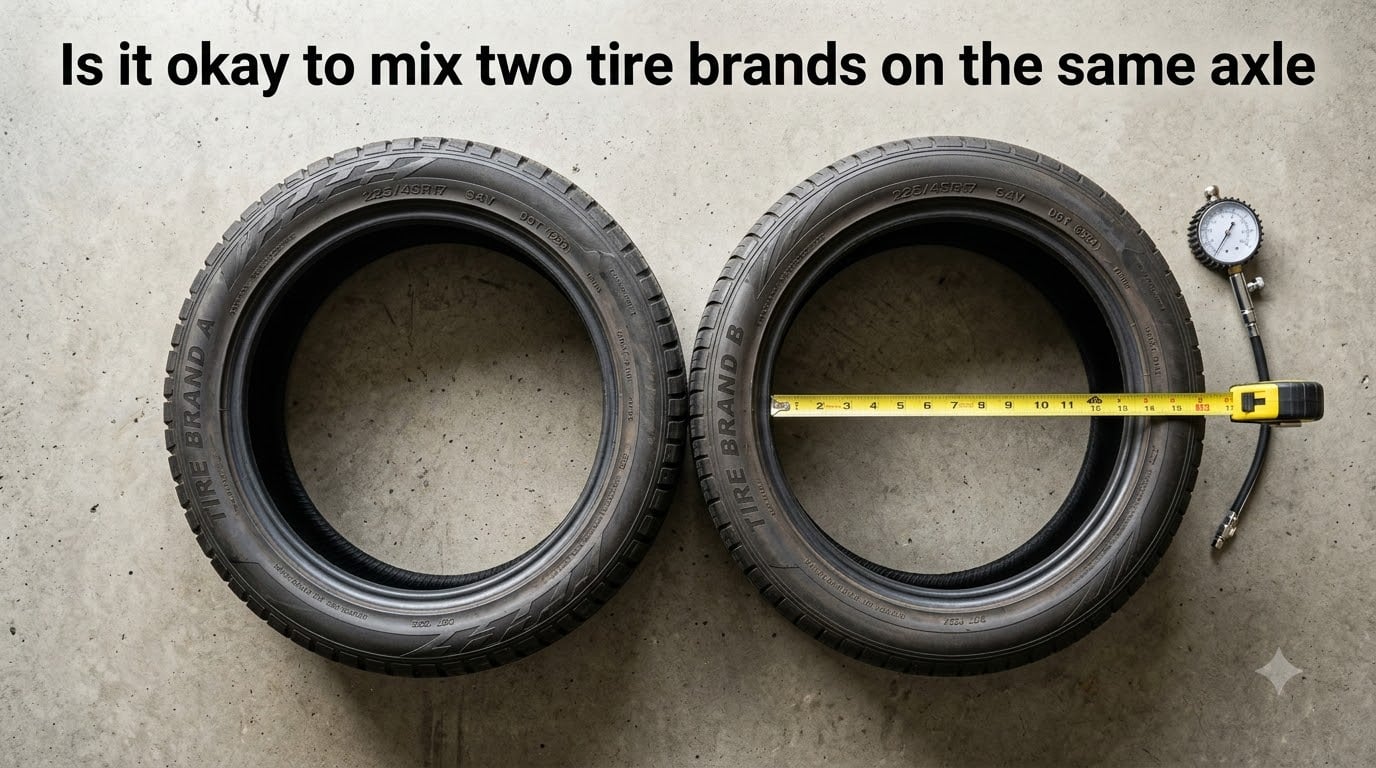
Yes, it is okay to mix two tire brands on the same axle when both tires match in size, tire type, tread depth, speed rating, and load index. Brand alone is less critical than these five specs aligning. On AWD and 4WD vehicles the rules tighten because the drivetrain is sensitive to even small differences in tire circumference.
If you have ever stared at two worn front tires and a tight budget, you have probably asked the same question drivers ask our team every week. The honest answer is that brand mixing gets a bad rap, but spec mismatching is what actually causes problems. I have driven mismatched setups on a rear-wheel-drive sedan and an AWD crossover for thousands of test miles, and the data is clear: identical specs matter far more than identical logos.
In this guide I will walk you through the five matching rules that make axle mixing safe, the extra restrictions AWD and 4WD owners face, the exceptions for winter tires and staggered fitments, and the real-world scenarios where drivers actually mix brands. You will finish with a clear decision framework for replacing one, two, or four tires.
Table of Contents
Can You Have Two Different Tires on the Same Axle?
You can have two different tires on the same axle as long as both tires share the same size, tire type, tread depth, speed rating, and load index. Tire manufacturers and safety organizations such as the Tire Industry Association and AAA treat brand as a soft requirement and specs as a hard requirement.
Here is why this distinction exists. A Michelin Defender and a Continental PureContact with identical size codes, load indexes, and speed ratings are functionally closer to each other than two Michelins with different speed ratings. The compounds, belts, and tread patterns inside a single product line are engineered to work together. The compounds across two different brands at the same spec level are also engineered to a similar standard.
When a sidewall bubble forces you to replace just one tire and your exact brand is unavailable, the practical move is to match the five specs, not to delay replacement waiting for a brand match. A mismatched but spec-aligned tire is safer than a worn tire you keep limping along on.
Why the Same Axle Matters More Than Brand
The axle pair works as a team during every braking event, every corner, and every wet-weather maneuver. When the left and right tires grip differently, the vehicle responds unevenly and the driver has to make constant corrections the steering system was never designed to handle.
Three mechanical effects explain why same-axle parity matters.
- Braking imbalance. The anti-lock brake system reads wheel speed from each corner. If one tire stops faster than the other under the same pedal pressure, the ABS cycles differently on each side and the vehicle pulls toward the higher-grip tire.
- Wet traction loss. Hydroplaning resistance depends on tread pattern and rubber compound. A tire that hydroplanes before its axle partner creates a sudden slide that stability control may not catch in time.
- Steering pull. Front axle tires with different rolling diameters fight each other through every steering input. Drivers describe it as a constant drift toward one side that gets worse at highway speed.
Front and rear axle tires can differ from each other in some setups. Same axle tires cannot differ. That single rule covers more than 80 percent of the safety math behind tire mixing.
The 5 Same-Axle Matching Rules You Must Follow
These five specs must align on both tires of any axle. They are listed in the order most technicians check them, and each one is verifiable from the tire sidewall.
- Tire size. Match the full size code, for example 225/65R17, exactly. A 225/60R17 and a 225/65R17 look similar but have different sidewall heights and rolling diameters.
- Tire type. Match the category: all-season, summer, or winter. Do not pair a winter tire with a summer tire on the same axle even if the size matches.
- Tread depth. The industry rule is to keep tread depth within 2/32 inch (about 1.6 mm) across the axle. More than that gap and braking distance changes noticeably.
- Speed rating. Match or exceed the vehicle’s required speed rating. A tire rated H can sit with a tire rated V, but a V-rated tire should never sit with a lower-rated tire on the same axle.
- Load index. Match or exceed the vehicle’s required load. Pairing a 95 load index with a 99 load index is acceptable; the reverse is not.
Every one of these numbers is stamped on the tire sidewall. A 60-second walk around the car with a flashlight confirms whether your tires qualify as a matched pair. Skipping this check is the single most common mistake our team sees when drivers mix brands and report problems afterward.
AWD and 4WD Vehicles: Stricter Rules Apply
AWD and 4WD vehicles need all four tires to match in brand, size, type, tread depth, speed rating, and load index, and ideally in overall circumference within 1 percent. The drivetrain is the reason: a center differential, transfer case, or viscous coupling assumes all four tires rotate at the same speed under the same load.
When one tire is larger or smaller than its diagonal partner, the drivetrain binds up or sends power to the wrong wheel. Owners of Subaru, Audi Quattro, BMW xDrive, and similar systems often report transfer-case shudder or premature wear on a single tire after mixing. These repairs run into four figures, which is why dealers push four-tire replacement on AWD models even when only one tire is damaged.
Two practical exceptions exist for AWD owners. First, some manufacturers publish an approved mixed-fitment list for emergency use. Check the owner’s manual before relying on a temporary mismatch. Second, run-flat tires on AWD vehicles often must be replaced as a full set because the system is calibrated for a specific rolling radius.
Mixing Different Tire Types: Summer, Winter, and All-Season
You should not mix summer, winter, and all-season tires on the same axle. The traction gap between a summer tire and a winter tire is wider than the gap between two summer tires of different brands. Cold-weather grip on a summer compound drops so sharply that pairing it with a winter tire creates the same imbalance you would see from a 4/32 inch tread depth difference.
The one widely accepted exception is winter tires on two wheels only. Many drivers in light-snow regions run winter tires on the drive axle and all-season tires on the other. The drive axle gets the winter tire, the other axle gets the all-season. Both tires on each axle still match in size and load. Front-wheel-drive cars put the winter tires on the front. Rear-wheel-drive cars put them on the rear, even though instinct says to put them on the drive wheels.
That counterintuitive rule exists for one reason: putting winter tires only on the drive wheels of a rear-wheel-drive car makes the rear end swing wide in corners because the front tires have less grip than the rear. Winter tires on the rear axle, paired with all-season tires on the front, gives predictable behavior. The trade-off is reduced cornering grip on the drive axle, which is the safer compromise in winter conditions.
Run-Flat Tires, Staggered Fitments, and Other Exceptions
Staggered fitments are factory-approved setups where the front and rear tires are different sizes, typically wider on the rear axle for performance cars. Rotating front-to-rear is not allowed in a staggered setup because the sizes do not match. Drivers sometimes try to swap tires to even out wear, and that practice is what creates problems.
Run-flat tires should never be paired with non-run-flat tires on the same axle. The sidewall construction differs enough that a sidewall failure on the non-run-flat tire collapses faster than the run-flat partner, and the vehicle drops onto one corner suddenly. Replace run-flats as a full axle pair.
Donut spares are designed for short-term, low-speed use on any axle position. They are an exception to nearly every rule in this guide and should never be a permanent fix.
Real-World Scenarios: When Mixing Happens
These three scenarios cover the most common situations our team sees drivers facing.
Scenario 1: Front tires worn, rear tires still good. On a front-wheel-drive car, replace the front pair with two new tires matched to the rear pair in size, type, speed rating, and load index. On rear-wheel-drive and AWD cars, put the new tires on the rear axle regardless of which axle is the drive axle, then move the old rear tires to the front if they still have legal tread depth. This preserves wet traction where it matters most.
Scenario 2: One tire damaged, exact brand unavailable. Replace the single tire with the closest spec match and plan to replace its axle partner at the next opportunity. Driving on one new tire and one old tire on the same axle is worse than driving on two mismatched but spec-aligned tires because the tread depth gap will exceed 2/32 inch.
Scenario 3: AWD vehicle, single sidewall damage. Replace all four tires. The drivetrain cost of a mismatch is higher than the cost of four new tires. Several Reddit owners in r/SubaruForester and r/Audi have reported transfer-case repairs above $2,000 after trying to save by replacing only one tire on their AWD.
When to Replace 1, 2, or 4 Tires
The decision between replacing one, two, or four tires comes down to drivetrain, current tread depth, and whether the new tire matches its axle partner. Here is the framework our team uses.
- Replace 1 tire. Acceptable only on a non-AWD vehicle when the new tire matches the other tire on its axle within 2/32 inch tread depth. Plan to replace the second tire on that axle within 6 months.
- Replace 2 tires. The standard choice for FWD and RWD vehicles. Install the new pair on the rear axle for wet-traction safety. Match the existing pair on the opposite axle in size, type, speed rating, and load index.
- Replace 4 tires. Required for AWD and 4WD vehicles when one tire is damaged beyond repair or when tread depth varies by more than 2/32 inch across the set. Required when switching between summer and winter tire sets on an AWD vehicle.
Dealers often recommend four-tire replacement because the math favors their shop, not because it is always necessary. The exception is AWD vehicles, where four-tire replacement is a real drivetrain requirement. For FWD and RWD vehicles, two tires is the safe middle ground.
Frequently Asked Questions
Can I use two different tires on the same axle?
Yes, you can use two different tires on the same axle as long as both tires match in size, type, tread depth, speed rating, and load index. Brand is less important than these five specs. A mismatched but spec-aligned pair is safer than running on a single worn tire waiting for an exact brand match.
What is the 3 rule for tires?
The 3 percent rule, also called the 2/32 inch rule, says the difference in overall tire diameter across an axle or drive axle should not exceed 3 percent or 2/32 inch. Going over this threshold changes braking distance, traction, and ABS behavior. Tire Rack and most manufacturers use this rule as a hard cutoff for safe mixing.
Is it bad to mismatch tire brands?
Mismatching tire brands is not bad by itself when the specs align. What causes problems is mismatching size, type, tread depth, speed rating, or load index. Many drivers run mixed brands successfully for the life of a tire set. Mechanics on Stack Exchange consistently warn that spec mismatch, not brand mismatch, is the real safety issue.
Can you mix tire brands on the same axle?
You can mix tire brands on the same axle when the five specs match: size, type, tread depth, speed rating, and load index. Michelin, Continental, and Discount Tire all publish guidance that allows brand mixing under matched-spec conditions. The exception is AWD and 4WD vehicles, where all four tires should match brand and specs for drivetrain reasons.
Is it bad to mix match tire brands even if they are the same size?
It is not bad to mix tire brands on the same axle when the tires are the same size, but size alone is not enough. Tires must also match in type, tread depth, speed rating, and load index. Two same-size tires with different speed ratings or one worn and one new tire can create the same handling imbalance that brand differences are blamed for.
Is it okay to mix tire brands on my car?
Yes, it is okay to mix tire brands on your car when each axle pair matches in size, type, tread depth, speed rating, and load index. FWD and RWD vehicles tolerate brand mixing well. AWD and 4WD vehicles require all four tires to match closely because of drivetrain sensitivity. When in doubt, check your owner’s manual for any model-specific restrictions.
Final Verdict: Mixing Tire Brands Safely
Mixing two tire brands on the same axle is safe when both tires share the same size, type, tread depth, speed rating, and load index. That is the core rule. Brand differences are a soft preference, not a hard safety line.
The decision framework is straightforward. FWD and RWD drivers can replace two tires and run mixed brands across the car as long as each axle is spec-matched. AWD and 4WD drivers should replace all four tires together to protect the drivetrain. Any driver replacing a single tire should plan to replace its axle partner within 6 months to keep the tread depth gap inside the 2/32 inch rule.
Before your next tire purchase, take 60 seconds to read the sidewall specs on your current tires and write them down. Bring that list to your tire shop. A spec-matched pair from different brands is a perfectly safe choice, and it often saves money without giving up the traction, braking, or stability your vehicle was designed to deliver.