
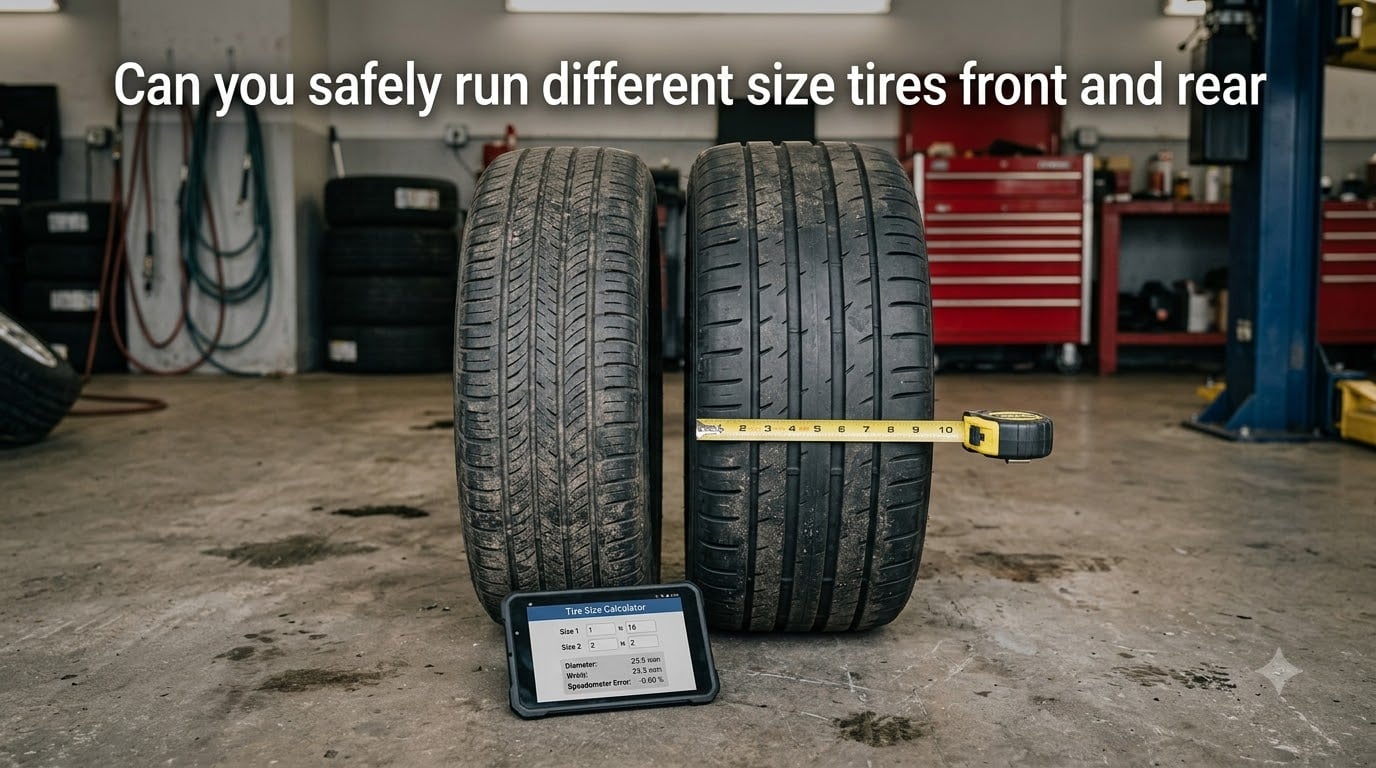
Can you safely run different size tires front and rear? Yes, only when the vehicle was designed that way from the factory (a staggered fitment). Otherwise, every tire must match. The two tires on the same axle must always match in size, and across all four corners the overall diameter should stay within roughly 3% so the drivetrain, ABS, and traction control read equal wheel speeds.
I dug into owner forums, OEM manuals, and tire-industry sources to put together this guide. If you just swapped to a different size, had to fit a spare, or are budgeting for two new tires on an AWD vehicle, the rules below will tell you whether it is safe to drive and what could go wrong if you ignore them.
Table of Contents
Quick Answer: Is It Safe to Run Different Size Tires Front and Rear?
You can safely run different size tires front and rear only if your vehicle came from the factory with a staggered fitment. A staggered setup uses wider (and sometimes taller) tires on the rear axle than on the front, common on rear-wheel-drive performance cars like the Corvette, Mustang, Camaro, Challenger, and Porsche 911.
If your vehicle was not designed that way, every tire must be the same size. The two tires on the same axle must match each other, and across the car the overall diameter should be within roughly 3% so wheel-speed sensors, ABS, and traction control read correctly.
Mixing sizes by accident (a tire shop installs the wrong size, you swap a non-matching spare, or you replace only two tires with the wrong size) is the most common cause of drivetrain damage. On AWD and 4WD vehicles it can destroy the transfer case or center differential. On FWD and RWD vehicles it throws off handling and the speedometer even when no mechanical parts are damaged.
What “Different Size Tires Front and Rear” Actually Means
“Different size tires front and rear” describes a setup where the front axle carries one tire size and the rear axle carries another. It is not the same as having two different brand tires, mismatched tread depth, or a directional/asymmetric pattern on the wrong side.
A tire size is written like 245/45R18. The 245 is the section width in millimeters, 45 is the aspect ratio (sidewall height as a percentage of width), and 18 is the wheel diameter in inches. Two tires of the same nominal size can still differ in overall diameter by a few percent depending on brand and model, which is why the rolling circumference matters more than the printed numbers.
Three ways to actually mix sizes:
- OEM staggered fitment: factory-installed larger or wider tires on the rear axle. Designed and tested by the manufacturer.
- Unintentional mismatch: one tire was replaced with the wrong size, a non-matching spare is in use, or a tire shop installed two different sizes by mistake.
- Plus-sizing or minus-sizing: an owner deliberately fits larger or smaller wheels and tires than OEM for looks or performance, often without checking the consequences.
Staggered Fitment Explained (With OEM Examples)
A staggered fitment is a manufacturer-approved setup with wider (and sometimes taller) tires on the rear axle. It is most common on rear-wheel-drive performance cars where the rear wheels need more grip to put power down without spinning.
Real OEM staggered-fitment examples straight from the factory specs:
- Chevrolet Corvette Stingray: 245/40R19 front, 305/35R20 rear
- Ford Mustang GT Performance: 255/40R19 front, 275/40R19 rear
- Chevrolet Camaro SS 1LE: 255/40R20 front, 285/35R20 rear
- Dodge Challenger SRT Hellcat: 275/40R20 front, 325/45R20 rear
- Porsche 911 Carrera: 245/45R20 front, 305/35R21 rear
- BMW M3 (F80): 255/40R19 front, 275/40R19 rear
If your car is on this list or has a similar factory spec sheet, different size tires front and rear is by design. You must replace like-for-like (same size, same brand/model if possible) and you usually cannot rotate the tires side-to-side across the axles.
Outside that list, the safe default is to keep all four tires the same size. A BMW owner on the Cartalk forum runs 245/35-20 front and 275/30-20 rear on his M3 and confirmed staggered sizes are normal on sport cars, but his setup is factory-spec, not a guess.
The Same-Axle Rule
The same-axle rule is the single most important rule for mixing tires: the two tires mounted on the same axle must match in size, type, and ideally brand and tread depth. This is universally accepted, even by owners who are loose with the other rules on forums like Reddit’s r/MechanicAdvice and Car Talk community.
What happens if your two front tires are different sizes? The car pulls toward the larger-diameter tire under braking and acceleration because that wheel travels further per revolution. ABS and traction control read different wheel speeds and may disable themselves, light up the dash, or apply braking to the wrong wheel.
Even if the diameter difference is small, mismatched tires on one axle cause uneven braking, unstable behavior in wet conditions, and premature wear on the differential. Cartalk community members have reported 4×4 warning lights coming on within minutes of fitting mismatched sizes on the same axle, like the 2008 Jeep Patriot owner who put 205/55R16 front and 215/55R16 rear and saw the light stay solid until corrected.
Tire Diameter and the 3% Rule
The 3% rule states that the overall diameter of any tire on the car should be within 3% of the others for safe operation. This applies to ABS, traction control, and (on AWD/4WD) the center differential that splits torque between front and rear.
A Reddit mechanic on r/MechanicAdvice put it simply: “as long as total circumference is off by no more than 3% it should be ok.” Subaru and Audi publish their own tighter tolerances, often 2/32 to 4/32 inch of tread-depth difference between tires on an AWD vehicle, which lines up with the 3% rule.
How to calculate 3% for a 205/55R16 versus 215/55R16 swap:
- 205/55R16 overall diameter: 16 inches + 2 × (205 × 0.55 / 25.4) = 24.88 inches
- 215/55R16 overall diameter: 16 inches + 2 × (215 × 0.55 / 25.4) = 25.31 inches
- Difference: (25.31 − 24.88) / 24.88 × 100 = 1.7%
That 1.7% is within the 3% rule, but it is only true for diameter, not for the same-axle rule. The 205s and 215s still need to live on different axles if you mix them at all, and the ABS/traction system will still see a small mismatch. The Cartalk community ran 175 and 185 tires successfully on the same axle because the 185 was only about 2% larger in diameter, but this is an exception most modern vehicles with electronics will not tolerate cleanly.
If you want to be precise, use a free tire size calculator (Tire Rack, Discount Tire, and 1010Tires all publish one) and compare the calculated overall diameter for each size before fitting.
Where New Tires Should Go on the Car
For a FWD or RWD vehicle without a factory staggered setup, the new tires should go on the rear axle, even if the fronts are more worn. This is the most-repeated rule across tire-industry sources and is confirmed by Tire Rack, Discount Tire, and Consumer Reports testing.
The reason is oversteer prevention. New tires on the rear give the back end more grip than the front, which prevents the rear from breaking loose first in an emergency maneuver or on wet pavement. Drivers instinctively steer away from a problem at the front (understeer is recoverable); a rear-end slide (oversteer) is what spins a car.
On a factory staggered-fitment performance car (Corvette, Mustang GT, M3), new tires must go in the same size position. You cannot rotate a 245/40R19 to the rear where a 305/35R20 lives. You can usually rotate side-to-side on the same axle to even out wear, but never across axles.
On AWD vehicles, the safest play is to replace all four tires at the same time. Subaru, Audi, and most AWD manufacturers explicitly recommend this. If cost forces two tires only, put the new pair on the rear axle and accept that the center differential is taking some risk.
Speedometer, Odometer, and ABS Sensor Effects
Different size tires front and rear (or even different diameters within tolerance) will throw off your speedometer and odometer. The speedometer is calibrated to a specific tire size; a 3% larger tire means the speedometer reads about 3% slower than your real speed, and the odometer under-counts miles.
This matters for fuel economy calculations, lease mileage limits, and any legal speed concerns. Forum users have reported speedometers reading “high” after switching to smaller tires on drive wheels, which means the actual speed is faster than displayed.
ABS sensors sit at each wheel and report individual wheel speeds to the ABS module. If the front tires and rear tires rotate at different rates at the same vehicle speed (because their diameters differ), the module sees phantom slip. It can disable ABS, disable traction control, disable stability control, or apply brake pressure to the wrong wheel.
Drivetrain Breakdown: FWD, RWD, AWD, and 4WD
FWD and RWD: Mismatched Tires
Front-wheel-drive and rear-wheel-drive vehicles are the most forgiving of mismatched tire sizes. There is no center differential or transfer case to damage. The risks are:
- Speedometer and odometer error
- ABS/traction-control disable if diameter difference is large enough
- Handling imbalance, especially in wet or emergency maneuvers
- Uneven tire wear if the mismatched tires have different grip levels
As long as the same-axle rule is respected and the diameter difference is under 3%, FWD and RWD drivers will usually notice nothing more than a slightly different speedometer reading. This is why a FWD or RWD car is the only sensible choice for the staggered-fitment examples above.
AWD: Mismatched Tires and Drivetrain Damage
All-wheel-drive vehicles are the least forgiving. The center differential (or transfer case on some setups) is constantly compensating for any difference in wheel speed between front and rear axles. When tire diameters differ enough, the center diff works harder, runs hotter, and wears prematurely.
The repair bill when this goes wrong:
- Transfer case replacement: roughly $1,500 to $4,000 including labor
- Center differential replacement: roughly $800 to $2,500
- Coupling or clutch-pack replacement: roughly $600 to $1,800
This is why Subaru, Audi, BMW xDrive, and Mercedes 4MATIC all say the same thing: replace all four tires at the same time. Tire Rack, Discount Tire, and Continental all publish matching-tire rules for AWD vehicles. Reddit users running Audis and Subarus cite a 2/32 to 4/32 inch tread-depth tolerance as the practical working limit, which works out to roughly 3% diameter.
4WD: Mismatched Tires and Transfer Case Risk
Four-wheel-drive trucks and SUVs use a transfer case to send power to front and rear axles, usually through a center chain or gear set. Mismatched tire diameters cause the transfer case to bind, especially when 4WD is engaged on dry surfaces.
A Cartalk user with an Xterra asked about running 235/75R15 rear and 235/70R15 front. The diameter difference is roughly 2%, within the 3% rule, but the user was warned not to engage 4WD on dry pavement with that setup because the transfer case will fight the mismatch.
The same rule of thumb applies: replace all four tires at once when possible, keep tread depth within 2/32 to 4/32 inch across all four, and never engage 4WD High on dry pavement with mismatched sizes.
Spare Tire and Donut Compatibility
Spare tires and donuts are a special case. A full-size spare matching the other four is fine. A temporary donut (T-type spare) is intended for short, low-speed use only, usually under 50 miles and under 50 mph, and is meant to get you to a tire shop, not to drive on.
If you have to mount a donut on a drive axle of an AWD or 4WD vehicle, disengage AWD/4WD if possible (many modern AWD systems have a 2WD mode) and drive straight to the nearest tire shop. Running mismatched sizes on the drive axle of an AWD for any extended distance is the most common forum-reported cause of transfer-case damage.
Warning Signs You Already Have Tire-Size Damage
If you have been running mismatched tire sizes, watch for these warning signs that damage may already be happening:
- ABS, traction control, or stability control warning light on the dash (common on AWD vehicles within minutes of a mismatch)
- 4×4 or AWD warning light staying solid after restart (the 2008 Patriot owner saw exactly this)
- Vibration at highway speed that was not there before
- Uneven tire wear across an axle, especially cupping on one tire
- Whining or humming from the transfer case or center differential area
- Speedometer reading noticeably off compared to GPS speed
If any of these show up, stop driving on the mismatched setup and have the vehicle towed or flat-bedded to a shop. Continuing to drive turns a tire-cost mistake into a four-figure drivetrain repair.
How to Find Your Vehicle’s OEM Tire Size
The OEM tire size for your car is on the driver’s-side door jamb sticker, in the owner’s manual, or on the tire itself. Look for a line like “TIRE: 225/50R18 95H” or a table showing front and rear sizes if your vehicle is staggered.
You can also use the license plate or VIN lookup on Tire Rack, Discount Tire, or your dealer’s parts department. If your vehicle came with different front and rear sizes from the factory, the staggered setup is intentional and you must replace like-for-like.
Frequently Asked Questions
What happens if your two front tires are different sizes?
The car pulls toward the larger-diameter tire under braking and acceleration. ABS and traction control see different wheel speeds and may disable themselves, light up a warning, or apply the brakes to the wrong wheel. You also get uneven braking, unstable behavior in wet conditions, and premature wear on the differential.
Is it bad to run two different size tires?
It is bad unless your vehicle was designed that way. Factory staggered fitments (Corvette, Mustang, M3) are safe. Any other vehicle should keep all four tires the same size, the same-axle pair matched, and the overall diameter within roughly 3%.
What is the 3% rule for tire size?
The overall diameter of any tire on the car must be within 3% of the others. This keeps the wheel-speed sensors, ABS, traction control, and (on AWD/4WD) the center differential reading correctly. Subaru and Audi publish tighter 2/32 to 4/32 inch tread-depth tolerances that work out to about the same 3%.
Can I put 205 tires on front and 215 on rear?
You can if the overall diameter stays within 3% (it does, at about 1.7%) and your vehicle is not an AWD or 4WD model. The same-axle rule still applies: do not mix 205s and 215s on the same axle. On FWD or RWD only, the 205/215 front-to-rear swap is usually tolerated.
Can you have different tires on front and back AWD?
No, not as a general practice. AWD requires all four tires to match as closely as possible. Mismatched sizes force the center differential to work harder, run hotter, and wear prematurely. Subaru, Audi, BMW xDrive, and Mercedes 4MATIC all recommend replacing all four tires at once.
How much difference in tire size is acceptable on AWD?
The practical limit is about 3% overall diameter, which lines up with 2/32 to 4/32 inch of tread-depth difference across all four tires. Tire Rack, Discount Tire, and Subaru/Audi owner forums all cite this number. Beyond 3%, you risk transfer-case or differential damage that costs $1,500 to $4,000 to repair.
Is it okay to have different size tires front and back?
Yes, if your vehicle came from the factory with a staggered fitment (Corvette, Mustang GT, Camaro SS, M3, Porsche 911, Challenger SRT). Otherwise, keep all four tires the same size. The two tires on the same axle must always match, and across the car the diameter should be within roughly 3%.
The Final Rule for Mixing Tire Sizes Front and Rear
Can you safely run different size tires front and rear? Only if the vehicle was engineered for it from the factory. For every other car, SUV, and truck, the rule is simple: same axle always matches, all four tires stay within 3% overall diameter, and on AWD or 4WD you replace all four at the same time. Check the door-jamb sticker or owner’s manual for your OEM size, use a tire size calculator before any change, and put new tires on the rear axle when a staggered setup is not factory-approved.