
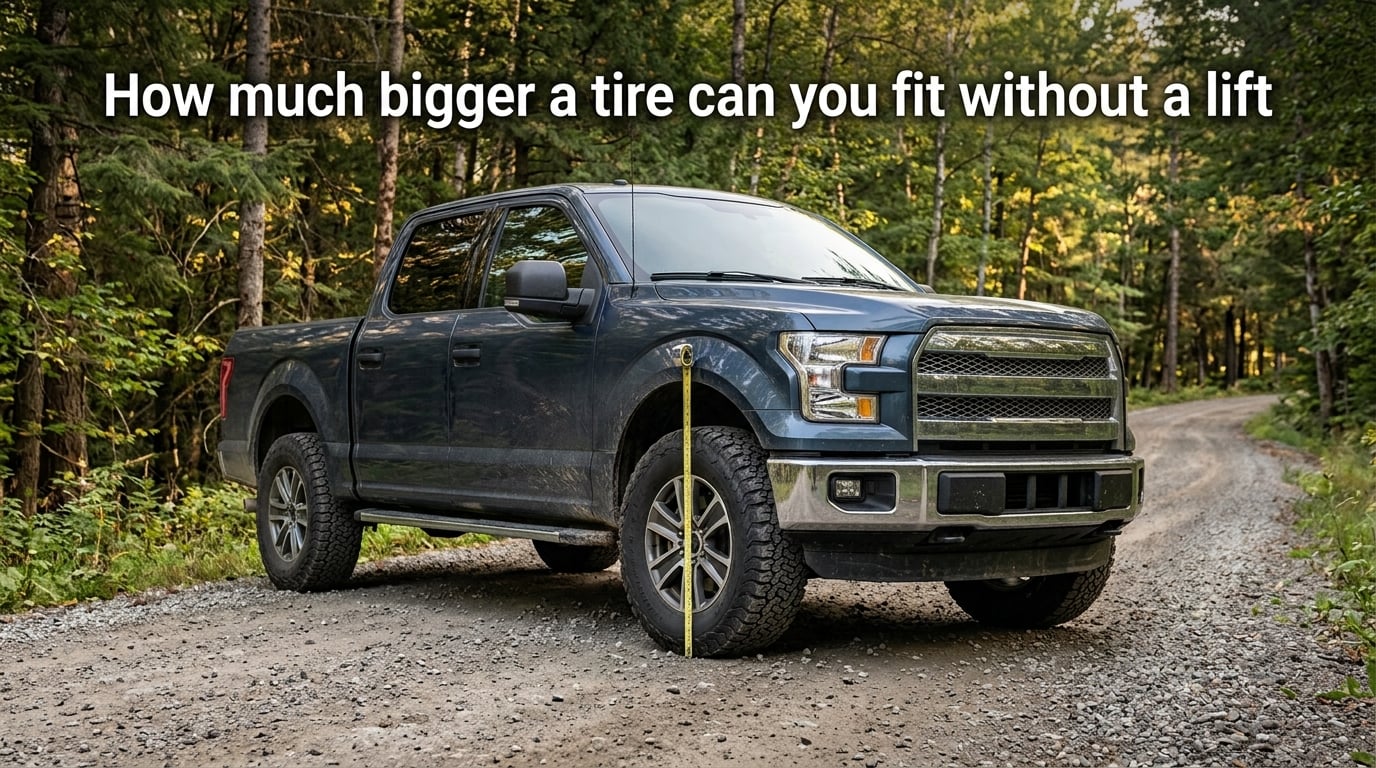
On most stock trucks and SUVs, you can safely fit tires up to about 33 inches in overall diameter – or roughly one size larger than what came from the factory – without a lift kit, as long as the new tire stays within 3% of the original overall diameter and clears the wheel well at full steering lock. Real-world fitment varies by vehicle, wheel offset, and how you drive, so the 33-inch guideline is a starting point, not a guarantee.
If you’ve been asking how much bigger a tire can you fit without a lift, the rest of this guide walks you through the math, the measurements, and the real-life tradeoffs. We’ll cover the 3% rule with a worked example, plus-zero, plus-one, and plus-two sizing, P-metric vs LT vs flotation size classes, per-vehicle fitment for the most popular trucks and SUVs, and a troubleshooting checklist for when new tires do rub.
Table of Contents
How Much Bigger a Tire Can You Fit Without a Lift? The Short Answer
Most stock-suspension trucks and SUVs accept tires up to about 33 inches in overall diameter, which usually means going one size larger than the factory tire (commonly called “plus-one” sizing). On trucks like the Ford F-150, Chevy Silverado 1500, and Ram 1500 with 18 or 20 inch factory wheels, that often works out to a 275/70R18 or 285/65R18. On a Toyota Tacoma or 4Runner, the safe no-lift ceiling is usually a 265/75R16 or 255/75R17.
The real answer is not a single number though. Clearance depends on three things: the new tire’s overall diameter compared to stock (the 3% rule), the actual physical gap between the tire and the wheel well at full lock and over bumps, and the wheel offset and width you pair with the tire. A tire that fits on one F-150 may not fit on another with a different wheel package.
The 3% Rule: The Real Math Behind Tire Upsizing
The 3% rule is the industry guideline that keeps your speedometer, gear ratios, and clearance honest when you upsize. It states that the new tire’s overall diameter should be within plus or minus 3% of the factory tire’s overall diameter. Outside that range, your speedometer reads noticeably wrong, your transmission shifts differently, and clearance problems start showing up.
Worked Example: 245/75R17 to a Bigger Tire
Let’s say your truck comes with a 245/75R17, which has an overall diameter of about 31.5 inches. A 3% increase tops out at roughly 32.4 inches. The next common size, 265/70R17, comes in around 31.6 inches – well inside the rule. The next jump, 285/70R17, lands near 33 inches and slightly exceeds the 3% limit, which is why 285/70R17 is often considered the practical ceiling for many stock-suspension setups.
How to Calculate It Yourself
Use any free tire size calculator or do the math by hand: tire diameter (inches) equals sidewall height (mm) times aspect ratio (percent) times two, plus rim diameter (inches) times 25.4. Convert the result to inches, then compare to your factory tire’s diameter. If the difference is under 3%, you’re in the safe zone.
Measuring Wheel Well Clearance the Right Way
Specs on a page only tell you part of the story. Before you commit to a tire size, measure your actual wheel well clearance with the new tire mounted.
Step 1: Park on Level Ground and Load the Vehicle
Ballast the truck or SUV to mimic real use – a full tank of fuel, your usual cargo, and passengers in the seats. Ride height changes with weight, and a lightly loaded truck has more clearance than one carrying a family and a roof box.
Step 2: Turn the Wheels to Full Lock
With the new tires installed and aired to your target pressure, crank the steering wheel to both full-lock positions. The tire needs at least a half inch of clearance from the fender liner and suspension components. Watch the front and rear of the tire as it rotates – that’s where rubbing usually starts.
Step 3: Test Over Bumps and Compression
Drive over speed bumps, driveway lips, and railroad tracks at normal speed. On the compression stroke, the tire pulls up and into the wheel well. If it contacts anything, you need to back off the size or add a leveling kit.
Step 4: Check the Bump Stops
Look at the gap between the tire and the bump stop with the suspension hanging free (wheels off the ground). This is your cushion for big hits. Less than an inch here means the tire will hit the stop on aggressive use.
Plus-Zero, Plus-One, and Plus-Two Sizing Explained
You’ll see these terms in every tire thread. Here’s what they mean in plain language.
Plus-Zero: Same Diameter, Slightly Wider
Plus-zero means swapping to a tire with the same overall diameter as stock but a slightly wider section width. A 245/75R17 to a 255/75R17 is a classic plus-zero. You get a wider footprint and slightly more stability without changing ride height or speedometer reading.
Plus-One: One Size Up in Diameter
Plus-one means going up one nominal size, which typically adds about 0.5 to 1 inch of overall diameter. A 245/75R17 (31.5 inch) to a 265/70R17 (31.6 inch) is the textbook plus-one. This is the most common no-lift upgrade on trucks and SUVs and usually clears without issues.
Plus-Two: Two Sizes Up – Often Requires Mods
Plus-two means going up two sizes, which adds roughly 1 to 1.5 inches of overall diameter and noticeably more width. A 245/75R17 to a 285/70R17 is a plus-two. Many stock-suspension setups can fit a plus-two on certain vehicles (Jeep Wrangler JL being the famous example), but most half-ton trucks need a leveling kit at this size.
P-Metric vs LT vs Flotation: Tire Size Classes That Matter
The same overall diameter can mean very different things depending on the size class. Choose the wrong one and you’ll fight rubbing, load capacity, or ride quality.
P-metric tires (e.g., P265/70R17) are designed for passenger vehicles and light-duty SUVs. They ride softer, weigh less, and have lower load capacity. They’re the best fit for daily-driven SUVs and half-ton trucks that don’t tow heavy loads.
LT (Light Truck) tires (e.g., LT265/70R17) have stiffer sidewalls, higher load ranges (often 10-ply equivalent), and are built for trucks that tow, haul, or go off-road. They ride firmer at low pressure but support more weight.
Flotation sizes (e.g., 33×12.50R17) use imperial measurements and are common in the off-road world. A 33×12.50R17 is roughly the same overall diameter as a 285/70R17 but reads as 33 inches tall and 12.5 inches wide. These are typically LT-construction tires with aggressive tread.
For the same overall diameter, an LT tire often measures slightly taller than a P-metric tire because of how the sidewall is constructed. That extra half inch can be the difference between clearing and rubbing.
Maximum Tire Size by Vehicle (No Lift)
Below is a consolidated per-vehicle fitment table for the most common trucks and SUVs our readers ask about. Stock sizes are approximate for current generation models; check your door-jamb sticker for your exact size.
Ford F-150 (2015+): Stock often 265/70R17 or 275/65R18. Max no-lift typically 275/70R18 or 285/65R18. F-150 owners on Reddit confirm 285/65R18 fits without rubbing on most trims.
Chevy Silverado 1500 (2019+): Stock often 255/70R17 or 275/60R20. Max no-lift typically 285/65R18 or 285/70R17 with stock wheels. Some trims need a 2 inch leveling kit for 33 inch tires.
Ram 1500 (2019+): Stock often 275/65R18 or 275/55R20. Max no-lift typically 285/65R18. Air suspension trims need extra clearance consideration at full droop.
Toyota Tacoma (3rd Gen, 2016+): Stock often 265/65R17 or 265/70R16. Max no-lift typically 265/75R17 or 275/70R17 with mild rubbing at full lock. 1st Gen Tacomas are limited by wheel well shape – 235/75R16 stock, with 265/75R16 often requiring trimming.
Toyota 4Runner (5th Gen, 2010+): Stock often 265/70R17. Max no-lift typically 255/75R17 – Reddit r/4Runner owners confirm this fits with mild rubbing at full lock. Some go 275/70R17 with a 1 inch leveling kit.
Jeep Wrangler JL (2018+): Stock often 245/75R17 or 285/70R17. Max no-lift widely confirmed at 285/70R17 with no mods. JL Wrangler Forums owners have even run 315/70R17 with minor rubbing.
Ford Bronco (2021+): Stock often 255/70R18 or 315/70R17 on Badlands/Sasquatch. Most trims fit 285/70R17 without mods. Sasquatch-equipped Broncos already ship with 35s.
Toyota Tundra (2022+): Stock often 265/70R18. Max no-lift typically 285/65R18 or 285/70R18 with mild rubbing depending on wheel offset.
Leveling Kit vs Lift Kit: When You Actually Need More Clearance
If your measurement step shows the new tires rub – or if you want to go beyond plus-one – you have three options to add clearance.
Leveling Kit (1 to 2 inches)
A leveling kit raises the front of the truck to match the slightly taller rear stance. It typically uses spacers on the front struts or torsion keys and adds 1 to 2 inches of front ride height. It’s the most common solution for fitting 33 inch tires on half-ton trucks and costs a fraction of a full suspension lift.
Body Lift Kit (1 to 3 inches)
A body lift raises the body off the frame using spacer blocks between the body mounts and the frame. It gives you clearance for taller tires without changing suspension geometry, but it doesn’t improve off-road performance or ground clearance under the frame. Body lifts also increase body roll and can affect bumper alignment.
Suspension Lift Kit (2 to 6+ inches)
A suspension lift replaces or extends the factory springs, shocks, control arms, and related components. It’s the right answer if you’re running 35 inch or larger tires, doing serious off-roading, or want the clearance under the frame for obstacles. Suspension lifts cost more, change ride quality, and require post-install alignment and sometimes regearing.
When to Skip the Lift Entirely
If your goal is a plus-zero or plus-one swap and your measurement step confirms clearance, skip the lift. You preserve factory ride quality, fuel economy, warranty coverage, and resale value. Most daily-driven trucks and SUVs never need more than a plus-one.
What Happens When You Go Bigger: Speedometer, MPG, Ride, and Warranty
Bigger tires change more than appearance. Here’s what to expect.
Speedometer Drift
A plus-one swap (about 3% larger diameter) makes your speedometer read roughly 3% slower than your actual speed. At 60 mph indicated, you’re really going about 62 mph. Most owners find this barely noticeable on the highway, but it adds up over time and matters for odometer readings if you resell the truck.
Fuel Economy Drop
Bigger, wider tires typically weigh more and create more rolling resistance. Expect about a 1 to 3 mpg drop going from a stock tire to a plus-one all-terrain. Aggressive mud-terrains can cost more.
Ride Quality
Lower-profile sidewalls (lower aspect ratio) ride firmer and transmit more bumps into the cabin. Higher-profile sidewalls (higher aspect ratio) absorb more but feel less precise in corners. Going up one size usually means a slightly higher sidewall, which actually softens the ride.
Warranty and Insurance
Most factory powertrain warranties are not voided by changing tire size, but exceeding the factory tire’s load rating can complicate a warranty claim. Tell your insurance carrier about upsized tires – some carriers require the new sizes listed on the policy.
TPMS, Gearing, and Recalibration After Upsizing
Three small details that often get missed.
TPMS Sensors
Tire Pressure Monitoring System sensors live inside the wheel and tire pressure must be matched to the new tire’s spec. Aftermarket wheels need new TPMS sensors, and many shops can clone your existing sensor IDs onto new ones. If you ignore this, you’ll get a TPMS warning light on the dash.
Axle Ratio Considerations
Bigger tires effectively raise your axle ratio. A 3.55 axle with 33 inch tires feels closer to a 3.31 with stock 31 inch tires. For most daily drivers, the difference is fine. For trucks that tow heavy loads or go off-road, regearing to a 4.10 or 4.30 axle restores lost performance.
Speedometer Recalibration
Many modern trucks allow speedometer recalibration through the driver’s information center or a dealership scan tool. For older vehicles, aftermarket inline modules can correct the reading. Doing the math manually and remembering the offset is the cheapest option.
Tires Rubbing at Full Lock? Troubleshooting Checklist
If your new tires rub after installation, work through this list before returning the tires.
Step 1: Check Cold Tire Pressure
Over-inflated tires measure slightly larger and rub more easily. Drop pressure to the vehicle’s recommended cold pressure (found on the door-jamb sticker) and re-test.
Step 2: Inspect Wheel Offset
A wheel with too much positive offset (pushed inward) can pull the tire into the suspension. A wheel with too much negative offset (pushed outward) pushes the tire into the fender. Verify your wheel offset is within the range recommended for your vehicle.
Step 3: Confirm Ride Height
If your truck has been used for towing or hauling, the factory springs may have sagged slightly. New tires on sagging springs can rub where they wouldn’t on a fresh truck. Helper air bags or fresh coils can solve this.
Step 4: Check for Aftermarket Components
Aftermarket control arms, sway bars, or bump stops can sit closer to the tire than the factory parts. Loose or incorrectly installed components can be the real cause.
Step 5: Try Fender Trim or Fender Flares
If rubbing is limited to a quarter inch at full lock, trimming the inner fender liner or adding bolt-on fender flares gives you the clearance without changing the tire size.
Step 6: Move Up to a Leveling Kit
If all the above fails, a 1 to 2 inch leveling kit typically solves persistent rubbing at plus-one sizes. It’s the most common fix for trucks that want 33 inch tires without going to a full suspension lift.
Frequently Asked Questions
How big can my tires be without a lift?
On most stock trucks and SUVs, you can fit tires up to about 33 inches in overall diameter – or roughly one size larger than the factory tire – without a lift kit, provided the new tire stays within 3% of the original overall diameter and clears the wheel well at full steering lock.
What is the 3% rule for tire size?
The 3% rule says the new tire’s overall diameter should stay within plus or minus 3% of the factory tire’s overall diameter. Outside that range, your speedometer drifts noticeably, gear ratios change, and clearance problems start showing up.
Do you need a lift for 33 inch tires?
It depends on the vehicle. On a Jeep Wrangler JL or certain 4Runners, 33 inch tires fit without mods. On most half-ton trucks like the F-150, Silverado 1500, or Ram 1500, fitting true 33 inch tires (such as a 285/70R17) usually requires a 1 to 2 inch leveling kit.
Can I get bigger tires without a lift kit?
Yes – in most cases you can go up one tire size (plus-one) without a lift kit. The new tire should be within 3% of the stock overall diameter, and you should verify clearance at full steering lock and over bumps before committing.
Are 33 tires bigger than 285?
It depends on the size code. A 33 inch tire is exactly 33 inches tall overall, while a 285/70R17 tire is approximately 33 inches tall. The 285 designation is the tire’s section width in millimeters, not its diameter.
What is the 3 tire rule?
There is no widely used 3 tire rule. You are most likely thinking of the 3% rule for tire size, which limits the change in overall diameter to plus or minus 3% of the factory tire when upsizing.
Final Word on Bigger Tires Without a Lift
If you remember nothing else from this guide, remember these three points: most stock trucks and SUVs can safely fit up to about 33 inch tires without a lift, the 3% rule governs whether your new tire will play nicely with your speedometer and gearing, and per-vehicle fitment varies – the Wrangler JL is generous, most half-ton trucks need a leveling kit at true 33 inches.
Before you buy, measure your wheel well clearance with the new tire mounted, check your wheel offset, and confirm ride height with your typical load. If the math and the measurement both say yes, you’re cleared for a plus-one upgrade with no lift kit, no warranty worries, and minimal impact on daily drivability. For anything bigger, plan on a leveling kit at minimum and budget for a real-world alignment after installation.