
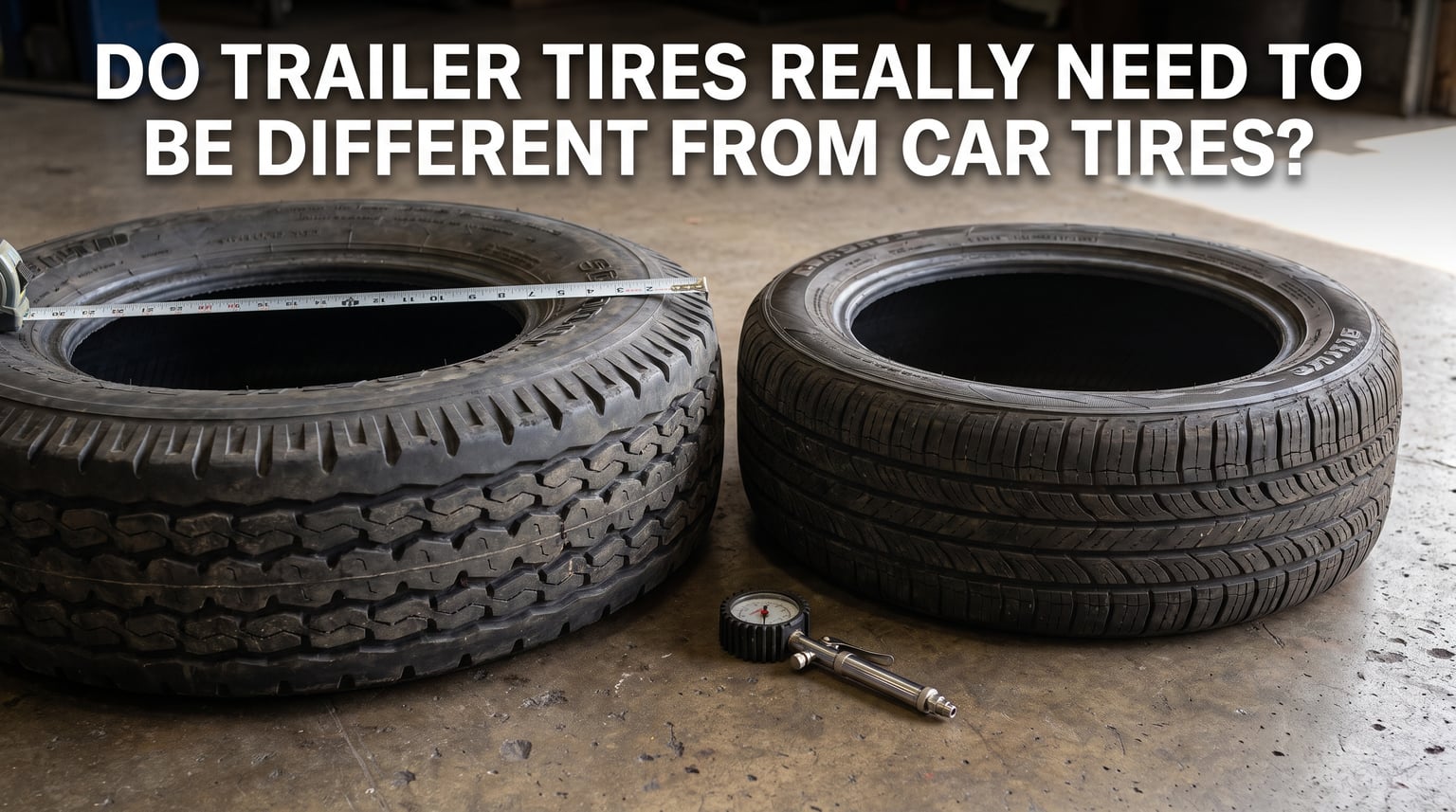
Do trailer tires really need to be different from car tires? Yes – and the difference is not a marketing gimmick. A tire marked ST (Special Trailer) is engineered for a non-steered, non-driven axle carrying a heavy, mostly straight-line load, while a P-metric or LT tire is engineered for steering, braking, and cornering forces on a powered vehicle. Using the wrong type is the single biggest cause of highway trailer blowouts, sudden sway, and roadside emergencies that put families at risk.
I’ve spent years around tow rigs and trailers, and the pattern is consistent: the trailer that blew a tire at 65 mph almost always had the wrong tire type, the wrong pressure, or was 7+ years past its DOT date code. In this guide, our team breaks down what makes trailer tires different from car tires, how to read every marking on the sidewall in 30 seconds, and the seven real-world failure patterns that lead to dangerous blowouts.
Table of Contents
Quick Answer: Yes, Trailer Tires Are Built Differently for a Reason
Trailer tires use a thicker, stiffer sidewall and a narrower tread to carry heavy loads in a straight line without flexing. Car tires use a softer sidewall and a wider tread for steering grip and cornering. The two jobs are so different that swapping them creates heat buildup, sway, blowouts, or – in reverse – poor wet grip and unpredictable handling. Always match the sidewall code (ST, LT, or P) to the axle it sits on.
How to Read the Trailer Tire Sidewall in 30 Seconds
The sidewall is the only place the tire tells you what it actually is. Every DOT-approved tire carries the same set of codes, and once you know the layout, you can identify any trailer tire or car tire on the lot in under a minute.
The Type Code Is the First Clue
Look for a single letter at the very start of the size string:
- ST = Special Trailer. Built only for trailer axles. Not for passenger vehicles.
- LT = Light Truck. Built for pickup trucks and vans; sometimes used on heavier trailers.
- P = P-metric (Passenger). Built for cars, crossovers, minivans, and SUVs.
If you do not see any of these letters, the tire is European-metric and you need to match the load index instead.
The Size String and Load Range
A typical trailer tire reads ST205/75R15. That breaks down as: ST = Special Trailer, 205 = millimeters of tread width, 75 = aspect ratio (sidewall height is 75% of the width), R = radial, 15 = wheel diameter in inches. Right next to that string you will see a load range letter – usually C, D, or E on trailer tires – and the maximum psi. Load range E tires run at 80 psi and carry roughly 1,500 lbs each.
The DOT Date Code Tells You the Tire’s Birthday
Look for the DOT stamp on the inner sidewall. The last four digits are a date code: the first two are the week, the last two are the year. A tire stamped DOT ... 1522 was made in week 15 of 2022. Trailer tires age out at roughly 5-7 years regardless of tread depth, because the rubber compound hardens and dry-rot long before the tread wears down.
Fundamental Design Differences Between Trailer Tires and Car Tires
Trailer tires and car tires look similar from 20 feet away, but the engineering priorities are almost opposite. Here is what changes when a tire is designed for a trailer axle instead of a driven steering axle.
Sidewall Thickness and Stiffness
Trailer tires have noticeably thicker, stiffer sidewalls than car tires. The added rubber resists the flex that happens when a heavy load shifts in a turn, which is what causes trailer sway. Passenger tires flex on purpose – that flex is what gives a car its steering feel and grip in corners.
Ply Construction and Load Capacity
Most modern trailer tires use a stiffer polyester body and a reinforced crown area. That reinforcement lets them carry 1,000-3,000 lbs per tire at high pressure (often 50-80 psi) without deforming. Car tires use lighter plies optimized for grip and ride comfort, with a typical max load of 1,200-1,500 lbs per tire at lower pressures (30-35 psi).
Tread Width and Heat Dissipation
Trailer treads are narrower than car treads on purpose. A narrower footprint concentrates the load and reduces rolling resistance, which lowers heat buildup. Car tires run wider treads to spread the load and maximize grip during acceleration and braking. That wider footprint traps more heat, which is fine on a moving car but deadly on a trailer that may sit still for weeks.
Speed Rating and Continuous Load
Most ST tires carry an L speed rating (75 mph) or are simply rated for sustained speeds up to 65 mph. Car tires typically carry T (118 mph) or H (130 mph) ratings. The lower ST rating is not a flaw – it reflects the duty cycle. Trailer tires are tested for hours of continuous load, not for the bursts of high speed that passenger tires see on highways.
ST vs LT vs P-Metric: Side-by-Side Comparison
The table below is the fastest way to see why do trailer tires need to be different from car tires. Each code is engineered for a different axle and duty cycle.
| Attribute | P-metric (Passenger) | LT (Light Truck) | ST (Special Trailer) | Tow Vehicle |
|---|---|---|---|---|
| Typical Use | Sedans, SUVs, crossovers | Pickups, vans, heavy SUVs | Trailer axles only | Truck/SUV doing the towing |
| Sidewall Stiffness | Soft, grip-tuned | Medium, load-tuned | Stiff, sway-resistant | Medium-high |
| Max Cold Pressure | 30-35 psi | 50-80 psi | 50-80 psi | 35-80 psi |
| Speed Rating | T to H (118-130 mph) | S to R (112-106 mph) | L or unrated (typically 65 mph) | S to T |
| Load Range | SL or XL | C, D, or E | C, D, or E | E typical for 3/4-ton+ |
| Tread Width | Wide | Medium | Narrower | Wide |
| Heat Dissipation | Moderate | Moderate | Engineered for sustained load | Moderate |
| Steering Capability | Excellent | Good | None – not for steered axles | Excellent |
| Typical Cost per Tire | Low | Medium | Low-Medium | Medium-High |
What Happens When You Put Car Tires on a Trailer
It is technically possible to mount many P-metric or LT tires on a trailer rim – they share common 14, 15, and 16 inch diameters. But possible does not mean safe. Here is what actually happens on the road.
Heat Builds Up Faster Than the Tire Can Shed It
Car tires are designed for a moving vehicle that constantly feeds air across the tread as you drive. A trailer wheel on a tandem axle traps more heat because the inner tire sits in the shadow of the outer one. Add the wider tread and softer sidewall of a P-metric tire, and the heat has nowhere to go. Internal ply separation and catastrophic blowouts follow.
Sidewall Flex Creates Trailer Sway
A softer passenger sidewall flexes under load shifts. When a semi passes you or a wind gust hits, that flex delays the trailer’s response and amplifies sway. ST tires resist that flex and recover quickly, which is exactly why they’re engineered the way they are.
Blowouts Cluster Around the First Highway Trip
Reviewers report that a single highway run at sustained 65+ mph is often enough to kill a passenger tire used on a trailer. The tire looks fine going in and shredded coming out. Our team has seen this pattern repeatedly on customer rigs that came in with mismatched tire setups.
The Insurance Question Nobody Wants to Ask
If a tire failure on a trailer causes an accident, the insurer will look at whether the tire met the trailer manufacturer’s specifications. A P-metric tire on an axle that calls for ST can void coverage. It is a quiet detail buried in most policy fine print, but it has come up in real claims after tow vehicle accidents.
Why Trailer Tires Are Unsafe on Passenger Cars
The reverse swap is just as dangerous. An ST tire on a passenger car sounds appealing if you have a spare and a flat, but the engineering mismatch shows up fast.
Steering Response Goes Flat
The stiff sidewall that resists sway on a trailer also resists turning on a car. Steering becomes vague, and the car feels like it is sliding on ice when you turn the wheel. In emergency maneuvers, that delay is the difference between a clean lane change and a ditch.
Wet Grip Drops Sharply
The narrower tread and harder compound of an ST tire evacuate less water than a P-metric tire. Hydroplaning happens at lower speeds. Anyone who has driven through a thunderstorm on ST tires knows the floating sensation that sets in around 50 mph.
Braking Distances Get Longer
Because the contact patch is smaller and the rubber compound is tuned for endurance, not grip, ST tires need more distance to stop. That is fine on a 5,000 lb trailer doing 55 mph, but dangerous on a 3,500 lb car doing 70 mph in traffic.
Common Trailer Tire Failure Patterns and How to Prevent Them
Reviewers on RV forums and trailer owner groups name the same handful of causes for nearly every blowout they report. Most are preventable.
Seven Causes That Lead to Most Trailer Tire Blowouts
- Underinflation. A 5 psi shortfall can cause a 20% increase in operating temperature.
- Overloading the axle. Exceeding the tire’s load range is the single biggest heat trigger.
- Age over tread. A tire with great tread but a 2017 DOT code is already on borrowed time.
- Speed above 65 mph. Sustained high speed compounds heat faster than the tire can shed it.
- Dry rot from outdoor storage. UV and ozone break down the sidewall rubber in 3-5 years.
- Wheel imbalance and misalignment. Uneven wear and hot spots lead to sidewall failure.
- Mixing ST and LT on the same axle. Different sidewall flex creates unpredictable handling.
The Maintenance Checklist That Actually Extends Tire Life
Pressure check before every trip, including the spare. Visual inspection for cracks, blisters, or uneven wear once a month. Rotation every 3,000-5,000 miles to even out the wear pattern. Covering the tires when stored outside, or better yet, storing the trailer on wood blocks with tire covers on. Replacing tires at 5-7 years regardless of tread depth – the DOT code is the deciding factor, not the look of the rubber.
How to Choose the Right Trailer Tire for Your Setup
The right tire starts with the axle, not the brand. Match the tire to the gross vehicle weight rating (GVWR) printed on the trailer’s VIN plate, then add a 10% safety margin.
Step 1: Find the GVWR and Per-Tire Load
Divide the GVWR by the number of tires on the ground (usually 2 or 4). A 7,000 lb GVWR tandem-axle trailer carries 1,750 lbs per tire. That puts you in load range D or E territory, not load range C.
Step 2: Match the Tire Size to the Wheel
Trailer wheels come in 12, 13, 14, 15, and 16 inch diameters. The tire size must match the wheel exactly – mixing a 15 inch tire on a 14 inch rim is not possible, and a mismatch is unsafe.
Step 3: Pick Radial or Bias-Ply
Radial trailer tires run cooler, last longer, and give a better ride than bias-ply. Bias-ply is cheaper and stiffer, which some flatbed and equipment trailer owners prefer for stability. For most RV and cargo trailers, radial is the better choice.
Step 4: Replace All Four (or All Six) at Once
Mixing new and aged tires on the same axle is a common mistake. The newer tire carries more load because it has stiffer rubber, which overloads the older tire. Replace trailer tires in matched sets.
Frequently Asked Questions
Can I use regular car tires on my trailer?
Technically you can mount many P-metric and LT tires on a trailer rim, but it is not recommended. Car tires are engineered for steering, braking, and cornering – not for sustained heavy loads in a straight line. Under trailer conditions they build up heat faster than ST tires and are far more likely to fail.
What happens if you put a trailer tire on a car?
Steering response goes flat, wet grip drops, and braking distances get longer. ST tires have stiffer sidewalls and harder compounds than car tires, which hurts cornering and hydroplane resistance. They are not designed to steer, brake, or be driven at highway speeds on a passenger vehicle.
Can I use trailer wheels on my car?
Usually no. Trailer wheels use a different bolt pattern, offset, and center bore than most car wheels. Even if a wheel physically bolts up, the load rating, tire type, and speed rating are almost always wrong for a passenger car. Stick with wheels engineered for your specific vehicle.
Why are trailer tires only for trailers?
ST tires have thicker, stiffer sidewalls and a narrower tread engineered to carry heavy loads in a straight line without flexing. Those same traits make them poor at steering and braking, so the federal tire standards restrict them to non-steered trailer axles only.
What does ST mean on a tire?
ST stands for Special Trailer. It is a DOT designation that means the tire meets the Federal Motor Vehicle Safety Standard for trailer use only – with a stiffer sidewall, higher load range, and a narrower tread than passenger or light-truck tires.
Are trailer tires speed rated?
Most ST tires are rated for sustained speeds of 65 mph, with some carrying an L speed rating up to 75 mph. They are tested for hours of continuous load rather than bursts of high speed. Sustained speeds above 65 mph dramatically increase heat buildup and blowout risk.
What is the difference between ST and LT tires?
LT (Light Truck) tires are designed for pickups and vans – they steer, brake, and carry load. ST (Special Trailer) tires are designed only for trailer axles, with thicker sidewalls and a narrower tread. LT tires can sometimes substitute for ST in heavier use, but ST tires should never be used on a passenger car or truck.
Why do trailer tires keep blowing out?
Most trailer blowouts come from underinflation, overloading, age over 5-7 years, sustained speeds above 65 mph, dry rot from outdoor storage, or mixing ST and LT tires on the same axle. Heat buildup is the common thread – it weakens the internal plies and leads to sudden sidewall failure on the highway.
The Bottom Line on Trailer Tires vs Car Tires
Do trailer tires really need to be different from car tires? Absolutely. They are built for opposite jobs – one for sustained heavy loads in a straight line, the other for steering, braking, and cornering. Match the sidewall code (ST for trailer axles, LT or P for tow vehicles), keep the pressure at the value on the tire, and replace by DOT age rather than by tread depth. That single habit is the difference between a safe tow and a roadside emergency.