
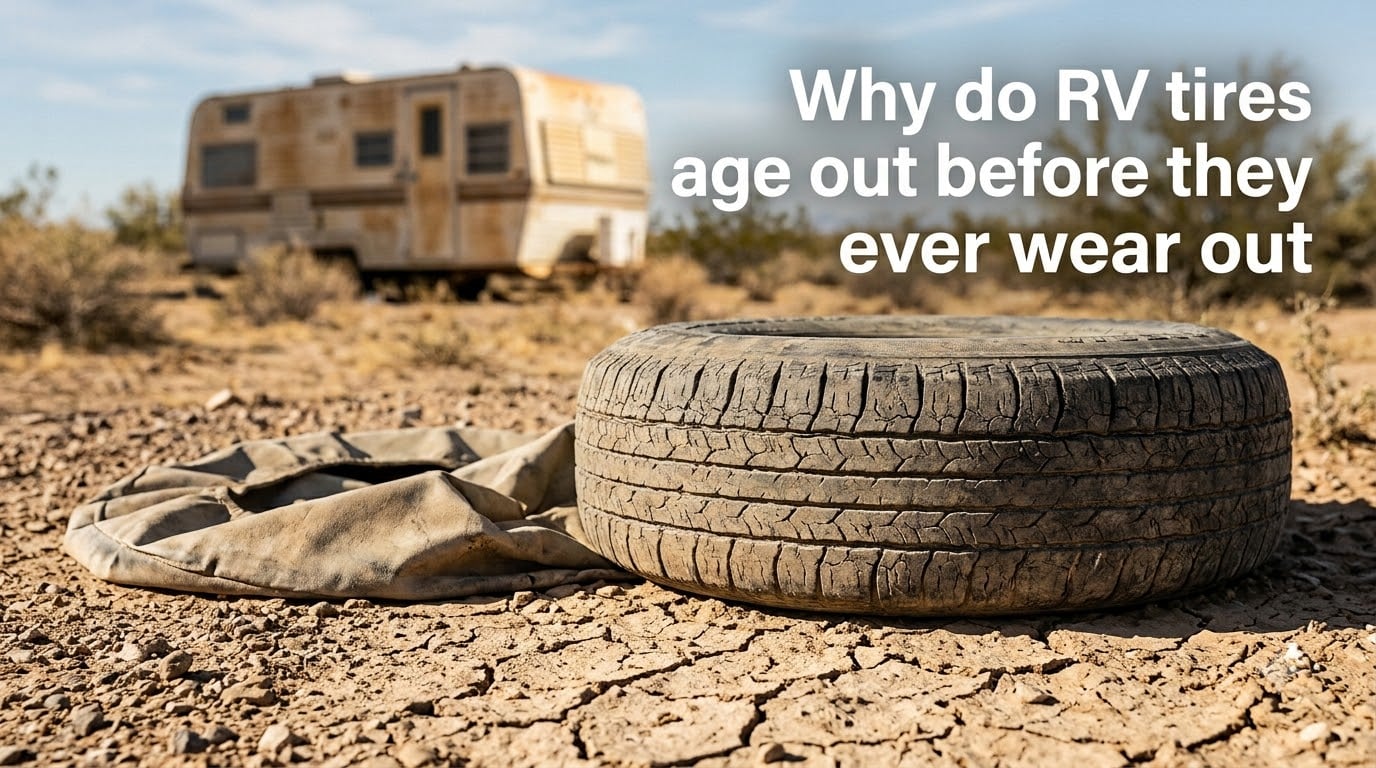
I learned this lesson the hard way on a July morning outside Yuma, Arizona. A buddy of mine was pulling his travel trailer home from a weekend trip. The tires looked fine the night before. He made it 38 miles before two of them blew within minutes of each other. The treads were still deep. The rubber was just gone.
That is the short answer to why RV tires age out before they wear out. Time, sun, and ozone break the rubber down chemically, long before the tread ever gets thin. Mileage barely matters. A 5-year-old trailer tire with 4,000 miles on it is a ticking clock, while a 3-year-old commuter car tire with 40,000 miles is still a teenager. In this guide, I will walk you through the actual chemistry of dry rot, show you how to read the DOT date code stamped into every tire, break down what climate and storage do to your timeline, and give you the prevention playbook our team uses on our own rigs.
Table of Contents
Why do RV tires age out before they wear out?
RV tires age out before they wear out because their rubber polymers break down from UV radiation, ozone, and heat over time, regardless of how much tread remains. Passenger car tires see enough flexing, miles, and use that they usually wear out first. RV tires, especially trailer tires, sit still for weeks or months at a time, baking in the sun, while the protective chemicals inside the rubber slowly get used up. By year six or seven, a tire with deep tread can fail catastrophically.
That single fact rewires how you should think about replacement. Tread depth is a mileage problem. Dry rot is a calendar problem. Most RVers I know replace tires by age, not by wear bars.
The chemistry of dry rot: how rubber actually breaks down
No competitor I have read on this topic actually explains the chemistry. Let me fix that, because once you see what is happening inside the rubber, the 5-to-7-year rule stops sounding arbitrary.
UV photons and the carbon bonds in rubber
Tire rubber is a polymer, meaning long chains of carbon atoms (C-C) and sulfur cross-links (S-S) holding everything together. Sunlight carries UV photons with enough energy to snap those bonds. When a C-C or S-S bond breaks, the polymer chain shortens, and the rubber loses elasticity. That is what dry rot is at the molecular level. The chains are literally being cut.
Ozone attacks the sidewalls first
Ozone (O3) is a highly reactive gas that forms naturally in air, especially around electrical equipment, urban smog, and lightning. Tire manufacturers add antiozonant chemicals to the rubber compound to neutralize ozone before it can crack the sidewall. Those antiozonants are sacrificial, though. They get used up over years. Once they run out, ozone reaches the rubber directly and creates those characteristic vertical and branching cracks you see on aged sidewalls.
Heat speeds up every reaction
Heat accelerates both UV damage and ozone attack. A tire stored in Phoenix, Tucson, or Las Vegas ages roughly twice as fast as the same tire stored in Minneapolis or Seattle, all else equal. Every 10°C rise in average temperature roughly doubles the reaction rate of rubber oxidation.
The polymer chain scission timeline
Inside a tire, the breakdown follows a predictable pattern. Years 1-3 look fine. Years 4-5 show subtle color change and micro-cracks. Years 6-7 produce visible sidewall cracking and reduced flexibility. Years 8-10 bring deep cracks, brittleness, and real blowout danger. Premium tires with higher antiozonant loads (like Michelin XPS Rib or Goodyear Endurance) can stretch that timeline to 8-10 years safely, which is why Michelin publishes a 10-year replacement bulletin for some lines.
Age vs miles: why tread depth is misleading on RVs
I keep a spreadsheet on every rig I have owned. My current Class A motorhome is on its third set of tires in 9 years of ownership. None of those sets wore out. They all aged out.
Passenger cars vs RVs: a usage mismatch
Passenger car tires typically rack up 12,000 to 15,000 miles a year and see road grime, water, and constant flexing. They usually wear down to 4/32 inch or less within 5 to 6 years. By the time tread is gone, the rubber has only had to survive 5 years of weathering, which is borderline acceptable. RV tires, especially trailer tires, often see 2,000 to 4,000 miles a year at most. The tread will look brand new at year seven. The rubber inside, though, has had 7 years of UV and ozone exposure with no rotation or significant flexing to keep it healthy.
Sidewall flex matters
Every rotation of a tire flexes the sidewall, which works the antiozonants into the outer layer and helps distribute protective waxes that migrate through the rubber. A tire that sits for 6 months in a row loses that protective flex cycle. The outer layer of rubber can dry out faster than a daily-driven tire, even with the same calendar age.
Flat spotting compounds the problem
Tires that sit under load for months develop flat spots where the rubber has been compressed against the pavement. These flat spots can become permanent if the tire sits too long, and they are a sign that the tire is aging unevenly. Always move your RV a few inches forward every 30 days during long storage.
How long do RV tires last? Typical lifespan by climate and use
This is the table I wish someone had given me on day one. The numbers below are typical replacement timelines for standard ST (Special Trailer) and LT (Light Truck) tires. Premium brands like Michelin can stretch the upper ranges by 2 to 3 years.
| Climate Zone | Storage | Use Pattern | Typical Replacement Age |
|---|---|---|---|
| Sun Belt (AZ, TX, FL, Southern CA) | Outdoor, covered | Weekend trips only | 5 to 6 years |
| Sun Belt | Outdoor, covered | Full-time / snowbird | 6 to 7 years |
| Sun Belt | Indoor / shaded barn | Any use pattern | 7 to 9 years |
| Northern (MN, MI, NY, WA) | Outdoor, covered | Seasonal use | 7 to 9 years |
| Northern | Indoor heated storage | Any use pattern | 8 to 10 years |
| Coastal (FL Gulf, Outer Banks, Carolinas) | Outdoor, covered | Any use pattern | 5 to 7 years |
| Mountain (high altitude, high UV) | Outdoor, covered | Seasonal use | 6 to 7 years |
The single biggest variable is direct sun exposure. A covered outdoor tire in the Sun Belt will outlast an uncovered tire in the same yard by 2 years.
How to read the DOT date code on your RV tires
The DOT date code is the fastest way to know how old a tire is. Every tire sold in the US has a DOT stamp on the sidewall. Here is how to read it.
Step 1: Find the DOT stamp
Look on the outboard sidewall of the tire for a stamp that begins with “DOT” followed by a series of letters and numbers. The DOT code includes a plant code, tire size, and the critical last 4 digits at the end.
Step 2: Locate the last 4 digits
After the letters and plant codes, the final 4 digits of the DOT code are the date of manufacture. The first two digits are the week of the year (01 to 52). The last two digits are the year.
Step 3: Read the example
A DOT code ending in 4721 means the tire was manufactured in week 47 of 2021, which is mid-November 2021. A code ending in 0819 means week 8 of 2019, which is late February 2019. Once you can read this, you can age any tire in seconds.
Step 4: Check all four tires plus the spare
Tires on the same rig can have different manufacture dates if they were replaced one at a time. Always check all four positions plus the spare. The oldest tire sets your replacement timeline.
Visual warning signs of dry rot to inspect every season
The DOT code tells you the age. The sidewall tells you the condition. Both matter, because age is a risk factor, but visible damage is a stop-driving-now signal.
Sidewall cracking
Fine, hairline cracks on the outer sidewall are often just cosmetic weathering, especially on older tires. Deep cracks that you can fit a fingernail into, or cracks that go all the way through the rubber to the cords underneath, are dangerous. Any tire with deep sidewall cracks should be replaced immediately, regardless of age.
Color change and fading
Fresh tire rubber is deep black with a slight sheen. Aged rubber turns gray, brown, or chalky. Color change indicates the protective oils and waxes inside the rubber have depleted. It is an early warning sign.
Bulges and blisters
A bulge on the sidewall means the internal cords have separated and air is pushing the rubber out. A bulging tire is one bad pothole or hot day away from a blowout. Replace it the same day you see it.
Cracking between the tread ribs
Cracks running circumferentially between the tread blocks are called “weathering cracks.” They are common on trailer tires that have sat unused. If the cracks are shallow and the tire is under 5 years old, the tire is often still serviceable. Deep cracks between the treads on a 7-year-old tire mean replacement time.
Embedded debris and slow leaks
Tires with chronic slow leaks often have tiny embedded objects or cracked rubber around the bead. If you find yourself adding air more than once a quarter, the tire is telling you something.
Climate and storage impact: Sun Belt vs northern, indoors vs outdoors
Where you live and where you store your RV matters more than how you drive it. Let me break down the four biggest climate factors.
Sun Belt climate
Arizona, Texas, Florida, Southern California, and Nevada see 300+ days of sun per year and average summer highs above 95°F. UV dose in Phoenix is roughly 70% higher than in Seattle. Trailer tires in Phoenix realistically need replacement every 5 to 6 years, even with covers. If you store in the Sun Belt, budget for replacement more aggressively.
Coastal climate
Salt air and humidity attack tire rubber from a different angle. Salt crystals embed in micro-cracks and wick moisture, accelerating oxidation. Coastal owners should rinse tires with fresh water monthly and expect a 5 to 7 year lifespan on outdoor-stored tires.
Northern climate
Cold northern climates are easier on tires. The UV dose is lower, and the freeze-thaw cycle actually does less damage to rubber than sustained heat. Stored-outdoor tires in Minnesota or Michigan can routinely hit 7 to 9 years if covered and rotated.
Indoor vs outdoor storage
An indoor-stored tire in a barn or garage can outlast an outdoor-covered tire in the same yard by 2 to 3 years. If you have any kind of covered shed, RV port, or barn, use it. Even partial shade from a tree drops UV exposure significantly.
Trailer tires vs motorhome tires: why ST tires age faster
Most travel trailers and fifth wheels come from the factory with ST (Special Trailer) tires. They are cheaper and rated for higher loads at higher pressures, but they have thinner sidewalls and less antiozonant protection than LT (Light Truck) tires. That makes them age faster under the same conditions.
ST tire characteristics
ST tires use a stiffer sidewall construction designed for the high inflation pressures (often 65 to 110 psi) that trailer axles demand. The stiffer sidewall flexes less, which means less protective wax migration and faster surface aging. ST tires are also more sensitive to underinflation damage.
LT tire characteristics
LT tires use the same construction principles as passenger truck tires, with deeper antiozonant packages and more flexible sidewalls. A set of LT tires on a travel trailer will typically outlast ST tires by 2 to 3 years in the same conditions.
When to upgrade ST to LT
If your trailer has 15-inch or 16-inch wheels and your rims can accept LT sizes, upgrading to LT tires (like Goodyear Endurance or Michelin XPS Rib) is one of the best upgrades you can make. Just confirm load range compatibility with your trailer’s GVWR. Some heavier fifth wheels still need ST tires for the load rating.
Replacement age rules: 5 to 7 years standard, 10 years for premium brands
Here is the consensus view from tire manufacturers and RV industry groups like the RV Safety Education Foundation.
The 5 to 7 year standard
Most tire manufacturers, including Goodyear, Continental, and the Rubber Manufacturers Association, recommend replacing RV tires (especially ST trailer tires) every 5 to 7 years from the date of manufacture, regardless of tread depth or visual condition.
The 10 year Michelin premium exception
Michelin has published technical bulletins stating that certain premium lines (Michelin XPS Rib, Michelin XZE, and specific Michelin truck tires used on heavy Class A motorhomes) can be safely used up to 10 years when properly maintained. This assumes regular inspections, correct inflation, indoor storage, and no visible damage.
The spare tire rule
The spare tire is the most-forgotten tire on any RV. It sits under the rig or in a rear compartment, covered, often for the entire life of the rig. By the time you need it, the rubber is dangerously old. Replace your spare every 6 years, even if it has never touched pavement.
Insurance considerations
Most RV insurance policies require tires to be in roadworthy condition. A blowout caused by visibly aged tires can complicate a claim. Document your DOT codes and replacement dates with photos, and keep receipts. It protects you if anything ever goes wrong.
7 proven prevention methods that actually extend RV tire life
These are the steps our team uses on every rig we own or manage. None of them are expensive. All of them work.
1. Use UV-resistant tire covers
A quality set of UV-resistant tire covers blocks the majority of UV photons from reaching the rubber. Look for covers with an elastic hem and double-stitched seams. Vinyl covers are cheap but can trap moisture. Breathable fabric covers (like Camco or Classic Accessories) are better for long-term storage. Covers pay for themselves many times over by extending tire life 2 to 3 years.
2. Maintain correct cold tire pressure
Underinflation is the single biggest preventable cause of RV tire failure. Check cold pressure (before driving more than a mile) monthly. Inflate to the pressure listed on your RV’s tire information placard, not the maximum on the tire sidewall. Underinflation generates heat, which accelerates both aging and tread separation.
3. Move the RV monthly during storage
Roll the rig forward or backward a few feet every 30 days. This flexes the sidewalls, redistributes the load, prevents flat spotting, and works fresh protective waxes to the outer surface. It is the cheapest prevention method that exists.
4. Avoid petroleum-based tire shine
This is the mistake that catches even experienced RVers. Most off-the-shelf tire shine products contain petroleum distillates or silicone oils that actually break down the antiozonants in the rubber. They make the tire look shiny for a week, then accelerate aging by 6 months. Use only water-based rubber protectants like 303 Aerospace Protectant.
5. Use 303 Aerospace Protectant
303 Aerospace is the gold-standard UV protectant for tire rubber. Spray it on clean, dry tires every 60 to 90 days. It contains no petroleum distillates, no silicones, and no alcohol that can dry out rubber. Independent testing has shown it reduces UV-driven surface cracking significantly.
6. Install a TPMS
A Tire Pressure Monitoring System (TPMS) for RVs is non-negotiable for us. Sensors mount inside the tire or on the valve stem and alert you to pressure loss in real time. Pressure drops are an early warning of slow leaks, valve issues, and temperature-related underinflation. A good TPMS pays for itself the first time it catches a leak on a highway.
7. Store indoors whenever possible
Indoor storage is the single most effective prevention method. A barn, garage, RV port, or even a pole-barn style cover blocks UV, blocks rain, and moderates temperature swings. If you cannot store indoors, combine a high-quality cover with monthly movement and UV protectant.
8. Rotate motorhome tires
On Class A and Class C motorhomes, front and rear tires see different loads and wear patterns. Rotate every 6,000 to 8,000 miles to even out the wear and UV exposure. Trailer tires typically should not be rotated side-to-side, but they should be inspected every trip.
9. Wash tires before long storage
Road grime, brake dust, and salt hold moisture against the rubber. Wash tires with mild soap and water before putting the RV into long-term storage. Let them dry completely before covering.
Winter and long-term storage playbook
If you live in a cold climate or only use your RV seasonally, this storage checklist will save you a set of tires.
Inflation before storage
Inflate tires to the maximum pressure shown on the sidewall before putting the RV into storage. Cold temperatures drop pressure by 1 to 2 psi per 10°F, so starting high gives you margin. Do not exceed the load range rating, but maximizing within the sidewall range is fine for stored tires.
Park on pads or plywood
Concrete can hold moisture against the rubber and freeze-bond to the tire in extreme cold. Park on wooden planks, rubber tire pads, or sheets of plywood. This also prevents flat-spotting on the bottom of the tire.
Clean and dry
Wash tires and let them dry completely. Apply a coat of 303 Aerospace Protectant. Cover with breathable tire covers. Do not use plastic tarps directly on tires, as they trap moisture.
Monthly rolling
Roll the rig forward or backward one tire rotation every 30 days. This prevents flat spots and keeps the protective waxes circulating.
Pre-trip re-inflation
Before your first trip after storage, drop tire pressure back to the recommended cold inflation on your tire placard. Check pressure at ambient temperature, before any driving.
Common owner mistakes that accelerate RV tire aging
I have made some of these myself. Here is the list to avoid.
Trusting tread depth over age
The most expensive mistake. A 7-year-old tire with 8/32 tread is not safer than a 3-year-old tire with 4/32 tread. Replace by age, not by tread depth, on RVs.
Using tire shine products
As covered above, most tire shine products damage rubber over time. Use only water-based protectants like 303 Aerospace.
Ignoring the spare
The spare tire sits unused for years. By the time you need it, it can be 8 to 10 years old. Replace it on the same schedule as your main tires, every 6 years.
Storing on concrete without covers
Uncovered tires on hot concrete in Arizona or Texas bake all summer. Always cover, and ideally store indoors or on pads.
Basing replacement on tire shop advice alone
Tire shops sometimes recommend early replacement because their liability is on the line. Get a second opinion if your tires are 4 to 5 years old and a shop wants to replace them with no visible damage. Document the DOT code and sidewall condition yourself.
Mixing tire brands or ages on a rig
All four tires (or six, on a dually) should be the same brand, model, age, and load range. Mismatched tires wear unevenly and age at different rates. Replace all tires together, not one at a time.
Driving on visibly cracked tires
If the cracks are deep enough to catch a fingernail, the tire is dangerous regardless of DOT date. Replace immediately. The forum poster who wrote “dry rot gives you zero warning” was right.
Frequently Asked Questions
What is the average lifespan of RV tires?
The average lifespan of RV tires is 5 to 7 years from the date of manufacture, regardless of tread depth. Premium Michelin lines on motorhomes can last up to 10 years when properly maintained. Trailer tires in Sun Belt climates typically need replacement every 5 to 6 years, while indoor-stored tires in northern climates can reach 8 to 10 years.
Are 10 year old RV tires safe?
Standard ST and LT RV tires should not be used past 7 years from the DOT date code. Premium Michelin lines used on heavy Class A motorhomes may be safe to 10 years when regularly inspected, properly inflated, indoor-stored, and free of visible sidewall damage. After 10 years, replacement is mandatory regardless of condition.
How do I keep my RV tires from dry rotting?
Keep RV tires from dry rotting by using UV-resistant covers, maintaining correct cold inflation pressure, moving the RV monthly during storage, applying 303 Aerospace Protectant every 60 to 90 days, avoiding petroleum tire shine, installing a TPMS, and storing indoors whenever possible. These seven steps can extend tire life by 2 to 3 years in most climates.
How long does it take for dry rot to develop on tires?
Dry rot becomes visually noticeable on unprotected RV tires in 4 to 5 years in Sun Belt climates and 6 to 7 years in northern climates. Micro-cracks and color change appear earlier, around year 3 to 4 on outdoor-stored tires. Indoor storage and UV protectant sprays can delay visible dry rot by 2 to 3 years.
Can tires dry rot in 3 years?
Yes, tires can show visible dry rot in 3 years in extreme conditions: uncovered outdoor storage in Arizona, Texas, or Florida summers; coastal humidity with salt air; or constant underinflation that generates heat. In milder northern climates with covered or indoor storage, 3 years is usually too early for visible dry rot but early micro-cracks may appear.
How bad is a dry rotted tire?
A dry rotted tire with deep sidewall cracks, bulging, or tread separation is dangerous and can blow out without warning at highway speeds. Mild surface weathering with hairline cracks is cosmetic and the tire may still be serviceable, but deep cracks that catch a fingernail, color change to gray or brown, and any sidewall bulge mean immediate replacement is required.
Are 20 year old trailer tires safe?
No, 20 year old trailer tires are not safe under any condition. The antiozonants and protective compounds in the rubber have long been depleted, and the polymer chains have lost most of their elasticity. Even unused 20-year-old tires can fail catastrophically under load. Replace them immediately and do not drive on them.
Conclusion
RV tires age out before they wear out because time, UV radiation, ozone, and heat break the polymer chains in the rubber, even when the tread is deep. Mileage is a misleading metric. Age, climate, storage, and maintenance are what determine your real-world tire life. Read the DOT date code on every tire on your rig, including the spare, and use the climate-zone table above to plan your next replacement. If you take one thing from this guide, take the spare tire rule. It is the most-overlooked tire on any RV, and it is the one that gets people stranded.
Your next step is simple. Walk to your RV, check the DOT date on all four tires plus the spare, and write those dates down with today’s date next to them. If any of them are over 6 years old, schedule replacement this season. If they are 3 to 5 years old, start a prevention routine now and you can stretch them another 2 to 3 years safely.