
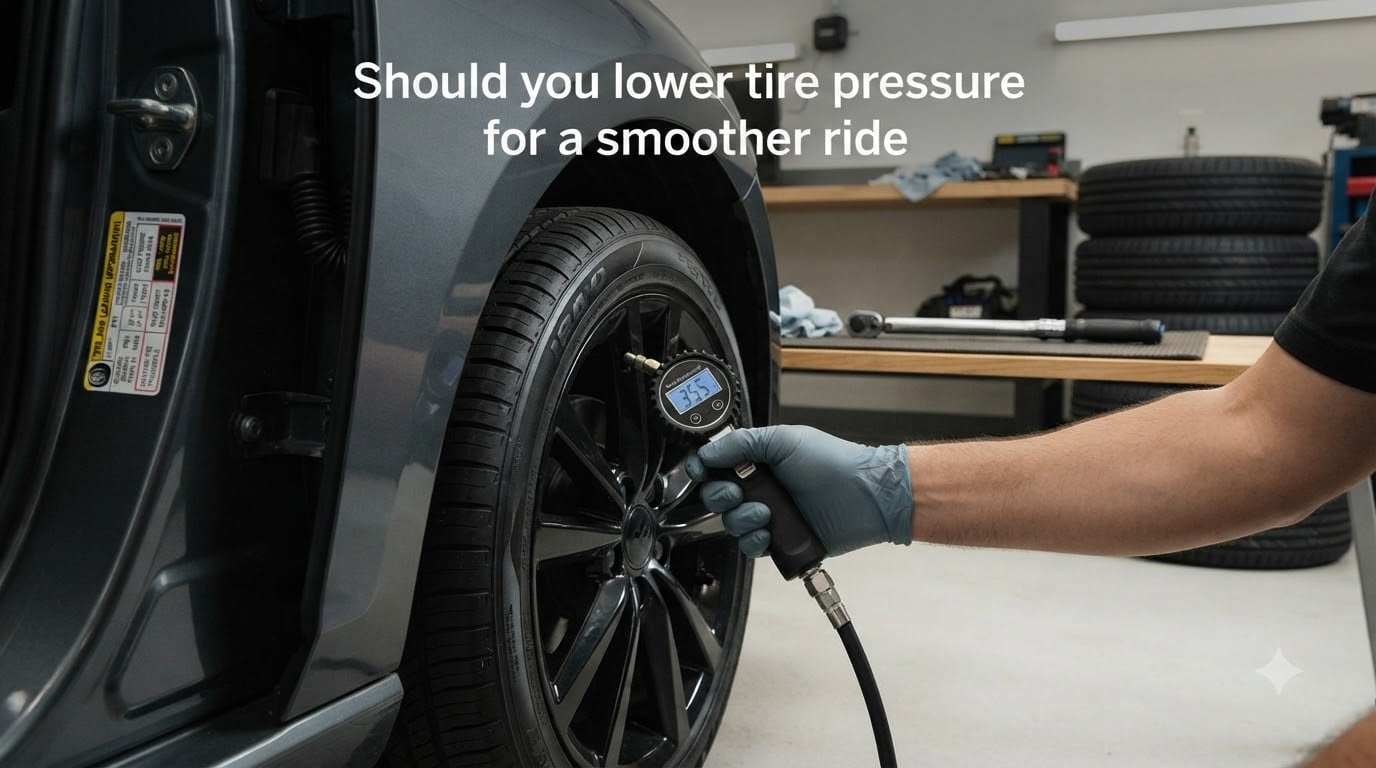
Yes, lowering tire pressure by a small amount – typically 2 to 3 PSI below the pressure printed on your vehicle’s door-jamb sticker – will give you a noticeably softer ride. Going further than that, or running below the manufacturer’s recommendation for extended periods, costs you handling response, fuel economy, and tire life. The smart move is to start with the door-jamb number, drop 2 PSI if the ride feels harsh, and stop there.
Table of Contents
Direct Answer: Should You Lower Tire Pressure for a Smoother Ride?
Yes, lowering tire pressure gives a smoother ride – up to a point. Tire pressure directly controls the spring rate of your tires, and reducing it by 2 to 5 PSI lets the sidewalls flex more over bumps, which absorbs impact before it reaches the cabin.
Beyond that small range, the trade-offs get ugly. Handling goes soft, stopping distances grow, the shoulders of your tires wear out faster, and your fuel economy drops. The vehicle manufacturer’s recommended PSI exists because it’s the engineering balance between comfort, safety, and tire longevity.
Here’s the practical answer our team gives drivers who ask: stay within 2 PSI of the door-jamb number for a comfort boost. If you want more softness than that, the problem is your tires, not your pressure – and the next section explains why.
| Adjustment vs. Door-Jamb PSI | Ride Softness | Handling | Tire Wear | Fuel Economy | Safety |
|---|---|---|---|---|---|
| Door-jamb PSI (baseline) | Firm | Sharp | Even | Best | Best |
| -2 PSI | Slightly softer | Nearly identical | Minimal change | Negligible | Safe short-term |
| -5 PSI | Noticeably softer | Mushy turn-in | Shoulder wear begins | About 1% lower | Compromised |
| -10 PSI or more | Very soft, sloppy | Dangerous response | Severe shoulder wear | 2-3% lower | TPMS warning, blowout risk |
How Tire Pressure Affects Ride Quality (The Physics)
Tire pressure is the single biggest free adjustment that changes how your car feels over bumps. That’s because your tire acts like a spring, and the pressure inside it sets how stiff that spring is.
The engineering term is spring rate – how much vertical force it takes to compress the tire by one unit. Higher pressure means a stiffer spring, less sidewall flex, and more impact reaching the cabin. Lower pressure means a softer spring, more sidewall flex, and more impact absorbed before it gets to you.
Three things happen when you lower pressure:
- The sidewall flexes more, so each bump compresses the tire instead of slamming through the suspension.
- The contact patch deforms more under load, spreading the impact over a longer, slightly flatter footprint.
- The vertical stiffness drops, which is the measurable number engineers tune against.
This is why a tire inflated to 35 PSI feels harsher than the same tire at 32 PSI on the same road. The pressure drop of 3 PSI is small, but the spring-rate change is real and you feel it.
Why the ride feels different immediately
Tire spring rate scales roughly with inflation pressure. A 10% drop in PSI gives you roughly a 10% drop in vertical stiffness on a passenger tire, which is a change your body notices on broken pavement and expansion joints. The trade is that the same lower pressure makes the tire less precise when you turn the steering wheel.
Where to Find Your Manufacturer-Recommended PSI
Your vehicle’s correct tire pressure is on a sticker fixed to the driver’s-side door jamb. Open the driver’s door and look at the edge of the door frame – you’ll see a yellow or white sticker listing front and rear pressures for the stock tire size. That’s the number to start from.
If the sticker is missing or unreadable, check your owner’s manual under “Wheels and Tires” or “Specifications.” Tire Rack and most manufacturer websites also publish the spec by year, make, and model.
One common confusion: the number molded into the tire’s sidewall (for example, “MAX PRESS 51 PSI”) is not the pressure you should run. That’s the maximum the tire can safely hold, not what your vehicle is engineered for. Most passenger cars run 30-35 PSI, even though their tires can handle 50+.
How Much Can You Safely Lower Pressure?
For a comfort bump without crossing into safety territory, drop 2 PSI below the door-jamb spec. That’s the range where sidewall flex increases enough to soften bumps but handling, wear, and fuel economy are still essentially unaffected. Going 5 PSI or more below spec starts producing visible trade-offs.
If your car has low-profile tires (45-series or lower sidewall), even a 2 PSI drop helps more than it would on a 65-series sidewall because there’s less sidewall to flex in the first place. If your tires are already 60- or 65-series, the pressure tweak gives less comfort improvement – the sidewall is already doing most of the work.
Measuring the actual benefit
When I test a car for ride quality, I run the same loop at door-jamb PSI, then at -2 PSI, then at -5 PSI. At -2 PSI the ride is softer on rough pavement but the car still feels tight in corners. At -5 PSI the ride is clearly plusher, but turn-in gets lazy and the front end feels vague on highway cloverleafs. That’s the practical ceiling for most drivers.
Cold vs. hot tire pressure
Tire pressure rises as you drive – typically 3 to 5 PSI above the cold reading after 20 minutes of highway driving. Always check pressure when the tires are cold: parked for at least 3 hours, or driven less than a mile. If you set pressure after a long drive, you’re under-inflating the cold baseline.
Risks of Under-Inflation: What Happens When Tire Pressure Is Too Low
Under-inflation is one of the leading causes of premature tire wear and roadside failures. The Rubber Manufacturers Association estimates that under-inflated tires waste about 1.5 billion gallons of fuel per year in the U.S. and shorten tire life by an average of 15%. That’s not the price of comfort – that’s the cost of running pressure below engineering spec.
Here are the specific consequences our team sees when drivers run too low:
- Shoulder wear: The outer edges of the tread carry the load and wear out 30-50% faster than the center.
- Reduced handling: The sidewall flexes too much under cornering loads, so steering response goes vague and you lose grip earlier.
- Longer stopping distances: A tire at 25 PSI can take 10-15% longer to stop from 60 mph than one at 32 PSI.
- Lower fuel economy: Rolling resistance rises, costing roughly 1% MPG per 5 PSI below spec.
- TPMS warning light: Most systems alert at 25% below door-jamb spec, which is around 24-26 PSI on a 32 PSI vehicle.
- Rim damage and blowout risk: Severely low pressure lets the rim strike the road surface inside potholes, which can cut the sidewall or crack a wheel.
- Hydroplaning: Under-inflated tires can’t evacuate water through the tread grooves as effectively, raising wet-weather risk.
Will 30 PSI hurt tires?
On a vehicle with a 35 PSI door-jamb spec, 30 PSI is roughly 14% below spec – within the TPMS warning threshold but not dangerous for short-term driving. You should add air before the next highway trip, but a single day at 30 PSI won’t destroy the tires. Sustained driving at 30 PSI on a 35-spec vehicle, however, will wear the shoulders unevenly and cut tire life significantly.
Sidewall Aspect Ratio vs. Pressure: The Permanent Comfort Fix
If you really want a smoother ride, look at the numbers on the side of your tire before you reach for the pressure gauge. The aspect ratio – the second number in a size like 215/55R17 – is the sidewall height as a percentage of the tire’s width. A 55-series sidewall is taller than a 40-series sidewall, and that extra height absorbs impacts that a short sidewall can’t.
This is the actual lever for comfort, not pressure. A tire with a 65-series sidewall will ride softer than a 45-series tire at the same pressure, every time, on every road. Pressure changes the spring rate of the existing sidewall; aspect ratio changes how much sidewall you have in the first place.
| Profile | Sidewall Height (215 width) | Ride Comfort | Handling | Typical Use |
|---|---|---|---|---|
| 40-series | 86 mm | Harsh | Sharp | Sports cars, performance |
| 45-series | 97 mm | Firm | Precise | Sport sedans |
| 55-series | 118 mm | Comfortable | Good | Family sedans |
| 65-series | 140 mm | Soft | Composed | SUVs, crossovers, comfort sedans |
Vehicle-Specific Guidance: Sedans, SUVs, Trucks, and EVs
For sedans: Most sedans come with 55- or 60-series tires from the factory and ride reasonably soft at door-jamb PSI. If your sedan rides harsh, the issue is usually a low-profile tire upgrade or a worn suspension bushing, not pressure. Stay at spec, or drop 2 PSI for marginal comfort.
For SUVs and crossovers: SUVs are heavier and often come with stiffer sidewalls to support the load, which makes the ride feel busier over small bumps. Going 2 PSI below door-jamb spec is reasonable for comfort. Going 5 PSI below makes the vehicle feel floaty in corners – not what you want with a top-heavy vehicle.
For trucks: Light trucks have two PSI recommendations – one for normal load, one for maximum load. Use the normal-load number day-to-day. Lowering pressure below that doesn’t really help ride comfort much because the springs and shocks carry most of the load. Stick with the door-jamb spec.
For EVs (Tesla, Mustang Mach-E, others): Electric vehicles are heavy and many owners run 2-3 PSI above door spec for range, which makes the ride even firmer. Drop back to door-jamb spec for a real comfort gain without sacrificing too much range – you’ll lose maybe 1-2% efficiency but gain meaningful ride softness.
Common Tire Pressure Myths Debunked
Myth: “Softer tires grip better.” Wrong, and it’s the most common misconception on tire forums. A softer tire deforms more, but the deformation uses up part of the grip budget before the car even asks for traction. Properly inflated tires have a larger effective contact patch and respond faster to steering input. The “soft tires grip better” feeling is the car leaning on the sidewall, which feels like grip but is actually the tire rolling under you.
Myth: “The MAX PSI on the sidewall is what I should run.” No – that’s the maximum safe inflation, not the recommended pressure. Running max PSI gives you the harshest possible ride and accelerates center wear.
Myth: “Lowering pressure is safer on slippery roads.” Partially true for sand and deep snow, but on wet pavement the opposite is true. Under-inflated tires hydroplane more easily because the contact patch deforms in a way that traps water instead of shedding it.
Myth: “If the TPMS light is off, my tires are fine.” TPMS only warns when pressure drops roughly 25% below spec – so 24-26 PSI on a 32 PSI vehicle. By that point your tires are already under-inflated enough to wear badly. Check pressure monthly with a real gauge, not just the dashboard light.
Better Alternatives for a Smoother Ride
If you’ve dropped 2 PSI from door-jamb spec and the ride still isn’t soft enough, the answer is usually a tire or suspension upgrade, not more deflation. Here’s the priority list our team recommends.
- Switch to a touring or comfort-tuned tire. Tires like the Michelin Premier, Continental PureContact, or Goodyear Assurance ComfortDrive are engineered for soft impact absorption without sacrificing tread life. Expect 10-20% improvement in ride quality on the same wheels.
- Move to a higher sidewall profile. If your current wheels allow it, going from 45-series to 55-series on the same wheel diameter adds noticeable comfort. Most cars have room to go up one or two profiles within the wheel well.
- Check the shocks and struts. Worn shocks can’t dampen road impact and the harshness transfers straight to the cabin. Shocks over 60,000 miles are usually past their comfort prime.
- Inspect the suspension bushings. Cracked or hardened control-arm bushings let impacts through that should be absorbed. A $200 bushing set can transform the ride of an older vehicle.
- Verify wheel balance and alignment. An out-of-balance tire vibrates at highway speed and feels harsh in a way that no pressure change can fix.
How to Measure Tire Pressure Correctly
A quality gauge is a $15 tool that pays for itself in tire life. The pencil-style gauges that come with new tires are accurate to about ±2 PSI – close enough for monthly checks but not precise enough if you’re tuning pressure for comfort. A digital gauge is more accurate and easier to read.
Measure cold – before you’ve driven, or after the car has been parked 3+ hours. Push the gauge firmly onto the valve stem; a hissing sound means the seal isn’t tight and you’ll get a low reading. Write down each tire’s pressure and the date, so you can spot slow leaks before they become flats.
Check pressure once a month and before any long road trip. Pressure drops about 1 PSI per month from natural seepage, and about 1 PSI for every 10°F drop in outside temperature. That’s why TPMS lights come on the morning after the first cold snap of fall.
Frequently Asked Questions
Does lower tire pressure give a smoother ride?
Yes – dropping 2 to 5 PSI below the door-jamb specification lets the sidewalls flex more, which softens the impact of bumps and rough pavement before it reaches the cabin. Beyond 5 PSI below spec, the ride continues to soften but handling, tire wear, and fuel economy degrade noticeably.
How much should I lower tire pressure for a softer ride?
Start with 2 PSI below the pressure on your vehicle’s door-jamb sticker. That small drop softens the ride without meaningfully affecting handling, tread wear, or fuel economy. Avoid going more than 5 PSI below the door-jamb spec, as the trade-offs in safety and tire life become significant.
What PSI gives the smoothest ride?
The smoothest ride that is still safe comes from 2 PSI below your door-jamb specification – usually around 30-33 PSI for most passenger cars. Going lower than that feels softer in the moment but reduces handling response, increases shoulder wear, and can trigger your TPMS warning light.
Will 30 PSI hurt tires?
On a vehicle with a 35 PSI door-jamb spec, 30 PSI is roughly 14% below spec – within TPMS warning range but not catastrophic for short-term driving. A single day at 30 PSI will not destroy the tires, but sustained driving at that pressure will wear the shoulders unevenly and shorten tire life.
What happens if tire pressure is too low?
Under-inflation causes shoulder wear on the tread, slower and vaguer steering response, longer stopping distances, lower fuel economy, TPMS warning lights, increased risk of rim and sidewall damage from potholes, and higher hydroplaning risk on wet roads. Sustained under-inflation is one of the leading causes of premature tire failure.
Are higher profile tires better for a smoother ride?
Yes – a higher aspect ratio (the second number in a tire size, such as 55 vs 45) means a taller sidewall, which absorbs more impact before transferring it to the suspension. A 65-series tire will ride softer than a 45-series tire at the same pressure, because there is simply more sidewall to flex.
Conclusion
So, should you lower tire pressure for a smoother ride? Yes – but only by 2 PSI below your door-jamb specification, and only as a short-term comfort adjustment. Anything more costs you real safety, tire life, and fuel economy that no ride-softening is worth.
If your vehicle still rides harsh after a 2 PSI drop, the answer is in your tires, not your pressure. Move to a higher sidewall profile, switch to a touring tire, or check the suspension. Those changes deliver real comfort without the trade-offs that come with chronic under-inflation. Check your pressure cold once a month, keep it within 2 PSI of door-jamb spec, and you’ll get the best balance of comfort, safety, and tire life that your vehicle can deliver.