
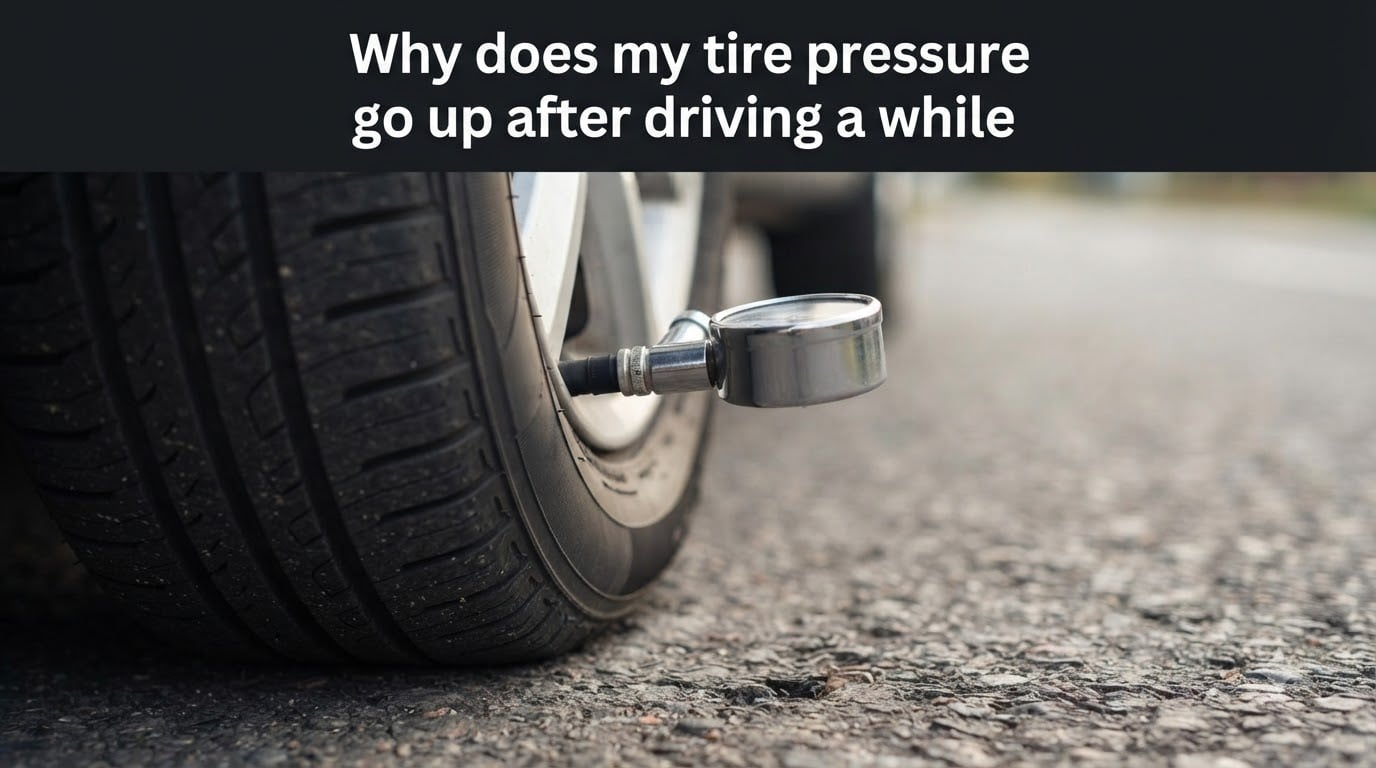
If you have ever checked your tires at a gas station after a long drive and watched the gauge climb 3, 4, or even 6 PSI above what you set that morning, you are not imagining things. Why does my tire pressure go up after driving a while? It is a normal physical effect: friction and sidewall flexing heat the air inside your tire, and air expands when it heats up. For most passenger vehicles, expect a 2 to 6 PSI increase above your cold setting within 15 to 30 minutes of driving.
I have been chasing this exact question on customer cars for years, and the short answer almost always reassures drivers more than it worries them. In this guide, I will walk you through the physics in plain language, the typical PSI range you should expect, and the small handful of warning signs that actually deserve attention.
Table of Contents
The Science: Why Driving Makes Tire Pressure Rise
Your tire pressure goes up after driving because heat builds up inside the tire, and the air inside has nowhere to go. Two main sources of heat work on every rolling tire.
The first source is tread friction. Every square inch of your tread is constantly grabbing and releasing the road surface, and that mechanical work converts into thermal energy. The second, often overlooked source is sidewall flexing. As the tire rolls, the sidewall bends and rebounds thousands of times per mile. That flexing also turns into heat, and a surprising amount of it ends up warming the air sealed inside.
Once that air warms up, physics takes over. The ideal gas law tells us that in a fixed, sealed volume, pressure rises in proportion to temperature. Tire engineers usually simplify this as Charles’s Law, or sometimes Gay-Lussac’s Law: as the air inside the tire gets hotter, its pressure climbs at a predictable rate. A useful shortcut is the 1 PSI per 10 degrees Fahrenheit rule. If the air inside your tire warms by 30 degrees during a highway drive, you can expect roughly 3 PSI of additional pressure on the gauge.
Reddit’s r/AskEngineers community has confirmed this mechanism many times. Engineers there point out that the tire is specifically engineered to handle this heat and pressure cycle, day after day, without damage.
How Much Tire Pressure Increases While Driving
For a typical passenger car, tire pressure usually rises 2 to 6 PSI over the cold baseline after 15 to 30 minutes of normal driving. That is the range I see most often in our shop, and it lines up with what drivers report on r/tires and similar forums.
Here is a quick reference for what is normal versus what is at the edge:
- Short trips (under 1 mile): pressure barely changes, often less than 1 PSI.
- Normal street driving (15 to 30 minutes): expect about 2 to 4 PSI of rise.
- Highway driving (30 to 60 minutes): expect about 4 to 6 PSI of rise.
- Performance, towing, or extreme heat: up to 8 to 10 PSI is still within engineering limits.
Let me give you a real-world example. If you set 32 PSI cold in the morning and then drive 45 minutes on the highway, the gauge might show 37 or 38 PSI when you arrive. That looks alarming at first glance, but it is exactly what the tire was designed to do. The number on the door-jamb placard is your cold target, and a hot reading 5 or 6 PSI above that is still perfectly safe.
Why Cold Tire Pressure Is the Only Accurate Reading
Cold tire pressure means the tire has been parked and untouched for at least 3 hours, or driven less than a mile at low speed. In that state, the air inside has reached thermal equilibrium with the surrounding environment, so the gauge reading reflects the actual amount of air in the tire rather than the heat currently trapped inside.
The 3-hour rule is not arbitrary. r/Cartalk veterans repeat it constantly because heat needs time to dissipate through the rubber, the wheel, and out into the air. A tire you parked 30 minutes ago is not cool. A tire you parked 3 hours ago is close enough.
This matters because the only number your vehicle manufacturer trusts is the cold number. That is the value printed on the door-jamb placard, the value listed in the owner’s manual, and the value your Tire Pressure Monitoring System (TPMS) is calibrated against. If you bleed air from a hot tire to make the gauge match the placard, you will end up dangerously underinflated once the tire cools.
Factors That Make Pressure Rise More Than Usual
Not every drive produces the same pressure rise. Here are the five biggest factors, ranked roughly by how much extra PSI they tend to add.
- Highway speed: rolling resistance and sidewall flexing increase with speed, so 70 mph driving heats tires more than 35 mph neighborhood driving.
- Heavy load or towing: more weight on the tire means more flexing per revolution, which means more heat.
- Hot ambient temperature: a 95 degree summer day starts you closer to the heat ceiling than a 60 degree morning, so the same drive produces a larger swing.
- Aggressive braking and acceleration: scrubbing speed at every light dumps extra heat into the tread and shoulder.
- Rough road surface: chip seal, gravel, and potholed pavement generate more friction than smooth asphalt.
If two of these factors stack up, do not be surprised to see an 8 PSI jump on the gauge. It is still within design limits, as long as your cold baseline was correct.
Finding Your Manufacturer’s Recommended PSI
The number you actually want to hit lives on the door-jamb placard, usually on the driver’s side door edge when you open it. That sticker lists the recommended cold pressure for the front tires, the rear tires, and sometimes the spare. It is set by the engineers who built your vehicle, and it accounts for the weight, suspension, and intended use of that specific model.
Many drivers confuse this with the number printed on the tire sidewall. The sidewall number is the maximum allowable pressure for that tire, not the recommended pressure for your vehicle. A tire rated for 44 PSI max can be safely used at 32 PSI if that is what your door-jamb placard says. Filling to the sidewall max on a car whose placard recommends 32 PSI will give you a harsh ride, worse traction in the rain, and accelerated center-tread wear.
When in doubt, the door-jamb wins. Always.
Warning Signs That the Pressure Rise Is Not Normal
A steady 3 to 6 PSI climb after driving is normal. A jump that is much larger, much faster, or uneven across tires is a different story. Here are the warning signs I tell my own family to watch for.
- More than 10 PSI rise after a normal drive: the tire may be underinflated to begin with, generating excess flex heat.
- One tire runs much hotter than the other three: could indicate a slow leak, a dragging brake, or a wheel bearing issue.
- Visible bulge or blister on the sidewall: get the tire inspected immediately, even if the pressure number looks reasonable.
- Pressure climbs while the car is parked: almost never heat related, often a failing TPMS sensor or a temperature-sensitive leak.
- TPMS light flickers on and off repeatedly: on Reddit’s r/GoRVing community, owners seeing 50 to 60 PSI swings usually trace it to a bad wheel sensor rather than the tire itself.
One last note on warning signs. If your cold pressure is set correctly and your post-drive numbers fall in the 2 to 6 PSI above range, you do not have a problem. You have a tire doing its job.
How to Check and Adjust Tire Pressure Correctly
Here is the routine I walk every new tire owner through. It takes five minutes and prevents 90 percent of the pressure-related headaches I see in the shop.
- Wait 3 hours after driving, or work first thing in the morning before the car has moved. The tires need to reach ambient temperature.
- Grab a quality gauge. Cheap pencil gauges can be off by 2 PSI or more. A digital gauge or a calibrated dial gauge is worth the small upgrade.
- Check the door-jamb placard on the driver’s side, not the number on the tire sidewall.
- Unscrew the valve cap and press the gauge firmly onto the stem. A brief hiss means you did not get a clean seal.
- Compare to the placard. Add air slowly if low, release air in short bursts if high. Recheck after each adjustment.
- Repeat monthly, and before any long road trip. Tires lose roughly 1 PSI per month even without a leak.
Important: never bleed air from a hot tire to match the cold number on the door-jamb placard. Let the tire cool first, then check again. Bleeding from a hot tire is the single most common cause of chronically underinflated tires I see at the shop.
Frequently Asked Questions
Is it normal for tire PSI to go up while driving?
Yes. Heat from road friction and sidewall flexing warms the air inside the tire, and that air expands in its fixed volume. A 2 to 6 PSI increase over your cold setting is completely normal after 15 to 30 minutes of driving.
How much does tire pressure increase while driving?
Most passenger vehicles see a 2 to 6 PSI rise after normal driving, and up to 8 to 10 PSI under heavy load, high speed, or hot ambient temperatures. Short trips under a mile usually produce less than 1 PSI of change.
Will tire pressure go back to normal when it cools down?
Yes. As the tire sits parked, heat dissipates through the rubber and wheel, and the pressure returns to the original cold reading within about 3 hours. If your cold pressure was 32 PSI, the tire will settle back to roughly 32 PSI once fully cooled.
Should I release air from hot tires?
No. Never bleed air from a hot tire to match the door-jamb placard number. You will end up dangerously underinflated once the tire cools. Let the tire rest for at least 3 hours and recheck cold.
Is 40 PSI too high to drive?
It depends on your door-jamb placard. Many sedans recommend 32 to 35 PSI cold, so a hot reading of 40 PSI after driving is normal. If your tire reads 40 PSI cold, you are overinflated and should release air to match the placard.
Why is my tire pressure going up even though it is cold outside?
Cold ambient temperatures do not stop heat from building inside the tire. The heat source is the tire’s own motion, not the weather. A cold morning drive can still produce a 2 to 4 PSI rise once you reach highway speeds.
How often should I check my tire pressure?
Check cold tire pressure at least once a month, before any long road trip, and whenever the seasons change. Tires lose about 1 PSI per month from natural permeation, and a TPMS warning light usually means pressure is already 25 percent below target.
The Bottom Line on Tire Pressure Going Up After Driving
If you walked away with one thing from this guide, let it be this: tire pressure rising after driving is normal, predictable, and engineered into every tire on the road. Set your pressure cold against the door-jamb placard, check it once a month, and let the gauge climb in peace.
The next time someone asks why does my tire pressure go up after driving, you can tell them it is just physics. Heat from friction and flexing warms the trapped air, and the air pushes back harder on the gauge. That is the whole story, and now you have the numbers, the rules, and the warning signs to handle it like a pro. For more tire maintenance tips, explore the rest of our guides for 2026.