
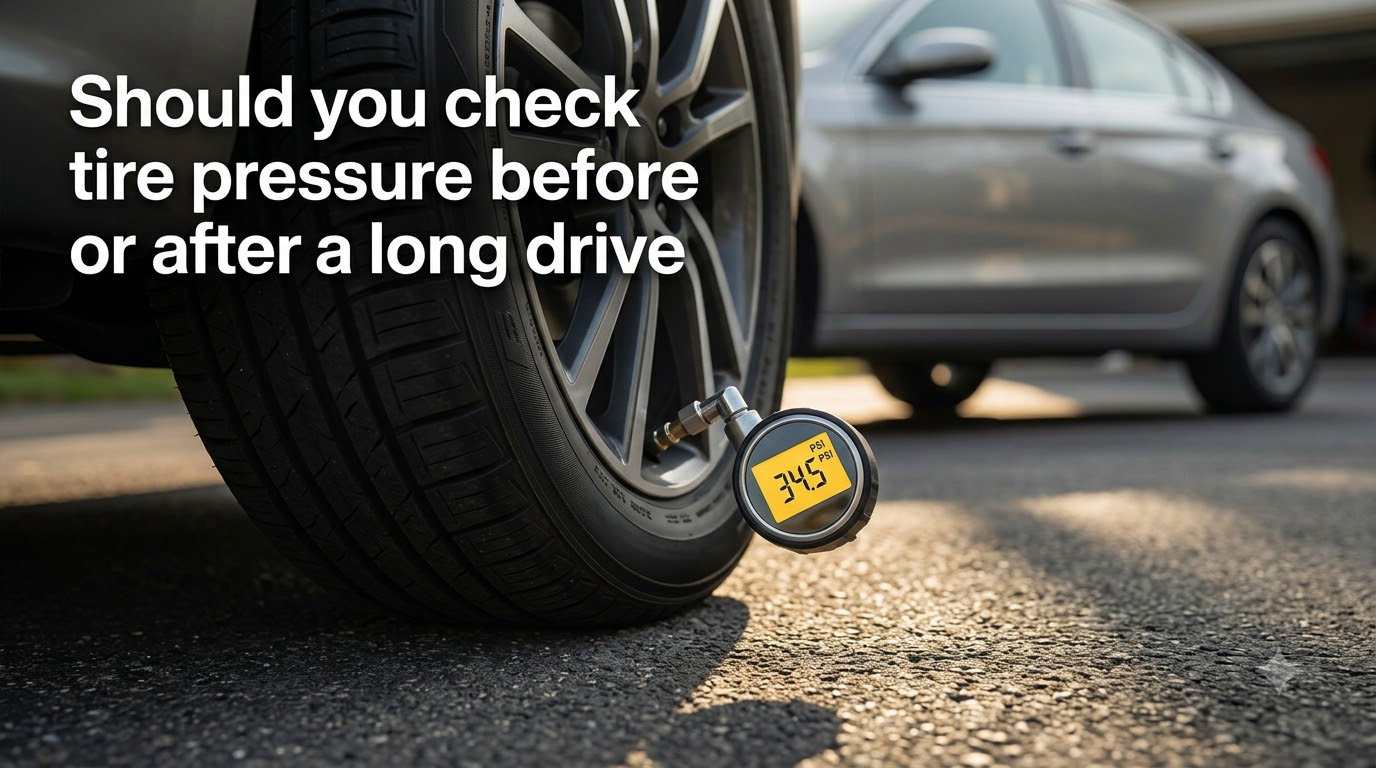
If you only have 30 seconds, here is the answer: check your tire pressure before a long drive, when the tires are cold. A hot tire gives a falsely high reading, and acting on that reading is how drivers end up dangerously underinflated the next morning.
I learned this the hard way on a Phoenix to Denver run a few years back. I pulled into a gas station after four hours on the interstate, saw 40 PSI on the gauge, and figured my door-jamb spec of 35 PSI meant I had overdone it. I let five PSI out, drove another hour, and woke up the next morning at a National Park with a soft front tire and a flashing dashboard light. The gauge was right at the time. The reading just did not mean what I thought it meant.
This guide walks through exactly when to check, why hot readings mislead, and what to do if the only chance you get to check pressure is mid-trip.
Table of Contents
Direct Answer: Check Tire Pressure Before a Long Drive
The short answer is yes, check tire pressure before a long drive and before the tires have warmed up from rolling. The cleanest reading comes from a car that has been parked for at least three hours, ideally checked first thing in the morning before you have moved.
If the tires are already hot from a previous drive, the reading will be 4-6 PSI higher than the cold baseline on a typical passenger car. Acting on that elevated number is the most common mistake I see, and it is the one that leads to a soft tire the next day.
What Does “Cold Tire Pressure” Actually Mean
Cold tire pressure is the reading you get when the air inside the tire is the same temperature as the surrounding air. Tire makers and the NHTSA both define “cold” as at least three hours after the vehicle was last driven, with no significant sun load on the tire.
The three-hour rule matters because the pressure reading on your gauge tracks air temperature, not just the amount of air in the tire. A tire that has been baking in summer sun for an hour is technically not cold even if the car has not moved, which is why garages are the best place to take baseline readings.
Here is the rule of thumb I use with my own cars:
- Parked 3+ hours in the shade = cold
- Parked overnight in any condition = cold by morning
- Drove less than a mile at low speed = effectively cold
- Just off the highway = hot, do not trust the reading
Why Driving Heats Your Tires and Raises Pressure
Driving heats your tires through two mechanisms working at the same time: rolling resistance at the contact patch, and the flexing of the sidewall as the tire rolls. Both convert mechanical energy into heat, and that heat transfers into the trapped air inside the tire.
The physics behind the PSI rise is the same idea as the ideal gas law you may remember from chemistry class. When you heat a fixed volume of air, the pressure goes up. A tire is a near-fixed volume, so warming the air inside pushes the gauge reading higher even though no air has been added or removed.
For most drivers this is invisible until they check a tire mid-trip and find a number that surprises them. For heavier vehicles, the effect is dramatic. An iRV2 forum member reported steer tires cold at 118 PSI climbing to 134 PSI hot on a warm summer day, which is a 16 PSI jump on commercial-grade rubber.
How Much PSI Rises After a Long Drive
On a normal passenger car, expect a 4-6 PSI rise after sustained highway driving. The exact number depends on speed, ambient temperature, load, and how aggressive the driving is, but the 4-6 PSI range is the rule of thumb used by tire technicians and confirmed across the forums I read.
If you want a more precise rule, the Car Talk community consensus is that hot tire pressure should be no more than 10 percent higher than cold pressure. So a 35 PSI cold spec translates to a hot maximum of about 38.5 PSI. Anything above that is a sign the tire is genuinely overinflated, not just warm.
For loaded or commercial vehicles, the rise is bigger:
- Passenger car, mixed driving: 4-6 PSI rise
- Passenger car, sustained 70+ mph highway: 6-8 PSI rise
- SUV or light truck with cargo: 6-10 PSI rise
- RV steer tires, summer highway: 10-16 PSI rise
One Grand Design RV owner reported a TPMS reading 12 PSI above the cold 80 PSI baseline after a long highway run. That kind of delta is normal for that vehicle, but it would look alarming on a passenger car.
How Long to Wait After Driving Before Checking Tire Pressure
Wait at least three hours after driving before taking a cold reading. That is the industry standard and the number the NHTSA, tire manufacturers, and AAA all align on.
If three hours is not realistic, here are the practical compromises in order of accuracy:
- Overnight: gold standard, always treat as cold
- 3+ hours parked in shade: cold by definition
- 1 hour parked in shade: close to cold, within 1-2 PSI
- Just pulled in from the highway: hot, do not trust the number
The Subaru Outback owner forums have a useful rule when you absolutely must fill while the tire is warm: target about 5 PSI above your cold door-jamb spec as a starting point, then recheck the next morning and top off or bleed as needed to land exactly on spec. It is not perfect, but it beats guessing blind.
Where to Find the Correct PSI for Your Vehicle
The correct PSI for your vehicle is on the Tire and Loading Information placard, which is on the driver-side door jamb. Open the driver door and look at the edge of the door frame or the side of the body right where the door latches. There is a sticker there that lists the recommended cold pressure for the front and rear tires.
If the sticker is missing or unreadable, the owner’s manual has the same spec, and most manufacturer websites list it by VIN. Some vehicles also print the spec inside the fuel door or on the glove box lid.
Two important things that placard does not tell you, and that most drivers get wrong:
- The number on the placard is a recommendation for normal driving, not a maximum
- The number on the tire sidewall is the maximum the tire can safely hold, not the recommendation for your car
In other words, the door jamb is what you set the tires to. The sidewall is what you never exceed, and there is usually room between them. A tire marked 44 PSI max on the sidewall and 35 PSI on the door jamb is correctly inflated at 35 PSI cold, not underinflated.
What to Do If You Must Check Tire Pressure After a Long Drive
If you must check tire pressure after a long drive, treat the reading as a hot snapshot and do not let air out to match the cold spec. The single most damaging mistake in this whole topic is releasing pressure from a hot tire to “fix” what looks like overinflation, then driving the next day on a tire that is genuinely 4-6 PSI underinflated.
Here is the workflow I use at highway rest stops when something feels off:
- Check the pressure and write down the reading.
- Compare it to your cold spec plus the expected 4-6 PSI rise.
- If the hot reading is below cold spec plus 4 PSI, the tire is genuinely low. Inflate carefully to the cold spec plus a small buffer.
- If the hot reading is above cold spec plus 6 PSI, the tire is fine. Do not bleed it. Recheck in the morning.
- Mark the tire and recheck cold the next morning before driving again.
The hard rule: never deflate a hot tire down to the cold recommendation. You are correcting for heat, not air volume, and you will be wrong.
Temperature, Altitude, and Seasonal Effects on Long Drives
Temperature changes tire pressure at roughly 1 PSI per 10 degrees Fahrenheit of air temperature swing. A 35 PSI cold tire in July at 80 degrees can drop to about 30 PSI in January at 30 degrees without any air actually escaping. This is why winter tire pressure warnings are so common even on tires that were fine in the fall.
Altitude has a smaller but real effect on long drives, especially through the Rockies or the Sierras. As you climb, the pressure inside the tire drops by roughly 1 PSI for every 1,500 to 2,000 feet of elevation gain. A Denver to Vail run can pull 2-3 PSI out of your tires just from the elevation change, before temperature does anything.
For a long trip that crosses both altitude and temperature zones, here is the practical sequence:
- Inflate cold at your starting altitude and temperature
- Expect a 2-4 PSI drop when you cross a major mountain pass
- Expect a 2-3 PSI drop for every 30 degree Fahrenheit temperature fall
- Recheck cold at your destination if you are staying more than a day
TPMS Limitations and What to Do When the Light Comes On
The Tire Pressure Monitoring System, or TPMS, is a low-pressure alert system, not a precision gauge. Federal rules require it to warn when pressure drops 25 percent below the placard spec, so a 35 PSI tire has to fall to about 26 PSI before the light comes on. By that point you are already well into the underinflation danger zone for heat buildup and tread wear.
If the TPMS light comes on during a long drive, do not ignore it and do not assume you can make it to the next exit at highway speed. Here is the sequence I follow:
- Reduce speed gradually and avoid aggressive braking.
- Find a safe place to pull over within the next few miles.
- Visually inspect all four tires and the spare if accessible.
- If a tire looks flat or significantly low, change it or call roadside assistance.
- If all tires look normal, drive slowly to the nearest service station with air.
- After inflating, drive above 25 mph for about 10 minutes to allow some TPMS sensors to reset.
- If the light stays on after a confirmed correct cold pressure, the vehicle may need a manual TPMS relearn procedure.
The TPMS relearn step is the most common frustration forum users report. Many vehicles require a specific sequence of ignition cycles, a scan tool, or a button-press sequence to re-pair the sensors after a pressure change or tire rotation. Your owner’s manual will have the exact procedure for your model, and it is worth doing once before a long trip so you know what to expect.
Tools for Checking Tire Pressure: Manual vs Digital vs Smartphone
For an accurate cold reading, the gauge matters less than the timing, but the tool does affect how easy it is to read the number correctly. Here is how the three common options compare:
- Stick (manual) gauges: Cheap, reliable, no batteries. Accuracy is usually plus or minus 1 PSI. Best for occasional checks and emergency use.
- Digital gauges: Easier to read, often backlit for night use. Accuracy can be plus or minus 0.5 PSI on mid-range models. Best for monthly cold checks.
- Smartphone TPMS apps with external sensors: Continuous monitoring, real-time alerts, four-tire display. Best for RVs, trailers, and drivers who want to see pressure change as they drive.
For most drivers a mid-range digital gauge is the sweet spot. For RV owners or anyone pulling a trailer on long drives, the smartphone TPMS option pays for itself the first time it alerts you to a slow leak before it becomes a blowout.
Whichever tool you pick, calibrate your expectation: an inexpensive stick gauge and a mid-range digital gauge will agree within a PSI on the same tire at the same temperature. The difference is readability, not accuracy.
Pre-Trip Tire Pressure Checklist for Long Drives
Before any long drive, run through this checklist the morning of departure when the tires are cold. Print it, save it on your phone, or tape it inside the glove box. This is the single highest-value habit you can build around tire pressure, and it takes about 10 minutes.
- Park on level ground in the shade and confirm tires have been parked 3+ hours.
- Check the cold pressure on all four tires and the spare, comparing each to the door-jamb placard.
- Inflate or bleed as needed to land within 1 PSI of the placard spec on each tire.
- Visually inspect each tire for cracks, bulges, embedded objects, and uneven tread wear.
- Confirm the TPMS light is off after the pressure adjustment and a short drive above 25 mph.
- Verify the jack, lug wrench, and tire sealant or spare are accessible and in working order.
- Recheck cold pressure at any overnight stop on trips longer than three days.
One last piece of advice from the long-haul forums: if you are loading the vehicle for a trip, add pressure to the rear tires per the loaded spec on the door jamb before you load the cargo, not after. Inflating a heavily loaded tire requires cranking the compressor against the weight on the contact patch, and it is harder to get an accurate reading.
Frequently Asked Questions
What should my tire pressure be when tires are hot?
Expect a hot tire to read 4-6 PSI higher than the cold door-jamb spec on a passenger car, and 6-10 PSI higher on an SUV or light truck. As a rule, hot pressure should not exceed 10 percent over cold pressure. A 35 PSI cold tire should never read more than about 38.5 PSI when hot.
What is the 4 PSI rule on tires?
The 4 PSI rule says that a tire will typically gain around 4 PSI of pressure after a normal drive due to heat from friction and flexing. It is a quick mental shortcut for estimating whether a hot reading is just warm air or actually overinflated. Anything above cold plus 4 PSI on a short drive is heat, not extra air.
What is the 5 PSI rule?
The 5 PSI rule is the same idea as the 4 PSI rule, just for longer or more aggressive drives. After sustained highway driving, you can expect up to 5 PSI of heat-related rise on a passenger car. If you must fill a warm tire, target cold spec plus 5 PSI as a starting point and recheck in the morning.
Will my tire pressure go back up when it warms up?
Yes, tire pressure rises with temperature and falls with temperature, at roughly 1 PSI per 10 degrees Fahrenheit. A tire that read 30 PSI on a cold 30 degree morning will climb back to 35 PSI on a 80 degree afternoon without any air being added. This is normal physics, not a leak in reverse.
How long after driving to check tire pressure?
Wait at least three hours after driving for a true cold reading. Overnight is the gold standard. If you cannot wait, treat the reading as hot, add 4-6 PSI to your cold spec as the expected baseline, and never bleed a hot tire down to the cold recommendation.
Can I check tire pressure after driving?
You can, but the reading will be artificially high by 4-6 PSI on a passenger car and more on heavier vehicles. Use the reading only as a hot snapshot to confirm the tire is not dangerously low, then recheck when the tires are cold before trusting the number for inflation decisions.
Can I use the pressure on the tire sidewall?
The sidewall number is the maximum safe pressure the tire can hold, not the recommended pressure for your vehicle. Always use the driver-side door jamb placard spec as your target, and treat the sidewall number as a ceiling you should never exceed.
Final Verdict: Before the Drive, Every Time
So, should you check tire pressure before or after a long drive? Before, every time, when the tires are cold. A hot reading is a snapshot of a moment, not a calibration, and acting on it is how well-meaning drivers end up with underinflated tires the next morning.
If you take one habit from this guide, make it this: the morning of any long drive, walk around the car with a gauge, check all four tires plus the spare against the door-jamb spec, and adjust cold. Ten minutes of work is the difference between a confident road trip and a roadside lesson in tire physics.