
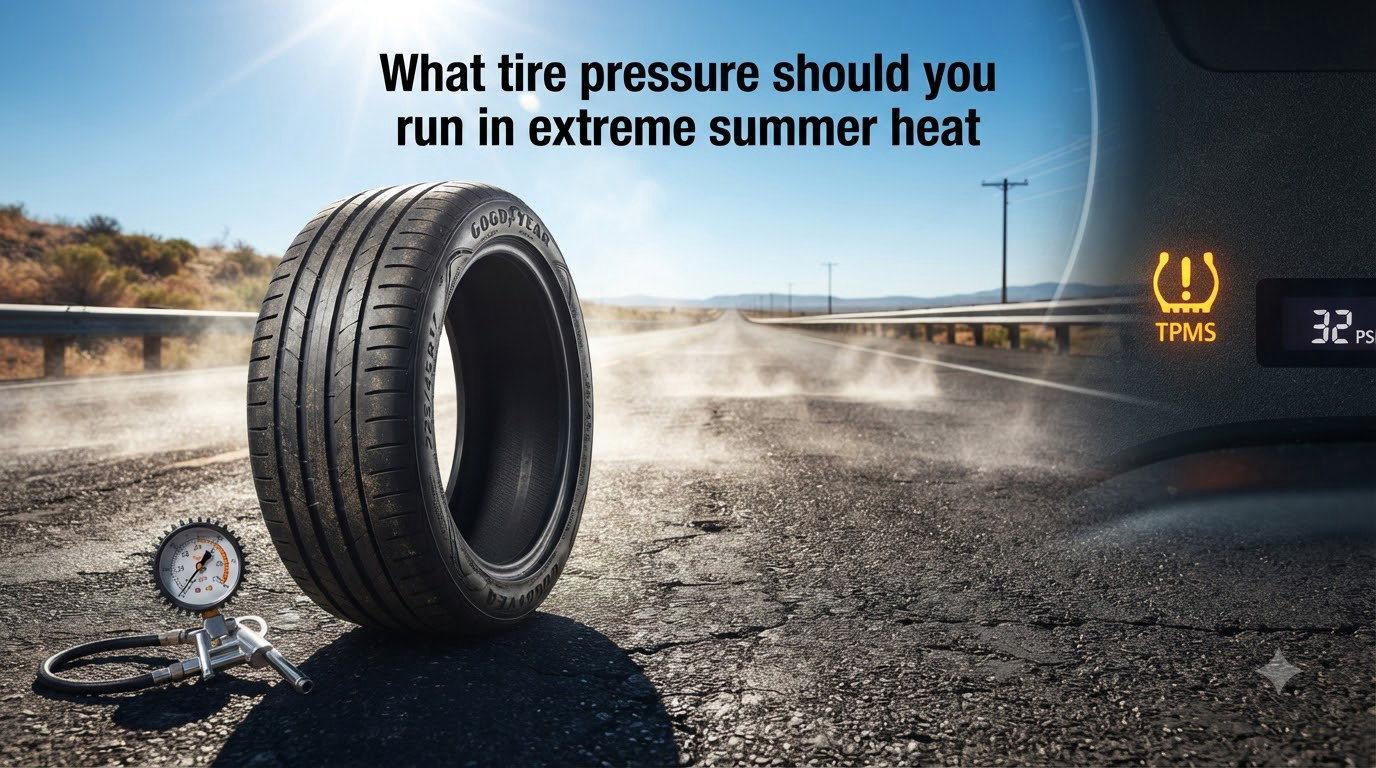
If your tires read 40 PSI on a 100 degree afternoon and you are wondering whether to grab an air compressor, take a breath. Your correct summer tire pressure is exactly what it was in March, on the door jamb sticker. Summer heat simply adds about 1 PSI for every 10 degrees Fahrenheit to your cold reading, and a hot reading of 4 to 8 PSI above your door-jamb number is normal, expected, and safe to drive on.
I have helped drivers dial in summer tire pressure across everything from commuter sedans to heavy pickup trucks, and the same confusion shows up every July: drivers either panic when their tires climb to 40 PSI hot or they let a tire shop deflate them below the manufacturer number on a hot day. Both mistakes shorten tire life. In this guide I will walk you through the 1 PSI per 10 degrees rule, where to actually find your target PSI, when to ignore a TPMS light, and how to set up a quick cold-morning routine so you stop guessing.
Table of Contents
The Short Answer: Summer Tire Pressure Is Set Cold, Not Hot
The tire pressure you should run in extreme summer heat is the exact PSI printed on your driver-side door jamb sticker, measured cold. That number does not change with the seasons. Expect that cold reading to climb 4 to 8 PSI on a hot day, and do not let anyone deflate your tires back down to the door-jamb number while they are warm.
Three rules drive everything in this article:
- Target PSI is the door-jamb number, taken cold. Not the tire sidewall, not a shop recommendation, not the number on a 95 degree afternoon.
- Heat adds about 1 PSI per 10 degrees Fahrenheit to your cold reading. A 35 PSI cold tire in 80 degree weather will read about 37 to 38 PSI after driving.
- A hot reading up to 8 PSI above your target is normal while driving. Drive on it, then recheck the next morning when the tires are cold.
Why Summer Heat Drives Your Tire Pressure Up
Air is a gas, and gases expand when they heat up. The science behind tire pressure in summer is the ideal gas law (PV=nRT), where pressure rises in direct proportion to temperature. Every 10 degree jump in ambient air pushes your PSI up by about 1. Add direct sunlight on blacktop, and the air inside the tire soaks up even more heat from the road surface.
That is the part most drivers miss. A sun-baked asphalt surface in Phoenix, Austin, or Dallas regularly hits 140 to 150 degrees Fahrenheit, which is 30 to 50 degrees hotter than the air your weather app reports. Your tires are sitting in that oven, absorbing radiant heat through the sidewalls, even when the car is parked.
Heat is also generated internally. Flexing rubber under load builds friction, and friction turns into heat. Stop and go city traffic in 95 degree weather will heat your tires faster than a steady highway cruise in 80 degrees. By the time you read 40 PSI on a summer afternoon, your tires have absorbed heat from the air, the road, and your own driving.
The 1 PSI per 10 Degrees Rule, Explained With Real Numbers
The 1 PSI per 10 degree rule is the industry shorthand for how much your cold tire pressure changes as temperatures swing. If your door-jamb target is 35 PSI and the morning temperature is 50 degrees, a 100 degree afternoon will push that same tire to about 40 PSI hot. Nothing is wrong. Nothing needs to be fixed.
Here is the worked example I walk new drivers through:
- Cold reading at 7 a.m., 55 degrees outside: 35 PSI (matches door jamb, perfect).
- Outside climbs to 90 degrees by 2 p.m.: expect about 3.5 PSI of additional pressure from the air alone.
- Asphalt and driving friction add another 1 to 3 PSI, depending on speed and load.
- Hot afternoon reading: roughly 39 to 41 PSI. Drive on it.
Now flip the script. The same 35 PSI cold tire in winter at 20 degrees will read about 31 PSI once the car has been parked outside overnight. That is why your TPMS light flickers on the first truly cold morning of November but stays quiet through July. The pressure change is symmetric; the seasons just point in opposite directions.
Where to Find Your Correct Tire Pressure (Not the Sidewall)
Your correct tire pressure lives on a yellow and white sticker on the driver-side door jamb, inside the fuel door, or in your owner’s manual. That sticker lists the PSI the vehicle manufacturer engineered for your specific car, with its specific weight, suspension, and tire size. Ignore the tire shop when they say 32 PSI is “standard.” Ignore the number molded into your tire sidewall.
The sidewall number is the maximum safe pressure for that tire, not the recommended pressure. Pushing 51 PSI into a tire rated for 51 maximum would put you at the very edge of safety when cold, and well over it when hot. Common door-jamb targets run 30 to 36 PSI for most passenger cars, 35 to 42 PSI for SUVs and light trucks, and 50 to 80 PSI for RVs and trailers. Always trust the placard for your specific vehicle.
If your sticker has been painted over or falls off, your owner’s manual has the same number. Do not guess. Tires that are 3 PSI low lose about 1 percent of fuel economy, wear the shoulders faster, and run hotter under load. Tires that are 3 PSI high wear down the center tread and lose wet grip.
Should You Lower Tire Pressure Proactively for Summer?
No. This is the single most common summer tire mistake I see, and it costs drivers thousands in premature wear. Lowering your cold tire pressure below the door-jamb number in summer does not help you. It hurts you.
Here is what actually happens when you preemptively deflate:
- A cold 32 PSI tire (4 PSI under target) heats up the same amount as a 35 PSI tire.
- Under-inflated tires flex more with every rotation, building more internal heat.
- More internal heat means higher running temperatures and faster tread wear.
- Under-inflation also increases the risk of a heat blowout, especially on the highway.
I have seen Reddit threads where drivers vent 5 PSI in summer because the tires “look bulgy.” The bulge was the normal hot-tire shape at 40 PSI, not over-inflation. If you want to release air, do it cold, in the morning, and only down to the door-jamb number. If your tires look right at 35 PSI cold, leave them there. The heat will lift them to 38 to 40 PSI on their own.
Dangers of Overinflation and Underinflation in Heat
Both extremes are dangerous, but they fail in different ways. Overinflated tires in summer have a smaller contact patch with the road, so braking distances get longer and the center tread wears down to the cords long before the edges. Underinflated tires in summer build destructive heat because the sidewalls flex too much on every rotation.
Blowout thresholds depend on tire condition more than absolute PSI. A healthy tire tolerates +10 PSI above the door-jamb number while driving hot. An old, dry-rotted tire can fail at the door-jamb number on a 100 degree highway. Replace any tire older than 6 years, regardless of tread depth, before summer road trip season.
Visual clues to watch for:
- Overinflation: center tread wears faster than the edges, ride feels harsh and bouncy, tire looks “ballooned” with no visible sidewall flex.
- Underinflation: shoulders wear faster than the center, sidewalls look bulged outward, steering feels vague or floaty.
- Uneven wear side to side: usually an alignment issue, not a pressure issue. Get an alignment if you see cupping or feathering.
How and When to Check Tire Pressure in Summer
Check your tire pressure cold, once a month, plus before any road trip. Cold means the car has been parked for at least three hours and driven less than a mile at low speed. The morning is best, before the sun hits the side of the car or the pavement warms up.
Step by step:
- Park on level ground in the shade if possible. Tires in direct sun read 1 to 2 PSI higher than shaded tires.
- Remove the valve cap and press a digital or dial gauge straight onto the stem. Pencil gauges are cheaper but easier to misread.
- Read the PSI. A short hiss of air is normal and does not mean you lost pressure.
- Add air in short bursts if needed. Recheck after each burst so you do not over-inflate.
- Release air by pressing the small pin inside the valve stem with the back of the gauge or a dedicated tool. Recheck often.
- Replace the valve cap. It keeps dirt and moisture out of the stem.
- Repeat for all four tires and the spare. Yes, the spare.
Do not trust the readings at the gas station air machine if the tires are warm. Those machines are notorious for being off by 2 PSI. Use a personal gauge you trust, calibrated annually, and check at home. Summer is also when I recommend bumping inspection frequency to twice a month if you commute on hot highways or drive a heavy load.
TPMS in Summer: Why the Light Is Normal, and Why It Misses Overinflation
Your Tire Pressure Monitoring System (TPMS) only flags underinflation, not overinflation. It is a low-pressure warning system, period. That means a 45 PSI hot reading will never trigger a TPMS light, even if you are dangerously overinflated for the conditions.
TPMS sensors also drift in summer. Hot air inside the tire changes the sensor’s calibration slightly, and many drivers see the warning light flicker on during a heat wave even though the cold reading the next morning is fine. This is normal thermal behavior, not a slow leak. Reddit threads in r/Cartalk and r/Austin fill up every July with the same question: “TPMS light in 95 degree heat, is it a leak?” Most of the time, no. Check cold the next morning before you head to a shop.
Cold-to-Hot PSI Conversion Chart for Summer Driving
This is the chart I wish more articles published. Start with your door-jamb cold target in the left column, then read across to find your expected hot reading at common summer ambient temperatures. Asphalt and driving friction can add another 1 to 3 PSI beyond the air temperature alone.
| Cold Target PSI | 70 degree day | 80 degree day | 90 degree day | 100 degree day | 110 degree day |
|---|---|---|---|---|---|
| 30 PSI | 30 | 31 | 32 | 33 | 34 |
| 32 PSI | 32 | 33 | 34 | 35 | 36 |
| 35 PSI | 35 | 36 | 37 | 38 | 39 |
| 38 PSI | 38 | 39 | 40 | 41 | 42 |
| 40 PSI | 40 | 41 | 42 | 43 | 44 |
| 42 PSI | 42 | 43 | 44 | 45 | 46 |
| 50 PSI (light truck) | 50 | 51 | 52 | 53 | 54 |
A reading up to 5 PSI above your cold target while driving hot is normal. A reading 8 PSI or more above cold target can mean ambient temperatures are extreme, you are hauling a heavy load, or you have been driving at highway speeds for a long time. Cool down, recheck cold the next morning, and adjust only if the cold reading is now off.
Summer Road Trip Tire Pressure Checklist
Heat waves and long highway miles are the worst combination for tires. A quick pre-trip check takes 15 minutes and is the cheapest insurance you can buy before a 1,000 mile drive. Print this, stick it in your glove box, and run through it the morning you leave.
- Cold pressure check: confirm all four tires plus the spare match the door-jamb PSI, taken in the morning before driving.
- Tread depth: insert a quarter upside down into the tread. If you see the top of George Washington’s head, the tires are below 4/32 inch and need replacement before a highway trip.
- Sidewall inspection: look for cracks, bulges, or blisters. Heat expands small flaws fast. Any bulge means replace the tire now, not later.
- Tire age: check the DOT date code on the sidewall. Tires older than 6 years, even with good tread, are heat-vulnerable and should not lead a road trip.
- Spare tire: confirm the spare is inflated. A 60 PSI spare that has been sitting for two years often reads 30 PSI.
- Valve stems: cracked or leaking valve stems are a top cause of slow summer pressure loss.
- Cargo load: if you are hauling heavy gear, add PSI per your vehicle’s load placard. Pressure needs rise with weight.
Overinflation vs Underinflation: How to Tell at a Glance
If you do not have a gauge handy, the tires themselves will tell you a lot. Use this quick comparison next time you walk up to your car.
| Sign | Overinflation | Underinflation |
|---|---|---|
| Wear pattern | Center tread wears down first | Shoulder edges wear down first |
| Ride feel | Harsh, bouncy over bumps | Soft, floaty, vague steering |
| Sidewall look | Stretched, ballooned, no flex | Bulged outward at the bottom |
| Braking feel | Longer stopping distances on wet roads | Longer stopping distances on dry roads |
| Fuel economy | Slightly better, but unevenly | Worse, plus overheating risk |
| Heat risk | Blowout on impact, not from heat | Blowout from heat buildup under load |
If your tires match the overinflation column but your gauge says they are at the door-jamb number, the issue is probably ride quality, not pressure. Consider dropping 1 to 2 PSI cold for a smoother ride on rough roads. If they match the underinflation column, add air cold, check for a leak, and recheck weekly until you are confident the rate of loss has stopped.
Frequently Asked Questions
What is the best tire pressure for hot summer driving?
Your best tire pressure for hot summer driving is the exact PSI listed on your driver-side door jamb sticker, measured cold. Heat will naturally push that reading up about 1 PSI for every 10 degree Fahrenheit rise in temperature, so a 35 PSI cold tire can read 39 to 41 PSI on a 95 degree afternoon. That hot reading is normal, not overinflation, and you should not release air to bring it back down.
Is 40 PSI too high for tire pressure?
Not necessarily. If your door-jamb target is 35 PSI and you see 40 PSI on a hot day, that is normal heat expansion. It only becomes too high if your cold reading the next morning is still 40 PSI or higher, in which case you should release air down to the door-jamb number.
What is the 4 PSI rule on tires?
The 4 PSI rule means that a tire running more than 4 PSI below its door-jamb target is considered dangerously underinflated. In summer heat, expect a 4 to 8 PSI increase over your cold reading while driving. Always judge pressure from a cold baseline, not a hot afternoon reading.
What is the 5 PSI rule?
A 5 PSI rule is sometimes used to describe the maximum safe increase over a cold tire pressure during normal summer driving. Anything within 5 PSI above your cold door-jamb number is generally safe. Beyond that, especially combined with heavy loads or old tires, the risk of heat failure goes up quickly.
Should I lower tire pressure in summer?
No. Lowering your cold tire pressure below the door-jamb number in summer does not help and actually increases heat buildup and blowout risk. Set tires to the manufacturer PSI cold, and let the heat raise them naturally. A hot reading 4 to 8 PSI above your target is normal while driving.
Do overinflated tires cause blowouts?
Overinflated tires rarely cause blowouts from heat alone, but they do wear out the center tread faster, lose wet grip, and fail more easily on impact with potholes or curbs. The bigger summer blowout risk is underinflation, which builds internal heat as the sidewalls flex too much.
What tire pressure will cause a blowout?
There is no single PSI number that causes a blowout. A healthy tire can briefly tolerate 10 PSI above the door-jamb target on a hot highway. An old, dry-rotted tire can fail at the door-jamb number in extreme heat. Condition, age, load, and speed all matter more than any fixed PSI threshold.
Is 37 PSI too high for tires?
If your door-jamb target is 35 PSI, a 37 PSI reading is fine on a warm day. If your door-jamb target is 32 PSI, then 37 PSI is too high and you should release air cold down to 32 PSI. Always match the reading to the placard for your specific vehicle, not a universal number.
How often should you inspect your tire pressure in very hot weather?
In very hot weather above 90 degrees, check tire pressure at least once a month cold, plus before any road trip or heavy load. Drivers in the Sun Belt or anyone commuting on hot highways should check twice a month. Always check cold, in the morning, before the tires have absorbed heat from driving or sun.
What causes low tire pressure in summer?
Low tire pressure in summer is almost always a slow leak, a damaged valve stem, or a recent cold snap, not the heat itself. Heat raises pressure, so a low reading in 95 degree weather means air is escaping faster than heat is adding it. Common culprits include nails in the tread, corroded rims, and tire bead leaks.
Does tire pressure decrease in hot weather?
No. Hot weather increases tire pressure by about 1 PSI per 10 degree Fahrenheit. If your tires read lower in summer, you have a slow leak. If they read higher, that is normal heat expansion and you should not release air unless the cold reading the next morning is also too high.
What is the correct tire pressure in extreme heat?
The correct tire pressure in extreme heat is the door-jamb PSI measured cold. In extreme heat above 100 degrees, expect a hot driving reading 6 to 10 PSI above your cold target, which is safe. Recheck cold the next morning, especially after a heat wave ends, since pressure typically drops back as temperatures normalize.
The Bottom Line on Tire Pressure in Extreme Heat
Tire pressure in extreme summer heat comes down to three habits: set your tires cold to the door-jamb number, leave them alone as the temperature climbs, and recheck cold the next morning if anything looks off. A hot reading 4 to 8 PSI above your target is normal physics, not a problem to fix. Stop deflating on hot days, ignore the sidewall number, and trust the manufacturer placard for your specific vehicle.
If you take one thing from this guide, take the cold-morning routine. Park in the shade, check all four tires plus the spare with a calibrated gauge, and write the door-jamb PSI on a piece of tape inside the glove box. That 10 minute habit, repeated once a month and before every road trip, is the cheapest insurance you can buy against summer tire problems.