
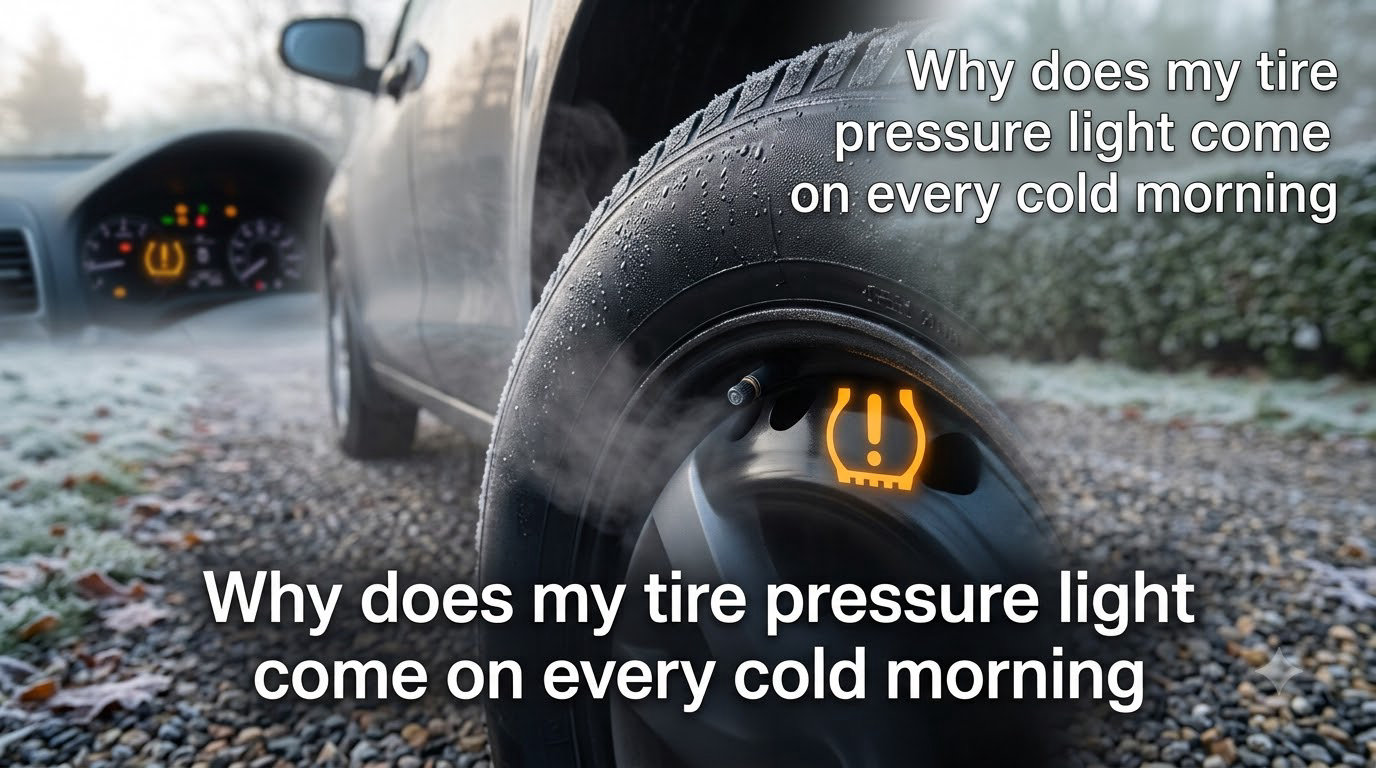
If your tire pressure light comes on every cold morning, here’s the short answer: cold temperatures cause the air inside your tires to contract, dropping pressure by about 1 PSI for every 10°F drop in temperature. Overnight cooling pushes your tires below the TPMS warning threshold, which is why the light greets you every morning. This is completely normal and happens to millions of drivers each fall and winter.
I’ve dealt with this exact frustration for years as someone who lives in a cold climate and maintains multiple vehicles. In this guide, I’ll explain why it happens, when to worry, and exactly what to do about it.
Table of Contents
Why Cold Weather Causes Tire Pressure to Drop
It comes down to basic physics. Air molecules slow down and take up less space when temperatures drop. This contraction reduces the pressure inside your sealed tires.
The rule of thumb is straightforward: tire pressure drops roughly 1 PSI for every 10°F decrease in temperature. So if you set your tires to 35 PSI on a 70°F fall afternoon and the temperature overnight drops to 30°F, your tires can lose 4 PSI — putting you at 31 PSI. That’s often enough to trigger the warning light.
This happens even when your tires are in perfect condition with no leaks. The air simply contracts as it cools. As one user on r/chicago put it: “The manual indicates one possible cause as very low temperature in tyres which cause cold air inside to exert low pressure. Yeah this is normal.”
The effect is more dramatic when temperatures swing sharply. A sudden cold front that drops 20-30 degrees overnight will trigger more lights than a gradual seasonal cooling. That first really cold morning of the season catches the most drivers off guard.
Why the Tire Pressure Light Comes On Every Morning
The “every morning” pattern is one of the most common complaints I hear, and it has a logical explanation.
Overnight, your car sits parked for 8-12 hours. Tires cool to the ambient air temperature — which is at its coldest in the early morning hours. This is when pressure hits its lowest point and the TPMS light turns on.
Once you start driving, friction between the tires and road generates heat. That heat warms the air inside the tires, pressure rises, and the light turns off. As one Reddit user in r/HondaElement described: “My tire pressure light always comes on when it’s cold, even when my tires are fine. It’s on when I drive in the morning but turns off by the time it warms up a bit.”
This creates the frustrating cycle: light on every morning, off by afternoon, back again the next day. The important thing to know is that this cycle typically means your tires are borderline — close to the TPMS threshold but not critically low. Adding a few PSI of air usually solves it.
TPMS Light Types: What the Dashboard Warning Means
Not all tire pressure lights mean the same thing. Your dashboard has two distinct warning indicators, and knowing the difference matters.
Solid TPMS light (stays on steadily): This means at least one tire has dropped below the recommended pressure — usually 25% below the manufacturer’s specification. This is what you see on cold mornings. It’s a pressure problem, not a system problem.
Flashing TPMS light (blinks for 60-90 seconds then stays on): This indicates a fault in the TPMS system itself — typically a dead sensor battery or a communication problem between the sensor and your car’s computer. As one r/4thGen4Runner user noted: “If it’s blinking then sensors are bad. If it’s solid and the PSI is good on ALL 5 TIRES then just ignore it.”
The dashboard icon looks like a horseshoe or U-shape with an exclamation point in the center. Some vehicles display text that says “LOW TIRE PRESSURE” alongside the icon.
Common Cold-Weather TPMS Scenarios
I’ve broken down the four most common situations drivers face with their tire pressure light in cold weather. Here’s what each one means and what to do.
Scenario 1: Light comes on in the morning, turns off after driving. This is the classic cold-weather pattern. Your tires are slightly below the TPMS threshold when cold but recover as driving warms them. Action: Check your pressure on a cold morning and add 2-3 PSI to each tire. This usually stops the cycle.
Scenario 2: Light stays on all day, even after driving. This means your tires are significantly underinflated — cold weather alone probably isn’t the full story. You may have a slow leak, a puncture, or tires that haven’t been inflated in months. Action: Check all four tires immediately and inflate to the door jamb recommendation.
Scenario 3: Light comes on for one tire only. When only one tire triggers the light, suspect a nail, screw, or valve stem issue in that specific tire. Cold weather may have just pushed an already-low tire past the threshold. Action: Inspect that tire visually, check its pressure, and have it examined at a tire shop if the pressure keeps dropping.
Scenario 4: Light flashes then stays on. A flashing light means the TPMS system has a fault — not necessarily a pressure problem. The sensor battery may be dead (they last 7-10 years), or there’s a communication error. Action: Have the TPMS sensors checked. This usually requires a tire shop visit.
How to Tell If It’s Just Cold Weather or a Real Problem
This is the question that trips people up the most. Here’s how to tell the difference.
It’s probably just cold weather if: the light comes on only when temperatures drop significantly overnight, it turns off after 10-20 minutes of driving, all tires look normal when visually inspected, and the pressure in each tire is within 3-5 PSI of the recommended amount.
It might be a real problem if: the light stays on after the tires warm up, one tire consistently reads lower than the others, you can see a nail or object embedded in the tread, the tire looks visibly flat or bulging, or you’ve had to add air to the same tire repeatedly over several weeks.
A practical test: check your tire pressure when the tires are cold (before driving in the morning). Then check again after driving for 20 minutes. If all four tires recover to within a few PSI of the recommended pressure, cold weather is likely the culprit. If one tire stays low, that tire has a problem.
Don’t forget to check your spare tire. Most people overlook it, and if your car has a full-size spare with a TPMS sensor, a low spare can also trigger warnings on some vehicles.
What to Do When Your Tire Pressure Light Comes On
Follow these steps the next time that light appears on a cold morning.
Step 1: Don’t panic. A solid TPMS light on a cold morning is almost always a temperature-related pressure drop, not an emergency. You can safely drive to a gas station or home to check the pressure.
Step 2: Find your recommended PSI. Look at the sticker on the driver’s side door jamb (open the door and look at the frame). This is the manufacturer’s recommended cold tire inflation pressure — NOT the number on the tire sidewall, which is the maximum pressure the tire can handle.
Step 3: Check the pressure with a gauge. Use a reliable tire pressure gauge on each tire when they’re cold. Press the gauge firmly onto the valve stem and read the measurement. Note: the TPMS light typically triggers at 25% below the recommended PSI, so by the time the light comes on, your tires are meaningfully underinflated.
Step 4: Add air as needed. Inflate each tire to the door jamb recommendation. If you’re heading into a cold spell, add 2-3 PSI extra as a buffer. As a mechanic on r/MechanicAdvice advised: “Often you have to add a bit more air after setting the pressure to keep the light from turning on when pressure drops due to temperature.”
Step 5: Reset the TPMS light if needed. On most modern vehicles, the light resets automatically after driving for a few minutes at proper pressure. Some older vehicles require a manual reset through a button (often under the steering wheel) or through the dashboard menu. Check your owner’s manual for specifics.
Safety Risks of Driving on Underinflated Tires
While the cold-morning TPMS light is usually benign, driving on genuinely underinflated tires is a real safety concern.
Reduced traction and handling. Underinflated tires flex more than they should, which reduces their grip on the road. In winter conditions where traction is already compromised by ice and snow, this is especially dangerous.
Longer stopping distances. Tests show that tires at 25% below recommended pressure can increase braking distances by 10-20% on wet roads. In an emergency stop, those extra feet matter.
Increased blowout risk. Low tires generate more heat from excessive flexing. Over time — especially at highway speeds — this heat can cause a tire to fail catastrophically. The risk is higher in cold weather because rubber becomes stiffer and more brittle.
Accelerated tread wear. Underinflation causes the outer edges of the tire to wear faster than the center. This uneven wear shortens tire life significantly and can cost you hundreds of dollars in premature replacement.
Reduced fuel efficiency. Underinflated tires create more rolling resistance, which forces your engine to work harder. The U.S. Department of Energy estimates that every 1 PSI drop in all four tires reduces fuel economy by about 0.2%.
Cold Weather Tire Pressure Reference Guide
Use this reference to estimate how much your tire pressure will drop as temperatures fall. The exact PSI loss depends on your tire volume, but the 1 PSI per 10°F rule applies to most passenger vehicles.
If your tires are set to 35 PSI (a common recommendation), here’s what to expect:
At 60°F, your tires will read approximately 34 PSI — a 1 PSI drop. At 50°F, expect about 33 PSI. At 40°F, you’ll see around 32 PSI. At 30°F, approximately 31 PSI. At 20°F, roughly 30 PSI. At 10°F, about 29 PSI. At 0°F, approximately 28 PSI. And at -10°F, expect around 27 PSI.
Most TPMS systems trigger the warning light at about 25% below the recommended PSI. For a 35 PSI recommendation, that’s around 26 PSI. This means a car set to 35 PSI on a warm day could trigger the light when temperatures drop 60-70 degrees below the inflation temperature.
Pro tip: If you know a cold snap is coming, proactively add 3-5 PSI to your tires before temperatures drop. This prevents the morning light cycle entirely and keeps your tires at safe pressures throughout the cold spell.
Frequently Asked Questions
Is it normal for low tire pressure in the morning during cold weather?
Yes, it is completely normal. Cold temperatures cause air molecules inside tires to contract, reducing pressure by about 1 PSI for every 10°F drop in temperature. Overnight cooling is when temperatures hit their lowest, which is why the light often appears in the morning. This is not a sign of a tire problem — it’s basic physics affecting every vehicle.
Should you put air in your tires when it’s cold?
Yes, you should add air to your tires in cold weather if the TPMS light comes on or if a pressure check shows you’re below the manufacturer’s recommended PSI. In fact, adding 2-3 PSI above the recommended amount heading into winter gives you a buffer against temperature drops and prevents the morning light cycle.
How long can I drive with the TPMS light on?
If the light is solid and came on during a cold morning, you can drive to the nearest gas station or tire shop to check and inflate your tires. However, you should not drive for days or weeks with the light on. Underinflated tires reduce traction, increase stopping distances, raise blowout risk, and waste fuel. Check your tires within the same day.
Will tire pressure go back to normal after cold weather?
As temperatures warm up during the day or as the seasons change, the air inside your tires expands and pressure naturally rises. If you added extra air during winter, you may need to release some pressure in spring to avoid overinflation. The TPMS light will typically turn off on its own once pressures rise above the warning threshold.
Do I need to put air in my tires when it’s cold?
If your TPMS light comes on or a gauge reading shows your tires are more than 3 PSI below the recommended amount, yes — add air. Don’t wait for warmer weather to fix it. Driving on underinflated tires is a safety risk in any season, and it’s particularly dangerous in winter when road conditions are already challenging.
Is 26 PSI too low in winter?
For most passenger cars and SUVs, 26 PSI is below the typical recommended range of 30-35 PSI. At 26 PSI, your tires are meaningfully underinflated, which affects handling, braking, fuel efficiency, and tire wear. If your gauge reads 26 PSI on a cold morning, add air to bring the tires up to the door jamb recommendation.
How to permanently turn off the TPMS light?
You cannot and should not permanently disable the TPMS light. It is a federally mandated safety system required on all vehicles sold in the U.S. since 2007. To keep the light off, maintain proper tire pressure by checking monthly and adjusting for seasonal temperature changes. If the light stays on despite correct pressure, have the TPMS sensors inspected — the sensor batteries may need replacing.
Can cold weather affect tire pressure sensors?
Cold weather does not typically damage TPMS sensors themselves, but extreme cold can reduce the sensor battery’s voltage output, which may cause intermittent communication issues. TPMS sensor batteries last 7-10 years on average. If your sensor is older and you notice erratic behavior in cold weather, the battery may be reaching end of life.
Conclusion
So, why does my tire pressure light come on every cold morning? It’s simple physics — cold air contracts, pressure drops, and your TPMS system flags it. In most cases, checking your tires on a cold morning and adding a few PSI above the recommended amount solves the problem entirely. Make tire pressure checks part of your monthly routine, especially when seasons change, and you’ll keep that dashboard light off for good.