
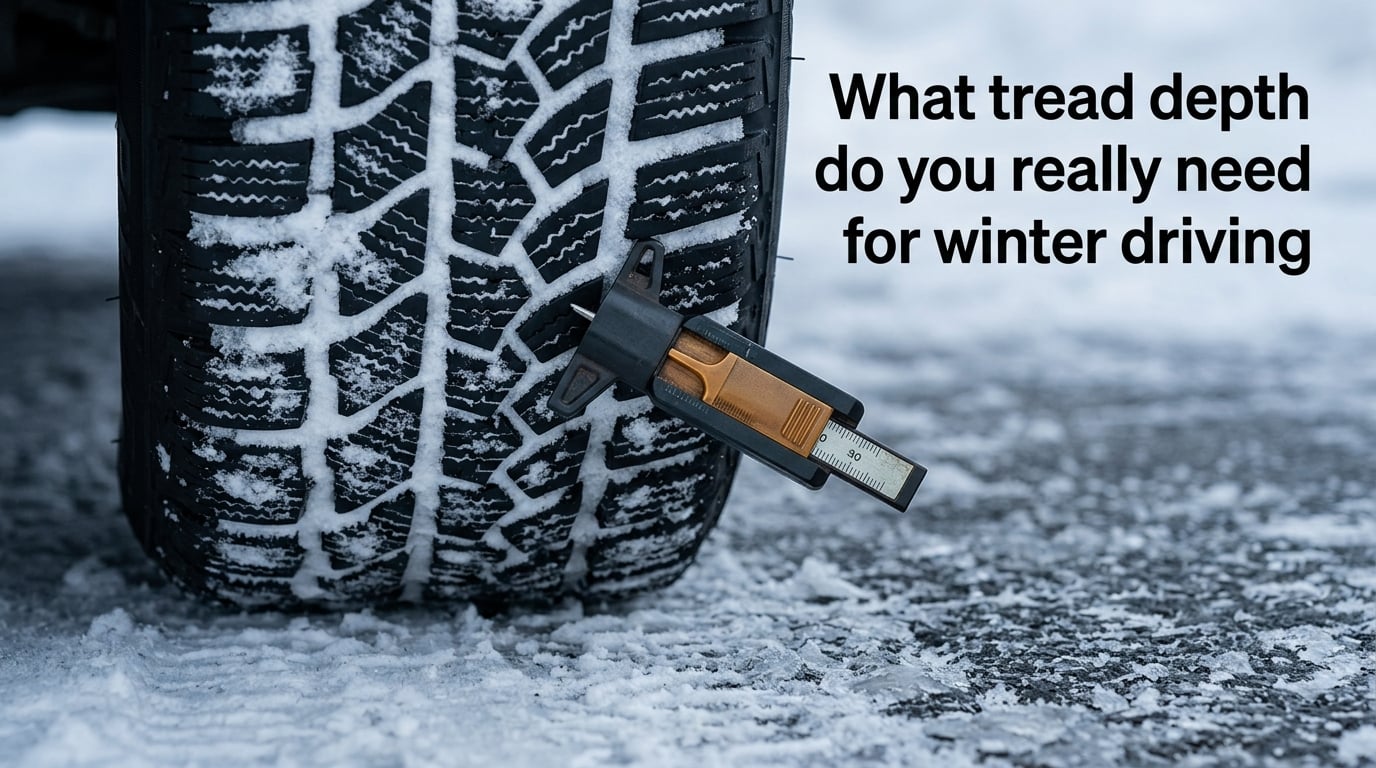
If you ask ten drivers what tread depth you need for winter driving, you’ll get five different answers. Most of them are wrong. After years of testing tires through Colorado winters and comparing notes with our service team, I can give you the short version first, then we’ll back it up with the numbers.
The minimum tread depth for safe winter driving is 5/32 of an inch (about 4 mm). For confident snow and ice performance, plan on 6/32 inch (about 4.8 mm). Anything below 5/32 in winter is a gamble, and anything below 4/32 is asking for trouble. New dedicated winter tires ship with 10/32 to 11/32 inch of tread because the rubber has to do real work once temperatures drop.
This guide covers what each tread depth actually does in snow, how to measure it at home in under a minute, when to replace your tires, and the winter mistakes we see drivers make every year.
Table of Contents
What Tread Depth Do You Really Need for Winter Driving?
For winter driving, you need a minimum of 5/32 inch of remaining tread depth, with 6/32 inch being the practical number most tire makers and our team recommend for real snow conditions. The legal U.S. minimum is just 2/32 inch (1.6 mm), but that floor exists for warm, dry pavement. On snow and ice, 2/32 inch is dangerously inadequate.
Tread depth is measured in 32nds of an inch in the United States. A brand-new passenger all-season tire starts around 8/32 to 10/32 inch. A new dedicated winter tire starts deeper, usually 10/32 to 11/32 inch, because winter tread has to plow through snow rather than just squeegee water off wet asphalt.
The conversion matters if you read European or metric sources: 5/32 inch equals about 4 mm, and 6/32 inch equals about 4.8 mm. When a Nordic tire maker says “minimum 4 mm for winter,” they mean the same number as our 5/32 inch recommendation.
Legal Minimum vs Safe Minimum: Why 2/32 Isn’t Enough in Winter
The U.S. Department of Transportation sets 2/32 inch as the absolute minimum tread depth for any passenger tire on public roads. That number hasn’t changed since the 1960s, and it was designed around wet braking and hydroplaning on warm pavement, not snow traction.
Winter adds three demands the 2/32 rule ignores. First, snow needs somewhere to compress into the tire’s grooves. Once the tread is flush with the wear bars, the grooves are basically gone. Second, slush and water need channels to evacuate from under the contact patch, and shallow tread cannot move that volume. Third, ice grip comes from hundreds of tiny sipes that depend on rubber depth to flex.
That is why Tire Rack, Nokian Tyres, Consumer Reports, and most regional tire chains recommend 5/32 inch for winter and 6/32 inch for serious snow. The legal floor keeps you out of a ticket. The winter recommendation keeps you out of a ditch.
Tread Depth Chart: What Each Level Means in Snow and Ice
This chart is the one I wish every driver taped inside their glove box. It maps each 32nd of an inch to what the tire can still do in winter conditions.
| Tread Depth | Status | Winter Performance |
|---|---|---|
| 10/32 inch and up | New winter tire | Full snow compression, slush evacuation, and ice siping. Best winter performance available. |
| 8/32 inch | New all-season | Strong wet and dry grip, but limited snow capability compared to a dedicated winter tire. |
| 7/32 inch | Light wear | Plenty of tread for confident winter driving on dedicated winter tires. Excellent on all-seasons for light snow. |
| 6/32 inch | Half-tread | Practical minimum for serious snow. Consumer Reports calls this the comfort threshold for daily winter drivers. |
| 5/32 inch | Half-tread | Minimum recommended for winter driving. Snow traction drops noticeably, especially in deep or wet snow. |
| 4/32 inch | Quarter test fail | Marginal in snow. Hydroplaning risk rises fast on wet roads at highway speeds. |
| 3/32 inch | Heavy wear | Unsafe in snow and increasingly risky on wet pavement. Replace immediately. |
| 2/32 inch | Legal limit | Worn out. Stop driving on snow or in heavy rain. Replace before the next storm. |
Consumer Reports ran half-tread winter tires (5/32 to 6/32) against full-tread sets and measured real losses: 14% less snow traction, 8% worse hydroplaning resistance, and 7% longer wet braking distances. Those numbers are before the tire is even “worn out.” They are exactly why 5/32 is the floor and 6/32 is the goal.
Why Winter Driving Needs Deeper Tread Than Summer Driving
Summer tires only have to evacuate water and grip warm asphalt. Winter tires have to bite into packed snow, compress loose snow into the grooves, sling slush out of the tread, and flex hundreds of sipes against ice. Each of those jobs eats tread depth.
Think of it like this: a winter tire plows snow. A summer tire hydroplanes on top of water. A bald winter tire does neither, because there are no grooves left to do the work. The deeper the tread, the more snow the tire can hold in its grooves before it packs solid and turns into a slick.
That is also why new winter tires ship with 10/32 to 11/32 inch of tread instead of the 8/32 to 10/32 inch you’ll see on a new all-season. Winter compounds are softer, so the tread wears faster in cold weather. Makers start deeper so the tire still has usable depth after a few seasons.
Studded winter tires follow the same depth rule, with one extra note: as the tread wears down, the studs can eventually contact the road and wear unevenly. If you run studded winters, plan to retire them at 6/32 inch or above to keep the studs seated properly.
How to Measure Your Tread Depth at Home
You do not need a shop visit. Three household tests cover almost every case, and an inexpensive tread depth gauge nails it.
The Penny Test (2/32 inch)
Stick a U.S. penny into the main tread groove with Lincoln’s head pointing down. If you can see the top of Lincoln’s head, your tread is below 2/32 inch and the tire is legally bald. Replace it before the next drive.
The penny test is a pass-or-fail check. It only tells you that you have hit the legal floor. It does not tell you whether you have enough tread for winter.
The Quarter Test (4/32 inch)
This is the Consumer Reports method. Insert a quarter into the tread with Washington’s head pointing down. If the top of his head is visible, your tread is below 4/32 inch. At that point, snow traction has dropped sharply and hydroplaning resistance is compromised.
Pass the quarter test but fail the 5/32 winter recommendation? You still have legal tread, but you should start shopping for replacements before the snow flies.
The Tread Depth Gauge (Exact Reading)
A tread depth gauge is inexpensive and available at any auto parts store, giving you an exact reading in 32nds or millimeters. Push the probe into the main groove, press the shoulders flat against the tread blocks, and read. Measure at three spots across each tire (inner edge, center, outer edge) and on all four tires. Keep a small notebook in the glove box so you can track wear over time.
Inner-edge wear usually points to low air pressure or alignment problems. Center wear points to over-inflation. Uneven side-to-side wear almost always means an alignment is overdue. If you see any of these patterns, measure all four tires individually and bring the readings to your shop.
Tread Wear Indicators (TWI Bars)
Every modern tire has small raised bars sitting in the bottom of the main tread grooves. When the tread wears down flush with those bars, you are at 2/32 inch and legally done. Look for the small “TWI” arrow or triangle on the sidewall that marks the bar’s location.
Many winter tires add a second set of indicators called Winter Wear Indicators, also called snow platforms. These sit higher in the groove, usually around 5/32 inch, and often carry a snowflake symbol. When the tread wears down to that level, the tire is no longer considered effective in snow, even if it still has legal depth.
When to Replace Winter Tires (and How Many Miles You Have Left)
Plan to replace winter tires once they reach 5/32 inch of remaining depth. If you drive mostly highway or rarely see deep snow, 5/32 is fine. If you commute through the snow belt, run mountain passes, or drive a 2WD vehicle, target 6/32 inch as your replacement point.
How much life is left at 5/32 inch? On a typical passenger winter tire, expect roughly one to two more winter seasons of normal commuting, or around 8,000 to 15,000 miles, depending on your driving. A typical winter tire delivers about 15,000 to 20,000 miles before reaching the 5/32 mark. Drivers in heavy stop-and-go traffic or hilly areas will be on the low end.
Tire age matters as much as tread depth. Rubber hardens with age, and once a winter tire passes about six years of service (or ten years from the manufacture date stamped on the sidewall), the compound loses grip even if the tread still looks fine. If your tires are six years old and still have 7/32 inch of tread, the harder compound is hurting you more than the missing tread. Replace them.
One more thing drivers ask us about: AWD does not reduce the tread depth you need. Four-wheel drive helps you accelerate in snow. It does almost nothing for braking or cornering, which is where tread depth matters most. If your AWD SUV has 4/32 inch winter tread, it stops on ice almost exactly like a 2WD sedan with 4/32 inch winter tread. The AWD misconception is one of the costliest winter mistakes we see.
Common Winter Tread Mistakes Drivers Make
Every November, our service bays fill up with the same handful of issues. Skip these and you will save yourself a tow bill.
Trusting AWD to cover for bald tires. AWD sends power to all four wheels. Tread depth determines whether those wheels grip or slip. The two are independent.
Running all-season tires at 4/32 inch through winter. All-seasons start with less tread than winter tires and have shallower, less aggressive patterns. By 4/32 inch, snow traction is barely better than summer tires.
Replacing only two tires. Winter tires should go on in sets of four. Mixing new and half-worn tires creates an unstable handling balance, especially in snow.
Ignoring tire age. A six-year-old winter tire with 7/32 inch of tread is past its prime. The rubber has hardened and grip has dropped, even though the tread looks fine.
Waiting until the first storm to check tread. Late October is the right window to measure, not the morning of the first blizzard. Selection gets thin in November and shop schedules fill up.
Winter Driving Checklist Before the First Snow
Run through this list the first week of November and you will avoid most winter tire headaches.
- Measure all four tires with a tread depth gauge and write the numbers down.
- Check each tire’s age on the sidewall DOT code (the last four digits are week and year).
- Run the quarter test on the worst-worn tire.
- Inspect each tire for uneven wear patterns or sidewall damage.
- Set tire pressures to the door-jamb spec once temperatures drop below 40 degrees Fahrenheit.
- Book a mounting appointment now if any tire reads 5/32 inch or below.
Frequently Asked Questions
Is 7/32 tread depth good for winter?
Yes, 7/32 inch is plenty of tread for winter driving on a dedicated winter tire. On an all-season tire, 7/32 inch is still solid for light snow but traction in deeper snow will be limited compared to a winter tire with the same depth.
Should I replace tires at 5/32?
Replace winter tires at 5/32 inch if you regularly drive in snow or on ice. If you only see occasional light flurries on dry, plowed roads, 5/32 can last a bit longer, but it is the practical winter floor.
What is the 7/7 rule for winter tires?
The 7/7 rule means swap to winter tires when the temperature drops below 7 degrees Celsius (about 45 degrees Fahrenheit) consistently, and swap back to all-season or summer tires when it climbs back above 7 degrees Celsius in spring. Winter compounds stay flexible in cold weather and wear faster in warm weather, so timing matters.
How many miles will 5/32 tread last?
On a typical passenger winter tire, expect around 8,000 to 15,000 miles of remaining life once you hit 5/32 inch, assuming normal commuting. Highway drivers and those in light snow will land on the higher end; city drivers in heavy snow will land on the lower end.
Is 6.5/32 tread depth good for winter tires?
Yes, 6.5/32 inch is solid for winter driving and sits comfortably above the 5/32 minimum. Most drivers will feel confident snow traction at this depth, especially with a dedicated winter tire compound.
Do AWD vehicles need less tread depth in winter?
No. AWD helps with acceleration and traction from a stop, but braking, cornering, and hydroplaning resistance depend on tread depth at each tire. AWD with bald tires is still unsafe on snow and ice.
The Bottom Line on Winter Tread Depth
For winter driving, you need at least 5/32 inch of tread depth, and 6/32 inch is the practical recommendation if you drive through real snow. Anything below 5/32 is the danger zone. Anything at or below 2/32 is legally bald and unsafe in any season.
Measure your tread before the first storm, not after. A basic tread depth gauge and a few minutes of your time can save you a tow, a fender-bender, or worse. If your tires are at 5/32 inch or below, start shopping now while selection is wide and shop schedules are open.
Stay safe out there this winter, and remember: in snow, too little tread is never enough.