
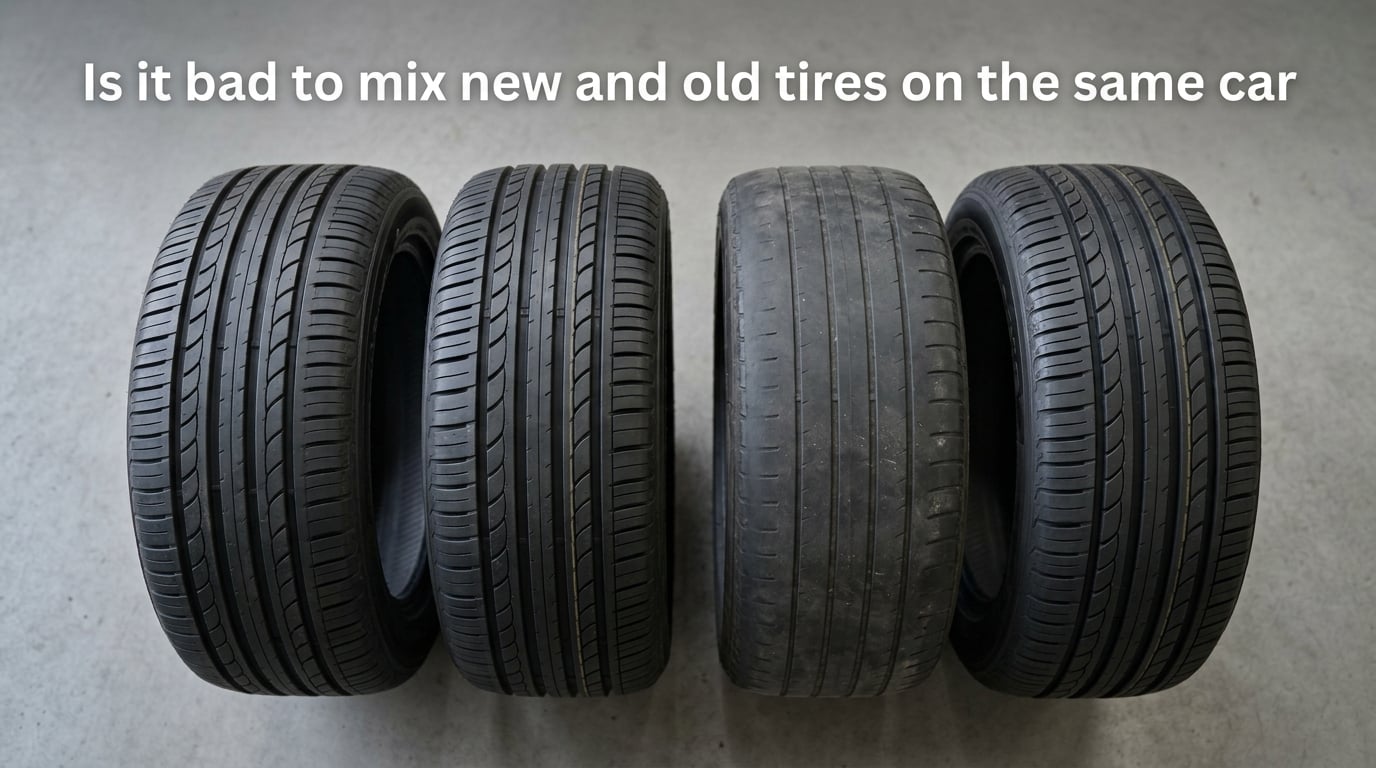
Yes, it is bad to mix new and old tires on the same car. Tires with different tread depths grip the road unevenly, which can cause unpredictable handling, longer stopping distances, and a higher risk of hydroplaning in the rain. On all-wheel-drive vehicles, mismatched tires can also damage the transmission and drivetrain. Tire manufacturers including Michelin, Continental, and General Tire all advise against mixing.
I have worked with tire retailers for years, and this question comes in every single week. Drivers usually ask because one tire got damaged, money is tight, or a mechanic recommended replacing only two. The honest answer is simple: replacing tires in pairs – and ideally in full sets of four – keeps your car safer and your wallet happier over the long run.
This guide covers what makes mixing risky, the specific tread depth rule that decides whether it is okay, how AWD changes the math, and what to do if you already have a mismatched set on your car right now.
Table of Contents
Why Mixing New and Old Tires Is Generally a Bad Idea
Tires with different tread depths respond to braking, acceleration, and steering at different rates. That difference matters more than most drivers realize.
Here is what happens at the contact patch. A new tire with 10/32 inch of tread bites into the road with full grip. An older tire at 4/32 inch has noticeably less traction, especially on wet pavement. The car wants to turn, brake, and correct based on the average of the four corners, but the front pair and rear pair are not pulling in the same direction. In an emergency stop, the worn tires lock up first while the new tires keep rolling – which pulls the vehicle off-line and adds braking distance.
The five biggest safety risks of mixing new and old tires are:
- Uneven braking distances. Mismatched grip means the car stops in a curve instead of a straight line.
- Hydroplaning risk. Worn tires lose water evacuation at lower speeds, so the back end can break loose in rain.
- Oversteer and understeer. Most drivers are not trained to catch a sudden rear-tire slide.
- ABS and traction control confusion. Stability systems calculate grip differently at each corner and may apply the wrong correction.
- AWD drivetrain damage. Different tire circumferences force the transfer case to work overtime, eventually wearing out expensive components.
On Reddit’s r/AskAMechanic and r/MechanicAdvice, drivers regularly report vibration at highway speed with mismatched tires, especially above 65 mph. Vibration is not just uncomfortable – it is a warning sign that the tires are not tracking together.
The 2/32 Inch Tread Depth Rule
The single most important number in this whole conversation is 2/32 of an inch. That is the legal minimum tread depth in most U.S. states, and it is the line tire manufacturers use to define “worn out.”
Many people think the rule about mixing is about brand or pattern. It is not. It is about tread depth. Most tire makers recommend keeping all four tires within 2/32 inch of each other, and never pairing a new tire with one that has less than 4/32 inch remaining. If the older tire is already at the wear bars, it has no business being on the same axle as a fresh tire.
How to check tread depth at home:
- Use a tread depth gauge (a few dollars at any auto parts store).
- Measure at the center, inside, and outside of each tire – not just one spot.
- Look for the tread wear indicator bars inside the grooves. When tread is flush with those bars, the tire is at 2/32 inch and needs replacement.
- The quarter test works in a pinch: insert a quarter into the tread with Washington’s head down. If you can see the top of his head, you are below 4/32 inch.
If your front tires are at 6/32 inch and the rears are at 3/32 inch, replacing just the fronts is fine – the fronts and rears are within tolerance. But pairing a brand-new 10/32 inch tire with a 3/32 inch tire on the same axle is asking for trouble.
New Tires on the Rear Axle: The Industry-Wide Rule
If you only have the budget for two tires, mount them on the rear axle – not the front. This is the consistent recommendation from Michelin, Continental, Goodyear, and General Tire, and it surprises almost every driver the first time they hear it.
The reasoning is counterintuitive. Drivers assume new tires go on the front because the front steers and brakes. In reality, new tires on the back prevent the rear end from breaking loose. Understeer – where the front loses grip and the car plows forward – is easy for any driver to recognize and correct by simply slowing down. Oversteer – where the rear steps out sideways – can spin an untrained driver in seconds, especially on wet roads.
Putting the freshest, deepest-tread tires on the rear axle maximizes resistance to hydroplaning at the back of the car. In a sudden lane change or wet corner, the rear tires hold the line. Once the front tires wear down to match, you can rotate normally. Until then, treat the rear pair as the safety pair.
AWD and 4WD vs. FWD and RWD: Different Rules Apply
Do all four tires need to match? On an AWD or 4WD vehicle, the answer is essentially yes.
All-wheel-drive systems use the front and rear tires to do real mechanical work. When tires rotate at slightly different speeds because of different circumferences or wear levels, the center differential or transfer case compensates constantly. That compensation generates heat and stress on components that can cost thousands of dollars to replace – the transfer case, the differentials, and the driveshafts.
Most AWD manufacturers – Subaru, Audi, BMW, Acura – specify that all four tires must be within 1/32 inch of each other, and they should be the same brand, model, size, and age. Some vehicles even trigger a warning light or disable AWD if the mismatch is severe enough.
Front-wheel-drive and rear-wheel-drive cars are more forgiving. The driven axle pairs (two tires) need to match closely in tread depth, but you can often run a different brand or model between the front and rear axles. FWD and RWD vehicles do not have a center differential that punishes you for slight circumference differences across the car.
Quick comparison for replacement rules by drivetrain:
- AWD/4WD: Replace all four together; keep all four within 1/32 inch of tread depth; same brand, model, and age.
- FWD: Replace the front pair in matching sets; can rotate with the rear pair if sizes match.
- RWD: Replace the rear pair in matching sets, especially on rear-wheel-drive performance cars; match the front pair to each other but they can differ from the rears if the manufacturer allows staggered fitment.
Mixing Tire Brands, Patterns, Speed Ratings, and Run-Flats
Tread depth is the headline. The other ways tires differ matter too, and most drivers do not realize how strict the matching rules get.
Tread pattern. Tires come in three pattern families – symmetric, asymmetric, and directional. A directional tire has a single rotation arrow on the sidewall and channels water one way. Mixing directional and non-directional tires on the same axle breaks the water evacuation path and hurts wet grip. Asymmetric tires have an inside and outside sidewall designation. Mixing inside and outside mounted tires throws off the contact patch geometry.
Speed rating. Every tire has a letter on the sidewall indicating maximum speed: T is 118 mph, H is 130 mph, V is 149 mph, W is 168 mph. The lowest-rated tire on the car sets the practical limit for the whole vehicle. Mounting a W-rated tire next to an H-rated tire means your top speed is governed by the slower tire, and under hard cornering the H-rated tire will give up grip sooner.
Load index. The load index is a number that corresponds to how much weight each tire can carry. A mismatched load index on the same axle means one tire is doing more work per revolution. If the lighter-rated tire is on the front of a heavy SUV, it can overheat and fail.
Run-flat vs. non-run-flat. Run-flat tires have reinforced sidewalls that support the car after a puncture. Mixing run-flat and standard tires on the same car is unsafe because the run-flat corner sits higher after pressure loss, which causes unpredictable handling. Many cars are designed around run-flat performance and lose their intended ride and handling with standard tires installed.
If you have to mix – say, one tire was damaged and the matching model is unavailable – the rule is to keep the new tire’s size, load index, speed rating, and tread pattern family identical to the other tire on the same axle. Brand can differ if needed.
Mixing Winter, Summer, and All-Season Tires
Winter tires use a softer rubber compound that stays pliable below 45 degrees Fahrenheit. Summer tires use a harder compound optimized for dry and wet pavement above freezing. All-season tires are a compromise that works in mild climates but not in heavy snow or extreme heat.
Can you mix winter and all-season tires on the same car? Tire manufacturers say no, for the same reasons as tread depth: grip differs across the four corners. But there is one situation where mixing is common and acceptable – dedicated winter sets on separate wheels, where two winter tires are mounted together on the rear axle and the front pair stays on all-seasons for a short transition period. Even that is temporary. By the second winter, drivers should commit to four matching winter tires.
If you live somewhere with real winter weather, four matching winter tires on a second set of wheels is the safest option. The cost is real too, which is why many drivers compromise. Just know that any compromise reduces grip in the worst conditions – exactly when you need grip most.
When Mixing Is Unavoidable: Rules to Follow
Sometimes you do not have a choice. A sidewall bubble forces a single-tire replacement. Money is tight and you can only afford two. The lease is up next month and you do not want to invest in a full set. Here is how to minimize risk when mixing is unavoidable.
Seven rules for unavoidable tire mixing:
- Always pair the two new tires on the same axle. Never mount one new tire on the front and one on the rear.
- Match size, load index, speed rating, and tread pattern. Brand and model can differ if needed.
- Keep tread depth within 2/32 inch on the same axle. Below that, the grip difference becomes unsafe.
- Mount the new pair on the rear axle, not the front. This protects against oversteer in wet conditions.
- Recalibrate TPMS sensors after any tire change so the warning system reads correctly.
- Avoid highway speeds until the tires are broken in. New tires have a release agent on the surface and need about 500 miles of gentle driving to reach full grip.
- Replace the remaining two tires as soon as budget allows. Mixing is a temporary state, not a destination.
Forum users on Reddit’s r/tires and r/askcarguys often describe exactly this scenario – one tire damaged, replaced with whatever was in stock, and the other three original tires still on the car. The advice from experienced members is consistent: replace the damaged tire’s axle partner at the same time if you can. Two new tires plus two worn tires on the same axle is a much smaller problem than three mismatched corners.
What to Do Right Now If You Already Have Mixed Tires
If you are reading this because you already have mismatched tires on your car, do not panic. Mismatched tires are not an emergency – they are a risk to manage.
Step one: check the tread depth at all four corners with a gauge. If the worst tire is above 4/32 inch and the best is below 8/32 inch, you are in a tolerable range for short-term driving.
Step two: drive gently for the next week. Avoid highway speeds above 65 mph, skip aggressive cornering, and double your following distance in rain. This is not a permanent fix – it is buying time to plan your next tire purchase.
Step three: shop for a matched pair now, even if you cannot afford all four. Mount the new pair on the rear axle. Then plan to replace the remaining older pair within the next six months or 6,000 miles, whichever comes first.
Step four: if you drive an AWD vehicle, contact the dealer or a tire specialist before mixing. Many AWD systems will register a fault code or even disable themselves if the circumference difference exceeds roughly 1/32 inch. A tire shop with AWD experience can measure your current tires and recommend the right replacement.
Frequently Asked Questions
Is it safe to mix different tire brands for both front and rear tires?
It is not recommended. Tires from different brands often have different rubber compounds, tread patterns, and grip characteristics, which can cause unpredictable handling. If you must mix brands, keep the same brand on each axle and match size, load index, speed rating, and tread pattern family across each axle pair.
What is the 3 rule for tires?
The 3 mm rule, sometimes called the 2/32 inch rule in the U.S., states that tires should be replaced when tread depth reaches 3 mm (about 2/32 inch). For mixing purposes, all four tires should stay within about 2/32 inch of each other, and a new tire should never be paired with one below 4/32 inch of remaining tread.
Is it okay to change two tires on a car and not all?
Yes, on a FWD or RWD car, replacing two tires is fine as long as the new pair goes on the rear axle and matches the other pair in size, load index, speed rating, and tread pattern. On an AWD or 4WD vehicle, all four tires should generally be replaced together to avoid drivetrain damage.
Do all four tires need to match?
On AWD and 4WD vehicles, yes – all four should be the same brand, model, size, and within roughly 1/32 inch of tread depth. On FWD and RWD vehicles, the tires on each axle must match closely, but the front and rear pairs can differ in brand or even size on cars with factory staggered fitments.
Is it okay to run mismatched tires?
Short term, mild mismatches within 2/32 inch of tread depth on the same axle are tolerable if you drive conservatively. Long term or large mismatches – especially mixing new and bald tires, different tread patterns, or different speed ratings – are unsafe and can cause handling instability, longer stopping distances, and on AWD vehicles, expensive drivetrain wear.
Can you mix winter and all-season tires?
Mixing winter and all-season tires on the same vehicle is not recommended because the soft winter compound and harder all-season compound grip very differently. If you run dedicated winters, mount all four in matching sets on a second pair of wheels and swap the whole set seasonally.
Final Verdict on Mixing New and Old Tires
Is it bad to mix new and old tires on the same car? Yes – and now you know what to do about it.
The safest path is always four matching tires. The second-safest path is replacing in matched pairs on the rear axle, then the front pair when budget allows. Avoid pairing new tires with anything below 4/32 inch of tread, especially on the same axle. If you drive an AWD or 4WD vehicle, treat all four as a single set and replace them together. Your stopping distances, your wet-weather grip, and your transmission will all thank you.
For a personalized recommendation based on your specific vehicle and tire size, stop by a local tire shop. They can measure your current tread depth, check your tire age via the DOT code on the sidewall, and recommend a replacement plan that fits your driving and your budget.