
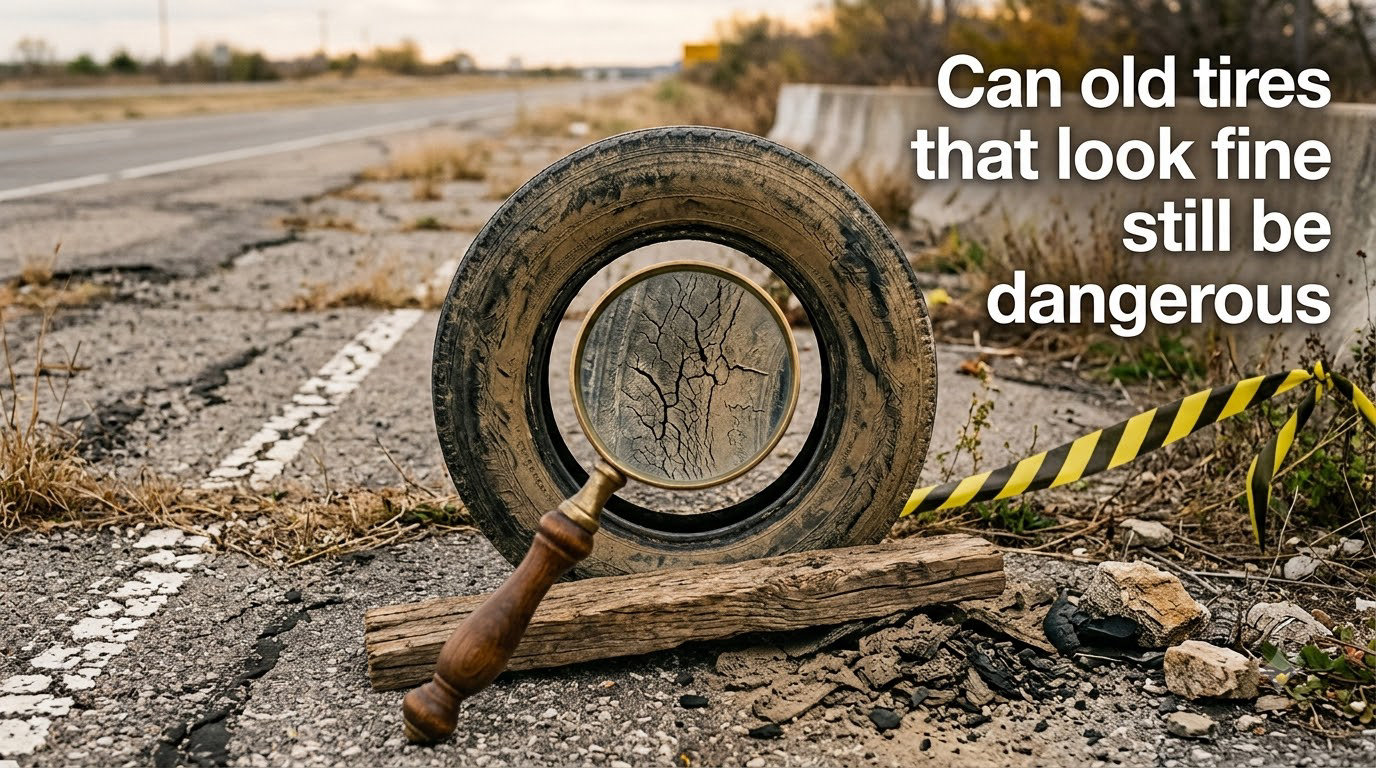
Yes – old tires that look fine can still be dangerous. Tread depth and tire age are independent safety factors, and rubber compounds degrade over time even when the tread looks deep enough to drive on. A tire with full tread can still harden, crack internally, or begin separating from its steel belts, and the failure often happens at highway speed with no warning.
I have walked hundreds of drivers through this exact question over the years, and the most common reaction is surprise. People expect tires to wear out from use, not from time. But the chemistry of rubber does not care how many miles you have put on the tire. It ages from heat, sunlight, ozone, and the slow evaporation of the plasticizers that keep it flexible.
This guide walks through what actually happens to old tires, how to read the DOT date code stamped on your sidewall, the manufacturer replacement windows, the seven warning signs to look for, and what to do if you discover your tires are older than you thought. By the end, you will know exactly how to answer the question for your own vehicle.
Table of Contents
Yes – Old Tires That Look Fine Can Still Be Dangerous
The short answer is yes, and the reason is that tire aging is mostly invisible from the outside. The tread can look like new while the rubber underneath has hardened, dried out, and started breaking down at the molecular level.
When rubber hardens, it loses grip on wet pavement, especially during braking and cornering. When it dries out, it develops micro-cracks in the sidewall and between the tread blocks. When those cracks reach the steel belts inside, the belts can separate from the carcass and the tire can fail suddenly. None of this requires low tread depth. It only requires time, heat, and exposure.
That is why every major tire manufacturer recommends replacing tires no later than 10 years from the date they were made, and having them professionally inspected starting at year six. We will cover how to find that date and what to do with it below.
Why Tire Age Matters Even When the Tread Looks Good
Modern tires are made of a blend of natural rubber, synthetic rubber, carbon black, and a group of chemicals called plasticizers that keep the rubber soft and pliable. From the day a tire is cured, those plasticizers start migrating to the surface and evaporating.
Three environmental forces accelerate that loss:
- Heat – the single biggest factor. A tire running in Phoenix at 110 degrees Fahrenheit ages several times faster than the same tire in Minneapolis.
- Ultraviolet light – sunlight breaks down the polymer chains in the rubber and fades its color from black to a chalky gray or brown.
- Ozone – the same ozone that cracks rubber door seals attacks tire sidewalls. Electrical equipment, gasoline vapors, and exhaust all generate ozone near your tires.
Under the surface, the steel belts and polyester or nylon plies that give the tire its strength are bonded to the rubber with adhesive that also degrades with age. As the bond weakens, the belts can shift. As the rubber hardens, it loses the ability to flex over bumps without cracking. The result is a tire that may look fine on the outside but is brittle, dry, and close to failure inside.
This is why tire age, not just tread depth, is the right safety benchmark. The tire industry calls the visible end-stage of this process dry rot, but by the time dry rot is obvious to the eye, the tire is already well past safe.
How to Read the DOT Date Code on Your Tires
Every tire sold in the United States since 2000 has a DOT date code stamped on one sidewall. That code is the single most useful piece of information on the tire, and most drivers never look at it.
Here is how to read it. Look on your sidewall for a string of letters and numbers that begins with DOT. Toward the end of that string, you will find four digits. The first two digits are the week of the year the tire was manufactured. The last two digits are the year.
For example, a tire stamped 2319 was made in week 23 of 2019, roughly early June 2019. A tire stamped 0824 was made in week 8 of 2026, which is late February 2026. Once you know how to read it, you have a built-in answer to the question of how old your tires are, regardless of what the tread looks like.
Tires made before the year 2000 used a three-digit code where the last digit was the decade. A code like 328 meant the 32nd week of 1988 or 1998, depending on the decade mark. If you see a three-digit code, the tire is at least 25 years old and should not be on a vehicle regardless of appearance.
The DOT code is on the inner sidewall on many tires, which means you may need to crouch down and look at the side facing the car. It is always there. If you cannot find it, the tire is either so old the marking has worn away, which is itself an answer.
Manufacturer Guidance: The 6-Year and 10-Year Replacement Windows
Every major tire manufacturer publishes the same general guidance, and the Tire Industry Association and the National Highway Traffic Safety Administration (NHTSA) reinforce it.
The standard recommendation is this: have your tires professionally inspected at six years of age, and replace them no later than ten years from the DOT date code, regardless of tread depth. Bridgestone, Michelin, Continental, and Dunlop all publish a 10-year absolute maximum service life. Some manufacturers shorten that window for specific use cases like RV and trailer tires, where heat buildup and prolonged parking push aging faster.
This is a conservative consensus, not a marketing slogan. The reason it is conservative is that the chemistry of rubber aging is not linear. A tire that passes every check at eight years can be unsafe at nine. Manufacturers set the 10-year line so that well-cared-for tires still have margin at the boundary, not so the average tire makes it exactly to year 10.
If you live in a hot climate, tow heavy loads, drive on rough roads, or park outside in the sun, treat the window as shorter. Six years to inspect, eight years to plan replacement.
7 Warning Signs Your Tires Are Too Old
This is the list every driver should memorize. None of these signs requires a tread-depth gauge. If you spot any of them, the tire needs a professional inspection even if the tread looks fine.
1. Cracks in the Sidewall (Dry Rot)
Look at the sidewall, the smooth black surface between the tread and the rim. Fine lines that look like the wrinkles on an old dried-out balloon are dry rot. Once you can see them with the naked eye, the rubber has lost most of its plasticizers and is brittle. Cracks that go all the way through the sidewall can let the inner liner leak, and a deep crack under load is how sidewall blowouts start.
2. Cracking Between the Tread Blocks
Look straight down at the tread pattern from above. Hairline cracks running across the tread blocks, especially on the inner edge or shoulder, are a sign the rubber is aging through to the working surface. A few light marks on a tire with deep tread is one thing. Cracks deep enough to catch a fingernail are another.
3. The Rubber Feels Hard and Plasticky
Press your thumb firmly into the tread or sidewall. New rubber yields slightly and warms under your touch. Old rubber feels stiff and cold, more like a hard plastic toy than a flexible material. This fingernail test is crude but it works. If the rubber does not give at all, it has lost most of its flexibility.
4. New Vibration or Noise That Balancing Does Not Fix
A tire that has developed flat spots from sitting, or whose internal belts have shifted, will vibrate at speed even when balanced correctly. If your wheel balance and alignment are good and the vibration only gets worse as you speed up, the tire itself may be failing.
5. Persistent Air Loss or Frequent TPMS Warnings
Slow leaks that no shop can trace to a nail or a rim are often micro-cracks in the inner liner of an aging tire. The TPMS warning that comes back every few weeks even after you inflate to spec is a strong signal. So is the tire that mysteriously needs a top-up every time the seasons change.
6. Brown, Faded, or Chalky Rubber
New tires are deep black with a slight sheen. Aged rubber fades to gray, brown, or a chalky finish even when it has been cleaned. This is UV damage at the surface and it usually means deeper damage below. If your tires will not clean back to black, they are telling you their age.
7. The Vehicle Has Been Parked for Years
Low mileage does not save a tire. A car that has sat in a driveway or a garage for three or more years has aging tires regardless of how much rubber is left. Classic cars, RVs, project cars, and second vehicles all fall into this category. The DOT code tells the truth even when the tread looks new.
How Aging Tires Actually Fail: Blowouts, Tread Separation, Hydroplaning
Knowing the warning signs matters because the failure modes of an old tire are sudden and dangerous. Three failure patterns account for most old-tire crashes.
Tread separation is the most common catastrophic failure in old tires. The steel belts inside the tire pull away from the carcass, and a chunk of tread peels off at highway speed. The driver often describes it as the tire suddenly losing its shape. One Reddit user put it bluntly after a 12-year-old blowout: “Inside the rubber was turning to powder.”
Hydroplaning happens when hardened rubber cannot squeeze water out from under the contact patch fast enough. The tire rides up on a layer of water and stops responding to steering or braking. Old tires hydroplane at lower speeds than new tires, sometimes in standing water that would not have been a problem a few years earlier.
Increased stopping distance is the failure mode nobody talks about until they need to brake. A tire that has lost grip because of hardened rubber needs 10 to 20 percent more distance to stop on wet pavement than the same tire when new. That is the difference between a close call and a collision.
Add to this sidewall blowouts, which often start from a crack that grew under repeated flexing, and you have a clear picture. Old tires do not give you more warning. They give you less.
Climate, Storage, and the Spare Tire: Hidden Accelerators
How fast a tire ages depends heavily on where it lives. The DOT date code tells you the absolute age, but the usable service life is shorter in some climates and storage conditions than in others.
| Climate or Storage | Effective Service Life | Why |
|---|---|---|
| Hot, arid (Phoenix, Las Vegas, inland California) | 4 to 6 years | High pavement and ambient temperatures drive plasticizer loss and heat-cycle damage to belts. |
| Cold, temperate (Minneapolis, Boston, Chicago) | 8 to 10 years | Lower temperatures slow rubber oxidation. Cold does not stop aging, it just slows it. |
| Coastal humid (Miami, Houston, Gulf Coast) | 6 to 8 years | Salt air, humidity, and strong sun combine UV, ozone, and moisture exposure. |
| Garaged daily driver, low mileage | Up to 10 years | Shade, stable temperatures, and gentle use slow every aging mechanism. |
| Outdoor storage or long-parked vehicle | 3 to 6 years | UV and ozone attack the sidewall directly. Lack of flexing allows flat-spotting. |
| RV or trailer tire (often unused for months) | 4 to 6 years | Static load, sun exposure, and lack of rotation accelerate sidewall dry rot. |
The single biggest accelerator is heat. A tire in Phoenix at 110 degrees ages roughly two to three times faster than the same tire in a 70-degree garage. That is why a 6-year-old tire in Arizona may have the same internal damage as a 12-year-old tire in Minnesota.
The spare tire is the easy one to forget. Most drivers never check the DOT code on the spare because they never see it. A donut or full-size spare that has been under the cargo floor for ten years is not a safe backup. Check the spare’s DOT code on the same schedule you check the four that touch the road.
DIY 3-Step Tire-Age Inspection Checklist
You can answer the question of whether your tires are too old in about ten minutes with a flashlight and a few minutes of your hands. Here is the inspection I run when a customer asks me to look at their tires.
Step 1: Read every DOT code on the vehicle. Start with the two front tires, then the rears, then the spare. Write down the four-digit code from each one. The oldest tire on the vehicle sets the replacement timeline. If the oldest is past six years, plan a professional inspection. If it is past ten, plan replacement.
Step 2: Look at the sidewall and tread under good light. Crouch beside each tire and look across the sidewall at eye level. Fine cracks, faded color, and chalky patches are visible from this angle. Then look straight down at the tread pattern and check for cracks running across the blocks. Anything that catches a fingernail is a real crack.
Step 3: Press and check pressure. Press your thumb hard into the sidewall. Stiff, plastic-feeling rubber is a warning sign. Then check the cold inflation pressure on each tire with a gauge. A tire that needs air every few weeks is showing its age even if the gauge reads fine today. If the TPMS light has come on more than once in the last six months, write that down too.
Ten minutes of this tells you more than any tread-depth measurement. If anything looks off, take the vehicle to a shop and ask for an age-based tire inspection specifically. Most shops will pull the DOT codes, look at the sidewalls, and give you an honest read.
What to Do If Your Tires Are Too Old (Action Plan)
Once you know the age, the response falls into one of three buckets. Pick the one that matches what you found.
If a tire is past 10 years or shows visible cracks: Replace it now. Do not wait for the blowout. A set of four tires is far less expensive than a single crash, a rim, a fender, or a hospital visit.
If a tire is 6 to 10 years old with no visible warning signs: Have it professionally inspected and start budgeting for replacement. Plan to replace within the next six to twelve months. If you live in a hot climate, tow a trailer, or drive on rough roads, plan sooner.
If a tire is under 6 years old and looks fine: Mark the install date on a sticker inside the glove box. Re-check at year six. Most tires will give you another two to four safe years from that point if you keep up the inspections.
One warning the tire industry rarely talks about. Tires sold as “new” at a shop can already be one to three years old. DOT codes on shop inventory are common, and I have seen tires sold with date codes from two years before the purchase. Always check the DOT code on tires you are buying, and reject any tire that is older than two years from the date of sale. Fresh rubber ages differently than warehouse-aged rubber, even on the same shelf.
Frequently Asked Questions
How safe are 20 year old tires?
No – 20-year-old tires are not safe regardless of tread depth. Industry guidance universally recommends replacement by 10 years from the DOT date code, and tires past that age have compounding rubber degradation, internal steel-belt separation risk, and dramatic loss of wet grip. Any 20-year-old tire should be removed from service immediately, even if it has never been driven.
Can 12 year old tires still be good?
By 12 years, tires are past every major manufacturer’s recommended service life. Even with deep tread and no visible cracks, the rubber has hardened, plasticizers have evaporated, and internal belts may be weakening. Replace them now rather than waiting for visible warning signs.
Are 10-year-old tires still safe to use?
Most manufacturers, including Bridgestone, Michelin, Continental, and Dunlop, place 10 years from the DOT date code as the absolute maximum service life. If the tires have been driven in hot climates, sat unused, or show any sidewall cracking, replacement should be sooner. By year 10, plan replacement even if tread looks new.
How long are tires good for after the dot date?
Industry guidance is a 6-year professional inspection and replacement between 6 and 10 years from the date code stamped on the sidewall. Heat, sunlight, and storage conditions can shorten that window, while cool garages and low mileage can extend it slightly. Never exceed 10 years regardless of tread depth.
Are 7 year old tires with good tread still good to use?
A 7-year-old tire with good tread is in the gray zone. Have it professionally inspected for sidewall cracking, tread-block cracking, and hardness. If it passes and you do not live in a hot climate or tow heavy loads, you can likely drive it a bit longer, but start budgeting for replacement.
Are old tires with good tread safe?
Not necessarily. Tread depth and tire age are independent safety factors. A tire can have full tread and still fail because the rubber has hardened, cracked internally, or begun separating from the steel belts. Always check the DOT date code, not just the tread.
The Bottom Line
Can old tires that look fine still be dangerous? Yes, absolutely. The answer to the question is built into every tire’s sidewall. The DOT code tells you the age, the manufacturer guidelines give you the window, and the seven warning signs tell you when the chemistry has already caught up with your tread depth.
Walk to your car, crouch down, and read the four-digit code on each tire, including the spare. If the oldest is past six years, schedule an inspection. If it is past ten, plan replacement this month. That single act answers the question for your specific vehicle better than any article, including this one.