
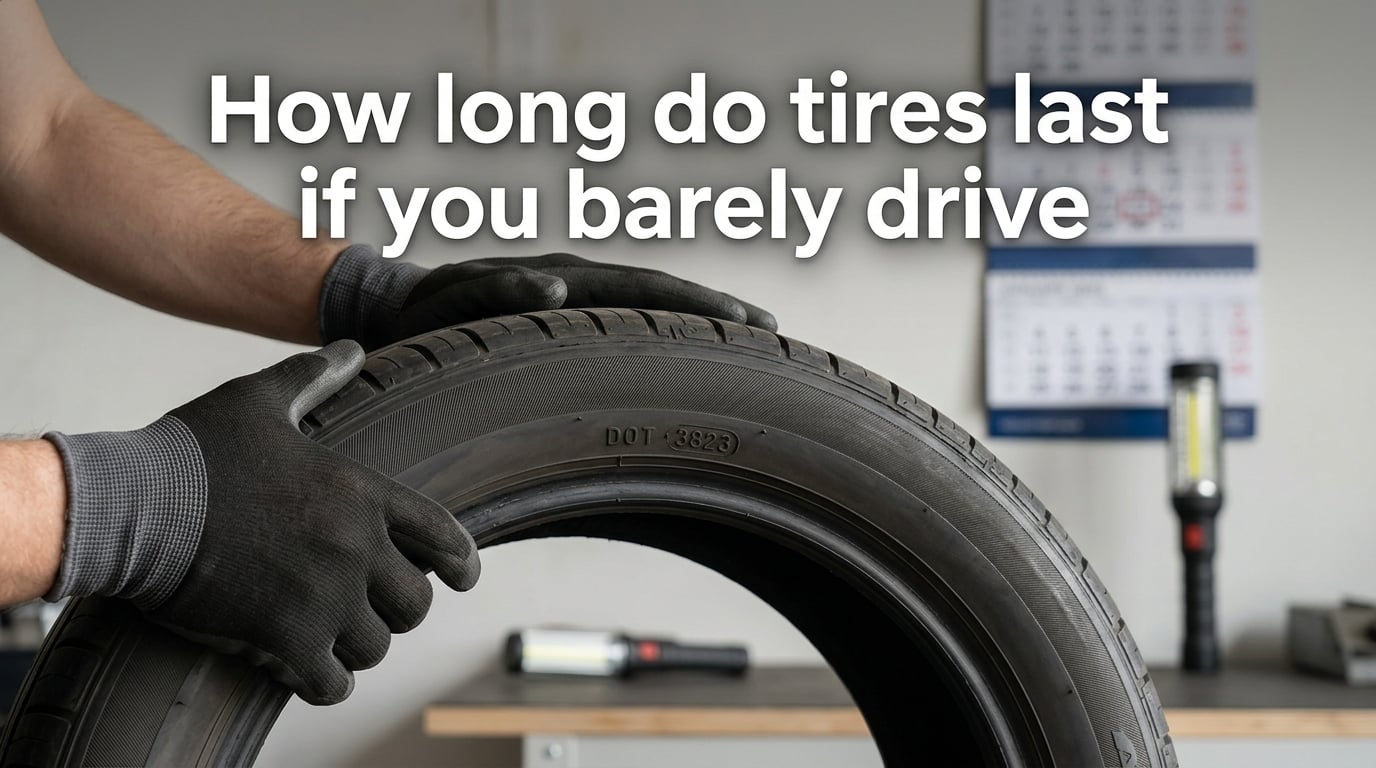
If you barely drive, your tires will typically last 6 to 10 years from the manufacture date, even when the tread looks fine. Time, not miles, breaks down the rubber compounds in your tires through oxidation, ozone exposure, and UV damage. A car that sits in the driveway can end up with unsafe tires long before the tread ever wears thin.
Owning a low-mileage vehicle comes with a hidden maintenance trap. Most drivers assume tires wear out only when they roll a lot of miles, but rubber ages whether the car moves or not. If you drive fewer than 5,000 miles a year, own a seasonal truck, store a classic car, or keep a second vehicle in the garage, this matters to you.
In this guide, our team breaks down how long tires actually last with low mileage, how to read the DOT date code stamped on every tire, the warning signs of tire aging, and what you can do to extend tire life on a vehicle you rarely drive. We pulled guidance from tire manufacturers, the National Highway Traffic Safety Administration (NHTSA), and the experiences of mechanics and low-mileage drivers on Reddit and Stack Exchange.
Table of Contents
How Long Do Tires Last If You Barely Drive? The 6-10 Year Rule
Tires last 6 to 10 years from the manufacture date if you barely drive, regardless of how many miles are on the odometer. Most major manufacturers, including Michelin, Goodyear, and Bridgestone, recommend replacing tires no later than 10 years from the date they were made, even if the tread still looks deep.
NHTSA does not set a hard expiration date on tires, but the rubber industry and tire safety organizations generally agree on the 6-to-10-year window. The Rubber Manufacturers Association (RMA) advises replacing tires that are 6 to 10 years old. Some brands, like Continental, go further and recommend replacement at 6 years regardless of visual condition.
Here’s the short version: if your tires are 6 years old, start inspecting them closely every month. If they are 10 years old, replace them. “Barely driving” does not buy you extra years on the calendar.
A common misconception is that tires wear out only from friction with the road. That is true for tread depth, but not for the rubber itself. The polymers in a tire slowly cross-link and harden over time, which is a chemical process driven by oxygen, heat, sunlight, and ozone. A tire with 3/32 inch of tread left after 50,000 miles can grip better than a tire with 8/32 inch of tread after 8 years sitting in a garage.
Why Mileage Matters Less Than Age
Mileage matters less than age because rubber degrades through chemical reactions, not just mechanical wear. Oxidation, ozone exposure, and UV radiation break down the long-chain polymers that give tire rubber its flexibility and grip. Each of these processes happens whether or not the tire is rolling.
Tread depth tells you how much road contact material is left. Calendar age tells you whether the rubber is still rubber, or has slowly turned into something closer to hard plastic. The two failure modes are independent. A high-mileage commuter with fresh rubber often stops better than a low-mileage garage queen with 8-year-old tires.
This is why mechanics on r/MechanicAdvice and Stack Exchange consistently warn against judging old tires by tread alone. One user with an 8-year-old Lexus that had only 18,500 miles asked whether the tires needed replacement, and the consensus from professional mechanics was yes, based on age alone.
There is also a safety liability angle most articles skip. If you are in an accident on visibly aged tires and the other driver’s insurer investigates, old rubber can be cited as contributory negligence. Several U.S. states have used tire age as a factor in assigning fault, and some commercial fleets have been fined for running tires past 6 years. For personal drivers, this is rarely prosecuted, but it can affect a civil claim.
How to Read the DOT Date Code on Your Tire
You can read the DOT date code by looking at the last 4 digits of the “DOT” stamp on your tire’s sidewall. The first two digits are the week of manufacture, and the last two digits are the year. For example, “DOT XXXXXXX 2219” means the tire was made in the 22nd week of 2019.
Tires made before the year 2000 used a 3-digit code, but virtually all tires on the road today use the 4-digit format. If your tire shows only 3 digits, it is more than 25 years old and unsafe regardless of tread.
Follow these steps to find and read your DOT code:
- Step 1: Look at the sidewall of the tire (not the tread or the wheel).
- Step 2: Find the letters “DOT” stamped into the rubber, usually on the inner side of the tire facing the car.
- Step 3: Read the full DOT serial number that follows. It begins with a plant code, then a tire size code, then the date code.
- Step 4: Locate the last 3 or 4 digits of the DOT number. These are the date code.
- Step 5: Read the first two digits as the week (01 to 52) and the last two digits as the year.
If the DOT code reads “2924,” the tire was manufactured in the 29th week of 2024, roughly mid-July 2024. If it reads “0818,” the tire is from late February 2018 and is approaching the replacement window.
One catch: tire manufacturers sometimes paint a small colored dot on the sidewall to indicate the “fresh” side of the tire, and DOT stamps are sometimes hard to read on new tires because the rubber is still coated in mold release. A flashlight and a quick scrub with a damp rag usually solves this.

Signs of Tire Aging: Dry Rot, Sidewall Cracks, and Hardening
The most common signs of tire aging are dry rot, sidewall cracking, tread discoloration, and a hard or polished feel when you press a fingernail into the rubber. Aged tires often fail suddenly, so visual inspection is your best early warning.
Dry rot, technically called ozone cracking, looks like a network of fine cracks in the sidewall or between the tread blocks. The rubber loses its plasticizers and becomes brittle. On really old tires, you can see cracks that look like dried mud in a riverbed. If you press a thumbnail into the rubber and it does not flex or leave a mark, the compound has hardened past safe levels.
Here is a 6-point home inspection checklist:
- Check the sidewalls: look for cracks, cuts, bulges, or discoloration.
- Check the tread surface: look for fine cracks between the tread blocks and any “weathering” pattern.
- Press the rubber: a thumbnail should leave a slight mark. If the surface feels like hard plastic, the tire is aged out.
- Look for bulges: any bubble or raised spot on the sidewall means internal cord damage and immediate replacement.
- Smell the tire: aged rubber can develop a stale, chemical odor, especially in storage.
- Check the inner sidewall: many aging signs show up first on the side facing the car, away from sunlight.
If you spot any of these, do not wait for the tire to fail. Tread depth becomes irrelevant once the rubber compound has lost its grip. A tire with 7/32 inch of tread that has hardened will brake worse than a fresh tire with 4/32 inch of tread.
How Climate and Storage Affect Tire Lifespan
Climate and storage dramatically affect tire lifespan, with hot and arid regions shortening tire life to as little as 4 to 6 years, while temperate climates and indoor storage can keep tires safe for the full 10-year window. UV radiation, heat cycling, and ozone exposure are the three biggest accelerators of rubber aging.
In places like Phoenix, Las Vegas, and inland Southern California, surface temperatures on a parked car can exceed 150 degrees Fahrenheit in summer. That heat cooks the rubber and accelerates oxidation. In cold, dry regions like Montana or Minnesota, the freeze-thaw cycles and road salt shorten casing life even when tread depth looks fine. Coastal humid climates like Florida add moisture and salt air to the mix, which can degrade the steel belts inside the tire.
A simple climate guide for tire aging speed:
- Hot and arid (Southwest US, inland California, Arizona, Nevada): replace tires at 6 years.
- Hot and humid (Gulf Coast, Florida, Southeast): replace tires at 6 to 7 years.
- Temperate (Mid-Atlantic, Pacific Northwest, most of the Midwest): 6 to 10 years is acceptable with inspection.
- Cold and dry (Mountain West, Northern Plains): 7 to 10 years with inspection.
- Cold and coastal (New England, Pacific Northwest coast): 7 to 9 years, watch for sidewall corrosion.
Storage matters even more than climate for parked vehicles. A car kept in a climate-controlled garage at 60 to 75 degrees Fahrenheit with low humidity and no direct sunlight will keep tires in good shape far longer than the same car parked outside. Tire covers help when indoor storage is not an option. They block UV, which is the single biggest aging accelerant.
If you store a vehicle for more than a month, overinflate the tires by 3 to 5 PSI to prevent flat spots, then return to the placard pressure before driving. Flat spots from sitting rarely become permanent unless the vehicle sits for 6 months or more under load.
7 Tips to Extend Tire Life on a Low-Mileage Vehicle
You can extend tire life on a low-mileage vehicle by keeping them inflated, parked in shade, and driven briefly every few weeks. Tires that sit unused actually age faster than tires that roll occasionally, because movement redistributes the plasticizers inside the rubber compound.
Seven practical tips that work for weekend cars, seasonal trucks, stored classics, and second vehicles:
- Drive the car at least once every two to three weeks, even if only for 15 to 20 minutes.
- Keep tire pressure at the vehicle’s recommended placard PSI, and check monthly since older rubber loses air faster.
- Park in a garage, under a carport, or use tire covers if outdoor parking is the only option.
- Rotate tires every 3,000 to 5,000 miles, even if mileage is low, so they age evenly.
- Avoid harsh cleaners, tire shine products with petroleum distillates, and prolonged contact with brake dust buildup.
- If you store the vehicle long-term, lift it off the ground on jack stands to remove weight from the tires.
- Inspect tires visually every 6 months, even when the car is in regular use.
The 15-minute drive recommendation shows up repeatedly across tire manufacturer guidance and Reddit threads in r/tires and r/cars. Short trips keep the rubber supple, top off the charge in the tire pressure monitoring system (TPMS), prevent dry rot from sitting in one position, and keep the brake rotors from rusting. It is one of the cheapest insurance policies for low-mileage vehicle owners.
Tire shine products are worth a quick warning. Silicone-based tire dressings are fine in moderation, but solvent-heavy products can leach plasticizers out of the rubber and accelerate aging. Stick with water-based dressings if you want a cosmetic shine, and avoid spraying the sidewalls of tires that are already 5 or more years old.
Frequently Asked Questions
How many years do tires last without driving?
Tires typically last 6 to 10 years from the manufacture date without driving, because rubber degrades through oxidation, ozone, and UV exposure regardless of mileage. In hot climates or outdoor storage, replace them closer to 6 years. In temperate climates with indoor storage, 10 years is acceptable if you inspect for cracks and hardening.
Are 7 year old tires too old?
Seven-year-old tires are not automatically too old, but they are at the midpoint of the replacement window and need close inspection. Look for sidewall cracks, tread block cracking, hardening, and bulges. Many tire manufacturers recommend replacement no later than 10 years regardless of condition, so 7-year-old tires should be on a 6-month inspection cycle.
Can tires dry rot in 3 years?
Tires can show early signs of dry rot in as little as 3 years if they are stored outdoors in direct sunlight, hot climates, or high-ozone environments. Tires stored in a cool garage with low UV exposure can go 8 to 10 years without visible dry rot. Geography and storage matter more than the calendar alone.
Can 12 year old tires still be good?
Twelve-year-old tires should be replaced regardless of tread depth or visual condition. The consensus from tire manufacturers, NHTSA, and industry groups is that 10 years is the outermost safe limit for any passenger tire. By year 12, the rubber compound has lost enough plasticizers that grip and impact resistance are compromised, even on a tire that looks fine.
Is it normal for tires to only last 3 years?
Tires lasting only 3 years is normal only for aggressive treadwear, performance tires, or vehicles driven 20,000+ miles per year. All-season touring tires on a commuter car typically last 4 to 6 years or 50,000 to 70,000 miles. If your tires are worn out at 3 years with low mileage, you may have an alignment, inflation, or suspension issue worth checking.
Final Verdict: Don’t Trust Your Tread, Trust the Date Code
How long tires last if you barely drive comes down to one rule: replace them 6 to 10 years after the manufacture date, not based on how much tread is left. The DOT date code on the sidewall is the only reliable way to know your tire’s true age.
Low-mileage drivers face a unique risk because their tires look new long after the rubber has aged out. If your vehicle sees fewer than 5,000 miles a year, follow three habits: check the DOT date code today, inspect the sidewalls every 6 months, and take a 15-minute drive every few weeks to keep the rubber flexible. When the tires hit 6 years in a hot climate or 10 years anywhere else, replace them regardless of how the tread looks.