
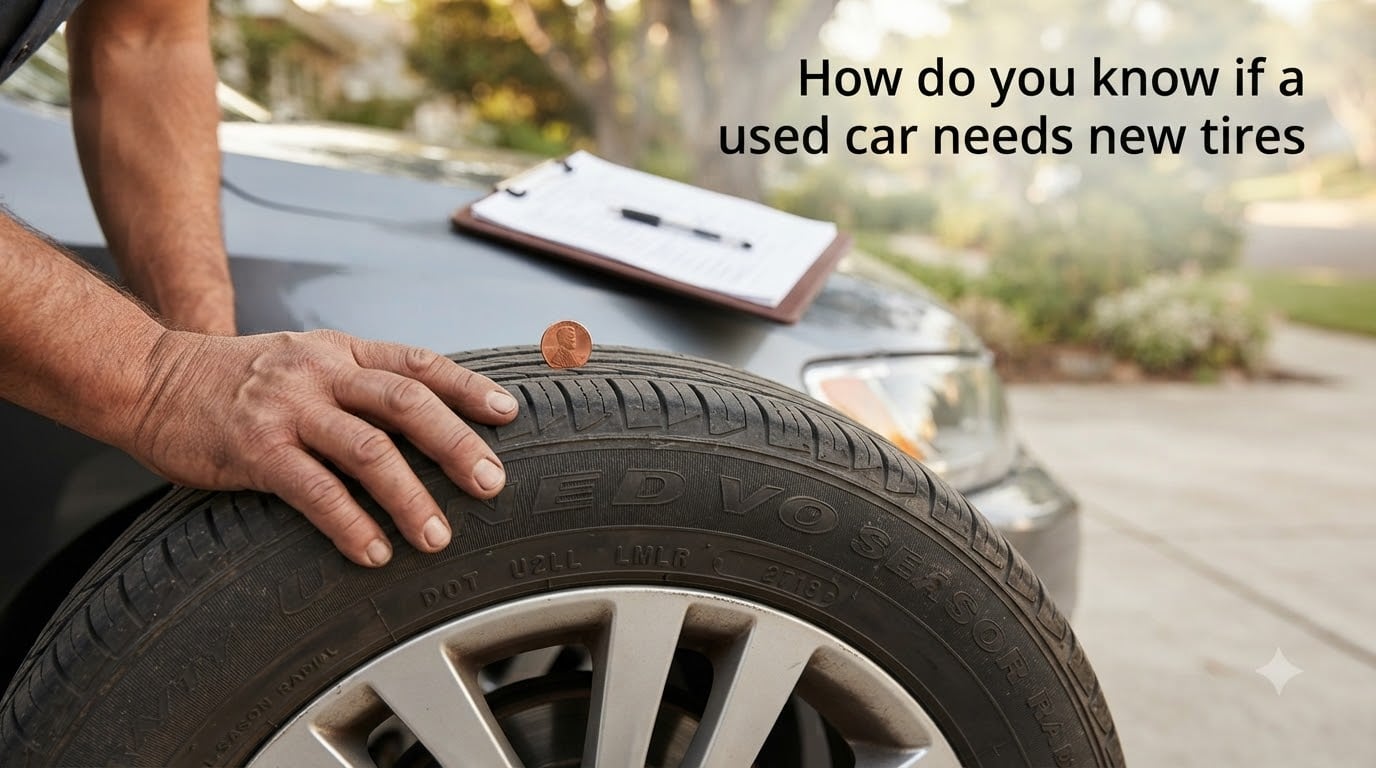
How do you know if a used car needs new tires? It is one of the first questions we hear from people who just bought, or are about to buy, a pre-owned vehicle, because the previous owner never left a tire maintenance log behind.
Tires are the only part of the car that touches the road. The National Highway Traffic Safety Administration links roughly 200 U.S. fatalities a year to tire-related crashes, and a used-car buyer inherits tires whose age, alignment history, and damage record are usually a blank page.
In this guide I’ll walk you through the seven warning signs we look for first, how to actually measure tread depth with a penny, how to read the DOT date code stamped on every sidewall, and a 5-minute inspection sequence you can run in any driveway before you sign the paperwork.
Table of Contents
7 Warning Signs You Need New Tires
When a tire shop tells you the tires are done, you should be able to verify it yourself in about five minutes. Here are the seven warning signs I check, in the order I check them.
- Tread wear bars are flush with the tread. Every tire has small raised bars that sit inside the main grooves. When the surrounding tread wears down to the same level as those bars, the tire is at the legal end of its life and needs replacement.
- The penny or quarter test fails. If you can see the top of Lincoln’s head when a penny goes head-first into a groove, the tread is below 2/32 inch and the tire is unsafe.
- Cracked or dry-rotted rubber. Hairline cracks across the sidewall or between the tread blocks mean the rubber has hardened with age, usually after six to ten years regardless of how much tread is left.
- Sidewall bulges, cuts, or deep punctures. A bulge means the internal cords are broken; the tire can fail at any speed. Cuts deeper than 1/16 inch or any visible cord are also a fail.
- Uneven tread wear across the tire. Wear on one edge, the center, or in scalloped patches points to alignment, inflation, or suspension issues that no amount of new rubber will fix until the underlying cause is corrected.
- Vibration, noise, or pulling while driving. Steering-wheel shake at highway speed, a thumping that changes with road speed, or a car that drifts left or right on a flat road are all reasons to pull over and inspect.
- TPMS light or repeated low-pressure warnings. A tire that consistently loses pressure even with no visible nail is failing, either through a bead seal, a cracked rim, or a deteriorated inner liner.
How to Check Tread Depth (Penny Test and Wear Bars)
Tread depth is the single most useful number on a tire. Three thresholds matter: 10/32 inch on a brand-new tire, 4/32 inch as the wet-traction safety floor most technicians recommend, and 2/32 inch as the legal minimum in most U.S. states.
Tread Depth Thresholds at a Glance
- 10/32 inch – new tire, full grip in rain and snow.
- 6/32 inch – typical replace-around point for normal drivers.
- 4/32 inch – replace-soon threshold for wet climates; stopping distance in rain climbs sharply below this.
- 2/32 inch – legal minimum in most states; tire is at the end of its service life.
The Penny Test, Step by Step
- Grab a U.S. penny and find the easiest groove to reach, usually on the center tread.
- Insert the coin with Lincoln’s head facing down and pointing into the groove.
- If any part of Lincoln’s head is always covered by tread, you have at least 2/32 inch and the tire passes the legal bar.
- If you can see the top of Lincoln’s hairline, the tread is below 2/32 inch and the tire should be replaced.
- Repeat on the inner, center, and outer grooves of every tire. Tires wear unevenly, so one good spot does not mean the tire is good.
The Quarter Test (a Stricter Check)
A quarter test is the upgrade most drivers skip. Insert a U.S. quarter with Washington’s head pointing down into the tread. If you can see the top of his head, the tread is below 4/32 inch, which is the wet-weather safety line. We recommend it for anyone who drives through heavy rain, lives in a four-season climate, or is buying a car sight-unseen.
How to Read the DOT Code and Check Tire Age
Tread depth tells you how much rubber is left. The DOT code tells you how old the rubber is, and age can matter more than tread. Tires degrade even when the car is parked, because the rubber compounds oxidize over time.
Where to Find the DOT Code
Look at the sidewall of the tire, on the side facing outward when the wheel is mounted. You’ll see a string that starts with DOT followed by a plant code, a size code, and a four-digit date code at the end.
Reading the Last 4 Digits
The first two digits are the week of manufacture, the last two are the year. So DOT … 2219 means the tire was made in week 22 of 2019. Tires made before 2000 use a three-digit code that ends in a single year digit, for example 328 meaning the 32nd week of 1998.
Tire Age Action Table
- 0 to 3 years old: Inspect normally, no age-based action needed.
- 3 to 5 years old: Inspect sidewalls for cracking every oil change; check pressure monthly.
- 6 to 10 years old: Plan replacement, especially before long road trips or winter seasons.
- Over 10 years old: Replace regardless of tread depth. Most manufacturers, including NHTSA-aligned guidance from tiremakers, treat this as the hard retirement line.
On a used car, this is the single biggest surprise for buyers. A tire can look brand new and still be seven years old, and the previous owner may have swapped tires of different ages onto the same axle.
Sidewall Damage, Cracks, and Bulges: What Counts as a Fail
The sidewall is the flexible side of the tire that flexes over bumps. Unlike the tread, it has no reinforcing bars, so any damage here is structural.
A bulge means an internal cord has snapped and the air pressure is pushing the inner liner through the gap. A bulging tire can fail without warning at highway speed, so it is an immediate-replace item every time, even if the tread is perfect.
Hairline cracks on the sidewall are usually a sign of age and ozone damage. Light surface cracks on a five-year-old tire are watch-and-monitor. Deep cracks that you can catch a fingernail in, or cracks that expose the black cords underneath, mean the tire is finished.
Cuts or punctures larger than 1/4 inch in the tread, or any puncture in the sidewall, are not safely repairable. Sidewall flexes too much for a plug or patch to hold.
What Uneven Tread Wear Is Telling You
Even wear across the full width of the tire is healthy. Anything else is a message from the tire about the car, and that message is worth reading before you replace anything.
- Center wear (smooth in the middle, more rubber on the edges): almost always over-inflation. Drop the pressure to the figure on the driver’s door jamb, not the number on the tire sidewall.
- Edge or shoulder wear (more rubber gone on the inside or outside edges): usually under-inflation, but if both edges are even and the center is fine, it can also be a worn suspension bushing letting the tire flex.
- One-sided wear (only the inner or only the outer edge is bald): alignment problem, almost always camber or toe. A new tire without an alignment will wear the same way in 10,000 miles.
- Cupping or scalloping (dip-dip-dip patches around the circumference): suspension issue, usually a worn strut, shock, or a wheel that needs balancing. New tires will not fix it.
If we see uneven wear on a used car, we treat the wear pattern as the primary diagnosis and the tire replacement as a secondary fix. Replacing tires without correcting the underlying issue is the most expensive way to find out your car needs an alignment.
Signs You Need New Tires While Driving
Some warning signs only show up at speed, and they are the ones most likely to catch you off guard on a highway entrance ramp.
- Steering wheel vibration at highway speed that does not change when you brake usually points to a tire that has lost its round shape from internal damage or uneven wear.
- A roaring or thumping noise that rises and falls with road speed often means a worn tread block pattern or a tire that is out of round.
- The car pulls to one side on a flat road with no crosswind. If alignment and tire pressure check out, the most likely cause is one tire with significantly less tread than the others.
- Slipping or hydroplaning in rain at speeds you used to feel fine on is the most dangerous sign, because it means the tread can no longer evacuate water.
Used-Car Pre-Purchase Tire Checklist (5-Minute Inspection)
This is the inspection sequence we run on every used car we look at, in this order. It takes about five minutes and only needs a penny and a flashlight.
- Walk around the car and read all four DOT codes. Note the ages. Anything over six years old is a negotiation point or a replacement plan.
- Run the penny test in three spots on each tire: the inner shoulder, the center, and the outer shoulder. The same tire should not pass on one side and fail on the other.
- Crouch and sight down each sidewall. Look for bulges, cracks, deep cuts, or screws. Run a hand over the sidewall to feel for any raised bump.
- Check tire pressure against the door-jamb sticker, not the sidewall. Cold pressure should be within 2 PSI of the listed number on every tire.
- Spin each wheel by hand (if the car is on the ground and safe to do) and look for the brake rotor edge to confirm the wheel turns freely without a grinding feel.
- Take a 3-minute test drive. Listen for hum or thump on smooth pavement, feel for vibration in the steering wheel above 45 mph, and note any pulling to one side.
- Ask for the previous owner’s tire records. Receipts for rotation, alignment, or replacement are worth as much as a service history for the engine.
If even one of these checks fails, you have leverage in the price negotiation. New tires for a sedan typically run several hundred dollars for a set, and a tire shop will quote you the same day.
Do You Have to Replace All Four Tires at Once?
Short answer: usually yes on an all-wheel-drive car, sometimes no on a front-wheel-drive or rear-wheel-drive car. The rule of thumb drivers call the 3-tire rule says the new tire should never be more than 3/32 inch deeper than its partner on the same axle, because the difference in rolling diameter sends the differential into a slow grind that you will not feel until the repair bill arrives.
On a front-wheel-drive car, putting two new tires on the rear axle is the safer move even if it feels counterintuitive; the rear tires are what keep the car stable in a slide. On staggered fitments, where the front and rear tires are different sizes by design, you can only replace them in axle pairs.
If you only need to replace one tire because of damage, most shops will recommend replacing the damaged tire and its axle partner, then rotating the deeper-tread pair to the front on a front-wheel-drive car.
Frequently Asked Questions
How many years do tires usually last?
Most tires last 6 to 10 years from the date they were manufactured, regardless of how much tread is left. The rubber hardens and loses grip with age, so a low-mileage tire that is eight years old is just as due for replacement as one with 50,000 miles on it.
Is 40,000 miles a lot on tires?
Forty thousand miles is average to slightly above average for a set of all-season tires. Higher-quality touring tires can reach 60,000 miles; performance tires often wear out at 25,000 to 35,000. The DOT date code matters more than mileage once you cross the six-year mark.
What is the 3 tire rule?
The 3-tire rule states that the new tire should not be more than 3/32 inch deeper in tread than its partner on the same axle. A bigger gap forces the differential or transfer case to work harder, which shortens its life and can trigger warning lights on all-wheel-drive vehicles.
Should I replace tires at 4/32 inch?
Yes, in wet or four-season climates. A tire at 4/32 inch stops noticeably shorter in rain than one at 2/32 inch, and hydroplaning resistance drops off quickly below 4/32. In dry desert climates you can usually wait until 3/32.
Is it safe to drive on 7 year old tires?
A 7-year-old tire with plenty of tread is still due for replacement. The sidewalls and inner rubber have already started to harden, and a blowout risk increases with age even when the tread looks fine. Plan to replace within the next year and inspect the sidewalls monthly for cracks.
How can I tell if a used car needs new tires before I buy it?
Read all four DOT date codes, run the penny test on three spots per tire, scan every sidewall for bulges and cracks, check cold pressure against the door-jamb sticker, and take a 3-minute test drive for vibration, noise, or pulling. Any tire over 6 years old or any failed penny test is fair negotiating ground.
Next Step: Verify in 5 Minutes, Then Schedule an Inspection
You can answer the question of how do you know if a used car needs new tires in a single afternoon, with a penny and a flashlight. Run the seven warning signs down the page, check every DOT code, and test-drive for vibration and noise before you commit.
If any check fails, take the car to a tire shop you trust and ask for a written inspection. A good shop will show you the measured tread depth, point out any sidewall damage, and give you a clear answer on whether the tires have another 20,000 miles in them or need to go today. That written inspection is also your best leverage if you are still in the negotiation window on the used-car price.