
Yes, it is worth replacing tires before a long road trip when any of these are true: tread depth is below 4/32 inch, the tire is more than 6 years old, sidewalls show cracks or bulges, or uneven wear points to an alignment or suspension issue. If your tires pass all four checks, inspect them, set cold tire pressure to the door-jamb spec, and go. AAA research found worn tires add up to 87 feet of stopping distance on wet roads at highway speeds, which is why the four checks matter more than the odometer reading.
I have been writing about road-trip prep for years, and the same question comes up every summer: drivers want a clear pass or fail answer, not a tire-shop pitch. This guide gives you that answer with the actual thresholds I trust, plus a self-inspection walkthrough you can do in your driveway the morning you leave.
Table of Contents
The Short Answer: Replace or Keep?
You only need new tires before a long road trip if your current set fails one or more of the checks below. If everything passes, you are safe to drive.
Replace before the trip if:
- Tread depth is 4/32 inch or less on any tire
- The tire is 6 years old or older (check the DOT date code)
- Sidewalls show cracks, cuts, bulges, or visible embedded objects
- Wear is uneven across the tread (feathering, cupping, inner or outer edge wear)
- You feel vibration at highway speed that did not exist a year ago
Keep and inspect if:
- Tread depth measures 5/32 inch or more on all four tires
- The DOT date code shows the tire is under 6 years old
- Sidewalls are smooth with no cracks or bulges
- Wear is even across each tire and across the axle
- The spare tire holds air and is not dry-rotted
If you sit on the line between these two lists, the next sections walk through how to confirm each check with simple tools. A 10-minute driveway inspection is enough for most decisions.
How to Check Your Tires Before a Long Road Trip
These are the five inspections I run before any trip longer than a few hundred miles. None require special tools beyond a quarter, a tire-pressure gauge, and your eyes.
Step 1: Measure Tread Depth (Penny and Quarter Test)
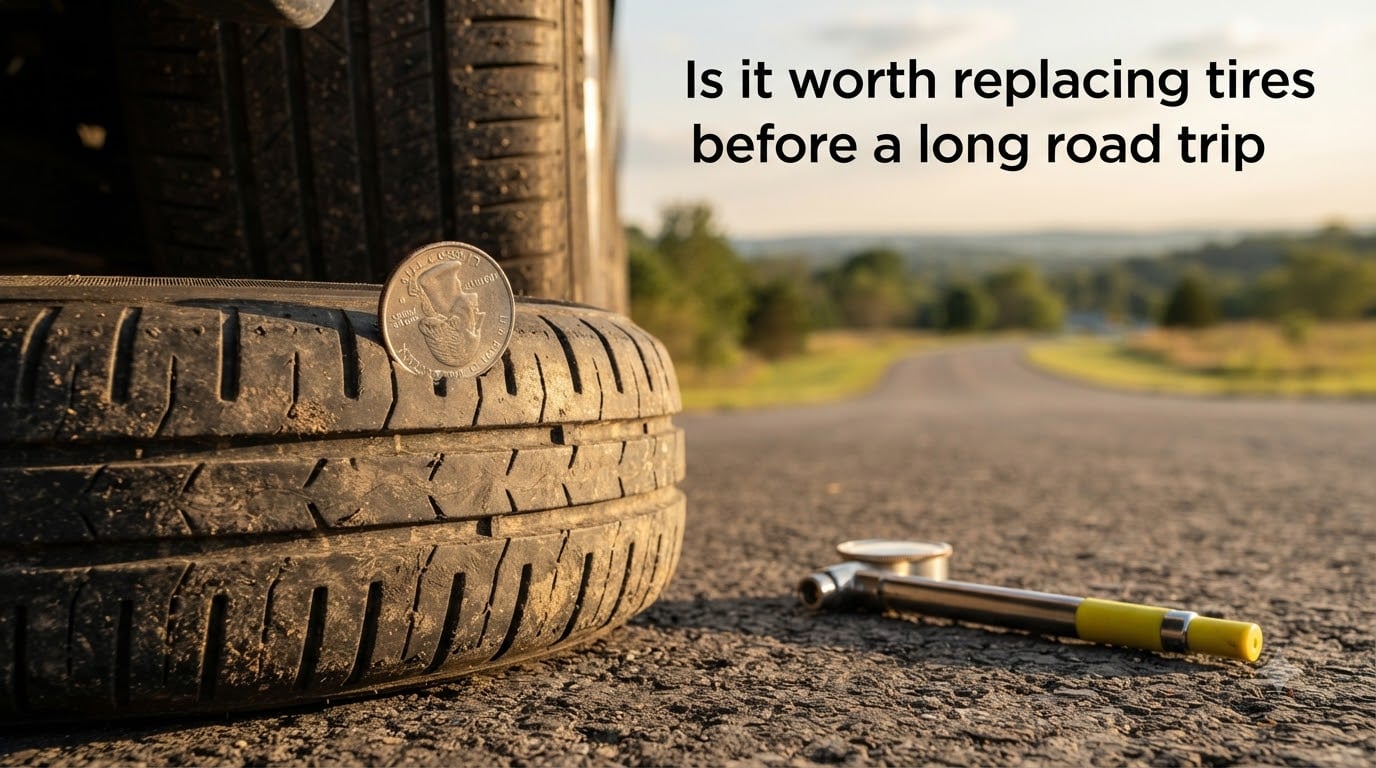
The penny test is the classic DIY check, but the quarter test is the one that actually matters for highway safety. Grab a US quarter and stick George Washington’s head into the tread groove with his hair pointing down.
If you can see the top of Washington’s head above the tread, you are below 4/32 inch and the tires should be replaced before any highway trip. If the tread touches or covers the top of his hair, you are at roughly 4/32 inch or above.
For a finer reading, buy a plastic tread depth gauge for a few dollars at any auto-parts store. It is more accurate than coins and lasts for years. Measure the center, inside edge, and outside edge of each tire, because uneven readings tell you about alignment and rotation issues.
Step 2: Read the DOT Date Code for Tire Age
Every tire sold in the US carries a DOT date code on the sidewall that ends in four digits. The first two are the week of manufacture, the last two are the year. A code ending in 1522 was made in week 15 of 2026.
Most tire and rubber industry groups recommend replacing tires at 6 years regardless of tread depth, and many safety experts cap tire life at 10 years even with low mileage. Rubber hardens and loses grip with age, and dry-rot cracks can appear before the tread is worn down.
If your DOT code shows the tire is 6 years or older, replace it before a long trip even if the tread still measures 6/32. If you cannot find a clear date code, the tire is old enough that a professional inspection is worth the cost.
Step 3: Inspect Sidewalls for Cracks, Bulges, and Embedded Objects
Sidewall damage is the leading cause of sudden blowouts at highway speed, and it is one of the clearest replace-now signals. Run your hand around each sidewall and look for:
- Cracks that run across the rubber, often called dry rot
- A bubble or bulge, which means the internal cords have failed
- A nail, screw, or piece of metal embedded in the rubber
- Cuts deeper than a few millimeters, or any cut that exposes the cords
Any bubble or bulge means the tire is unsafe at any speed and should not be driven on a highway trip. A single nail can sometimes be patched, but only if the tire is professionally removed and inspected from the inside. Sidewall punctures cannot be repaired.
Step 4: Check Cold Tire Pressure, Including the Spare
Tire pressure that is too low or too high is the single most common cause of tire failure on road trips. The right number is on a sticker inside your driver’s door jamb, not on the tire itself.
Check pressure when the tires are cold, meaning the car has been parked for at least 3 hours or driven less than a mile. A gauge from any auto-parts store works fine. Add or release air to match the door-jamb spec, and remember to check the spare at the same time. A flat spare 200 miles from home is the same problem as a flat tire.
Underinflated tires overheat on long highway drives, which is the most common blowout trigger. Overinflated tires wear the center tread faster and reduce wet grip.
Step 5: Look for Uneven Wear Across All Four Tires
Uneven wear is more than a maintenance issue. It is a safety signal. Compare the tread pattern across all four tires, and compare the inside edge, center, and outside edge of each tire.
Inner or outer edge wear usually means an alignment problem. Center wear means the tires have been overinflated. Cupping or scalloping, which feels like a rhythmic vibration, usually means a worn suspension part or a balance issue. Any of these is a reason to fix the root cause before a long trip, because the wear will only get worse at highway speed.
If the wear is even but the tread is simply low across the whole tire, you are looking at normal mileage wear and the replacement decision is straightforward.
Tread Depth and Stopping Distance: What the Numbers Mean
Tread depth is the most important number on the tire. The table below maps common readings to wet stopping distance and the recommendation I would give before a long highway trip. Stopping distance figures come from AAA research and Tire Rack testing at 60 mph on wet pavement.
| Tread Depth | Wet Stopping vs New Tire | Recommendation |
|---|---|---|
| 8/32 inch or more | Baseline | Safe for any road trip |
| 6/32 inch | Slightly longer | Safe for dry trips, inspect for trips in heavy rain |
| 5/32 inch | Noticeably longer in wet | Safe for dry highway, replace soon if rain is in the forecast |
| 4/32 inch | Significantly longer (up to 87 ft) | Replace before the trip, especially if any rain is expected |
| 3/32 inch | Much longer, hydroplane risk rises | Replace now, do not plan a long highway drive |
| 2/32 inch or less | Legal limit reached, unsafe in wet | Replace immediately, no exceptions |
The jump from 5/32 to 4/32 is where wet stopping distance grows fast. AAA testing showed vehicles on 4/32 tires needed up to 87 more feet to stop on wet roads compared to the same vehicle on new tires. At 60 mph, 87 feet is roughly three car lengths, and it is enough to turn a close call into a collision.
For most drivers planning a dry-weather trip of any length, 5/32 is the practical floor. For a trip that includes rain, mountains, or heavy load, 6/32 is the safer floor.
Trip Factors That Change the Decision
Two cars with the same tire age and tread depth can sit on different sides of the replace-or-keep line depending on the trip itself. Distance, terrain, load, and weather all shift the threshold.
Distance, Terrain, and Load
A 200-mile weekend trip on flat interstates is a different risk profile than a 2,000-mile haul through mountain passes with a loaded roof box. Long distance means more hours at highway speed, more heat buildup, and a longer drive home if something fails. Mountain terrain adds braking load on descents, which is when marginal tires show their weakness.
Heavier loads raise the working pressure on each tire. If you are towing a trailer, carrying four passengers, or packing the car to the roof, inflate to the load-rated pressure listed on the tire or in the owner’s manual, not just the door-jamb number.
Weather and Season
Rain is the single biggest amplifier of worn-tire risk. Hydroplaning starts earlier on low tread, and stopping distance grows fast as tread drops below 4/32. If your trip crosses any region with rain in the forecast, replace tires that measure 4/32 or less before you leave.
Snow and ice require more tread than dry pavement and ideally a dedicated winter tire. All-season tires at 6/32 are usually fine for a Florida-to-California winter drive through mild weather, but a Colorado mountain pass in February is a different question.
Highway vs City Driving Wear Patterns
Highway miles are gentler on tires than city miles. Steady speeds and long sweeping turns wear evenly, while stop-and-go traffic and sharp corners wear shoulders and edges faster. A tire with 30,000 highway miles often looks better than one with 30,000 city miles.
If your odometer is mostly highway and the tread still measures 5/32 or more, the tires are likely fine for another road trip. If most of your miles are city, the same reading might be closer to the replace-soon line.
Replace Now or Replace on the Road: The Cost-vs-Risk View
The honest argument for replacing before the trip is not the tire cost. It is the difference between replacing tires on your schedule versus replacing them on a roadside at mile 1,400 of your trip.
A planned set of four tires lets you shop around, choose the model you want, install at your convenience, and break the tires in over a few hundred miles. A roadside failure means a tow, a hotel, a rental car, and whatever tires the nearest shop has on the rack, often at premium pricing.
Multiply that risk by the cost of missing a hotel reservation, a flight, or a wedding, and the math usually lands on the side of replacing before you go. The exception is when the tires pass every check above, in which case the inspection and a few hundred dollars of rotation and balance is the right investment.
If money is the barrier, consider replacing just the two tires with the lowest tread and putting the newer pair on the rear axle. Rear-tire grip matters more for stability than front-tire grip, and this is the configuration most tire makers recommend for two-tire replacement.
If you are still unsure, take the car to a tire shop you trust and ask for a written tread-depth and age report on all four tires plus the spare. A reputable shop will give you that without pressure to buy, and the report gives you a neutral second opinion before a long drive.
Frequently Asked Questions
Should you get new tires before a road trip?
Replace tires before a long road trip if tread depth is below 4/32 inch, the tire is 6 years old or older, sidewalls show cracks or bulges, or wear is uneven. If your tires pass those four checks, inspect them, set cold tire pressure to the door-jamb spec, and you are safe to drive.
What is the minimum safe tire tread depth?
2/32 inch is the legal minimum in most US states, but 4/32 inch is the practical minimum for highway driving in rain, and 5/32 is safer for any wet-weather trip. AAA research shows stopping distance grows sharply once tread drops below 4/32.
Do I need new tires after 30,000 miles?
Not necessarily. Many all-season tires are rated for 50,000 to 70,000 miles, and highway-driven tires at 30,000 miles often have 7/32 or more tread left. Check tread depth and age rather than relying on the odometer alone.
Is 5/32 too soon to replace tires?
No. 5/32 is still safe for dry highway driving, but it is a good time to start planning replacement, especially if the trip includes rain. Below 5/32, wet stopping distance starts to grow noticeably.
How long can you drive on 3/32 tires?
You can drive on 3/32 tires for short local trips, but not for a long highway drive, and especially not in rain. Hydroplaning risk rises sharply below 4/32, and roadside replacement is more expensive than proactive replacement.
Do tires last longer with highway driving?
Yes. Highway miles are gentler on tires than city miles because speeds are steady and corners are gentle. A tire with 40,000 highway miles usually has more usable tread than one with 40,000 city miles.
How old is too old for tires?
Most tire and rubber industry groups recommend replacing tires at 6 years regardless of tread depth, and many safety experts cap tire life at 10 years. Read the four-digit DOT date code on the sidewall to find the week and year of manufacture.
The Bottom Line
Whether it is worth replacing tires before a long road trip comes down to four checks: tread depth above 4/32 inch, age under 6 years, sidewalls free of cracks and bulges, and even wear across all four tires. If any check fails, replace before you go. If all pass, inspect, set cold tire pressure to the door-jamb spec, and drive.
The cost of proactive replacement is almost always less than the cost of a roadside failure in the middle of a long trip. Take 10 minutes in your driveway, run through the checklist, and you will know the answer with confidence.