
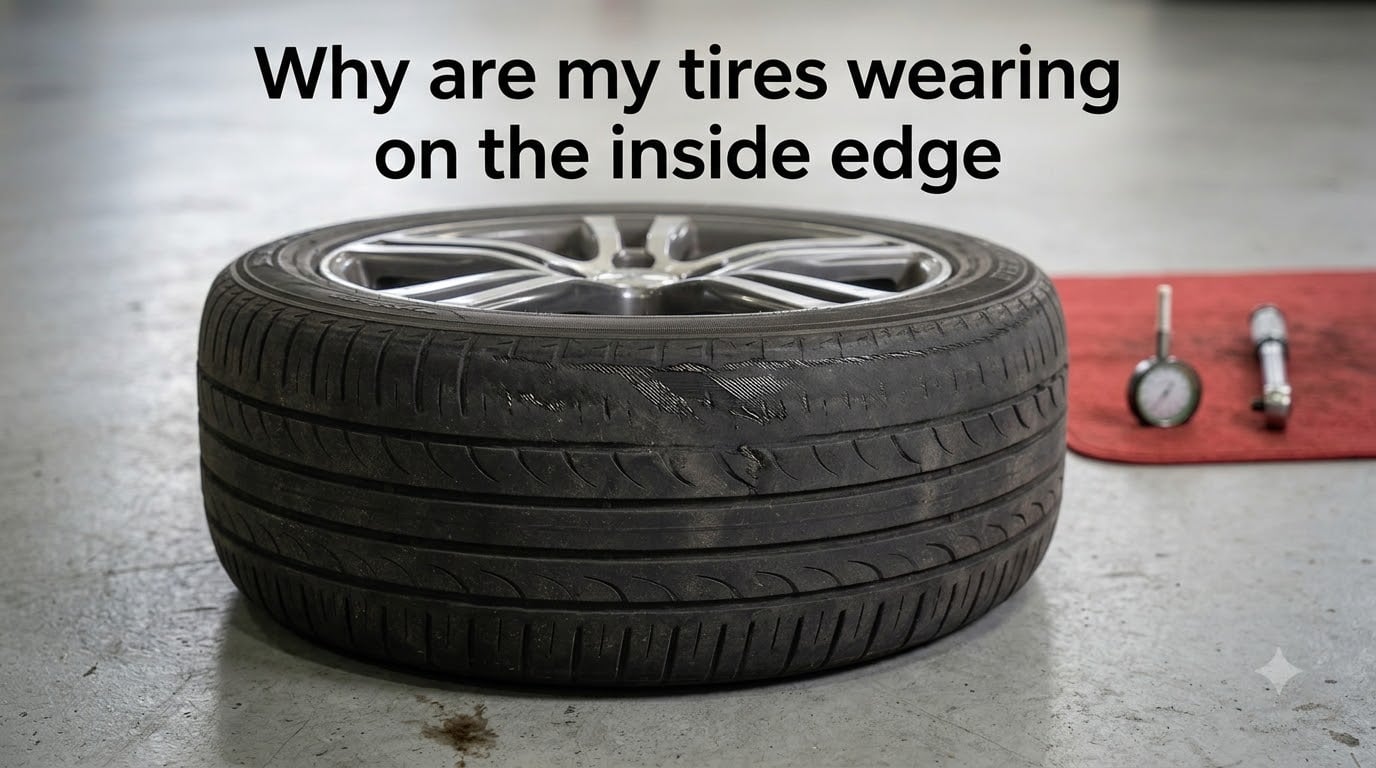
Your tires are wearing on the inside edge because the wheels are tilted or angled in a way that forces the inner shoulder of the tread to carry more of the vehicle’s weight. In most cases the culprit is negative camber, which tilts the top of each wheel inward toward the engine bay, or toe misalignment, which points the front of the tires outward like a duck stance. Worn ball joints, control arm bushings, or strut mounts can create the same symptom even after a fresh alignment, which is why so many drivers see the wear return within a few thousand miles.
I have walked customers through this exact diagnosis more times than I can count at the shop, and the inside edge is one of the most expensive wear patterns to ignore. The inner shoulder is hard to see during a casual walk-around, which is why most people catch it only after the tire is already noisy, feathering, or down to the wear bars. This guide walks through every common cause, how to tell them apart, and what to do about it.
Table of Contents
Quick Answer: Why Are Your Tires Wearing on the Inside Edge
If you need the short version before you keep scrolling, here is the diagnosis in one place. The full breakdown lives in the sections below.
- Negative camber is the most common cause. The wheel tilts inward at the top, the inner edge bears more load, and the tread rubber scrubs off faster on that side.
- Toe misalignment is the second most common cause. Toe-out at the front pushes the front of the tires apart, scrubbing the inner shoulders as you drive.
- Worn suspension components like ball joints, control arm bushings, strut mounts, or tie rod ends let the wheel drift out of alignment even after a shop adjusts it.
- Low tire pressure and chronic overloading can mimic the same wear pattern by letting the sidewall flex and the inner shoulder scrub against the road.
- Position matters. Front-only inside wear points to alignment or steering parts; rear-only inside wear usually points to a bent rear axle, a sagging spring, or a worn trailing arm bushing.
Negative Camber: The #1 Cause of Inside Tire Wear
Negative camber means the top of your wheel is tilted inward toward the center of the vehicle. When a tire sits at a negative camber angle during straight-line driving, only the inner edge of the contact patch is fully loaded, and that edge wears first.
A small amount of negative camber is normal and even helpful for handling, which is why most factory alignments leave a fraction of a degree on the front wheels. The trouble starts when the angle drifts past the factory spec, usually because of an impact with a curb, a worn upper strut mount, a sagging spring, or simply the suspension settling over time.
How to Spot Negative Camber Wear
The tell is a clean diagonal wipe across the inner tread blocks. The inside shoulder goes bald while the outer shoulder still has full tread depth. If you run your hand across the tread from the inside to the outside, you can feel a sharp edge where the wear ends, almost like a step. That sharp edge is the signature of camber wear.
What Causes Excessive Negative Camber
- Bent or sagging spring on the affected corner, which lowers that wheel and tilts the top inward.
- Worn upper strut mount, especially on vehicles where camber is set with shims or slots at the top of the strut.
- Collision or hard curb impact that knocks the knuckle out of position.
- Aftermarket lowering that drops the car past the alignment range the factory allows.
On many vehicles the camber adjustment lives under the hood at the top of the strut tower, or inside the strut-to-spindle connection. A shop with the right plates or cam bolts can usually pull it back into spec.
Toe Misalignment: Toe-Out vs Toe-In and Inside Wear
Toe is the angle of the wheels when you look at the car from above. Toe-in means the fronts of the tires point slightly toward each other. Toe-out means the fronts point slightly away from each other. Toe-out is the more common setup for aggressive inner edge wear.
When the wheels point outward at the front, every mile of driving scuffs the inside shoulder across the pavement. The wear usually shows up as a feathered edge you can feel by running your hand along the tread in the direction of travel, rather than the sharp diagonal wipe of camber.
Common Sources of Toe Drift
- Worn tie rod ends that allow the steering to wander and the toe to open up.
- Loose or worn steering rack bushings that let the whole rack shift under acceleration.
- Subframe shift after a curb impact or a worn subframe bushing.
- Previous botched alignment that was never corrected after suspension parts were replaced.
Toe is also the angle most affected by routine driving. A single pothole can move a front wheel several hundredths of an inch out of spec, and over time those small changes add up. This is why toe is checked at every alignment and is usually the first thing a technician re-checks if you come back with an inside wear complaint.
Worn Suspension Components That Mimic Alignment Problems
This is the cause that frustrates drivers the most. You pay for a four-wheel alignment, the printout says everything is green, and within 10,000 miles the inside edges are bald again. The reason is almost always worn parts the alignment cannot fix on its own.
Ball Joints and Control Arm Bushings
Ball joints connect the control arms to the steering knuckles, and bushings cushion where the control arms meet the frame. When either wears out, the wheel can rock slightly under load, which throws camber and toe out of spec the moment you drive over a bump. As one Reddit user put it after replacing their third set of tires in two years: “You need your suspension bushes and ball joints looked at with that amount of wear.”
Strut Mounts and Strut Bearings
On many front-strut vehicles, camber is set at the top of the strut tower. If the upper strut mount is worn or the bearing is binding, the strut tilts under braking and acceleration, which drags camber out of alignment continuously. A GMT Nation owner diagnosed this in their own truck and confirmed it was the real issue, not just an alignment problem.
Tie Rod Ends and Inner Tie Rods
Tie rods are the most overlooked source of toe drift. Inner tie rods can wear slowly for tens of thousands of miles before a noticeable looseness shows up in the steering. By the time the toe is visibly off, the inside edges have usually already paid the price.
The fix is to have a mechanic inspect every joint and bushing that affects wheel angle before paying for an alignment. A good shop will lift the car, grab each tire at six and twelve o’clock, and look for any play. If there is movement, the parts have to come first. Otherwise the alignment is built on a moving foundation.
Tire Pressure, Overloading, and Other Secondary Causes
Alignment is not always the cause. I have seen tires wear on the inside edge simply because the air pressure was chronically low, or because the vehicle was loaded past its payload rating on a regular basis.
Low Tire Pressure
Underinflated tires bulge the sidewall outward and push more of the contact patch toward the shoulders, including the inner one. The wear shows up on both shoulders rather than just one, which is a clue that pressure is part of the problem. Check the placard on the driver’s door jamb for the correct cold pressure and inflate to that number, not the number molded on the sidewall.
Overloading the Vehicle
Excess weight in the cargo area or cabin pushes the suspension closer to the bump stops, which can change camber at the loaded axle. If the inside wear appeared right after you started towing or hauling regularly, the load may be the trigger.
Aggressive Driving Style
Hard cornering loads the outside tire heavily, but the inside tire on the opposite side of the car still carries weight through the suspension geometry. Repeated hard cornering can accelerate inner edge wear on the inside wheels of the turn. Track-day cars and sport-tuned suspensions see this most often.
Front vs Rear Inside Wear: What the Position Tells You
The axle that is wearing tells you a lot about the cause. Front-only wear points at steering and front suspension. Rear-only wear points at the rear axle and is often missed because rear tires rarely get as much attention.
Front Tires Wearing on the Inside Edge
This is the textbook case for negative camber, toe misalignment, or worn front suspension parts. Front tires also steer, so any looseness in the steering or suspension shows up here first. Start with a four-wheel alignment and a suspension inspection at the same visit.
Rear Tires Wearing on the Inside Edge
Rear inner wear is less common but more concerning when it shows up. Causes include a bent rear axle, a sagging rear spring, worn trailing arm or control arm bushings, or a body twist from an accident. All-wheel-drive and performance vehicles with independent rear suspensions are the most frequent cases. A rear alignment often finds nothing wrong with the toe itself but a lot wrong with the camber, because the camber is being set by a bent or worn component rather than by an adjustment.
All Four Tires Wearing on the Inside Edge
If every corner shows the same pattern, the cause is usually something global: chronic low tire pressure, an overloaded vehicle, a vehicle with a factory stance that is too aggressive for the alignment range, or a modification that changed the ride height beyond the alignment spec. Start with pressure and load, then check ride height and alignment together.
How to Fix Tires Wearing on the Inside Edge
Fixing inside tire wear is a sequence, not a single step. Skipping a step is how drivers end up replacing tires twice in one year.
Step 1: Check Tire Pressure First
Set all four tires to the pressure listed on the driver’s door jamb, cold, before anything else. Tire pressure is free, takes five minutes, and rules out the simplest cause. If the wear pattern is on both shoulders, low pressure is the most likely culprit on its own.
Step 2: Inspect Suspension Components
Have a technician lift the vehicle and check ball joints, control arm bushings, tie rods, strut mounts, and any other joint that controls wheel angle. If anything is loose or worn, replace it before paying for an alignment. Aligning a worn suspension is like balancing on a cracked chair leg.
Step 3: Get a Four-Wheel Alignment With a Printout
Ask the shop for a before-and-after printout that shows camber, caster, and toe on all four wheels against the manufacturer spec. The printout is your evidence that the alignment was actually performed and that every angle is within tolerance. If a shop refuses to provide one, take your business elsewhere.
Step 4: Decide Whether to Replace the Tires
If the inner shoulder is already down to the wear bars or below 4/32 inch of remaining tread, the tire is not safe and no alignment will bring the tread back. New tires before or after the alignment depends on the shop’s equipment. Many alignment shops prefer to align with the old tires installed in their current positions, then mount the new tires, so the alignment captures the way the car actually sits.
Step 5: Reset Your Maintenance Habits
After the repair, commit to tire rotations every 5,000 to 7,500 miles and a quick alignment check once a year or after any curb or pothole impact. This is the cheapest insurance against the wear coming back.
The total cost of a proper fix usually runs from a basic alignment on a vehicle with healthy suspension up to several times that if ball joints, control arms, or bushings need replacement. New tires are a separate cost on top of the mechanical work. The reason the inside edge is worth catching early is that one set of tires is far cheaper than two, and a worn ball joint that destroys a fresh set of tires is a hard lesson.
How to Prevent Inside Tire Wear From Coming Back
Once the cause is fixed, prevention is mostly about habits. I have seen drivers keep the same set of tires running smoothly for 50,000 miles with a simple routine, and I have seen others burn through tires in 15,000 miles by ignoring the same checks.
Rotate Tires Every 5,000 to 7,500 Miles
Rotation spreads wear across all four positions, so even if one corner wants to wear faster, no single tire carries the load long enough to fail prematurely. One Reddit user described exactly this dynamic: “I rotated religiously from 0 to 30k and slacked on 30 to 40k and the wires showed on the inner edges.” The pattern showed up the moment the rotation lapsed.
Check Alignment Once a Year
An annual alignment check costs less than a single tire and catches drift before it shows up as wear. Include it with your seasonal tire swap if you run winter and summer sets.
Inspect After Every Curb or Pothole Impact
A hard impact can move a wheel out of alignment instantly. If you feel a pull, a vibration, or a new noise after hitting something, get an alignment check before the wear develops.
Watch for EVs and Heavy Vehicles
Electric vehicles are heavier than their gasoline counterparts, and the extra mass loads the inside shoulder harder, especially on performance-oriented EVs with staggered wheels. Heavy trucks and vans see similar patterns. Both benefit from more frequent rotations and a closer eye on alignment intervals.
Keep Tire Pressure in the Right Range
Check pressure monthly, not just at oil changes. Temperature swings of 10 degrees can change pressure by a pound or more, and small drops add up over a season.
Frequently Asked Questions
How to fix tires wearing on inside?
Start with tire pressure, then have a mechanic inspect the suspension for worn ball joints, bushings, tie rods, and strut mounts. Replace any worn parts before paying for a four-wheel alignment with a printed before-and-after report. If the inner shoulder is below 4/32 inch of tread, replace the tires as well so the new alignment is built on a fresh, even contact patch.
Can you drive with inner tire wear?
You can drive short distances at low speed with mild inside wear, but if the inner shoulder is down to the wear bars, below 4/32 inch of tread, or showing exposed cords, the tire is unsafe and should not be driven on. Inner wear reduces wet traction, makes braking uneven, and increases the risk of a blowout under hard cornering. Replace or repair the tire as soon as you spot the pattern, and treat any high-speed driving with the worn tire as out of the question.
Is it legal to have a tire worn on the inside edge?
In most U.S. states and Canadian provinces, a tire is legal only if every point across the tread, including the inner edge, has at least 2/32 inch of remaining depth. Many states also enforce that tread is not worn unevenly below that mark on any one spot. If the inside shoulder is below 2/32 inch even when the rest of the tire has plenty of tread, the tire can fail inspection and is technically illegal to drive on. Check your local regulations for the exact threshold.
Why are my tires bald on the inside edge?
Tires go bald on the inside edge for the same reasons they wear there in the first place, just taken further. The most common cause is negative camber from a sagging spring, a worn strut mount, or a hard curb impact that tilted the top of the wheel inward. The second most common cause is toe-out, where the front of the tires point outward and scrub the inner shoulder against the road. Worn ball joints, control arm bushings, and tie rods keep the wheel drifting out of alignment even after a fresh adjustment, so the baldness returns within months if those parts are not fixed first.
Bottom Line on Inside Tire Wear
The short answer to why are my tires wearing on the inside edge is almost always negative camber or toe misalignment, often combined with worn suspension parts that let the wheel drift out of spec. The inside shoulder is hard to see, so most drivers catch it after the damage is already done, which is why a quick walk-around inspection every few months pays for itself.
If you take one thing from this guide, take this: do not pay for an alignment until a mechanic has lifted the car and checked every joint and bushing that affects wheel angle. Aligning a worn suspension is the most common reason inside tire wear keeps coming back, and it is also the most avoidable. Get the suspension right, set the alignment with a printed report, replace any tire below 4/32 inch, and rotate on schedule. That sequence solves the vast majority of inside edge wear cases and keeps the next set of tires wearing the way the manufacturer designed them to.