
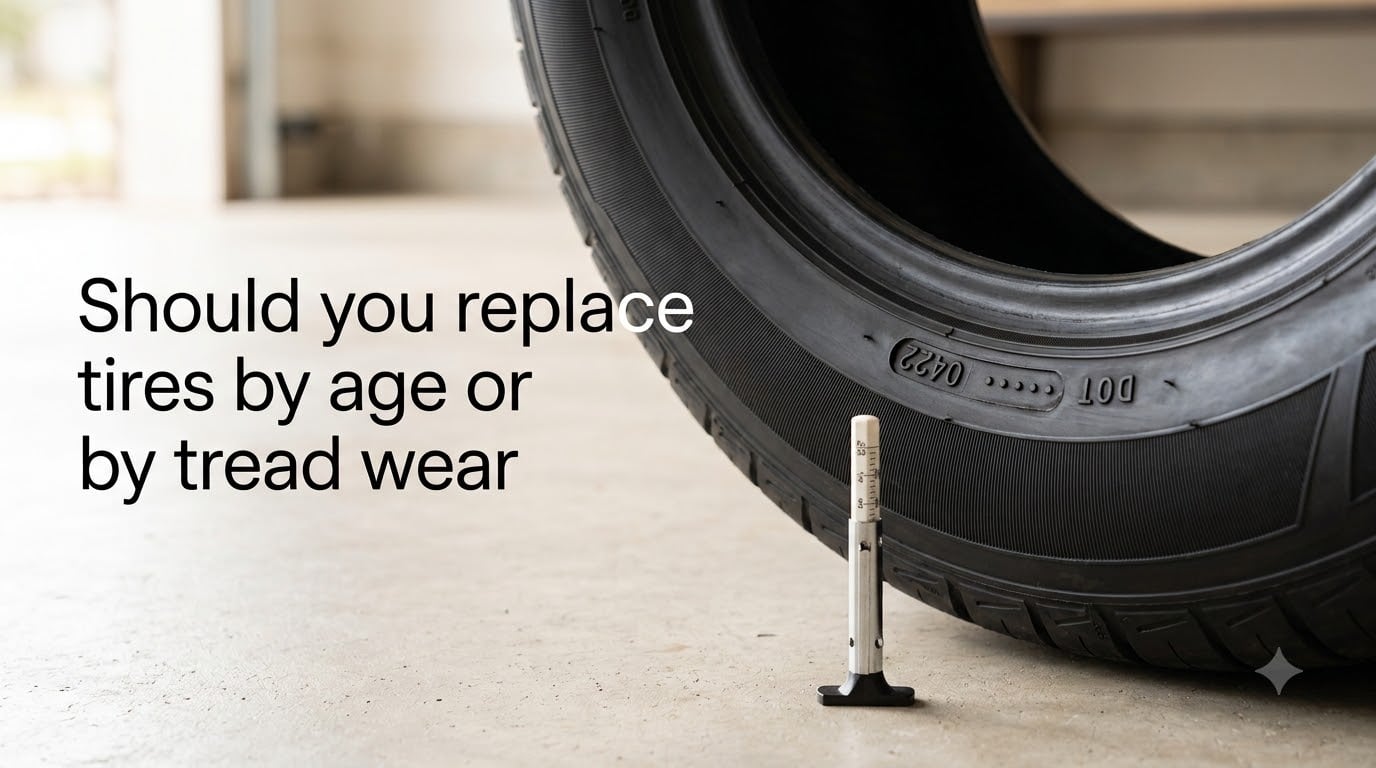
You should replace tires based on both age and tread wear, not one or the other. Tread depth tells you how much grip is left, but rubber ages even when a tire sits in a garage. Manufacturers disagree on the exact age cap: Discount Tire recommends replacement at 6 years, while Michelin says 10 years. The legal minimum tread depth in most U.S. states is 2/32 inch, but Consumer Reports and many tiremakers suggest swapping tires at 4/32 inch for wet-weather safety.
If your tires are over 6 years old, schedule an annual inspection regardless of how much tread is left. If your tread drops below 4/32 inch, start shopping for replacements now. Below 2/32 inch is unsafe and illegal in most states.
Table of Contents
Tread Depth: When to Replace Tires Based on Wear
Tread depth is the most visible sign a tire needs replacement, and every tire sold in the U.S. has built-in wear indicators called treadwear bars. These bars sit 2/32 inch deep and become flush with the surrounding tread when the tire is worn out. Once those bars appear across the entire tread surface, the tire is legally bald and must be replaced.
The legal minimum in most U.S. states is 2/32 inch. Below that depth, hydroplaning risk jumps sharply, braking distances stretch out, and you can be ticketed. Snow and all-season tires lose meaningful grip earlier than that.
That is where the “3 rule” comes from. The Tire Industry Association and several tire makers recommend replacing tires when tread depth reaches 3/32 inch. At 4/32 inch, hydroplaning risk on wet pavement starts climbing noticeably. Consumer Reports pulls the trigger at 4/32 because stopping distances grow on wet roads well before the legal limit. In snow, traction drops off fast once you drop below 5/32 inch.
Many drivers replace tires at 4/32 in rain-heavy regions and at 3/32 in dry climates. If you use winter tires, swap them out at 5/32 since worn snow tires lose their siping advantage.
How to Check Tread Depth: Penny Test and Gauge Method
There are three reliable ways to measure tread depth at home. The penny test is the simplest and works in a pinch, but a tread depth gauge gives you an exact reading in 32nds of an inch.
Penny test steps:
- Grab a U.S. penny and turn Lincoln’s head upside down.
- Insert the penny into the deepest tread groove on the tire.
- If you can see all of Lincoln’s head above the tread, your tread is below 2/32 inch and the tire is legally worn out.
- Repeat in three or four spots across the tire, including the inner, center, and outer tread, because tires often wear unevenly.
For a more precise reading, a tread depth gauge costs a few dollars at any auto parts store. Push the gauge pin into the groove, press the shoulders flat against the tread blocks, and read the measurement in 32nds of an inch. A quarter test also works: if the top of Washington’s head is exposed, you are below 4/32 inch, which is Consumer Reports’ replacement threshold for wet driving.
Always measure in multiple spots across each tire and check all four tires. Uneven wear points to alignment, inflation, or suspension problems worth fixing at the same time.
Age-Based Replacement Guidelines for Tires
Tire age is the silent criterion that catches even careful drivers off guard. Most manufacturers now publish hard timelines regardless of how much tread is left.
Discount Tire recommends replacing tires at 6 years of age, regardless of mileage or visible condition. Michelin recommends replacement at 10 years from the manufacture date, though they advise annual inspections after year 5. Most other major tiremakers, including Bridgestone, Goodyear, and Continental, sit somewhere in the middle with a 6 to 10 year window depending on the product line and use case.
The National Highway Traffic Safety Administration (NHTSA) does not enforce a fixed age limit but points to manufacturer guidelines and DOT date codes as the reference. If you drive in extreme heat, carry heavy loads, or use the vehicle commercially, treat the lower end of that range as your real ceiling.
The cleanest approach is this: at 5 years, start an annual professional inspection. At 6 years, plan replacement if any wear or damage shows up. By 10 years, replace no matter what the tread depth gauge says.
How to Check Tire Age Using the DOT Code
Every tire has a DOT code stamped on the sidewall that ends with a four-digit date code revealing the week and year of manufacture.
Reading the DOT date code:
- Find the “DOT” stamp on the inner sidewall of the tire. You may need to crouch down or turn the steering wheel fully to see it.
- Look at the last four digits of the DOT serial number.
- The first two digits are the week of the year the tire was made (01 to 52).
- The last two digits are the year of manufacture. For example, “1224” means week 12 of 2026.
- Tires made before 2000 used a three-digit code, but you will not see those on the road anymore.
If your tire shows a four-digit code like “2319,” that tire was made in week 23 of 2019. In 2026, that tire is 7 years old, well past Discount Tire’s 6-year recommendation and approaching Michelin’s 10-year ceiling.
Check all four tires plus the spare. Tires on the same car are often from different production batches. The newest tires are usually on the rear axle if a shop did a recent rotation, since installers typically move the newer pair to the back for stability.
Why Age Matters Even With Good Tread Depth
Rubber is not a stable material. Over time, the polymers and antioxidants that keep tire compounds flexible slowly break down through heat cycling, UV exposure, and ozone contact. The tread can look fine and still be chemically past its safe service life.
Three failure modes appear in aged tires even with deep tread:
- Dry rot shows up as fine cracks in the sidewall and between tread blocks. Once cracking spreads across more than a small section, the tire is no longer safe.
- Internal cord weakening happens silently. The polyester and steel belts lose adhesion to the rubber, raising blowout risk under load or during hard braking.
- Loss of wet grip comes from hardened rubber. The tread compound stiffens, so even 8/32 of new-looking tread can hydroplane sooner than 4/32 of fresh rubber.
Forum users on r/cars and r/askcarguys report surprise blowouts and braking problems on tires that looked perfectly fine from the outside. Several posters traced failures back to 8 to 10 year old tires that still had useful tread. The pattern is consistent enough that experienced mechanics treat age as a hard ceiling, not a soft suggestion.
If you see any cracking on the sidewall, treat it as a replacement signal even if the tread is deep. Sidewall flex under load is what keeps the tire together at highway speed, and cracked rubber cannot flex safely.
Climate, Storage, and Low-Mileage Drivers
Low mileage does not protect tires from aging. A car driven 3,000 miles a year and parked in a garage still sees heat cycles, humidity swings, and ozone exposure every day. Heat is the worst accelerator. Desert climates, dark-colored wheels, and southern U.S. states all push tires toward the early end of the age window.
Cold climates are not free either. Winter brings temperature swings from below zero to warm garage air. The expansion and contraction cycles harden the rubber over time. Studless winter tires stored on a vehicle through summer often age faster than the all-season set kept on the car year-round.
Stored tires are the easiest case to explain. A full-size spare that has been sitting in a trunk or under a cargo floor has been aging since the day it was mounted, even if it has never touched pavement. The trunk gets hot in summer and cold in winter, accelerating the same chemical breakdown. Many low-mileage drivers are shocked to learn a 9-year-old spare tire is past its safe window, even if the tread still has visible depth.
If your vehicle lives outside in direct sun, rotates in winter tires, or sits for weeks between drives, lean toward replacing at 6 to 8 years rather than waiting for 10. Bring the car in for a sidewall and tread inspection every year once it crosses the 5-year mark.
Don’t Forget Your Spare Tire in the Age Calculation
Spare tires follow the exact same age timeline as the four tires on the road. A donut or full-size spare mounted in 2018 is now 8 years old in 2026, regardless of whether it has ever been used.
Michelin and most other manufacturers make this explicit in their guidance: treat every spare the same way you treat a mounted tire. Check the DOT date, inspect the sidewall for dry rot, and replace the spare when you replace the road tires, or at the 10-year mark, whichever comes first.
A spare that has never carried a load is even easier to forget about, and that is exactly why so many drivers find rotted spares during a roadside emergency.
Quick Decision Checklist for Tire Replacement
Use this checklist the next time you are unsure whether to replace a tire:
- Tread at or below 2/32 inch: replace now (legal minimum).
- Tread at or below 3/32 inch: replace soon, especially in rain or snow.
- Tread at or below 4/32 inch: replace if you drive in wet conditions regularly.
- Tire age 6 to 7 years with no problems: schedule an annual inspection.
- Tire age 8 to 10 years: plan replacement within the next year.
- Visible sidewall cracking, bulges, or dry rot: replace regardless of tread depth.
- Spare tire older than 6 years: replace the spare on the next service visit.
Frequently Asked Questions
Is a 7 year old tire too old?
A 7 year old tire is at the edge of the safe window. Discount Tire recommends replacement at 6 years, and Michelin recommends annual inspections after year 5. If you see any cracking, have it replaced. Even without visible damage, plan replacement within the next 1 to 3 years.
What is the 3 rule for tires?
The 3 rule means replacing tires when tread depth reaches 3/32 inch. At that depth, wet traction drops off, snow grip is nearly gone, and stopping distances grow on dry pavement. Many tire shops and safety groups use 3/32 as the practical replacement point rather than the 2/32 legal minimum.
Are 9 year old tires with good tread still good?
No. Rubber degrades from the inside even when tread looks fine. A 9 year old tire is past the point most manufacturers recommend replacement, and Consumer Reports and Discount Tire both call for replacement by year 6 to 8. Age weakens the internal cords and the rubber compound, so a tire with visible tread can still fail at highway speed.
Should you replace tires at 4/32 inch?
Yes, in most climates. Consumer Reports recommends replacing tires at 4/32 inch because wet stopping distances start to grow well before the 2/32 legal minimum. If you drive in heavy rain or snow, 4/32 is the safer threshold. In dry desert climates, 3/32 is usually acceptable.
How long do tires last before dry rot?
Dry rot typically appears between 5 and 8 years, depending on climate. Hot, sunny conditions accelerate it. Stored tires or vehicles parked outside in UV-heavy regions can show cracking as early as year 5. Once dry rot spreads across the sidewall, the tire must be replaced regardless of how much tread is left.
How do you check how old your tires are?
Read the last four digits of the DOT code on the tire sidewall. The first two digits are the week of manufacture, and the last two are the year. For example, 1224 means week 12 of 2026. Check all four tires plus the spare, since production dates often differ between them.
Final Verdict on Tire Replacement Age vs Tread Wear
Age and tread wear both drive tire replacement, and the right answer is to use them together. Replace tires when either limit trips: tread depth at 2/32 to 4/32 inch (depending on climate), or age at 6 to 10 years from the DOT code date. Check the DOT code today, measure the tread at the center, inner, and outer grooves, and inspect the sidewalls for any cracking. Those five minutes tell you everything you need to know about whether your tires are ready for another season or ready for the recycler.
If your tires cross either threshold, replace them soon. A tire that fails the age test but still has tread is the most common surprise our team sees on customer cars, and it is the one a tread-only inspection would miss entirely.