
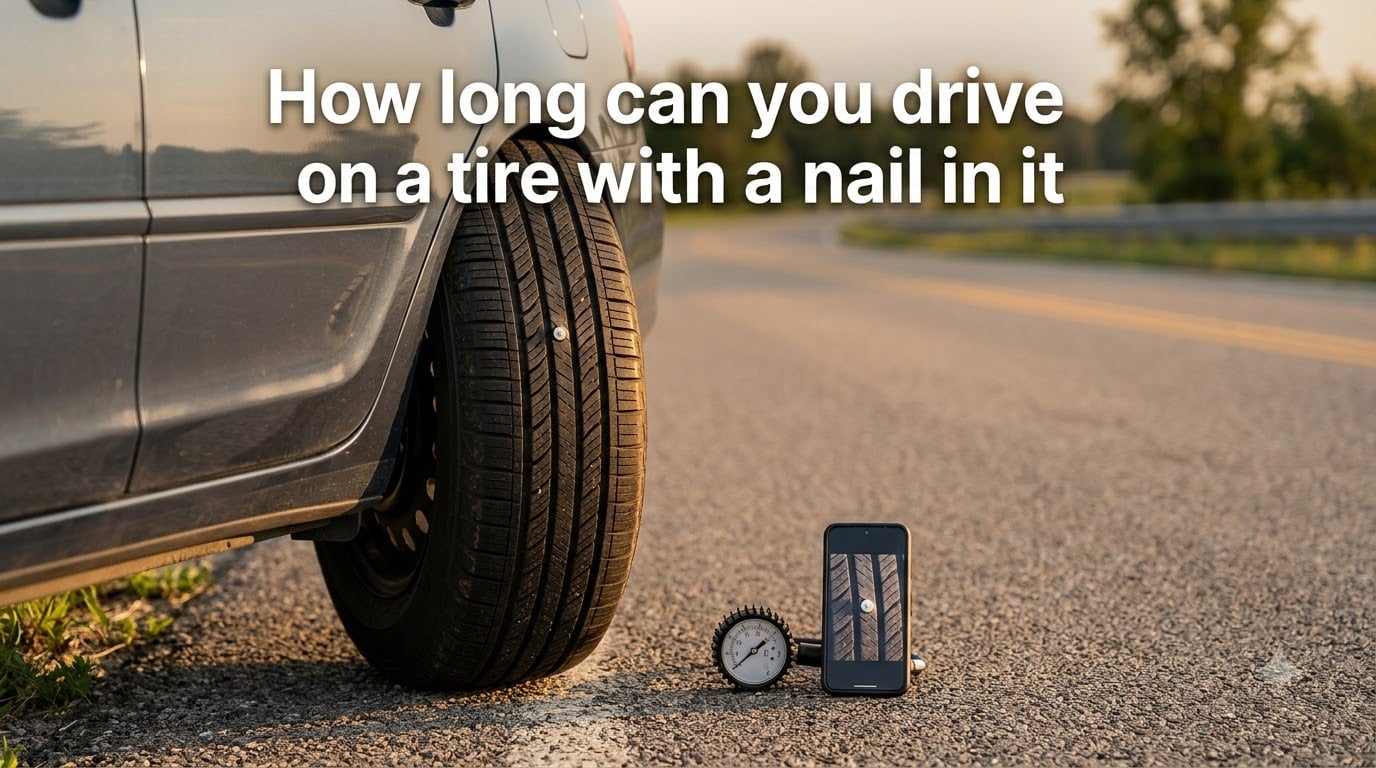
Finding a nail in your tire is one of those small moments that can ruin a whole day. The first question most drivers ask is the obvious one: how long can you drive on a tire with a nail in it before it becomes unsafe? The honest answer is that it depends on where the nail is, how fast your tire is leaking, and how closely you monitor it.
I’ve helped drivers handle this exact situation for years, and the same pattern keeps showing up. Most people can limp a slow-leaking tire to a shop without drama. A smaller group ignores the warning signs and ends up with a blowout on the highway. This guide walks you through what our team considers the safe middle path: short drives, low speeds, and eyes on the pressure gauge.
Quick Answer: You can usually drive a few miles to roughly 50 miles on a tire with a nail in it, provided the nail is in the center tread, the tire is losing air slowly, and you keep your speed under 45 mph. Drive straight to a tire shop, watch your TPMS light, and never pull the nail out yourself.
Table of Contents
Can You Drive With a Nail in Your Tire?
Yes, you can drive with a nail in your tire in most cases, but only under very specific conditions. The nail is actually doing you a small favor by staying lodged in the puncture. It partially plugs the hole and slows the air leak, which buys you time to reach a repair shop.
The catch is that this is a temporary situation. A tire with a nail in it is a compromised tire. Every mile you drive on it adds heat, flex, and stress to damaged belt layers. Driving is allowed for a short window. Driving on it for days or weeks is asking for trouble.
Our team’s rule of thumb is simple: if the tire still holds pressure and the nail is sitting in the tread, you can drive carefully to a shop. If the tire is going flat fast, the nail is in the sidewall, or you’re already seeing warning signs, do not drive it.
How Long Can You Drive on a Tire With a Nail in It?
The realistic distance you can drive on a tire with a nail in it ranges from a few miles to about 100 miles, depending on the leak rate. Most drivers in our experience make it 5 to 50 miles without the tire going fully flat, especially when the puncture is small and the nail is still embedded.
A slow leak might bleed off 1 PSI every few hours, which means you can drive normally for the day and still arrive at a shop with some pressure left. A faster leak can drop a tire from full pressure to flat in under an hour, which is a completely different situation.
Mechanics on Reddit’s r/Cartalk and r/MechanicAdvice consistently report the same range. One user drove 40 miles on a slow-leaking screw with no problem. Another limped 8 miles on a faster leak and had to add air at a gas station. The number is not fixed. Your tire, your nail, your drive.
For planning purposes, treat 50 miles as a soft ceiling and arrange to be at a tire shop well before then.
Why the Nail’s Location Matters: Tread vs Sidewall
The location of the nail is the single biggest factor in whether your tire can be repaired or must be replaced. Tread punctures are repairable in most cases. Sidewall punctures almost always mean a new tire.
The tread is the thick rubber surface that contacts the road. It has enough material above and below the puncture to allow a proper plug-and-patch repair. The sidewall is thinner, flexes constantly with every turn, and carries the structural load of the tire. A nail in the sidewall compromises the structural integrity of the whole tire, and no responsible shop will patch it.
Here’s a quick breakdown of how the two compare.
- Tread puncture (center): Usually repairable. Safe to drive short distances. Plug-and-patch from the inside is the gold standard repair.
- Tread puncture (shoulder area): Often repairable, but some shops decline because the shoulder flexes more than the center.
- Sidewall puncture: Not repairable. The tire must be replaced. Do not drive on it for long.
- Bead area (where tire meets rim): Not repairable. Replacement only.
If you can see the nail clearly, take a photo before you drive. That photo helps the shop confirm location before you even arrive.
What Happens If You Keep Driving With a Nail in Your Tire?
Driving too long on a tire with a nail in it leads to a predictable chain of damage. First, the tire loses pressure and runs underinflated. Then the sidewalls flex more than designed, building up heat. The belt layers separate, and at some point the tire fails, often suddenly and at speed.
A tire blowout at 60 mph is the scenario everyone wants to avoid. Even on modern cars with stability control, a blowout can cause a driver to lose control, especially on a busy highway. Other drivers swerve to avoid debris, and crashes follow. The National Highway Traffic Safety Administration tracks hundreds of tire-related crashes every year, and underinflated or damaged tires are a leading contributor.
The damage is not just safety. Driving on an underinflated tire also ruins the tire. The shoulder wears unevenly, the sidewall develops weak spots, and even after a proper repair the tire may never ride true again. A $30 plug turns into a $200 tire when the driver ignores the warning signs.
Bottom line: a nail is a small problem today and a big problem tomorrow if you ignore it.
Warning Signs You Should Stop Driving Immediately
Some signs mean you should pull over and call for help rather than keep driving. Our team treats these as hard stops. If any of these show up, stop as soon as it is safe to do so.
- TPMS light stays on or comes on while driving: The tire is below safe pressure. Continuing to drive damages the tire and risks a blowout.
- Visible hissing sound: Air is escaping faster than a slow leak. The tire may go flat in minutes.
- Tire feels soft or unstable: The handling goes vague or pulls to one side. Pressure is dropping in real time.
- Tire visibly bulging or deformed: Structural damage is already happening. Pull over now.
- Nail is in the sidewall: Driving on a sidewall puncture is not safe at any distance. Use the spare or call roadside assistance.
- Smell of hot rubber: The tire is overheating from running underinflated. This is the last warning before a blowout.
If you have to stop on a highway shoulder, stay inside the vehicle if traffic is heavy, turn on your hazard lights, and call roadside assistance. Changing a tire on the shoulder of a fast road is more dangerous than waiting for help.
TPMS Warning Signs to Watch For
The Tire Pressure Monitoring System is your best friend when driving on a compromised tire. Every car built since 2008 has one, and the warning light is designed exactly for situations like this. Pay attention to it.
A solid TPMS light means at least one tire is below the recommended pressure. It will usually come on as the tire loses air over the course of your drive. A flashing TPMS light, on the other hand, points to a sensor malfunction and is not related to the nail. If you see the solid light, your tire is the problem.
Before you start driving, check your tire pressure with a gauge and note the reading. Check it again after 10 minutes of driving, then every 30 minutes or so. A slow leak stays roughly stable. A faster leak shows up quickly. If you do not have a gauge, many gas stations have one. Use it.
Some cars show the actual pressure for each tire on the dashboard. If yours does, watch the affected wheel. As long as the pressure holds above 25 PSI on a passenger tire, you usually have time to reach a shop. Below 20 PSI, the tire is at risk of coming off the rim during hard cornering.
Temperature and Seasonal Effects on a Punctured Tire
Temperature has a bigger effect on tire pressure than most drivers realize. For every 10 degree Fahrenheit drop in outside temperature, a tire loses about 1 PSI. A nail puncture turns a small, manageable leak into a faster one as the weather cools.
This matters in two ways. First, if you discover a nail during a cold snap, the tire was already lower than the gauge reading from yesterday. The TPMS light may come on sooner than you expect. Second, if you find the nail in mild weather and then drive the next morning when temperatures drop 20 or 30 degrees, the tire pressure can fall below safe range overnight even without driving.
Hot weather creates the opposite problem. Underinflation plus high pavement temperatures plus highway speeds equals high internal tire temperature. That is the recipe for a blowout. Summer is when tire failures spike, and a compromised tire is more vulnerable than a healthy one.
The practical advice: check your tire pressure more often in extreme temperatures, and do not let a known puncture sit for days while you wait for a convenient repair appointment.
What to Do Right After You Find the Nail
The steps you take in the first 10 minutes after spotting a nail decide whether you have a minor inconvenience or a serious problem. Our team walks every driver through the same sequence.
- Pull over safely. Get off the road into a parking lot or wide shoulder. Do not try to inspect the tire in a traffic lane.
- Do not pull the nail out. The nail is currently acting as a plug. Removing it often makes the leak worse, not better.
- Take a photo. A clear picture of the nail, with something for scale (a coin works well), helps the shop confirm the location.
- Check the pressure. Use a tire pressure gauge. Note the reading. Anything above 25 PSI on a standard passenger tire is drivable for now.
- Drive straight to a tire shop. Stay off the highway if you can. Keep speeds under 45 mph. Avoid aggressive cornering.
- Recheck pressure at the shop. If you lose more than 3 PSI on the drive, the leak is faster than a slow leak and the shop will prioritize you.
If the shop is closed or too far, the safest option is to install the spare and drive on that until the shop opens. The spare is not fast or fun, but it is designed exactly for this scenario.
DIY Temporary Repair vs Professional Fix
Tire plug kits and aerosol tire sealants are sold at every auto parts store, and they can get you out of a bind. The question is whether a DIY repair is good enough or whether you still need a professional job.
A plug-only repair from the outside is considered a temporary fix by the tire industry. The Rubber Manufacturers Association and most tire shops treat an outside-only plug as a way to get home or to a shop, not as a permanent solution. A proper repair combines an outside plug with an inside patch, sealing the tire from both sides. That repair has to be done from the inside, with the tire removed from the rim.
Aerosol sealants like Fix-a-Flat have their place. They inflate the tire and seal small punctures in one step. The trade-off is that the sealant coats the inside of the tire, which makes a future proper repair messier and may void a road hazard warranty. Use them to reach a shop, then tell the shop what you used.
The honest answer: a DIY plug is fine to get you to the shop. A DIY plug is not fine to drive on for weeks. Get the tire properly repaired or replaced as soon as you can.
What to Tell the Tire Shop When You Arrive
Most drivers show up at the shop and say “I have a nail in my tire.” That is a fine start, but a few extra details help the tech work faster and avoid surprises.
- Where you noticed it: Front or rear, driver or passenger side. The tech will find it faster.
- How long you have driven on it: A rough estimate is enough. “I noticed it this morning and drove about 20 miles” tells the tech what to look for.
- What the tire pressure is now: If you checked with a gauge, share the number. It helps the tech estimate the leak rate.
- Whether you added air or used sealant: Sealants change how the repair is done. The shop needs to know before they start.
- Whether the tire has been repaired before: Two repairs in the same tire may push the shop toward replacement instead of another patch.
- A photo of the nail: If you took one, show it on your phone. It speeds up the inspection.
With those details, a typical nail repair takes 30 to 45 minutes. Without them, the tech has to start from scratch and may need to dismount the tire to find the puncture.
When the Tire Must Be Replaced Instead of Repaired
Not every tire with a nail in it can be saved. Some damage is bad enough that the only safe answer is a replacement. Here is when to expect that news.
- Nail in the sidewall: Sidewalls flex and carry load. No safe repair exists. Replace.
- Puncture larger than 1/4 inch: Most shops cap repairs at about 6 mm. Larger holes cannot be reliably patched.
- Multiple punctures close together: Two repairs in the same general area weaken the tire. Replacement is the responsible call.
- Tread depth already at the wear indicators: If the tire was near the end of its life anyway, repair is throwing money at a tire that needs to be replaced.
- Previous improper repair: A botched DIY plug or a plugged sidewall puncture means the tire has to come off and be replaced.
- Visible damage around the puncture: Cuts, gashes, or bulging rubber around the hole mean the structural integrity is gone.
The shop should walk you through the decision with the tire off the rim so you can see the damage. If they recommend replacement, ask why. A trustworthy shop will show you the reason rather than just telling you.
Frequently Asked Questions
What is the 3 tire rule?
The 3 tire rule is a piece of folk wisdom among drivers and some insurance adjusters: if you have had three or more tire failures (blowouts, unrepairable punctures, or sidewall failures) on the same vehicle in a short period, the cause is more likely the car, the driving habits, or a bad batch of tires rather than bad luck. It is not a formal rule, and it does not apply to a single nail puncture.
Is it okay to drive a car with a nail in the tire?
Yes, you can drive with a nail in your tire as long as the nail is in the tread, the tire is not losing air rapidly, and you keep your speed under about 45 mph. The nail is acting as a temporary plug. Drive straight to a tire shop, monitor your TPMS light, and do not pull the nail out yourself.
Will a nail in my tire cause a blowout?
A nail alone does not cause an immediate blowout, but driving on it for too long can. As the tire loses pressure, the sidewalls flex more than designed, heat builds up, and the belt layers can separate. That is what leads to a blowout, usually at highway speed. The longer you drive on an underinflated tire, the higher the risk.
How common is it to get a nail in a tire?
It is very common. Tire industry estimates suggest the average driver will experience a puncture from a nail, screw, or similar road debris several times over the life of a vehicle. Construction zones, rural roads, and older urban streets with debris are the most common places to pick one up.
Can I drive 2 hours with a nail in my tire?
It depends on the leak rate. Two hours at highway speed on a slow leak is risky because underinflation builds heat, and heat is what destroys a tire. Two hours of slow city driving with the tire holding pressure is more feasible, but most mechanics would still recommend stopping at the first tire shop rather than pushing for two full hours.
How fast will a tire deflate with a nail in it?
A small nail in the center tread can take days to deflate fully. A larger puncture or a nail that has worked loose can drop a tire from full pressure to flat in 30 minutes to an hour. The only way to know your leak rate is to check the pressure with a gauge and see how it changes over time.
Can I add air to a tire with a nail in it?
Yes, you can add air to a tire with a nail in it to keep the pressure high enough to drive to a shop. Adding air does not fix the puncture, and the leak will continue. Use the gas station air compressor, fill to the pressure listed on the door jamb sticker, and drive straight to a tire shop.
Final Thoughts on Driving With a Nail in Your Tire
A nail in your tire is a manageable problem if you handle it the same day. Check the pressure, photograph the puncture, drive under 45 mph, and head to a tire shop within a few miles. The biggest mistake our team sees is drivers who notice a nail and keep commuting for weeks, hoping it will hold. It usually does, until it does not, and that is when the tire fails at the worst possible time.
When you arrive at the shop, share what you know: location, drive time, pressure readings, and any sealants you used. With that information, a good tech will have you back on the road in under an hour with a proper repair or a fresh tire if replacement is the safer call.