
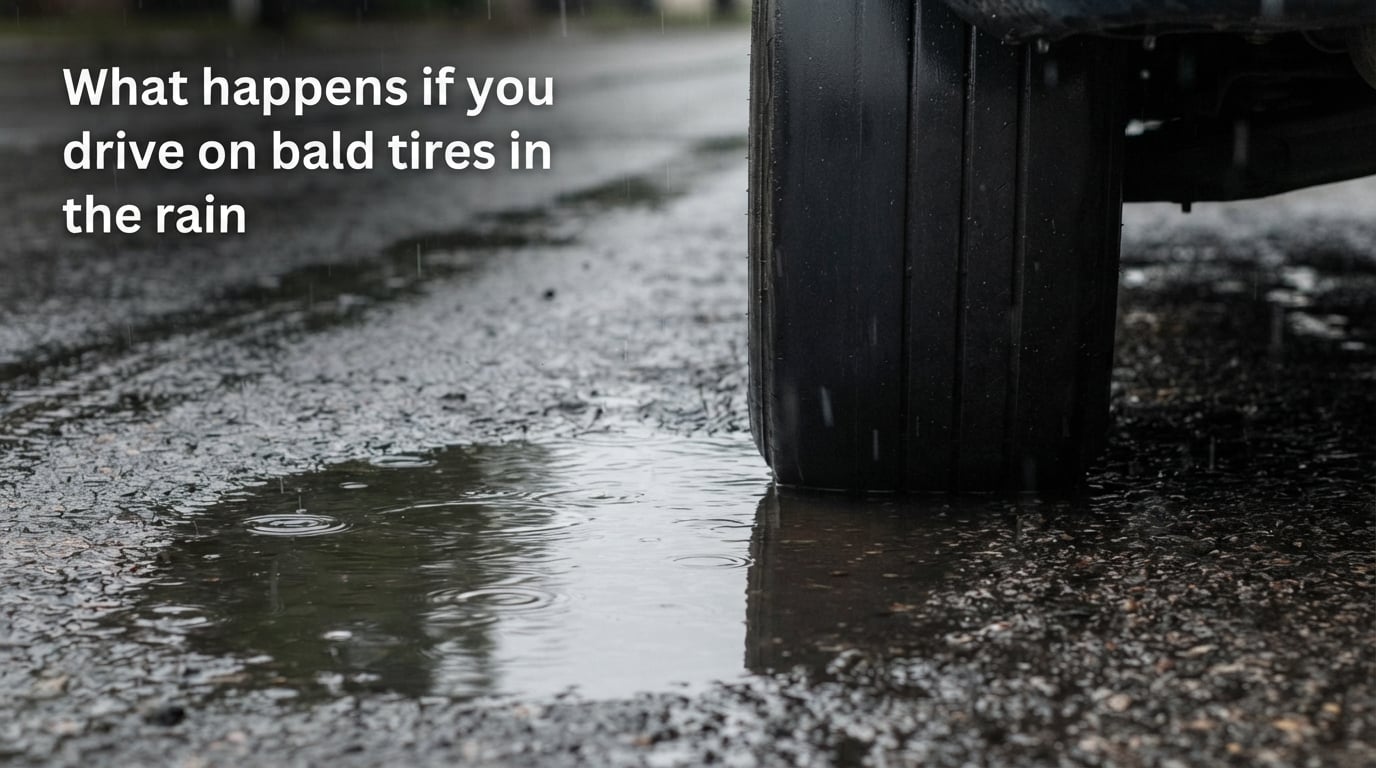
If you drive on bald tires in the rain, you face a sharply higher risk of hydroplaning, a much longer stopping distance, and the chance of losing steering control on wet roads. Bald tires have no tread left to channel water away from the contact patch, so your vehicle essentially floats on a thin film of water instead of gripping pavement.
This matters to anyone who drives in wet weather. According to AAA research, worn tires can add roughly 43 percent to your stopping distance on wet roads compared to new tires. That single number is the difference between a close call and a collision.
I want to walk you through the real mechanics of why bald tires in rain are so dangerous, how to check your tread in two minutes, and what to do if you are already on the road with worn rubber.
Table of Contents
What Are Bald Tires and Why Rain Makes Them Dangerous
Bald tires are tires whose tread has worn down to the legal minimum of 2/32 inch or less, exposing the tread wear indicator bars across the contact patch. At that point, the grooves that once channeled water, gripped corners, and bit into pavement are essentially gone.
On a dry road, bald tires are risky but manageable at low speeds. Drivers on forums sometimes note that worn tires actually create a slightly larger contact patch on dry asphalt, which can feel stable.
Rain changes everything. Water sits between your tire and the road. Tread grooves are designed to scoop that water out from under the tire and eject it sideways. Without those grooves, water has nowhere to go, and your tire starts to ride on top of the water layer instead of on the road.
The shift from dry to wet driving risk is not linear. It is exponential. A tire that felt fine on a sunny Tuesday can become uncontrollable in a moderate rainstorm on Wednesday.
Hydroplaning Risk with Bald Tires in Rain
Hydroplaning happens when a layer of water builds up between your tires and the road faster than the tire can push it out of the way. The tire loses contact with the pavement and you lose steering, braking, and acceleration in the same instant.
With healthy tread, hydroplaning usually starts around 45 to 50 mph in standing water. With bald tires, hydroplaning can begin as low as 35 mph, sometimes lower in heavy rain.
The physics are simple. Tire tread acts like a series of drains. As the tire rolls, the grooves pull water into the channels and sling it backward and outward through the circumferential and lateral grooves. That keeps the contact patch pressed against the asphalt. Remove the grooves and water just stays put, lifting the tire onto a cushion.
I have heard drivers describe the moment of hydroplaning as a sudden, unsettling silence. The engine sound stays the same, but the road noise disappears because the tire is no longer touching the road. If that happens, ease off the throttle, hold the steering wheel straight, and avoid braking until you feel the tires grab pavement again.
How Bald Tires Increase Stopping Distance
Stopping distance is where bald tires in rain get truly dangerous. A widely cited AAA study found that driving on relatively worn tires at highway speeds in wet conditions increased average stopping distances by about 43 percent compared to new tires.
To put that in real terms, if your vehicle normally stops from 60 mph in about 130 feet on wet roads with good tires, the same stop with bald tires can take 185 feet or more. That extra 55 feet is roughly the length of a semi-trailer, and you travel it in less than a second at highway speed.
Two things happen to your braking when tread is gone. First, the tire cannot evacuate water, so the brake pads are essentially squeezing a tire that is sliding on a water film. Second, the rubber compound on a bald tire is often hardened by age and heat, which reduces the friction coefficient against wet asphalt.
Brake harder and it gets worse. Anti-lock braking systems (ABS) rely on tire contact with the road to pulse effectively. When the tire is hydroplaning, ABS has nothing to grip, and stopping distance stretches even further.
How to Identify Bald Tires Before You Drive
The easiest way to know if your tires are bald is the penny test. Take a Lincoln-head penny, insert it into the tread groove with Lincoln’s head facing down and pointing into the tire.
If you can see the top of Lincoln’s head above the tread, your tires are worn down to about 2/32 inch or less and need replacement. If part of his head is always covered by tread, you still have some life left.
Modern tires also have built-in tread wear indicator bars. These are flat strips of rubber that run across the tire grooves. When the tread wears flush with these bars, the tire is legally bald. Look across the tire face and you will see the bars as smooth bands running side to side.
Other signs of a dangerously worn tire include:
- Uneven wear across the tread, often a sign of misalignment or worn suspension parts
- Cracks or cuts in the sidewall, especially on tires older than six years
- Visible bulges or blisters, which mean internal belt damage and an imminent blowout risk
- Vibration at highway speeds, often a sign of separated belts or uneven wear
The legal minimum tread depth in most U.S. states is 2/32 inch, but tiremakers and safety groups recommend replacing tires at 4/32 inch for consistent wet performance. The last 2/32 inch of tread drops wet traction sharply, so waiting for the legal minimum is risky.
Blowout and Tire Failure Risk in Wet Conditions
Bald tires are more likely to fail than tires with tread, and water makes that failure more likely. The steel belts and polyester cords inside a tire are protected by rubber and a thick tread cap. As the tread wears away, those internal components are exposed to road debris, heat cycling, and water.
Standing water can hide potholes, curb edges, and metal scraps that a healthy tire would roll over or push aside. A bald tire at highway speed can slap into those hazards at full pressure, and the sidewall flexes more without tread to stabilize it.
Reddit users and dashcam forums are full of drivers who lost a tire at speed during a rainstorm. Most of them describe the same pattern: wet road, worn tires, sudden loss of control and a trip to the body shop or hospital.
Heat also plays a role. Bald tires flex more per revolution, which builds heat in the sidewall and belt package. Combine that with sustained rain and standing water and you have a recipe for a tread separation or sidewall blowout, usually on a highway on-ramp or interstate.
What to Do If You Are Already Driving on Bald Tires in the Rain
If you are reading this on the road and you suspect your tires are bald, slow down first. Drop your speed by 10 to 15 mph and leave extra following distance. A four-second gap is the bare minimum on wet roads with worn tires.
Avoid cruise control. Reddit users with worn tires almost universally recommend not using cruise in rain. You want immediate throttle control the moment the front end starts to push or the rear steps out.
Stay out of the outside lanes and avoid puddles. If you spot standing water ahead, brake lightly before you reach it to shift weight onto the front tires, then ease off the brake as you cross. This keeps the front tires planted and reduces hydroplane risk.
If you start to hydroplane, do not slam the brakes or yank the wheel. Lift off the throttle gently, keep the steering pointed where you want to go, and wait for the tires to grip again. A quick brake stab can lock the wheels on a slick surface, and even ABS takes longer to recover on bald rubber.
If you can, exit the highway and find a safe place to wait out heavy rain. A parking lot is fine. Light rain at low speed is one thing. A downpour on bald tires at 65 mph is a gamble nobody should be taking.
And if your tires truly are bald, do not drive them again in any rain until they are replaced. The cost of new tires is far less than the cost of a single accident on wet roads.
Frequently Asked Questions
How long can I drive with balding tires?
You can legally drive until the tread reaches 2/32 inch, but safety experts recommend replacement at 4/32 inch for wet conditions. Bald tires can fail on the next heavy rainstorm, and there is no warning before a hydroplane event.
What do dangerously bald tires look like?
Dangerously bald tires show tread wear indicator bars flush with the tread surface, exposing smooth rubber across the contact patch. You may also see cracks in the sidewall, bulges from damaged belts, or uneven wear patterns. A penny inserted with Lincoln’s head fully visible confirms the tire is past safe use.
How likely are bald tires to pop?
Bald tires are significantly more likely to fail than tires with tread, especially in wet conditions where water exposure and impact with hidden road debris are more common. Most at-speed blowouts on wet highways involve tires that were already worn down before the storm.
Will bald tires cause hydroplaning?
Yes. Bald tires cause hydroplaning at much lower speeds than healthy tires, sometimes as low as 35 mph in moderate rain. Without tread grooves to evacuate water, the tire rides on top of a water film and loses contact with the road entirely, which removes steering and braking control.
Is it safe to drive in rain with bald tires?
It is not safe. AAA research shows bald tires can extend wet stopping distance by roughly 43 percent at highway speeds, and hydroplaning risk rises sharply with each missing 32nds of tread. Slow driving and light rain reduce risk only slightly and do not eliminate it.
Bottom Line on Bald Tires in Rain
Driving on bald tires in the rain puts a wall of water between you and the road. Hydroplaning can start at 35 mph, stopping distances stretch by 43 percent or more, and blowouts become a real possibility at speed.
Check your tread today with the penny test, replace tires at 4/32 inch or sooner if you drive in wet climates, and never use cruise control on worn tires in rain. Your tires are the only thing connecting your vehicle to the road, and rain is when they need to be at their best.