
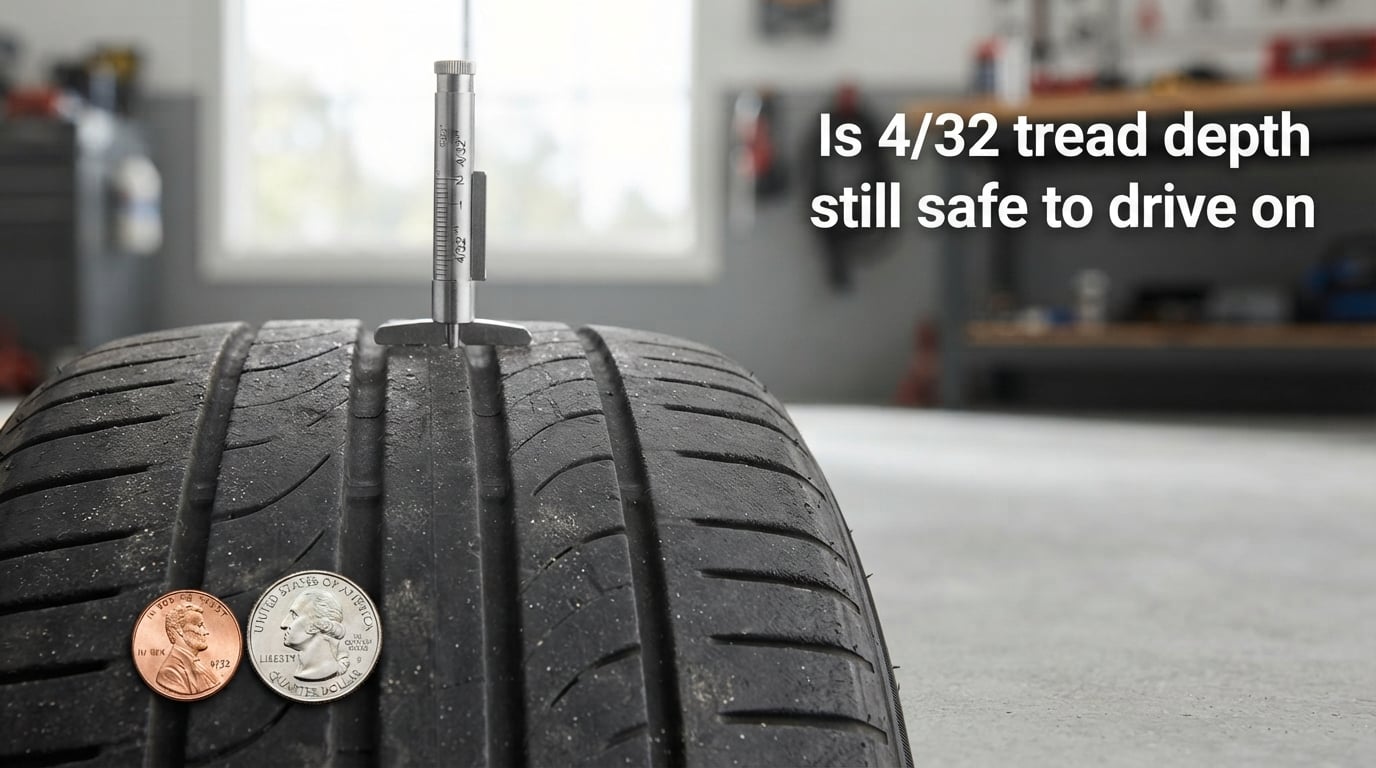
Yes, 4/32 tread depth is generally safe to drive on in dry, mild-weather conditions, especially if you’re heading into spring and summer. The answer changes when rain, snow, or steep temperatures enter the picture, because below 4/32 the tire’s ability to channel water away starts dropping fast.
I get asked this question a lot, and the short version is that 4/32 sits in a gray zone. It’s above the legal minimum in every U.S. state, but it is not the same as a fresh tire. Whether you should keep driving depends on where you live, what you drive, and what kind of weather you’re heading into.
In this guide, I’ll walk through what 4/32 really means, when it stays safe, when you should replace, and how to measure your own tread so you can make the call with confidence.
Table of Contents
What 4/32 Tread Depth Actually Means
4/32 tread depth means your tire has four thirty-seconds of an inch of tread rubber left. Most new passenger tires start with about 10/32 to 12/32 of tread, so 4/32 is roughly one-third of the original depth.
Tread depth is measured in 32nds of an inch because the U.S. legal minimum is 2/32, and tire makers build small bars called wear indicators into the grooves. When those bars sit flush with the surrounding tread, the tire is at 2/32 and legally worn out.
Here’s the practical picture: a brand-new tire has plenty of rubber to bite into pavement and push water out through the grooves. At 4/32, you still have functional tread, but you’re starting to lose the deep channels that handle heavy rain and snow.
When 4/32 Tread Depth Is Still Safe to Drive On
4/32 tread depth is still safe to drive on in dry conditions, on warm summer roads, and for everyday commuting in mild climates. If you’re rolling into May in a region with light rain and no snow, you can keep driving and plan replacement on your own timeline.
The Reddit r/tires community has plenty of owners running 4/32 through Northeast Ohio summers without drama. All-season tires at 4/32 in July behave very differently from the same tires in January on icy roads.
Three scenarios where 4/32 stays safe:
- Dry summer driving on highways and city streets with no standing water.
- Light rain commutes in regions where heavy downpours are rare.
- Low-speed neighborhood driving where stopping distances stay short.
When You Should Replace Tires at 4/32
You should replace tires at 4/32 if you regularly drive in heavy rain, snow, or on highways with traffic. AAA research has shown that braking distances start stretching out as tread drops below 4/32, especially on wet pavement.
Once tread falls below 4/32, the tire loses grip on wet roads faster than most drivers expect. Water has less channel to escape through, so the tire starts to ride up on a thin film of water. That’s hydroplaning, and it can happen at lower speeds than people think, sometimes as low as 45 mph in heavy rain.
Replace at 4/32 if any of these apply:
- Wet climate with frequent heavy rain or thunderstorms.
- Snow or ice in your regular driving environment.
- AWD vehicle where all four tires need closely matching tread depth.
- Steep hills, sharp curves, or stop-and-go traffic that demand strong braking.
- Tire age over six years, because rubber hardens and grip drops even with tread left.
How to Measure Tire Tread Depth
The most accurate way to measure tread depth is with a dedicated tread depth gauge, which costs a few dollars at any auto parts store. You press the probe into a main tread groove and read the number in 32nds of an inch.
If you don’t have a gauge, the penny test is a quick visual check. Stick a penny into the tread with Lincoln’s head pointing down. If you can see the top of his head, your tread is below 2/32 and you’re at the legal limit. The trick is that this only tells you the legal floor, not whether you’re at 4/32 or 6/32.
For a deeper read without a gauge, you can use a quarter. Place a quarter into the tread with Washington’s head pointing down. If the tread covers the top of his head, you’re above 4/32. If his head sticks out past the tread, you’re below 4/32 and getting close to replacement territory.
Measure in several spots across each tire, including the inside, middle, and outside edges. Uneven readings usually point to alignment, inflation, or suspension issues that need attention.
Mileage Expectations at 4/32 Tread Depth
At 4/32 tread depth, most tires have somewhere between a few thousand miles and a couple of years of typical driving left, but the exact number depends heavily on your habits. Highway commuters who rotate tires and keep alignment in check tend to squeeze more miles out of 4/32 than city drivers who brake hard at every light.
Rough ranges for passenger tires:
- 5/32 to 6/32 – Often 10,000 to 20,000 miles of normal driving remaining.
- 4/32 – Often 5,000 to 10,000 miles under ideal conditions.
- 3/32 – Usually only a few thousand miles of safe driving left.
These numbers shrink fast if the vehicle carries heavy loads, tows, or runs mostly short trips that wear tires unevenly. Aggressive braking and cornering will also cut the remaining range.
Legal Minimum vs Safe Minimum Tread Depth
Most U.S. states set the legal minimum tread depth at 2/32 of an inch, but a few require more. States like California, Alabama, and several others enforce 2/32, while places with harsher weather sometimes recommend 3/32 as a practical minimum.
Legal minimum is the floor at which police can ticket you or fail your inspection. It is not the depth where the tire stops working. By the time tread hits 2/32, wet braking distances are dramatically longer and hydroplaning risk is high even in moderate rain.
If a tire fails an inspection or causes an accident while below the legal minimum, insurance companies may also dispute the claim. Driving on bald tires has real legal and financial consequences beyond safety.
Seasonal Considerations for 4/32 Tread Depth
Season matters as much as tread depth. A tire at 4/32 in July behaves very differently from the same tire in December. If you’re heading into the dry months and your tires have 4/32 left, you’re usually fine to keep driving and replace at your convenience.
If 4/32 is your depth heading into fall or winter, the smart move is to replace before the bad weather arrives. Tire shops get slammed in October and November when the first storm rolls through, and prices and wait times climb right when you need service.
Regional climate shapes the call:
- Mild climates (California, Arizona, Gulf Coast): 4/32 is safe for routine driving year-round.
- Snow belt (Northeast, Great Lakes, Mountain West): replace at 4/32 before winter.
- Wet climates (Pacific Northwest, Florida, Southeast): replace at 4/32 before the rainy season peaks.
If you’re unsure about your local conditions, a quick check with a trusted tire shop or mechanic gives you a region-specific answer in minutes.
Signs You Should Replace Tires Now
Beyond tread depth, several visible signs mean you should replace tires immediately. Tread depth tells you one story, but rubber age, damage, and wear patterns can force a replacement even at 4/32 or higher.
Replace right away if you see:
- Wear bars flush with the tread, meaning the tire is at or below 2/32.
- Cracks in the sidewall or deep cuts in the tread that expose casing.
- Bulges or blisters, which signal internal damage and possible failure.
- Uneven wear like feathering, cupping, or heavy shoulder wear.
- Vibration or pulling that gets worse at highway speed.
- Tire age over six to seven years, regardless of remaining tread.
You can find the manufacturing date on the sidewall as a four-digit DOT code. The last four digits are the week and year the tire was made. Tires older than seven years should be replaced even with good tread left, because the rubber compound hardens and loses grip over time.
Frequently Asked Questions
How long can you drive on a 4/32 tread?
In dry, mild conditions, you can usually drive several thousand more miles on 4/32 tread. In wet or snowy climates, plan on replacing within weeks rather than months, because braking distances grow quickly below this depth.
Should I replace my tires at 4/32 or 3/32?
Replace at 4/32 if you drive in rain, snow, or heavy traffic. If you only drive on dry roads in mild weather, you can stretch to 3/32, but never below 2/32, which is the legal minimum in most states.
Is a 4/32 inch tread depth good for my car?
4/32 inch is acceptable for dry summer driving but not ideal for wet, snowy, or high-performance use. New tires start around 10/32, so 4/32 is roughly one-third worn and is approaching the point where wet traction drops noticeably.
At what tread depth should I buy new tires?
Buy new tires by 4/32 if you face wet roads, snow, or steep grades. Buy by 3/32 in dry climates, and never let any tire drop below 2/32, which is the legal minimum.
Is 4/32 tread safe in the rain?
4/32 tread can handle light rain, but stopping distances grow noticeably and hydroplaning risk rises in heavy downpours. If your region sees frequent storms, replace tires before they reach 4/32.
Final Verdict on 4/32 Tread Depth
4/32 tread depth is safe to drive on in dry, mild-weather conditions, but it is the point where wet and winter performance starts to drop. If you’re heading into summer on dry roads, you can keep driving and plan replacement at your pace. If rain or snow is in the near forecast, replace the tires before the bad weather arrives.
Grab a tread depth gauge or use the quarter test to check all four tires, measure in several spots, and look for uneven wear. If the tires are also over six years old, or if you see cracks, bulges, or visible wear bars, replace them right away regardless of the number. When in doubt, a quick stop at a local tire shop gives you a free, expert read on whether your 4/32 tires are still safe to drive on.