
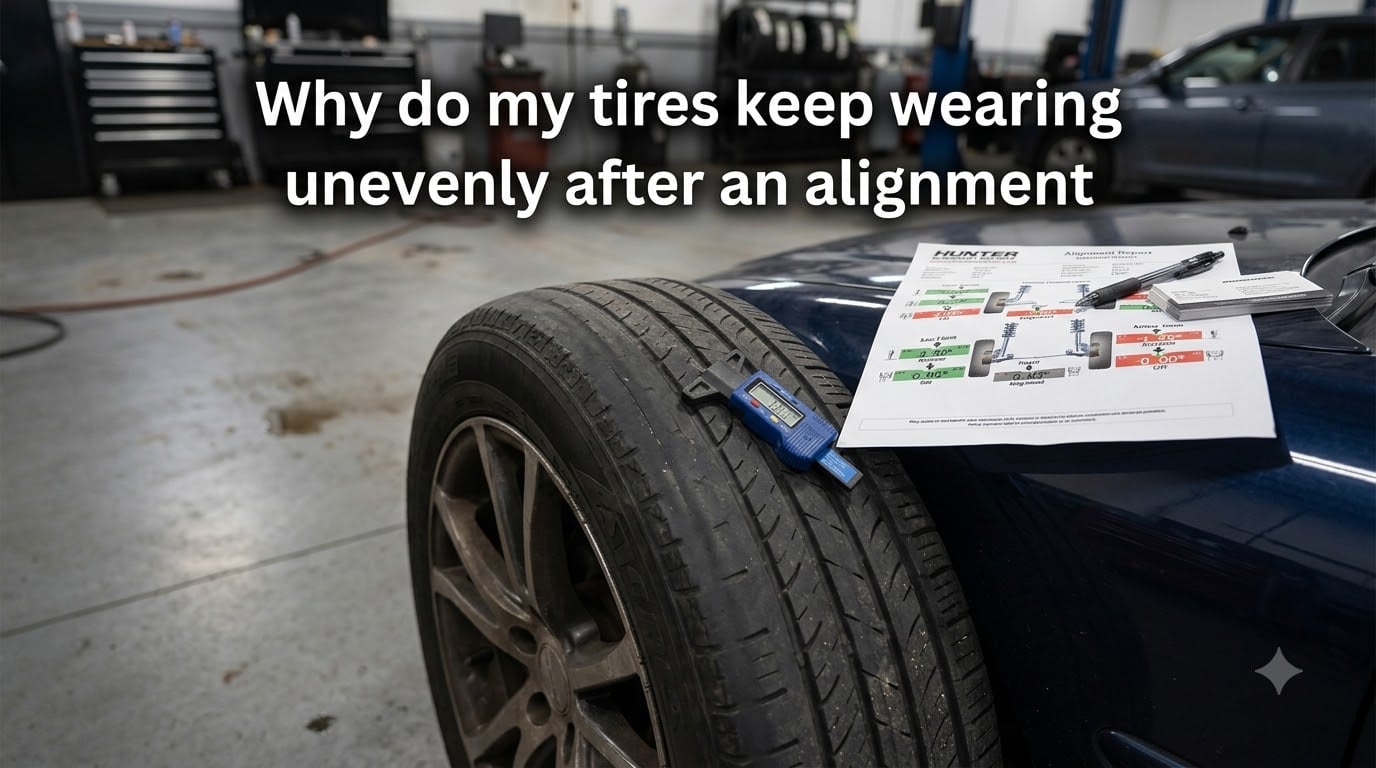
You just paid for a four-wheel alignment, and your tires are still scrubbing the inside edge down to the cords. If you’re asking why do my tires keep wearing unevenly after an alignment, the short answer is that an alignment only fixes three wheel angles; it cannot repair worn suspension parts, undo a non-adjustable rear axle, correct chronic under-inflation, or undo wear that already happened before the alignment.
An alignment adjusts toe, camber, and caster so the tires meet the road squarely. If any of those angles drift back out within weeks, the wear returns just as fast. In most cases the underlying cause is one of five things: a worn suspension component that walked the wheel out of spec again, a bent part the machine measured as “in range” but still pulls, a non-adjustable rear axle that no alignment can correct, the wrong alignment spec being loaded, or simply tire pressure that’s been off the whole time.
This guide walks through the wear patterns, the five most common post-alignment culprits, how to verify the shop actually performed the alignment, and when a second opinion is worth the money.
Table of Contents
Tire Wear Pattern Quick Reference
Before chasing causes, look at the tire. Where the rubber is gone tells you almost exactly what kind of problem you’re fighting. Use the chart below as your first read, then dig into the matching cause below.
| Wear Location | Most Likely Cause | Typical Fix |
|---|---|---|
| Inner edge (both sides, same axle) | Excessive negative camber or a non-adjustable rear axle | Camber kit, shims, or new tires sized for the spec |
| Inner edge (one tire only) | Bent control arm, strut, or knuckle on that corner | Replace the bent part, then re-align |
| Outer edge | Excessive positive camber or chronic under-inflation | Adjust camber to spec, set tire pressure to placard |
| Center rib | Over-inflation | Drop pressure to the door-jamb placard PSI |
| Both shoulders, smooth center | Under-inflation | Add air and check for slow leaks |
| Cupping or scalloping (dips every few inches) | Worn shocks, struts, or a wheel that’s out of balance | Replace dampers, balance and rotate |
| Feathering (smooth on one side, sharp on the other) | Toe misalignment | Re-align, then verify with a printout |
| One-sided wear on a rear tire | Solid rear axle, bent axle, or worn trailing arm bushings | Shim the axle, replace bushings, or fit offset wheels |
How an Alignment Is Supposed to Fix Tire Wear
A wheel alignment is a geometric reset of the angles between your tires, the suspension, and the road. When those angles match the manufacturer’s spec, the tire rolls flat, wears evenly across its width, and tracks straight without being steered.
Toe Angle: The Most Common Culprit
Toe is the direction the tires point relative to straight-ahead. Toe-in means the fronts of the tires are closer together; toe-out means the fronts are farther apart. Even a tenth of a degree off spec scrubs the tread side-to-side every revolution. Toe is the angle that throws wear patterns the fastest, which is why it gets the most attention on an alignment rack.
Camber Angle: The Vertical Tilt
Camber is the tilt of the wheel when viewed from the front. Negative camber means the top of the tire leans in toward the car; positive camber means it leans out. A small amount of negative camber helps cornering grip, but too much eats the inner edge; too much positive eats the outer edge.
Caster Angle: Steering Feel and Stability
Caster is the tilt of the steering axis when viewed from the side, like the rake on a bicycle fork. Caster mostly affects steering feel and straight-line stability, not tire wear directly. When caster is way off, you’ll usually feel the car wander before you see wear.
Thrust Angle: The Rear Reference Line
Thrust angle is the direction the rear axle points relative to the centerline of the car. If thrust angle is off, the front wheels get aligned to the rear wheels instead of to the body. The result is a car that dog-tracks slightly and front tires that wear in a feathered pattern.
Why Tires Keep Wearing Unevenly After an Alignment
An alignment only sets the three angles on a machine. It does not repair anything, and it cannot fix problems the machine doesn’t measure. Here are the five reasons your tires can come out of the shop “aligned” and still wear unevenly within a few thousand miles.
1. A Worn Suspension Part Walked the Wheel Back Out of Spec
Ball joints, control arm bushings, tie rod ends, and strut mounts all have a small amount of play. When that play grows, the wheel can sit in alignment on the rack and then drift the moment you hit a bump. A worn ball joint is the single most common reason a tire wears on the inner edge of one wheel only. Reddit mechanics in r/AskAMechanic flag this constantly: the alignment measured fine, but the wear came back because no one replaced the part with play in it.
2. A Bent Component That the Machine Calls “In Range”
An alignment machine reports numbers. If a slightly bent control arm still puts the wheel inside the tolerance window, the printout will say “green across the board” and the car will still pull and still wear the inside edge. Bent spindles, slightly tweaked control arms from a pothole, and even a subframe that’s been nudged can all do this. If you hit a curb or a deep pothole shortly before the wear started, this is the first place to look.
3. A Non-Adjustable or Solid Rear Axle
Many trucks, older SUVs, and rear-wheel-drive cars have a solid rear axle or a multi-link rear with no factory camber or toe adjustment. A “four-wheel alignment” on these vehicles is mostly cosmetic; the rear is set at the factory and shimmed if it’s off. If your car has a non-adjustable rear and the rear tires wear on the inside edge, no alignment in the world will fix it without adding aftermarket camber bolts, shims, or offset wheels. This is one of the most common complaints in r/Toyota and r/AskAMechanic, especially on Toyota Highlanders and older Ford trucks.
4. The Wrong Spec Was Loaded Into the Machine
Alignment machines pull specs from a database. If the tech selects the wrong trim level, the wrong wheel size, or the wrong region (US vs European spec), the machine will set your car to numbers that don’t actually apply. The printout looks perfect, the car drives fine for a while, then the wear shows up because the angles were a few tenths off from the true spec. This is more common than people think, especially on vehicles with multiple trims that share the same chassis.
5. Tire Pressure Has Been Off the Whole Time
An alignment does nothing for tire pressure. A tire that runs 5 PSI below the door-jamb placard will wear both shoulders and run hot. A tire that runs 5 PSI over will wear the center rib and ride rough. Either condition destroys tires regardless of how good the alignment is, and many drivers never check pressure after an alignment visit. Check it cold, once a month, with a real gauge.
Decoding Your Wear Pattern
Now that you know the five common causes, match what you see on the tire to the most likely culprit. Each pattern below is described by where the rubber is gone, what usually causes it, and what to do about it.
Inner Edge Wear on Both Tires of the Same Axle
Symmetric inner-edge wear usually means negative camber is too aggressive for the tire’s geometry, or that a non-adjustable rear axle is pushing the tops of the rear tires inward. On a lowered car or one with an aftermarket coil-over, this is the textbook symptom. The fix is a camber correction kit, adjustable control arms, or wheel spacers that bring the contact patch back to flat.
Inner Edge Wear on Just One Tire
One-sided inner wear is almost always a bent or worn part on that corner: a bent control arm from a pothole, a collapsed strut mount, or a ball joint with too much play. Alignment cannot fix a bent arm; the part has to be replaced and the alignment re-done.
Outer Edge Wear
Outer shoulder wear is the classic sign of chronic under-inflation or excessive positive camber. Start with pressure. If pressure is at spec on all four corners and the wear is still on the outside, the camber is too positive and needs to be pulled back to spec with shims or adjustment.
Center Wear
If the center rib is bald and the shoulders still have tread, the tire is over-inflated. Let air out to the door-jamb placard number, not the number molded on the tire sidewall. The tire’s max inflation is for load, not for daily driving.
Cupping and Scalloping
Cupping looks like a series of smooth dips scooped out of the tread every few inches, almost like a dinosaur’s back. It’s a suspension or balance issue, not an alignment issue. Worn shocks and struts let the tire bounce instead of staying planted, and an out-of-balance wheel bounces the same way. Replace dampers and balance before paying for another alignment.
Feathering
Feathering is when one side of each tread block is smooth and the other side is sharp, like running a finger across a deck of cards. It’s a classic toe-misalignment symptom. Re-align, then drive for 500 miles and feel the tread blocks with your hand. If they still feel sharp one way and smooth the other, the toe is still off.
How to Diagnose Persistent Uneven Wear Step by Step
Walk through this sequence in order. Most cases are solved by step 3, and the rest are caught by step 6.
- Look at the wear pattern. Inner edge, outer edge, center, cupping, or feathering. Match it to the table above before touching anything else.
- Check tire pressure cold on all four corners. Use a gauge you trust. Set to the door-jamb placard, not the tire sidewall. Look for slow leaks if a tire keeps going low.
- Measure ride height corner to corner. A sagging spring or a coil-over set too low on one side will tilt the camber. Compare front-to-front and rear-to-rear with the car on level ground.
- Inspect suspension parts by hand. Grab each tire at 3 and 9 o’clock and rock it; any clunk or play means a worn tie rod or ball joint. Grab at 12 and 6 and rock for wheel bearing and strut play.
- Look for bent parts. A recent pothole or curb hit, plus one-sided inner wear, means a bent control arm or knuckle even if the alignment reads “green.”
- Get a second alignment printout from a different shop. If both shops measure the same angles and the wear still comes back, the answer is in the suspension, not the alignment.
How to Verify Your Alignment Was Actually Done Right
If you’ve just paid for an alignment and you’re already seeing uneven wear, the first question most drivers have is whether the shop actually did the work. Here’s how to confirm.
- Ask for the printout. A reputable shop hands you a before-and-after sheet showing every measured angle, both sides, plus the spec range. No printout means no proof.
- Check the spec loaded. Make sure the trim level, engine, and wheel size on the printout match your car exactly.
- Compare before and after numbers. If the “before” and “after” columns are nearly identical, the alignment barely moved anything, which means the angles were already close and the wear is coming from elsewhere.
- Test drive on a flat road. The car should track straight with hands off the wheel on a level road. Any pull means something is still off.
- Re-measure in 1,000 miles. A good shop will recheck the alignment within 30 to 60 days if you’re still seeing wear. Ask up front; shops that say no are the ones to avoid.
- Ask whether suspension was inspected first. A tech should have checked ball joints, tie rods, and bushings before aligning. If they didn’t, that step got skipped.
Trust signals to look for: a printed before-and-after report, a tech who walks you through which angles were off, an inspection of suspension parts before the alignment, and a computer alignment machine rather than a string or bubble gauge. A rotation performed at the same visit is also a good sign the shop is thinking about tire life as a whole.
Will Uneven Tire Wear Even Out After an Alignment
No. An alignment sets the angles so the tire wears flat going forward; it cannot undo wear that already happened. A tire with a bald inner edge will still have a bald inner edge after the alignment. What the alignment does is stop the wear from getting worse and keep the new, unworn part of the tire wearing flat. This is why most techs recommend a new set of tires at the same time as a major alignment correction if the existing tires are already unevenly worn down to the wear bars.
How Fast Will Bad Alignment Ruin Tires
Even a small deviation from spec can cut tire life dramatically. A toe misalignment of just a few hundredths of an inch can scrub a set of tires out in 10,000 to 15,000 miles instead of the normal 40,000 to 60,000. Multiple owners in truck and Mustang forums have reported both front tires worn to the cords on the inside edge inside 12,000 miles after what was billed as a fresh alignment. Once you see the wear pattern repeating, the clock is already running.
Frequently Asked Questions
How do I know if my alignment was done correctly?
Ask for the printed before-and-after report showing every measured angle and the spec range. The car should track straight on a flat road with hands off the wheel, and the printout should match your exact trim, engine, and wheel size. A trustworthy shop will recheck the alignment within 30 to 60 days if you keep seeing uneven wear.
What can throw off an alignment?
Hitting a pothole, clipping a curb, worn ball joints or control arm bushings, a bent control arm or strut from an impact, sagging springs, an aftermarket coil-over set too low, a non-adjustable rear axle, and even a tire size difference between front and rear axles can all push angles out of spec. So can normal suspension wear over 50,000 plus miles.
Can alignment issues cause tire wear?
Yes. Toe misalignment scrubs the tread side-to-side every revolution, negative camber eats the inner edge, and positive camber eats the outer edge. Even a small deviation from the manufacturer’s spec can cut tire life in half, which is why an alignment is usually the first thing to check when tires start wearing unevenly.
Why are my tires wearing on the inside edges?
Inner-edge wear is usually caused by excessive negative camber, a non-adjustable rear axle on a truck or SUV, or a bent control arm or strut on one corner. Check tire pressure first, then inspect for bent parts, then ask the shop whether your rear axle has any factory camber or toe adjustment at all.
Will uneven tire wear even out after alignment?
No. An alignment stops future uneven wear but cannot reverse wear that already happened. The bald inner edge stays bald; the alignment just keeps the remaining tread wearing flat. If the existing tires are worn to the wear bars on one side, plan on a new set at the same time as the alignment correction.
How fast will bad alignment ruin tires?
Even a few hundredths of a degree off spec can scrub a set of tires out in 10,000 to 15,000 miles instead of the normal 40,000 to 60,000. Owners in truck and Mustang forums have reported both front tires worn to the cords on the inside edge in under 12,000 miles after a paid alignment.
How do I fix inner tire wear?
Confirm the alignment is at spec with a printout, check tire pressure on all four corners, inspect for bent control arms or worn ball joints on the affected corner, and check whether your rear axle has any camber adjustment at all. If the rear is non-adjustable, the fix is usually a camber correction kit, shims, or offset wheels rather than another alignment.
Is it legal to have a tire worn on the inside edge?
There is no specific law against driving on a tire with inner-edge wear, but most states fail tires at the same 2/32 inch minimum tread depth regardless of where the wear is. A tire worn to the wear bars on the inside edge is at or below that limit and should be replaced before the next safety inspection.
The Bottom Line on Uneven Tire Wear After an Alignment
If your tires keep wearing unevenly after an alignment, the alignment itself is rarely the only problem. Start by reading the wear pattern, then check tire pressure, then inspect for worn or bent suspension parts, then verify the rear axle has the adjustment your car actually needs. Get a printed before-and-after report from the shop and a recheck within 30 to 60 days. If the wear still comes back after all of that, the answer is almost always in the suspension or in a non-adjustable rear axle, not in another alignment ticket.