
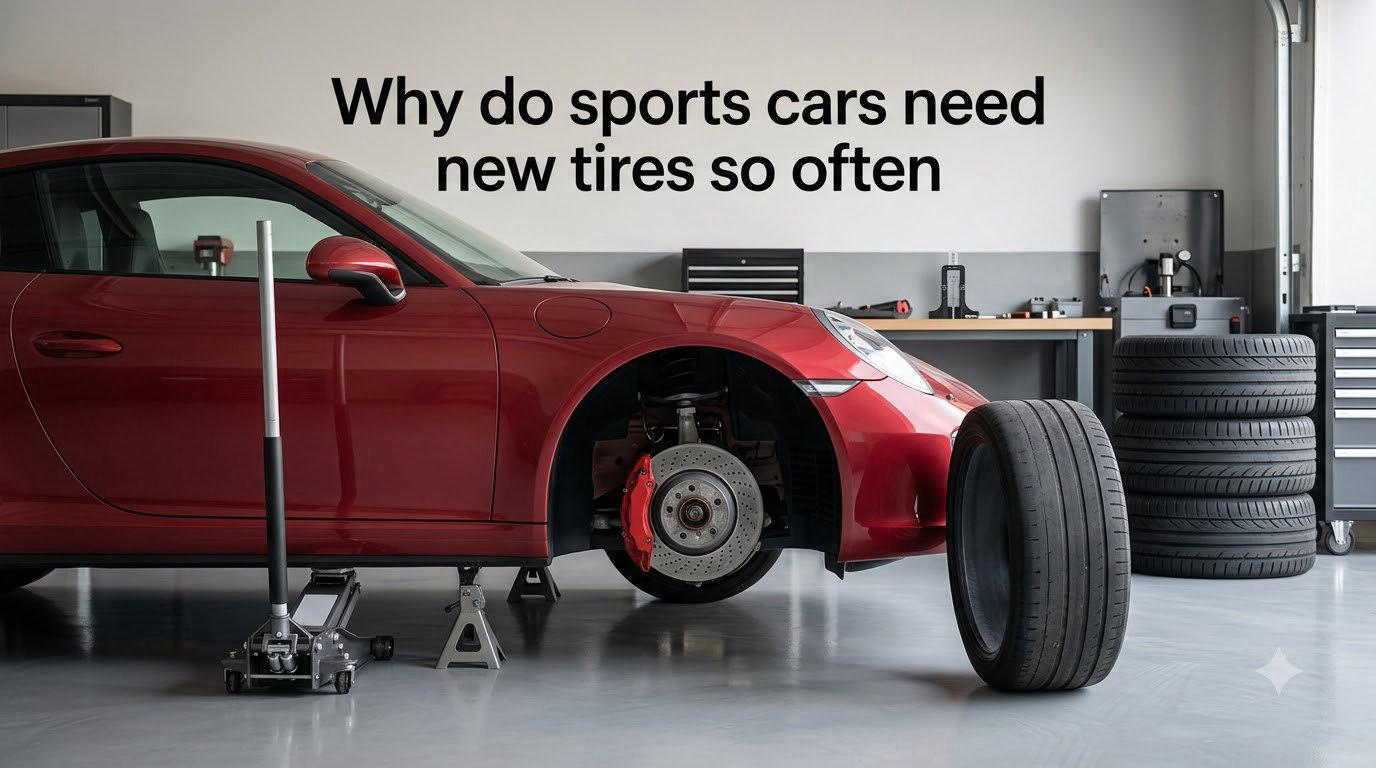
If you’ve ever owned a sports car and wondered why you’re replacing tires every couple of years, you’re not alone. Sports cars need new tires more often because performance tires use softer rubber compounds designed for maximum grip and handling—but that same softness causes them to wear out much faster than standard tires. A set of all-season tires might last 60,000 miles, while high-performance summer tires on your sports car could need replacement after just 20,000 to 30,000 miles. It’s a deliberate engineering trade-off: better traction, cornering, and braking performance come at the cost of shorter tire life.
I’ve been through this cycle multiple times with performance vehicles, and the replacement frequency can catch new owners off guard. In this guide, I’ll explain exactly why sports car tires wear faster, what you can realistically expect in terms of mileage, and practical steps to get the most life out of your performance tires without sacrificing the driving experience you bought the car for.
Table of Contents
Why Performance Tires Wear Faster Than Regular Tires
The short answer to why sports cars need new tires so often comes down to rubber compound chemistry. Performance tires are engineered for grip, not longevity, and that fundamental design choice affects everything about how quickly they wear out.
Softer Rubber Compounds Mean More Grip But Less Life
Performance tires use significantly softer rubber compounds than all-season tires. This softness allows the tire to conform to road surface irregularities at a microscopic level, creating more contact area and friction. That friction is what gives you superior cornering grip, shorter stopping distances, and better steering response.
The downside is that this same friction accelerates tread wear. Every time you accelerate, brake, or corner, the soft rubber compound is literally scrubbing away against the pavement. The softer the compound, the faster this happens.
The Science Behind Tire Compound Chemistry
Tire manufacturers blend synthetic and natural rubber with various fillers, oils, and chemical agents to achieve specific performance characteristics. Performance tire compounds use higher ratios of natural rubber and specialized polymers that stay pliable at high operating temperatures.
These compounds typically include silica and carbon black in formulations optimized for wet and dry grip rather than wear resistance. A touring tire compound might be engineered for 80,000 miles of tread life, while a competition-tire compound could wear out in a single track day.
Speed ratings also play a role. Tires rated V (149 mph), W (168 mph), or Y (186 mph) use compounds and construction methods that maintain structural integrity at sustained high speeds. That performance envelope comes with inherently faster wear rates compared to H-rated (130 mph) or T-rated (118 mph) standard tires.
Performance Tires vs All-Season Tires: A Direct Comparison
Understanding the differences between performance and all-season tires helps explain why sports cars chew through rubber so quickly. The comparison isn’t just about grip—it spans tread life, cost, and what each tire type is designed to do.
Tread Life Expectations by Tire Type
Here’s what you can realistically expect from different tire categories:
- Ultra-high-performance summer tires: 15,000 to 25,000 miles
- Performance summer tires: 25,000 to 40,000 miles
- Performance all-season tires: 40,000 to 60,000 miles
- Standard all-season tires: 50,000 to 80,000 miles
- Touring all-season tires: 60,000 to 100,000 miles
That means a sports car running ultra-high-performance tires might need new rubber three to four times as often as a sedan running touring tires. At current performance tire pricing, that adds up to a significant ownership cost difference over 100,000 miles of driving.
What You Gain and What You Give Up
Performance tires deliver measurable advantages that matter for sports car driving. Stopping distances from 60 mph can be 10 to 20 feet shorter on performance summer tires compared to all-season options. Cornering grip increases meaningfully, and steering feel becomes more precise and communicative.
Forum discussions from sports car owners consistently highlight that the safety improvement in emergency stopping distance alone justifies the faster wear rate. As one owner put it, “the more performance-oriented tires become, the faster they wear out—it’s a difficult trade-off, but I’d rather replace tires more often than compromise stopping distance.”
How Driving Style Impacts Sports Car Tire Wear
Your driving habits have a massive effect on how quickly sports car tires wear out. Two drivers with identical cars and tires can see dramatically different tread life depending on how they drive.
Aggressive Driving and Accelerated Wear
Hard acceleration, aggressive braking, and enthusiastic cornering all increase tire wear rates significantly. Launching from a stop with traction control partially defeated can scrub a measurable amount of tread in a single hard start. Sustained aggressive driving through canyon roads or on track can cut tire life in half compared to conservative street driving.
Traction control systems also affect wear, though in less obvious ways. When the system intervenes during hard acceleration, it’s applying brakes to spinning wheels and reducing engine power—actions that create additional tire scrub and heat buildup.
The Role of Track Days and Spirited Driving
Track days are especially hard on tires. The combination of sustained high speeds, extreme cornering forces, and repeated hard braking generates enormous heat in the tire compound. A set of tires that would last 30,000 miles of normal street driving might be completely worn after 5 to 10 track sessions.
Even without formal track time, regular spirited driving on back roads or canyon passes accelerates wear meaningfully. The key factor is how often and how hard you’re using the outer edges of the tire’s grip envelope.
Climate and Temperature Effects on Performance Tires
Temperature plays a bigger role in sports car tire wear than most owners realize. Performance compounds are designed for specific operating temperature ranges, and driving outside those ranges has consequences for both performance and longevity.
Why Summer Tires Struggle in Cold Weather
Summer performance tires use compounds optimized for warm weather operation. When temperatures drop below about 45°F (7°C), these compounds harden significantly, losing their designed flexibility and grip. Driving summer tires in cold weather doesn’t just reduce performance—it can cause the compound to crack and degrade prematurely.
Most tire manufacturers explicitly warn against driving summer performance tires in near-freezing temperatures. If you live somewhere with real winters, you’ll either need a separate set of winter tires or a performance all-season compound that handles a wider temperature range.
Heat Cycling and Tire Degradation
Performance tires experience heat cycling—repeated heating during driving and cooling afterward. Each cycle causes microscopic changes in the rubber compound’s molecular structure. Over many cycles, this gradually hardens the outer tread layer, reducing grip even before the tread depth becomes critically low.
Climate matters for storage too. Tires stored in hot garages or exposed to direct sunlight degrade faster due to UV radiation and thermal aging. Rubber compounds break down over time regardless of use, which is why tires have manufacture date codes and why tire age matters even for low-mileage vehicles.
How Long Do Sports Car Tires Really Last?
When owners ask how often sports cars need new tires, the honest answer depends on tire type, driving style, and maintenance habits. But here are realistic expectations based on real-world data and manufacturer guidelines.
Real-World Mileage Expectations
Mileage expectations vary widely by tire category:
- Maximum performance summer tires (Michelin Pilot Sport 4S, Continental ExtremeContact Sport): 25,000 to 35,000 miles with normal driving
- Ultra-high-performance tires (Bridgestone Potenza RE-71RS, Yokohama Advan Neova): 15,000 to 25,000 miles
- Performance all-season tires (Michelin Pilot Sport All Season 4): 40,000 to 55,000 miles
- Track-focused tires (Toyo Proxes R888R, Nitto NT01): 5,000 to 15,000 miles depending on track use
These numbers assume normal driving patterns. Aggressive driving, frequent track use, or poor maintenance can cut these figures by 30 to 50 percent.
Tread Depth Measurement Guide
Knowing when your tires need replacement requires measuring tread depth regularly. New performance tires typically start with 8/32″ to 10/32″ of tread depth.
The legal minimum in most states is 2/32″, but safety experts recommend replacing tires at 4/32″ for adequate wet weather performance. At 4/32″ tread depth, hydroplaning resistance drops significantly and wet stopping distances increase meaningfully.
You can measure tread depth with an inexpensive gauge, or use the penny test as a quick check. Insert a penny head-first into the tread groove—if you can see all of Lincoln’s head, your tread is at or below 2/32″ and the tire needs immediate replacement.
Signs Your Sports Car Tires Need Replacement
Don’t wait until you’re down to the wear bars. Watch for these indicators that your performance tires are ready for replacement.
Visual Indicators of Tire Wear
Tread wear bars are small raised sections in the tire grooves that become flush with the surrounding tread when the tire reaches 2/32″ depth. When you can see these bars connecting across the tread pattern, the tire is legally worn out.
Uneven wear patterns signal alignment or suspension issues. Inner or outer edge wear typically means camber misalignment, while center wear indicates over-inflation. Catching these patterns early lets you correct the underlying problem and potentially save the remaining tire life.
Look also for sidewall cracking, bulges, or cuts. These indicate structural damage that may require immediate replacement regardless of remaining tread depth.
Performance Changes That Signal Replacement Time
Reduced wet traction is often the first subjective sign that tires are wearing thin. If you notice the car sliding more easily in rain or the traction control intervening more frequently, your tread depth may be approaching unsafe levels.
Increased road noise, vibration, or a general feeling of vagueness in the steering can all indicate tire wear or damage. These symptoms warrant immediate inspection.
How to Make Your Sports Car Tires Last Longer
You can’t eliminate the faster wear rate of performance tires, but you can meaningfully extend their life with proper maintenance and driving habits.
Proper Tire Pressure Maintenance
Check tire pressure at least monthly and before any extended trips. Under-inflation causes the tire to flex more than designed, generating excess heat and wearing the outer edges faster. Over-inflation reduces the contact patch, causing center tread wear.
Use the manufacturer’s recommended pressure found on the driver’s door jamb sticker or in the owner’s manual—not the maximum pressure listed on the tire sidewall. For spirited driving, you might increase pressure by 2 to 3 psi, but return to normal for daily use.
Regular Tire Rotation Schedule
If your sports car uses the same size tires front and rear, rotate them every 5,000 to 8,000 miles. Front tires wear faster on the outer edges due to steering forces, while rear tires wear more evenly on rear-wheel-drive cars.
Many sports cars use staggered setups with wider rear tires. In this configuration, rotation options are limited or impossible, so tire life depends even more heavily on proper alignment and driving habits.
Alignment and Suspension Checks
Have your alignment checked every 12,000 miles or anytime you hit a significant pothole or curb. Even slight alignment drift can cause rapid uneven wear that cuts tire life substantially. Sports car suspension settings often run more aggressive camber and toe angles than standard cars, which can accelerate inner edge wear.
Worn suspension components—bushings, ball joints, shocks—affect tire wear too. If you notice uneven patterns developing, have the full suspension inspected before just getting an alignment.
Smart Driving Habits That Save Tires
Smooth, progressive inputs are the single biggest factor in extending tire life. Gradual acceleration, moderate braking, and flowing through corners rather than attacking them all reduce tread scrub and heat buildup.
Avoid burnouts and hard launches whenever possible. A single aggressive launch can remove a surprising amount of rubber. If you do enjoy spirited driving, balance it with conservative daily driving to average out the wear rate.
Seasonal Storage Tips for Performance Tires
If you store your sports car for winter or swap between summer and winter tires, proper storage extends tire life. Store tires in a cool, dry location away from direct sunlight and ozone sources like electric motors.
For mounted tires, reduce pressure slightly and store the car on jack stands to prevent flat spots. For unmounted tires, store them upright or stacked flat, and consider using tire bags to protect against UV and environmental degradation.
Frequently Asked Questions
Why do sports cars need new tires so often?
Sports cars need new tires more frequently because performance tires use softer rubber compounds designed for maximum grip and handling. This softness causes faster tread wear compared to standard all-season tires. Additionally, sports car driving patterns typically include more aggressive acceleration, braking, and cornering that further accelerate tire wear.
How long do performance tires last on a sports car?
Performance tire lifespan varies by type. Ultra-high-performance summer tires typically last 15,000 to 25,000 miles. Maximum performance summer tires last 25,000 to 35,000 miles. Performance all-season tires can last 40,000 to 55,000 miles. Track-focused tires may wear out in 5,000 to 15,000 miles depending on use intensity.
Should I replace tires at 4/32 tread depth?
Most safety experts recommend replacing tires at 4/32 of an inch tread depth rather than waiting for the legal minimum of 2/32 inch. At 4/32 inch, wet weather performance drops significantly with increased hydroplaning risk and longer stopping distances. For sports cars that rely on performance tires for safety margins, earlier replacement is even more important.
Can I put regular all-season tires on my sports car?
You can technically install all-season tires on most sports cars, but it will significantly reduce the performance capabilities the car was designed for. Cornering grip, steering response, and braking performance all decrease meaningfully. Many sports car owners choose performance all-season tires as a compromise that extends tread life while preserving reasonable performance characteristics.
How often should I rotate my sports car tires?
Rotate sports car tires every 5,000 to 8,000 miles if your car uses the same size tires front and rear. Many sports cars use staggered setups with wider rear tires that cannot be rotated side-to-side or front-to-rear, making proper alignment and inflation even more critical for even wear.
What is the 7-year rule for tire replacement?
The 7-year rule refers to the general recommendation that tires should be replaced after 7 years regardless of remaining tread depth. Rubber compounds degrade over time due to oxidation, UV exposure, and temperature cycling. Some manufacturers recommend replacement at 6 years, and tires should be inspected annually after 5 years of service regardless of mileage.
Wrapping Up: Understanding Why Sports Cars Need New Tires So Often
Sports cars need new tires more frequently because performance tire compounds prioritize grip and handling over longevity. The softer rubber, aggressive tread patterns, and performance-focused engineering that make sports cars so rewarding to drive also mean faster tread wear. Expect to replace performance tires every 20,000 to 35,000 miles for summer compounds, compared to 50,000 to 80,000 miles for standard all-season tires.
Proper maintenance—correct tire pressure, regular rotation when possible, alignment checks, and smooth driving habits—can extend tire life by 15 to 25 percent. Understanding why sports cars burn through tires helps you budget for replacements and choose the right tire compound for your driving style, whether that’s maximum performance summer tires for weekend canyon runs or performance all-season compounds for daily driving duty.