
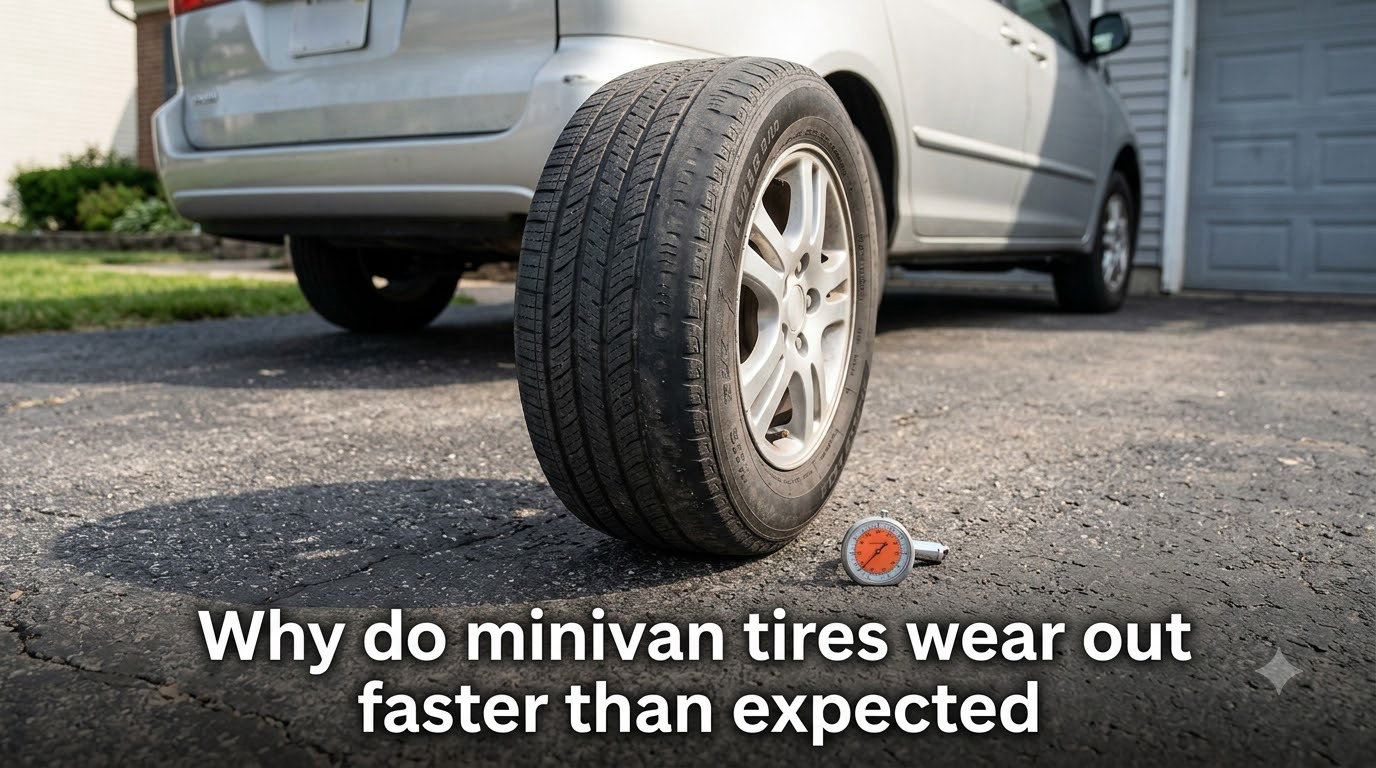
Minivan tires wear out faster than expected because the front end carries over 60% of the vehicle’s weight while also handling steering, braking, and acceleration at the same time. Add in underinflation, alignment drift, suspension wear, and hot climate conditions, and most minivan owners find themselves replacing tires every 25,000 to 35,000 miles instead of the 50,000+ they were promised.
I have spent years talking to minivan owners through our service bays, and the same frustration comes up again and again: front tires that look bald on the edges at 20,000 miles, rear tires with strange scalloped dips, or full sets that need replacing just two years after install. In this guide, I will walk you through every reason why minivan tires wear out faster than expected, how to identify what is happening on your own van, and the exact maintenance schedule that keeps tires rolling longer.
Table of Contents
Front Tire Weight Distribution on Minivans
The single biggest reason minivan tires wear out faster than expected is front-heavy weight distribution combined with front-wheel drive. On most minivans like the Toyota Sienna, Honda Odyssey, and Chrysler Pacifica, the engine, transmission, and transaxle all sit ahead of the firewall.
That layout pushes 60% to 65% of the curb weight onto the front axle. The front tires are not only carrying more pounds per square inch, they are also the ones doing the steering, the majority of the braking, and all of the acceleration on FWD models. Three jobs, one pair of tires.
Every time you turn the wheel, scrub across a parking lot, or brake for a stop sign, the front shoulders of the tire are dragged sideways across the pavement. Over thousands of daily trips, that scrubbing eats the outer edge of the front tires far faster than the rear. Rear tires on a minivan mostly just roll straight, so they often look nearly new when the fronts need replacement.
All-wheel-drive minivans spread the wear a bit, but they still wear faster than a sedan because of the curb weight, which typically runs 4,400 to 4,800 pounds. A Honda Civic weighs about 2,900 pounds. That extra ton of vehicle mass has to come off somewhere, and it usually comes off the rubber.
Tire Pressure and Inflation Issues
Improper tire pressure is the second most common reason minivan tires wear out faster than expected, and it is the easiest one to fix. Underinflated tires bulge outward at the sidewalls, so the tire’s contact patch shifts onto the shoulders instead of the center tread.
The result is shoulder wear on both edges, faster heat buildup, and a sidewall flexing every rotation. Sidewall flex generates internal friction that cooks the tire from the inside out. A tire running 5 PSI low can lose 15% to 20% of its tread life, and many minivans are sensitive to even small pressure drops because of their weight.
The placard pressure on your driver’s door jamb is set for the original SL-rated tire the van shipped with. Many owners replace the OEM tires with XL (Extra Load) rated tires for higher load capacity, but the placard pressure is often wrong for XL rubber. XL tires usually need 3 to 5 PSI more air than SL tires at the same load.
Check your tire pressure at least once a month, when the tires are cold, before you drive more than a mile. The TPMS light on your dash usually does not come on until a tire is 25% underinflated, which is already too late to prevent shoulder wear.
XL Versus SL Tire Ratings for Minivans
This is the section most articles skip, and it is one of the most important if you want to stop replacing tires every two years. SL stands for Standard Load, and XL stands for Extra Load. The two ratings look almost identical on the sidewall, but they handle very different weights.
An SL tire is built with a lighter internal construction and lower sidewall reinforcement. An XL tire has stiffer sidewalls, stronger belts, and a higher load index, typically allowing 800 to 1,000 more pounds of load per tire than the SL version of the same size.
For a 4,600 pound minivan split across four tires, plus passengers, cargo, and the tongue weight of a small trailer, XL tires run closer to their comfort zone. SL tires run closer to their maximum, which means more sidewall flex, more heat, and faster wear on the edges. Forum users on SiennaChat and PacificaForums consistently report going from 25,000 miles per set to 45,000+ miles after switching to XL-rated replacements.
The trade-off is a slightly firmer ride. XL sidewalls do not absorb small bumps as well as SL sidewalls, and you will notice it on rough pavement. For most family minivan owners, the trade is worth it.
Wheel Alignment and Suspension Wear
Wheel alignment is the third pillar of premature minivan tire wear, and it has three settings that all matter: camber, toe, and caster. Camber is the inward or outward tilt of the tire when viewed from the front. Toe is how much the tires point inward or outward when viewed from above. Caster is the steering axis angle that affects straight-line stability.
If camber is off by even half a degree on a minivan, the inner or outer shoulder wears noticeably within a few thousand miles. If toe is off, you will see feather edge wear, where the tread blocks feel sharp on one side and smooth on the other when you run your hand across them. Caster issues usually show up as pulling to one side and uneven wear patterns.
Minivan suspension components also wear faster than sedan components because of the weight. Ball joints, control arm bushings, tie rod ends, and wheel bearings all take a beating. A worn ball joint can throw off alignment every few weeks, which is why some owners say they get an alignment and the tires still wear out in 20,000 miles.
Before paying for another alignment, ask the shop to inspect the suspension components and provide a written report. If a ball joint or tie rod is worn, the alignment will not hold. Local alignment shops with strong reputations tend to do better diagnostic work than national chain tire stores, based on what we have seen across our service network.
Tire Rotation Importance
Tire rotation is the cheapest insurance you can buy for minivan tires, and skipping it is the fastest way to wear out a set unevenly. Because front tires wear 1.5 to 2 times faster than rear tires on a FWD minivan, rotating them every 5,000 to 6,000 miles spreads the wear across all four positions.
For FWD minivans, the most common pattern is front-to-rear on the same side for the rear tires, then swapping sides for the front. For AWD minivans, an X-pattern rotation works better because all four tires need to match in tread depth to prevent drivetrain damage. Check your owner’s manual for the exact pattern.
Rotating every other oil change is a simple rule of thumb. If you change oil every 5,000 miles, rotate at the same visit. Many owners stretch rotation to 10,000 or 15,000 miles to save a few dollars, and those owners are usually the ones replacing front tires every 18 months.
Common Wear Patterns on Minivan Tires
Reading your own wear pattern can tell you exactly why minivan tires wear out faster than expected, without guessing. Here are the four patterns we see most often in our shop.
Outer edge wear on both front tires almost always points to underinflation plus front-heavy weight. The tire is rolling on its shoulders because there is not enough air to support the center tread against the minivan’s weight.
Inner edge wear on one side usually means camber is off, often from a worn ball joint or control arm bushing. Get the suspension checked before you pay for an alignment.
Cupping or scalloping, where the tread has high and low spots every few inches, usually points to suspension components that are binding or unbalanced. Worn struts, bad shock absorbers, or a failing wheel bearing can all cause this pattern.
Center wear only usually means overinflation. The tire is rounding out at the top and bulging at the contact patch, so the center takes the brunt of the load. Drop the pressure to the door placard number.
Driving Habits and Climate Factors
How and where you drive the minivan changes tire wear dramatically. Short city trips with lots of stop-and-go braking heat up the front tires faster than steady highway driving, because every brake application loads the front tires harder.
Hot southern climates accelerate tire wear too. Rubber compounds oxidize faster above 90 degrees Fahrenheit on a regular basis, and road surface temperatures in summer can exceed 140 degrees in places like Texas, Arizona, and Florida. Minivan owners in the South regularly see 30% shorter tire life than owners in cooler northern states.
Heavy loads shorten tire life as well. Loading the van with seven passengers, sports gear, or towing a small trailer pushes the tires closer to their maximum load rating. If you regularly carry a full load, XL-rated tires and slightly higher cold pressures are worth the small ride trade-off.
Prevention Tips and Maintenance Schedule
Here is the maintenance schedule we recommend to minivan owners who want their tires to last. Following this plan is the single best way to make sure your tires do not wear out faster than expected.
Check tire pressure every month, when tires are cold, before driving more than a mile. Keep a quality digital gauge in the glove box. The cheap pencil gauges you find at parts stores are accurate to within 2 PSI at best.
Rotate tires every 5,000 to 6,000 miles, ideally at the same visit as your oil change. FWD minivans use a forward-cross pattern, AWD minivans use a side-to-side pattern. Mark your reminder in the owner’s manual or set a phone alert.
Get a four-wheel alignment once a year, or anytime you install new tires, hit a curb hard, or notice uneven wear starting. Ask for the spec sheet before and after the alignment so you can verify the numbers are within manufacturer tolerance, not just “close enough.”
Inspect suspension components every 25,000 miles, including ball joints, tie rod ends, control arm bushings, struts, and wheel bearings. Replace any worn part before paying for an alignment, so the alignment actually holds.
Upgrade to XL-rated tires when replacing the OEM set. The slightly firmer ride is the only real trade-off, and most family drivers cannot tell the difference on normal roads.
Watch your load. If you regularly carry seven passengers plus cargo, add 2 to 3 PSI to the door placard pressure and consider XL-rated tires for headroom on load capacity.
Frequently Asked Questions
Why do minivan tires wear out faster than expected?
Minivan tires wear out faster than expected because the front axle carries 60% or more of the vehicle weight while also handling steering, braking, and acceleration on front-wheel-drive models. Add in underinflation, alignment drift, and hot climate conditions, and tire life often drops to 25,000 to 35,000 miles instead of the 50,000+ the tires are rated for.
Is 40,000 miles a lot on tires?
Yes, 40,000 miles is a good run for minivan tires and better than average. Most minivan owners see front tires worn out by 25,000 to 35,000 miles due to weight distribution and FWD forces, so reaching 40,000 miles on a full set usually means the owner is rotating regularly and keeping pressure in check.
Why did my tires only last 2 years?
Tires that only last 2 years on a minivan are usually victims of chronic underinflation, missed rotations, alignment drift from worn suspension parts, or the wrong load rating. SL-rated tires on a heavy minivan run close to their maximum load, which causes shoulder wear and sidewall flex that destroys tread in under 25,000 miles.
How often should I rotate tires on a minivan?
Rotate minivan tires every 5,000 to 6,000 miles, or at every other oil change. Front tires on FWD minivans wear roughly twice as fast as rear tires, so rotating on schedule is the easiest way to keep all four tires wearing evenly and extend the life of the set.
Which brand of tire lasts the longest on a minivan?
Tire longevity comes down more to load rating and maintenance than brand name. An XL-rated tire from a mid-tier brand, rotated every 5,000 miles and kept at proper pressure, will outlast a premium SL-rated tire that is ignored. For heavy minivans, prioritize the XL rating and a mileage warranty of 60,000 miles or more over brand prestige.
Final Thoughts on Minivan Tire Wear
Minivan tires wear out faster than expected because the platform itself works against the rubber: heavy curb weight, front-loaded mass, and three jobs for the front tires instead of one. None of that is in your control, but the response is.
Keep cold pressure at the door placard plus the correct offset for your tire’s load rating, rotate every 5,000 to 6,000 miles, check the suspension before paying for alignment, and upgrade to XL-rated tires when the OEM set needs replacement. Follow that plan and you can realistically expect 45,000 to 55,000 miles from a quality set, which is what the tire manufacturers actually rate them for in the first place.