
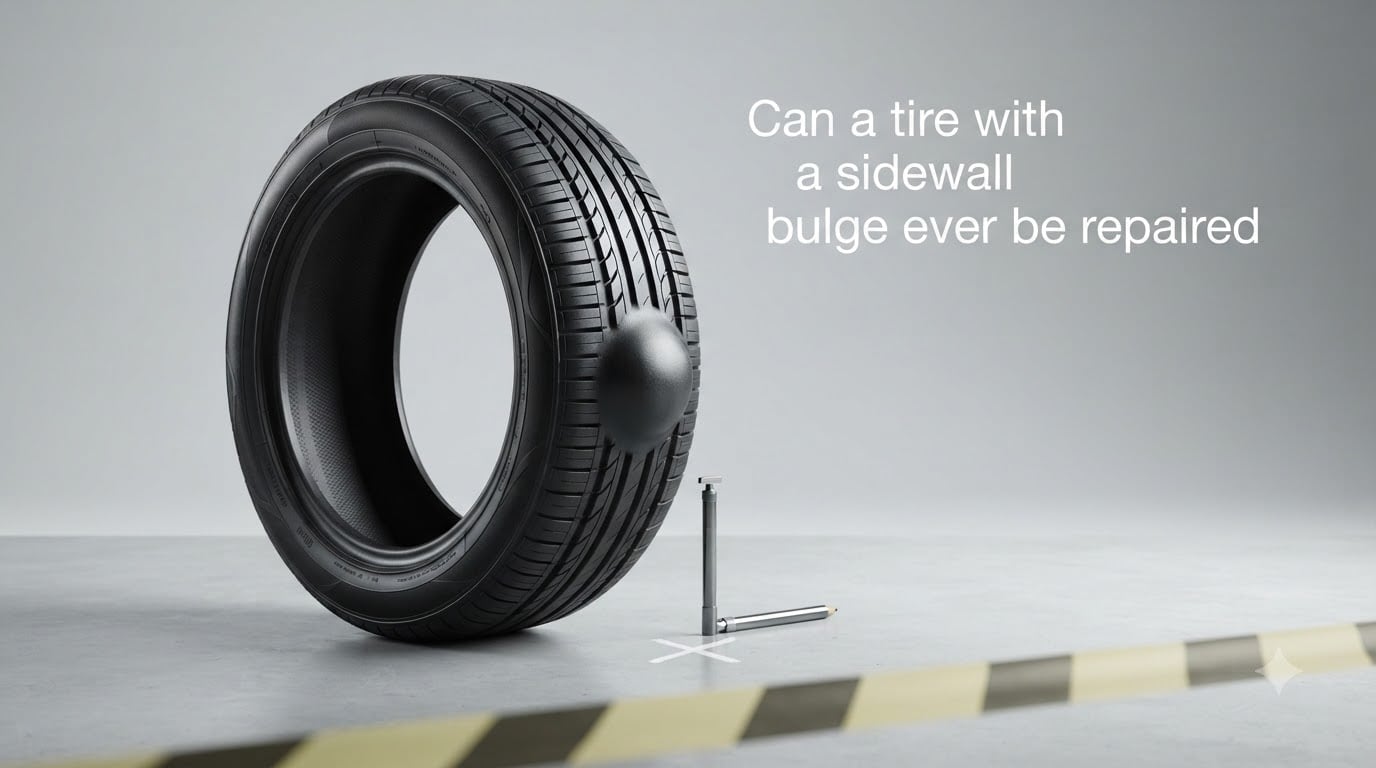
No. A tire with a sidewall bulge cannot be safely repaired under any circumstance, and the word “ever” in that question matters. I’ve walked dozens of customers through this exact conversation at the shop, and the honest answer is the same every time: the moment you see a raised bubble, blister, or bump on the sidewall of a tire, that tire is done. The damage is internal, structural, and irreversible – no patch, plug, sealant, or shop repair can restore the broken cords that hold the tire’s shape. The only correct action is replacement.
A sidewall bulge – sometimes called a tire bubble, sidewall bubble, or tire blister – is one of the clearest “replace immediately” signals in all of tire safety. Over the next several minutes I’ll explain exactly what a sidewall bulge is, why no repair is possible, what causes them, what to do in the next hour after spotting one, how warranty or insurance coverage works, and how to keep a new set of tires from ever bulging in the first place. If you only have 30 seconds, jump to the direct answer below.
Table of Contents
Table of Contents
Table of Contents
- The Short Answer
- What a Sidewall Bulge Actually Is
- Why a Sidewall Bulge Cannot Be Repaired
- What Causes Sidewall Bulges
- How Dangerous Is Driving on a Bulged Tire
- What to Do Right Now If You Spot a Bulge
- Why Tire Sealants and Patches Won’t Help
- Warranty vs Road Hazard vs Insurance
- How Many Tires Need to Be Replaced
- How to Prevent Future Sidewall Bulges
- Frequently Asked Questions
- Final Word
The Short Answer: No, a Sidewall Bulge Cannot Ever Be Repaired
A tire with a sidewall bulge cannot be safely repaired under any circumstance – not by a dealer, not by an independent shop, not by a roadside service, and not by you with a tire repair kit. Industry safety standards from the U.S. Tire Manufacturers Association (RMA) and the Tire Industry Association (TIA) define a sidewall bulge as structural damage, and structural damage is not within the patchable area of a tire. The plug-and-patch method used on tread punctures is only legal and safe when the injury is in the crown area of the tread and smaller than 1/4 inch. Sidewalls have no such option. Replace the tire.
Here’s why the word “ever” in the headline gets a flat no:
- The damage is to internal cords, not rubber. No outside-facing material is broken when a bulge forms, so no outside-facing material can be patched to fix it.
- The sidewall flexes constantly. Even a theoretical internal patch would face continuous flexing, heat, and pressure that would push the patch out within days.
- No reputable shop will attempt it. Michelin, Goodyear, Continental, Bridgestone, and every other major manufacturer list sidewall bulges as non-repairable in their service bulletins. A shop that agrees to “fix” one is a shop that should not be working on your car.
- Insurance and warranty programs all replace, never repair. Road hazard certificates, manufacturer warranties, and insurance claims all compensate you for a new tire – never a repair.
If a tire had a sidewall bulge that was somehow caught at the factory or during a recent dismount and proved to be a manufacturing defect, the answer from the tire maker is still replacement under warranty, not repair. The mechanism of the bulge – broken internal cords – is the same regardless of cause, and a repair is not in the available playbook.
What a Sidewall Bulge Actually Is (and What It Looks Like)
A sidewall bulge is a raised, balloon-like protrusion on the outside curve of a tire, almost always round, ranging from the size of a pencil eraser to the size of a golf ball or larger. It sits on the sidewall – the flexible black rubber between the tread and the bead (the part that seals against the wheel rim). When you crouch beside a tire and run your hand across the sidewall, a bulge feels like a soft lump pushing outward, almost like a half-inflated bubble trapped under the rubber.
Inside the tire is the cause. A modern radial tire is built in concentric layers:
- The inner liner – an airtight rubber layer on the inside that holds pressurized air.
- The carcass plies – layers of polyester or nylon cords (the “skeleton”) that give the tire its shape and strength.
- The belt package – usually two steel belts plus a nylon cap ply, sitting under the tread.
- The sidewall rubber – thin, flexible black rubber molded over the carcass to protect it from curb strikes and weather.
When the inner liner or one or more carcass plies rupture, the pressurized air inside the tire pushes through the gap and inflates the thin sidewall rubber from underneath. The result is the visible bulge. It is, very literally, the tire showing you where its skeleton has broken.
Two visual look-alikes are worth knowing, because they are sometimes mistaken for a real bulge on a brand-new tire:
- Splice points. During tire building, the carcass ply material is spliced to make a continuous belt. The splice sits under the tread shoulder but can sometimes appear as a slight ridge near the edge of the tread. It’s flat, hard, and perfectly even with the surrounding rubber – not round and soft.
- Mold vent marks or “spew.” Tiny rubber nubs or seams from the curing mold, usually flat and small. They don’t grow and they don’t protrude outward.
If you’re unsure whether a lump is a real bulge or a splice point, take the tire to a tire technician and ask them to chalk-test it or unmount and inflate it for inspection. A real bulge will press outward when inflated; a splice point won’t.
Why a Sidewall Bulge Cannot Be Repaired
The tire industry’s no-repair rule for sidewall bulges is one of the few areas of tire service where there is universal agreement. It comes down to three structural realities.
1. The broken cords cannot be re-bonded. When polyester or nylon cords snap, the broken ends pull apart and the surrounding rubber loses its tension. A patch – whether internal or external – can cover a hole, but it cannot re-tension a broken skeleton. There is no adhesive, vulcanization step, or shop technique that reconnects broken cords and restores their original strength.
2. The sidewall flexes more than any other part of the tire. Every rotation of the tire, the sidewall compresses against the road and rebounds as the tire rotates upward. Over a typical driving day, a sidewall may flex 30,000 to 50,000 times. Any patch or filler placed in that zone would be working against constant movement, and would either work loose or, worse, allow the rupture to enlarge around it.
3. The damage is almost always larger than it looks. A bulge the size of a quarter on the outside typically corresponds to a cord break spanning one or more inches inside. By the time pressurized air escapes to the outside, the damage has already propagated further than the visible lump suggests. Repairing just the visible lump would leave the surrounding zone weakened and ready to fail.
That’s also why industry repair standards (RMA, TIA) limit patches to the crown of the tread and require the injury to be less than 1/4 inch in diameter, even within that zone. The sidewall doesn’t meet either condition for safe patching.
If you’ve been told by a shop that they can “fix” a sidewall bulge with an internal patch, you are being told something that contradicts every major tire manufacturer’s published service guidance. Walk away and find a different shop.
What Causes Sidewall Bulges in Tires
Almost every sidewall bulge I’ve seen has one of six causes. Some are immediate; others build up slowly until something pushes the tire past its limit.
1. Pothole impacts. The single most common cause. A pothole impact compresses the sidewall hard enough to snap one or more carcass cords. Potholes between 2 and 6 inches deep, hit at speeds above 25 mph, are the typical trigger. Bulges from potholes often show up immediately but can also take a day or two to inflate fully as air slowly migrates through the broken liner.
2. Curb strikes. Side-swiping a curb at any meaningful speed can pinch the tire against the rim and break cords on the inner side of the sidewall. Curbs cause more bulges than most drivers realize, especially with low-profile performance tires that have less sidewall rubber to absorb the blow.
3. Speed bump and driveway apron impacts. Hitting a steep speed bump at an angle, or rolling a tire off a curb-shaped driveway apron too quickly, creates the same kind of compression as a pothole. The damage often shows up later as a bulge that seems to come from nowhere.
4. Chronic underinflation. Driving for weeks or months with tires a few PSI low allows the sidewall to flex more than it was designed to. Repeated over-flexing fatigues cords and creates separations between the plies. The final result can be a bulge without any single hard impact – just the cumulative effect of being under-inflated.
5. Overloading the vehicle. Every tire has a load rating printed on the sidewall. Exceeding that rating, even briefly (a heavy load of lumber, a trailer tongue load, an overpacked SUV) can stretch and snap cords. This is more common on trucks and SUVs than on passenger cars.
6. Manufacturing defects. A small percentage of new tires leave the factory with incomplete cord bonding or a small ply separation. These usually show up as a bulge within the first few weeks of ownership, often without any impact event. They are warrantable – more on that below.
There are also some rare causes worth mentioning: overheating from chronic low pressure combined with high-speed driving, age-related rubber deterioration in tires older than six years, and damage from road debris (broken concrete, exposed rebar). All of them end in the same outcome: a bulge and a tire that needs replacement.
How Dangerous Is Driving on a Tire with a Sidewall Bulge?
A tire with a sidewall bulge is dangerous. The size of the bulge does not change the verdict. Even a small bubble means the structural cords beneath it are broken, and broken cords can’t carry the load the tire was designed to carry.
The specific risks:
- Sudden blowout. The bulge is the weakest spot on the tire. Any additional stress – another impact, a hot day, higher speed – can rupture the sidewall completely. Drivers report blowouts at highway speeds within hours or days of first noticing a bulge, even small ones.
- Loss of vehicle control. A sidewall blowout at highway speed usually destroys the tire in a fraction of a second. On a non-run-flat tire, the affected corner drops suddenly, the vehicle pulls hard to that side, and braking distance stretches dramatically. A blowout on a busy highway is one of the most common triggers for multi-vehicle accidents.
- Damage to the fender, wheel, and suspension. When the sidewall fails, the wheel rim may strike the pavement directly. I’ve personally seen bent rims, cracked control arms, and damaged fenders caused by a blowout that started as a one-inch bulge someone ignored.
- The bulge grows over time. It will not stay the size it is today. Air continues to migrate through the broken cords, the inner separation expands, and the bulge becomes a tear. There is no slow, stable middle ground.
Run-flat tires don’t change this. A run-flat tire allows limited continued driving after losing pressure, but a structural sidewall defect is not “lost pressure” – it’s failed structure. Driving on a run-flat with a bulge is just as unsafe.
Bottom line: a sidewall bulge is a “do not pass go” situation. The tire is unsafe at any speed, on any road, for any distance beyond what is required to get safely off the road or to a tire shop.
What to Do Right Now If You Spot a Sidewall Bulge
If you’ve just spotted a bulge on one of your tires and you’re reading this in a parking lot or on the shoulder, follow these steps in order. They’re written for the person who needs to make decisions in the next 30 minutes.
Step 1: Slow down and stay off the highway. If you’re on a highway, take the next exit and drop to surface streets. Bulges are most likely to fail under high-speed heat and impact. Slow to surface-street speeds as soon as it is safe to do so.
Step 2: Find a safe place to stop and inspect. A parking lot, a wide shoulder, or a quiet side street. Crouch beside each tire and look at the sidewalls. Note the position and size of the bulge. Take a photo with your phone – it helps for warranty and road hazard claims.
Step 3: Install the spare (if you have one). Most cars still come with at least a temporary spare (“donut”) or a tire inflator kit. If you have a spare and the knowledge to install it, swap the bulged tire onto a non-driven position (on a rear-wheel-drive car, the bulge should be moved off the drive axle as soon as possible; on a front-wheel-drive or all-wheel-drive car, swap to the spare and place the spare on the drive axle only if the vehicle is FWD and the spare is full-size).
Step 4: If you have no spare, drive directly to the nearest tire shop at low speed. Stay under 30 mph, avoid highways, and turn on your hazard lights. If the nearest tire shop is more than a few miles away, call a mobile tire service – they will come to you. If neither is feasible within an hour, call for a tow rather than driving indefinitely on a bulged tire.
Step 5: Ask the shop to inspect the wheel/rim. A pothole or curb strike that broke the tire may have bent the rim too. Bent rims cause vibration, slow leaks, and additional tire wear. Get the rim checked while you’re there.
Step 6: Replace the tire – same size, same load rating, same or higher speed rating. Do not replace with a tire of a different size unless the shop recommends it. Do not downgrade the speed rating. If you replace only one tire, it should match the remaining three as closely as possible – same brand, same model, same age range if you can manage it. More on AWD rules below.
Why Tire Sealants and Patches Won’t Fix a Sidewall Bulge
Walk into any auto parts store and you’ll find cans of Fix-a-Flat, Slime, and other tire sealants marketed as universal tire repair products. They are useful for one thing and one thing only: temporarily sealing small tread-area punctures long enough to drive to a shop. They cannot fix a sidewall bulge. Here’s why.
Tire sealants work by pumping a liquid rubber compound into the tire cavity, where it coats the inside and physically plugs small holes. On a sidewall bulge, the leak isn’t a hole – it’s a ruptured liner and broken cords. Sealant will pool at the bulge site and may even temporarily slow visible bulging, but it cannot re-bond broken cords or close a separation that’s already in progress. The moment the tire heats up under normal driving, the sealant liquefies and the bulge returns.
Worse, sealant can make a proper replacement harder. Many shops charge extra to clean sealant out of a wheel before mounting a new tire, and in some cases a sealant-coated wheel is considered compromised. If you’ve used Fix-a-Flat or a similar product, tell the shop before they quote the work.
Bike-tire patch kits and the standard “plug” kits sold at gas stations have the same limitation – they’re designed for tread punctures, never for sidewall structural damage. There is no consumer-grade product that addresses a broken carcass, and there is no professional-grade service that does either. The honest, repeatable answer to “can a sidewall bulge be patched” is no.
Warranty vs Road Hazard Coverage vs Insurance for a Bulged Tire
A bulged tire is rarely a “you pay full out of pocket” situation. Three different coverage paths can apply, and it helps to know how each one works before you go to the shop.
- Manufacturer’s tire warranty. Covers defects in materials and workmanship, including ply separation and broken cords that originated inside the tire. Bulges that appear within the first few weeks to months of ownership, with no clear impact event, are the best warranty candidates. Most major brands pro-rate the replacement based on tread wear – a tire at 50% wear gets roughly a 50% credit toward a new one. The defective tire is sent back to the manufacturer for inspection, so expect to leave the bulged tire with the shop.
- Road hazard coverage. A separate certificate or program offered by tire retailers (Discount Tire, Costco, Tire Rack, America’s Tire, and most chain tire stores). Covers damage from road debris, potholes, and curbs. If you bought the road hazard certificate when you bought the tires, you pay a small deductible and get a comparable replacement. Coverage typically lasts 12 to 36 months from purchase. This is the most common coverage path for impact-caused bulges.
- Auto insurance (collision or comprehensive). Tire damage alone is usually not covered by standard auto policies. However, if the bulge is part of a larger claim (you hit a deep pothole and damaged both the tire and the rim, or hit a curb and damaged the tire plus bodywork), the tire portion can be rolled into the larger claim. Comprehensive coverage sometimes applies when a tire is slashed by vandalism or damaged by a fallen object; collision applies when the tire is damaged in a crash. Pure pothole damage without other vehicle damage is rarely covered.
- Reimbursement from a municipality. In some jurisdictions, you can file a claim against the city or county responsible for a damaged road. Most require a damage report filed within a short window (often 30 days), a police report or photo evidence, and proof of repair costs. Payouts are not guaranteed and the bar is higher than insurance claims.
If you don’t know which coverage you have, call the shop before authorizing the work. They can usually check manufacturer warranty status by the DOT date code on the sidewall and confirm whether you bought a road hazard certificate when you purchased the tires. Car owners who bought tires at retailers that include complimentary road hazard coverage (Costco is famous for this) often don’t realize they have it.
How Many Tires Need to Be Replaced?
When one tire bulges, the next question is always “do I have to replace the others?” The answer depends on your drivetrain.
- Front-wheel drive (FWD). Replace the bulged tire and ideally its pair on the same axle. Mismatched tread depth on the front axle causes the differential to bind and can damage the transmission over time. If budget is tight, the new tire should go on the rear axle if the bulged tire is currently on the rear – rear-end grip is more critical for stability than most drivers realize, especially in wet conditions.
- Rear-wheel drive (RWD). Same logic. The two rear tires should match in brand, model, and tread depth. Mismatched rear tires on a rear-drive car cause snap oversteer in the rain.
- All-wheel drive (AWD). This is where it gets strict. Most AWD systems (Subaru, Audi, BMW, Mercedes, Honda AWD, Toyota AWD) require all four tires to be within a few thousandths of an inch of the same tread depth or the AWD system will bind up and self-destruct. In practice, replacing just one tire on an AWD vehicle usually requires replacing all four. Some manufacturers will allow two new tires on the rear axle only if the fronts still have similar tread depth; check your owner’s manual.
For matching, try to replace with the exact same brand, model, and size as the surviving tires. Same model is more important than same brand – a “Michelin Premier A/S” matches another “Michelin Premier A/S” more closely than a different Michelin tire of the same size. If the exact model is unavailable, choose a tire with the same speed rating, same load rating, and tread depth within 3/32 inch of the existing tires.
For budget planning, here are typical per-tire replacement ranges before installation and balancing (which can add per-tire fees at most shops):
- Economy all-season (sedan, fitment): $80-$130 per tire
- Mid-range all-season (Toyota, Honda, Ford fitments): $130-$220 per tire
- Premium touring (Michelin, Continental, Bridgestone for SUVs and sedans): $200-$320 per tire
- Light truck / SUV all-terrain: $180-$300 per tire
- Light truck / SUV mud-terrain: $250-$400 per tire
- Performance / low-profile: $200-$450 per tire, depending on size
Installation, balancing, valve stems, and old-tire disposal typically add another $20-$35 per tire. Road hazard or warranty replacements generally credit you the price of the tire only, not installation.
How to Prevent Future Sidewall Bulges
Most sidewall bulges are preventable, or at least delayable for years beyond what you’d expect. Five habits make the biggest difference.
1. Check tire pressure monthly. This is the single most effective prevention. Cold tire pressure should match the number on your driver’s-side door jamb sticker (not the number molded on the sidewall, which is the maximum). Under-inflation is the leading cause of sidewall fatigue and the second-most common cause of bulges after potholes. Buy a $10 pencil gauge and check once a month. Many newer cars have a tire pressure monitoring system (TPMS), but those only alert you when pressure drops 25% or more – by then the damage may already be starting.
2. Read the DOT date code. On the sidewall, look for “DOT” followed by a series of letters and numbers. The last four digits are the week and year of manufacture (for example, “2624” means week 26 of 2024). Tires older than six years from that date begin to dry out and lose cord strength even if the tread looks fine. The Rubber Manufacturers Association recommends replacing tires at 10 years regardless of tread depth, and most tire shops recommend six years for tires in hot climates.
3. Slow down for known road hazards. A pothole hit at 20 mph is dramatically less damaging than the same pothole hit at 45 mph. The kinetic energy that has to be absorbed by the sidewall roughly doubles with every 8 mph increase. When you see a bad pothole, a sharp speed bump, or a crumbling driveway apron, slow down before you hit it – not after you’re on top of it.
4. Avoid curbs and parking-lot blocks. Side-curb parking and parallel parking against concrete stops are notorious for sidewall strikes. Pull in slowly, watch the front corners of the car as well as the rear, and don’t try to squeeze into spots that require grinding the tire against a curb.
5. Watch your load. The tire’s load rating is printed on the sidewall. Don’t exceed it. Roof racks full of camping gear, truck beds full of gravel, and trailers heavier than the tow rating can all push tires past their load limits during long drives.
Pair these habits with a 30-second visual inspection at every oil change. Crouch beside each tire, look at the sidewalls, and check for any lumps, cracks, or bumps that weren’t there before. The five minutes per year is the cheapest tire insurance you’ll ever buy.
Frequently Asked Questions
Can a tire with a sidewall bulge be repaired?
No. A sidewall bulge cannot be safely repaired under any circumstance. The bulge means the tire’s internal cords are broken, and broken cords cannot be re-bonded or patched back to their original strength. Industry safety standards from the RMA and TIA exclude sidewalls from the patchable area. The tire must be replaced.
Can you drive on a tire with a sidewall bulge?
Only for a very short distance, only at reduced speeds (under 30 mph on surface streets), and only to reach a tire shop. A sidewall bulge means the tire can fail suddenly at any moment, especially at highway speeds or under load. If you have a spare, install it. If you must drive on the bulged tire, take the shortest possible route to a tire professional and avoid highways entirely.
Can you fix a bubble in a tire or does it need to be replaced?
It needs to be replaced. A bubble (the same thing as a sidewall bulge) is structural damage to the internal cords of the tire, and no patch, plug, or sealant can restore broken cords. Replace the tire as soon as it’s safe to do so.
What causes bubbles to form on tire sidewalls?
Most sidewall bubbles come from impact damage – hitting a pothole, curb, speed bump, or piece of road debris hard enough to break the tire’s internal cords. Other causes include chronic underinflation, overloading the vehicle beyond the tire’s load rating, and rare manufacturing defects that show up within weeks of a new tire being installed.
Will tire warranty cover a bubble in the sidewall?
Manufacturer tire warranties cover bulges caused by manufacturing defects, usually within the first year of ownership and when there’s no clear impact event. They pro-rate the credit based on remaining tread depth. Road hazard certificates (sold separately by tire retailers like Discount Tire and Costco) cover impact-caused bulges for the life of the certificate, typically with a small deductible. Standard auto insurance generally does not cover tire-only damage unless it’s part of a larger claim.
How can I prevent tire bubbles from forming in the first place?
Check tire pressure monthly against your door-jamb sticker, slow down for potholes and speed bumps, avoid curb strikes, never exceed the tire’s load rating, and inspect sidewalls visually at every oil change. Replace any tire older than six years based on the DOT date code, regardless of tread depth.
Final Word on Sidewall Bulges
Can a tire with a sidewall bulge ever be repaired? No – not safely, not legally under industry standards, not by any legitimate shop, and not for any budget worth saving. A sidewall bulge is broken internal cords, and broken cords mean a tire that is one impact away from a blowout. Replace the tire, inspect the rim, save the bulged tire for warranty or road-hazard credit if applicable, and then refocus on prevention: monthly pressure checks, careful driving around potholes and curbs, and replacing tires before they reach six years of age from the DOT date code. The replace-now decision is the only one that protects you and your passengers.