
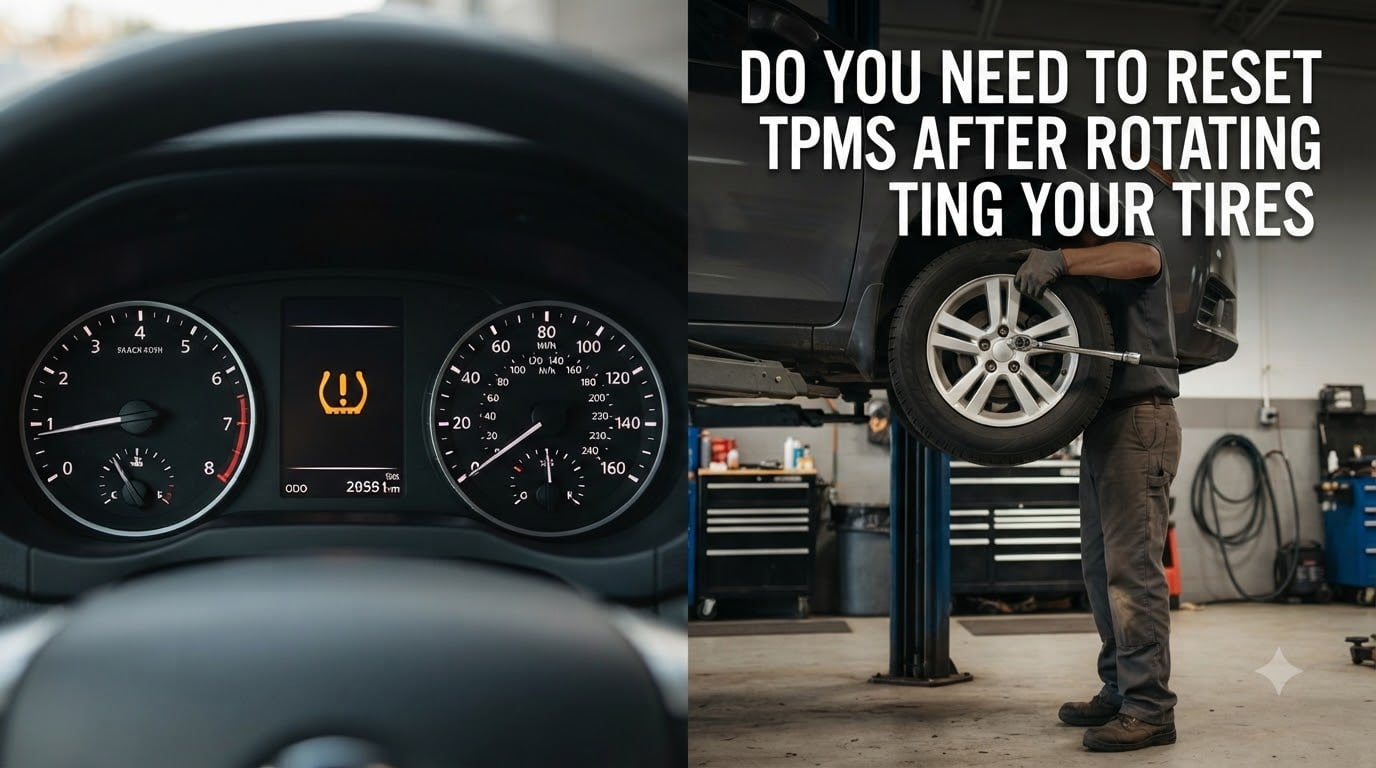
Yes, most vehicles with direct TPMS need a reset after tire rotation. When tires move to different wheel positions, the pressure sensors in each wheel no longer match the locations programmed into your car’s computer. A TPMS relearn teaches the system which sensor is where. If you skip it, the TPMS light may turn on even though all tires have correct pressure. Vehicles with indirect TPMS typically only need a recalibration drive rather than a formal reset.
In this guide, we cover exactly when and how to reset TPMS after rotating your tires, including vehicle-specific instructions for popular makes like GM, Ford, Honda, Toyota, and Nissan. We also explain the difference between a reset and a relearn, what happens if you skip the process, and whether you can handle it at home or need professional help.
Table of Contents
What Is TPMS and How Does It Work?
TPMS stands for Tire Pressure Monitoring System. It’s a safety feature mandated on all vehicles sold in the United States since the 2007 model year. The system continuously monitors tire air pressure and alerts you through a dashboard warning light when pressure drops below a safe threshold—typically 25% below the manufacturer’s recommended PSI.
There are two distinct types of TPMS, and understanding which one your vehicle uses is key to knowing how to handle it after a tire rotation.
Direct TPMS
Direct TPMS uses physical pressure sensors mounted inside each wheel. These small wireless devices measure the actual air pressure in each tire and transmit readings to your car’s central computer via radio frequency (usually 315 MHz or 433 MHz). Each sensor has a unique ID, and the system tracks which sensor is in which wheel position.
When you rotate your tires, the sensors physically move with the wheels. The car’s computer still thinks the front-left sensor is in the front-left position, but it’s now somewhere else. This mismatch triggers the TPMS warning light. A relearn procedure updates the computer with the new sensor positions.
Most domestic vehicles (GM, Ford, Chrysler/Stellantis) and many imports use direct TPMS. It provides real-time, accurate pressure readings for each individual tire.
Indirect TPMS
Indirect TPMS doesn’t use dedicated pressure sensors at all. Instead, it piggybacks on the existing ABS (Anti-lock Braking System) wheel-speed sensors. An underinflated tire has a slightly smaller diameter and rotates faster than a properly inflated one. The system detects this speed difference and infers that pressure is low.
Since indirect TPMS measures rotation speed rather than actual pressure, it doesn’t track specific sensor positions. After a tire rotation, you typically just need to recalibrate the system—often by pressing a button or driving for a set distance—so it establishes a new baseline for each wheel’s rotation speed.
Honda, Toyota (some models), Subaru, and several other manufacturers use indirect TPMS. It’s less expensive but less precise than direct TPMS.
Do You Need to Reset TPMS After Rotating Your Tires?
The short answer: it depends on which TPMS system your vehicle has.
If your vehicle uses direct TPMS, yes—you need a relearn procedure after every tire rotation. Without it, the system can’t match sensor IDs to the correct wheel positions. The TPMS light will likely illuminate, and the dashboard may display incorrect pressure readings (showing the front-left tire’s pressure where the rear-right should be, for example).
If your vehicle uses indirect TPMS, you need to recalibrate the system, but it’s usually much simpler. Many vehicles let you do this by pressing a reset button (often located under the steering column or in the glove box) and then driving for 10 to 30 minutes at speeds above 30 mph. Some newer models recalibrate automatically after a short drive cycle.
The critical distinction: not resetting direct TPMS after rotation won’t cause a tire blowout or damage your vehicle. But it will leave you with a persistent warning light and inaccurate pressure information, which defeats the entire purpose of having TPMS in the first place.
Reset vs Relearn: What’s the Difference?
These terms get used interchangeably online, but they describe different things. Knowing the distinction helps you understand what your car actually needs.
A TPMS reset generally refers to clearing the warning light and reinitializing the system. On indirect TPMS vehicles, this is often just pressing a button to tell the system to relearn baseline rotation speeds. The term “reset” is what most drivers use colloquially.
A TPMS relearn is a more specific technical procedure required by direct TPMS systems. It teaches the car’s computer the new physical positions of each sensor after the wheels have been moved. This can be done through a stationary procedure (using a TPMS activation tool), an OBD-II procedure (through the diagnostic port), or a drive cycle procedure (automatically after driving a certain pattern).
When a shop tells you they “reset your TPMS,” ask whether they performed a full relearn (updating sensor positions) or just cleared the warning light. The difference matters for accurate tire pressure monitoring.
How to Reset TPMS After Tire Rotation
The exact procedure depends on your vehicle’s make, model, and year. But most direct TPMS relearn procedures fall into one of three categories. Here’s how each type works.
Drive Cycle Relearn
This is the simplest method, used by some Honda, Toyota, and other vehicles. After rotating the tires, you simply drive the vehicle under specific conditions and the system automatically relearns the sensor positions.
- Ensure all tires are inflated to the recommended PSI (found on the driver’s door jamb sticker).
- Drive the vehicle at a steady speed above 30 mph for 15 to 30 minutes.
- Avoid hard braking and rapid acceleration during this period.
- The TPMS light should turn off once the system completes the relearn.
If the light doesn’t turn off after 30 minutes of steady driving, your vehicle likely requires a different relearn method.
Stationary Relearn
This method is common on GM, Ford, and Chrysler vehicles. You’ll need a TPMS activation tool (sometimes called a TPMS trigger tool or TPMS reset tool), which is available at most auto parts stores.
- Turn the ignition to the “ON” position without starting the engine.
- Put the vehicle into relearn mode. This varies by manufacturer—on many GM vehicles, you turn the key to “ON” then press and hold the lock and unlock buttons on the key fob until the horn chirps. On some Ford models, you cycle the hazard lights three times.
- Starting with the front-left tire, hold the TPMS tool against the tire sidewall near the valve stem and press the activation button. The horn will chirp to confirm the sensor was read.
- Move to the front-right, then rear-right, then rear-left tires in that order, repeating the activation at each wheel.
- The horn will chirp twice after the last sensor is registered, indicating the relearn is complete.
- Turn the ignition off.
OBD-II Relearn
Some vehicles—particularly newer models—require a relearn procedure through the OBD-II diagnostic port using a dedicated TPMS scan tool. This method is more common at professional shops because it requires specialized equipment that’s more expensive than basic TPMS tools.
- Connect the TPMS scan tool to the OBD-II port (usually under the dashboard near the steering column).
- Follow the tool’s on-screen prompts to read the current sensor IDs from the vehicle’s computer.
- Activate each sensor with the tool’s wand, similar to the stationary method.
- The tool writes the new sensor ID positions to the vehicle’s computer through the OBD-II port.
- Disconnect the tool and start the vehicle to verify the TPMS light is off.
Vehicle-Specific TPMS Reset Guide
Here are the typical TPMS relearn requirements for the most popular vehicle brands in the US. Always check your owner’s manual for the exact procedure for your specific year and model.
GM / Chevrolet
Most GM vehicles (Chevrolet, GMC, Buick, Cadillac) use direct TPMS with a stationary relearn procedure. You’ll need a TPMS activation tool. The relearn mode is typically activated through the key fob or the vehicle’s information display. GM vehicles are notorious for requiring this step—the TPMS light will almost certainly come on after a rotation if you skip the relearn.
Ford
Ford vehicles generally use direct TPMS and require a stationary or OBD-II relearn, depending on the model year. Older models (pre-2015) often use a stationary method activated by cycling the ignition and hazard lights. Newer Ford vehicles may require a Ford-specific scan tool or an aftermarket TPMS tool with Ford compatibility.
Honda
Many Honda vehicles use indirect TPMS, which makes post-rotation recalibration relatively simple. There’s usually a TPMS button under the left side of the dashboard that you press and hold until the TPMS light blinks twice. Then drive for about 20 minutes at 30 to 60 mph to complete the calibration. Some newer Honda models with direct TPMS follow a drive cycle relearn automatically.
Toyota
Toyota uses a mix of direct and indirect TPMS depending on the model. Vehicles with indirect TPMS (common on many Corolla, Camry, and RAV4 trims) have a TPMS reset button, often located under the steering column or accessible through the vehicle settings menu on the infotainment screen. Models with direct TPMS typically relearn automatically after a drive cycle of 15 to 30 minutes.
Nissan
Most Nissan vehicles use direct TPMS and require a stationary relearn procedure. You’ll need a TPMS activation tool. The relearn mode is usually entered through a sequence involving the ignition switch and sometimes the vehicle’s information buttons. Nissan’s procedure is similar to GM’s, requiring you to activate each sensor in a specific order starting from the front-left wheel.
What Happens If You Don’t Reset TPMS?
Skipping the TPMS reset after tire rotation won’t damage your tires or affect your vehicle’s drivability. The car will drive just fine. However, there are meaningful downsides.
The TPMS warning light will likely turn on, which means you lose the system’s ability to alert you to an actual low-pressure event. You won’t be able to distinguish between a false alarm caused by the sensor position mismatch and a real tire pressure problem. This is the main safety concern.
Additionally, if your state requires an annual vehicle inspection, an illuminated TPMS warning light may cause your vehicle to fail the inspection in states that check dashboard warning indicators.
Some vehicles with direct TPMS will eventually relearn the sensor positions on their own after extended driving, but this can take days or even weeks of normal driving—and there’s no guarantee it will happen on every vehicle. It’s faster and more reliable to perform the proper relearn procedure.
DIY vs Professional TPMS Service
Whether you handle the TPMS reset yourself or take it to a shop depends on your vehicle’s system and your comfort level with automotive procedures.
DIY is practical when: your vehicle uses indirect TPMS with a simple reset button, or when you’re comfortable following the drive cycle or stationary relearn instructions. The only tool investment for stationary relearn is a TPMS activation tool, which pays for itself after one or two uses.
A shop visit makes sense when: your vehicle requires an OBD-II relearn with manufacturer-specific software, when the TPMS light stays on after you’ve attempted a reset, or when you suspect a faulty sensor. Many tire shops include TPMS relearn as part of their rotation service at no extra charge, though some charge a separate fee. Dealerships typically charge the most for this service.
If you’re unsure whether your vehicle needs a reset after rotation, ask the shop performing the rotation to confirm they’ll handle the TPMS relearn as part of the service.
Frequently Asked Questions
Do you have to reset TPMS after tire rotation?
For vehicles with direct TPMS, yes—you need a relearn procedure after every tire rotation. The sensors move with the wheels, so the system needs to relearn which sensor is in which position. Vehicles with indirect TPMS only need a simple recalibration, often by pressing a button and driving for 15 to 20 minutes.
Will the TPMS light go off on its own after rotation?
On some vehicles, the TPMS light may eventually turn off on its own after extended driving as the system slowly relearns sensor positions. However, this is unreliable and can take days or weeks. Performing the proper relearn procedure is the recommended approach.
How long does it take for TPMS to reset?
A drive cycle relearn typically takes 15 to 30 minutes of steady driving. A stationary relearn using a TPMS tool takes about 5 to 10 minutes once you’re familiar with the procedure. An OBD-II relearn at a shop usually takes 10 to 15 minutes.
Do you need a special tool to reset TPMS?
It depends on your vehicle. Indirect TPMS vehicles usually need no tools—just a button press. Vehicles with stationary relearn need a TPMS activation tool (available at auto parts stores). Vehicles requiring OBD-II relearn need a TPMS scan tool, which is typically a shop-level investment.
Where is the TPMS reset button?
On vehicles with indirect TPMS, the reset button is typically located under the steering column, in the glove box, or accessible through the infotainment screen settings menu. Check your owner’s manual for the exact location on your specific vehicle.
Is TPMS reset the same as relearn?
Not exactly. A reset generally means clearing the warning light, while a relearn is the specific procedure that teaches the car’s computer the new sensor positions after they’ve been moved. A proper relearn includes a reset, but a simple reset may not update the sensor positions correctly.
Can I rotate tires without resetting TPMS?
You can physically rotate the tires without resetting TPMS, and your vehicle will drive normally. However, the TPMS warning light will likely illuminate, and the system will display inaccurate pressure readings. You lose the safety benefit of knowing which specific tire is underinflated.
Conclusion
So, do you need to reset TPMS after rotating your tires? If your vehicle has direct TPMS, absolutely—the relearn procedure is necessary to keep your pressure monitoring accurate and your warning light off. If your vehicle has indirect TPMS, a quick recalibration button press followed by a short drive is all it takes. Either way, taking five minutes to handle the reset now saves you from staring at an ambiguous warning light every time you start your car.