
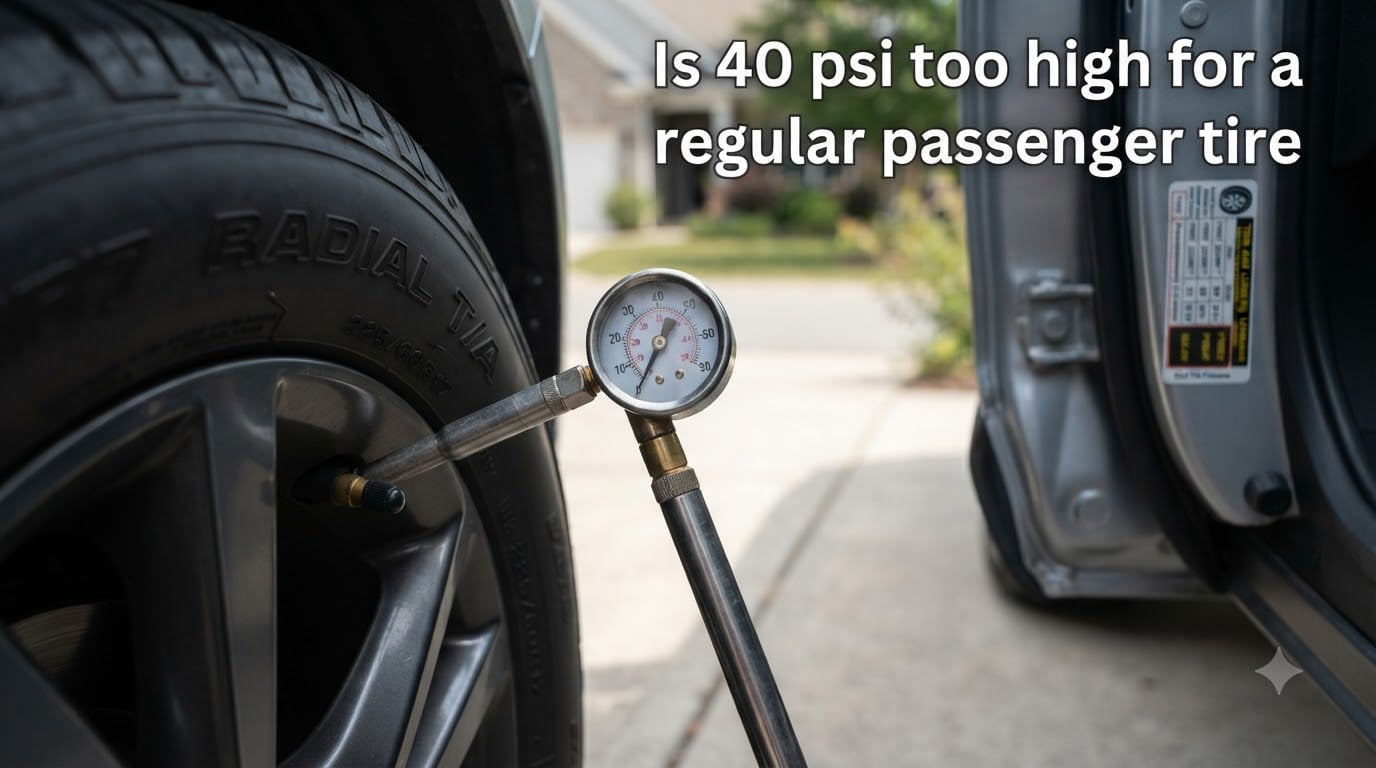
If you’ve recently inflated your tires to 40 PSI and now you’re wondering whether that’s too high, you’re not alone. We hear this question constantly from readers, and it’s one of the most common tire pressure misconceptions on the road today. The short answer is: for most regular passenger cars, 40 PSI is above the manufacturer’s recommended range, but it’s not automatically dangerous — and the exact details depend on your specific vehicle, your tires, and how you drive.
Table of Contents
Is 40 PSI Too High for a Regular Passenger Tire?
For the majority of regular passenger cars, 40 PSI is higher than what the manufacturer recommends. Most passenger vehicles call for 32 to 35 PSI, which means running 40 PSI puts you roughly 5 to 8 PSI above the target. That said, 40 PSI is not in the “dangerous” zone for most modern tires — it’s more like “unnecessarily high” that can cause a harsher ride, faster center tread wear, and slightly reduced traction in wet conditions.
The number that matters isn’t the MAX PSI stamped on your tire’s sidewall. It’s the recommended PSI printed on the driver’s-side door jamb placard or in your owner’s manual. That’s your vehicle manufacturer’s target, and it’s what you should aim for every time you check your tire pressure.
Where to Find Your Car’s Recommended Tire Pressure
The correct tire pressure for your vehicle is always listed in one of two places: the driver’s-side door jamb sticker (also called the vehicle placard) or your owner’s manual. The door jamb placard is a small label — usually white or yellow — that you’ll see when you open the driver’s door and look at the door frame or the edge of the door itself.
This sticker tells you the recommended cold tire pressure for both the front and rear tires. Some vehicles have different PSI targets for front and rear, which is especially common on sports cars and performance sedans. If your placard says “32 PSI front, 35 PSI rear,” that means you inflate each axle to its specific number — not a single universal number.
One important detail: the tire pressure listed on the placard is a “cold” reading, meaning the tires haven’t been driven on for at least three hours or haven’t been driven more than a mile. Tires heat up as you drive, and that heat naturally increases pressure by 2 to 5 PSI. That’s normal and expected — don’t deflate your tires to compensate for a warm reading.
Recommended PSI vs Sidewall MAX PSI: Why the Number on Your Tire Is Misleading
This is the single biggest source of confusion for drivers, and it’s the reason so many people end up running 40 PSI in the first place. The number molded into your tire’s sidewall — usually something like “MAX PSI 44” or “MAX LOAD 1,500 LBS AT 44 PSI” — is the maximum cold inflation pressure the tire can safely handle under maximum load. It is not the recommended driving pressure for your vehicle.
Your tire manufacturer and your vehicle manufacturer work together to determine the ideal PSI for your specific car. The vehicle’s engineers know exactly how much weight each tire supports, how the suspension geometry interacts with tire flex, and what inflation pressure gives the best balance of ride comfort, handling, traction, and tread life. That number goes on the door jamb placard — not on the tire sidewall.
Think of it this way: the sidewall MAX PSI is the tire’s ceiling. The door jamb PSI is your sweet spot. Running at the ceiling doesn’t give you extra performance or safety — it just makes the ride rougher and wears out the center of your tread faster.
What Happens When You Run 40 PSI in a Regular Passenger Tire
If your car’s recommended PSI is 32 to 35 and you’re running 40, here’s what you can expect over time:
Center Tread Wear
Overinflated tires bulge outward in the center, which means the center of the tread makes more contact with the road than the edges. This causes the center to wear down faster than the shoulders. You might notice your tires developing a flat, bald strip down the middle while the edges still have plenty of tread left. This kind of uneven wear shortens your tire life and can happen within 10,000 to 15,000 miles of sustained overinflation.
Harsher Ride Quality
With more air pressure inside, the tire becomes stiffer and absorbs less road impact. You’ll feel every bump, pothole, and road imperfection more sharply. Many drivers who’ve had their tires inflated to 40 PSI at a tire shop — a common complaint we hear — immediately notice the ride feels “bouncy” or “harsh” compared to before.
Reduced Wet-Weather Traction
An overinflated tire has a smaller contact patch with the road. That means less rubber gripping the surface, which translates to slightly longer stopping distances and reduced grip in rain or on wet roads. For daily commuters, this is a meaningful safety trade-off that’s easy to avoid.
Slightly Higher Blowout Risk (in Extreme Cases)
At 40 PSI, you’re still well within most tires’ structural limits — typically 44 to 51 PSI. But if you’re already at 40 PSI cold and then drive on a hot highway for hours, your pressure can climb to 44 to 48 PSI. At that point, you’re riding near the tire’s rated maximum, which leaves less margin for error if you hit a pothole or road debris.
When 40 PSI Is Actually Acceptable
There are situations where running 40 PSI is perfectly fine — and in some cases, it’s recommended:
Electric Vehicles (EVs)
EVs are significantly heavier than their gas-powered counterparts due to battery weight. Many EV manufacturers specify higher tire pressures as a result. Tesla, for example, recommends 42 PSI for many Model 3 and Model Y configurations. The Ford Mustang Mach-E runs around 38 to 42 PSI depending on the trim. If you drive an EV, your door jamb placard may already call for pressures in the 38 to 45 PSI range — and 40 PSI is right on target.
SUVs, Crossovers, and Light Trucks
Larger vehicles carry more weight and often have higher recommended PSI values than sedans. Many SUVs list 35 to 40 PSI on their door jamb sticker. If your crossover or light truck calls for 38 to 40 PSI, running 40 PSI is exactly what the manufacturer intended.
Heavy Loads and Towing
When you’re carrying a full load of passengers and cargo or towing a trailer, your tires support more weight than usual. Many owner’s manuals include a separate “heavy load” tire pressure recommendation that’s higher than the standard number — sometimes 38 to 42 PSI. If you’re loading up for a road trip or towing, check your manual for the load-specific PSI recommendation.
Highway Driving at Sustained Speeds
Extended highway driving at speeds above 65 MPH heats your tires and naturally increases pressure. Some manufacturers recommend bumping PSI up by 2 to 3 PSI above the placard value for sustained high-speed driving. If your placard says 35 PSI and you’re doing a long highway trip, 37 to 38 PSI cold is reasonable — but 40 PSI cold may still be higher than needed.
How Temperature Affects Tire Pressure
Tire pressure changes with temperature, and this is one of the most overlooked factors in the 40 PSI debate. A general rule of thumb: for every 10°F change in ambient temperature, your tire pressure changes by approximately 1 PSI.
This means if you inflated your tires to 35 PSI on a warm 80°F afternoon and the temperature drops to 40°F overnight, your tires will read roughly 31 PSI the next morning. Conversely, if you set 40 PSI on a cold 30°F morning and drive on a hot highway in 95°F weather, your running pressure could climb to 46 to 48 PSI — dangerously close to the sidewall MAX on many tires.
This is why the “cold tire pressure” standard exists. Always check and set your tire pressure when the tires are cold — meaning the car hasn’t been driven for at least three hours, or has been driven less than a mile at low speed. The placard PSI accounts for normal heat buildup from driving.
Seasonal Adjustment Tips
In fall and winter, when temperatures drop, check your tire pressure more frequently — at least every two weeks. A 30°F temperature swing between seasons can drop your PSI by 3 points, which is enough to trigger a TPMS warning light. In summer, if you set pressure in the cool morning, don’t be alarmed when it reads a few PSI higher after your afternoon commute — that’s normal thermal expansion.
How to Check Your Tire Pressure Correctly
Checking tire pressure is one of the simplest and most important maintenance tasks you can do. Here’s how to do it right:
Step 1: Buy a quality digital tire pressure gauge. They cost a few dollars and are far more accurate than the pencil-style gauges at gas station air pumps. Keep one in your glove box.
Step 2: Check pressure when tires are cold — first thing in the morning is ideal, before you’ve driven more than a mile.
Step 3: Remove the valve cap from one tire, press the gauge firmly onto the valve stem, and read the number. If it’s above your placard PSI, you need to release some air. If it’s below, you need to add air.
Step 4: Repeat for all four tires, including the spare if your vehicle has a full-size spare. Don’t forget: some vehicles have different recommended PSI for front and rear tires.
Step 5: Check monthly and before any long road trip. Tires naturally lose about 1 PSI per month through normal permeation, so even if nothing seems wrong, a monthly check keeps you in the safe range.
How to Deflate Tires from 40 PSI to the Correct Pressure
If you’ve discovered your tires are sitting at 40 PSI and your door jamb placard calls for 32 to 35 PSI, here’s exactly what to do:
Step 1: Locate the small metal pin in the center of the valve stem. You can use the back end of your tire gauge, a small screwdriver, or a dedicated valve stem tool.
Step 2: Press the pin inward briefly. You’ll hear a hissing sound as air escapes. Release in short bursts — about 2 to 3 seconds at a time.
Step 3: After each burst, check the pressure with your gauge. Repeat until the reading matches your placard PSI.
Step 4: Replace the valve cap and move to the next tire. Don’t forget to check all four tires — they may have been inflated unevenly.
This entire process takes less than 10 minutes and costs nothing. It’s the single best thing you can do right now if you’ve been running 40 PSI in a 32 to 35 PSI vehicle.
Frequently Asked Questions
Is 40 PSI too high for a sedan?
For most sedans, 40 PSI is higher than the manufacturer’s recommended pressure, which typically falls between 32 and 35 PSI. While it’s not immediately dangerous, sustained driving at 40 PSI can cause center tread wear, a harsher ride, and slightly reduced wet-weather traction. Check your driver’s door jamb placard for your specific sedan’s recommended PSI.
What PSI is dangerous for tires?
Most passenger tires have a sidewall MAX PSI rating between 44 and 51 PSI. Running significantly above the sidewall MAX — or running the placard-recommended PSI but driving in extreme heat for hours — can push you into a dangerous range. The real risk is sustained overinflation that compounds with heat buildup during driving, potentially exceeding the tire’s rated maximum.
Should tires be at 40 PSI?
Only if your vehicle’s door jamb placard or owner’s manual specifically recommends 40 PSI. Many SUVs, crossovers, and electric vehicles do call for pressures in the 38 to 42 PSI range. For standard passenger sedans, 32 to 35 PSI is the typical recommendation. Always use the placard number, not the sidewall MAX number.
Is higher tire pressure better for fuel economy?
Slightly higher tire pressure does reduce rolling resistance, which can marginally improve fuel economy. However, the gains are minimal — typically less than 1 MPG — and come at the cost of reduced traction, a harsher ride, and faster center tread wear. Running your manufacturer’s recommended PSI is the best balance of fuel economy, safety, and tire life.
Can high tire pressure cause a tire to blow out?
Sustained overinflation combined with high-speed driving, hot weather, or road hazards can increase blowout risk. At 40 PSI cold, you’re likely still within the tire’s structural limits. But if that 40 PSI climbs to 46 to 48 PSI from heat during a long highway drive on a hot day, you’re approaching the tire’s rated maximum with less safety margin.
How often should I check my tire pressure?
Check your tire pressure at least once a month and before any long road trip. Tires naturally lose about 1 PSI per month through normal air permeation. Temperature changes between seasons can also cause significant PSI swings. A monthly check with a quality digital gauge takes about five minutes and is one of the most important maintenance habits for tire safety and longevity.
Conclusion
So, is 40 PSI too high for a regular passenger tire? For most sedans and compact cars that call for 32 to 35 PSI, yes — it’s above the recommended range and you should deflate to your door jamb placard number. For SUVs, crossovers, and electric vehicles that specify higher pressures, 40 PSI may be exactly right. Check your driver’s-side door jamb sticker, grab a quality tire gauge, and make it a habit to verify your tire pressure once a month. It takes five minutes and it’s one of the easiest ways to extend your tire life, improve your fuel economy, and keep your ride safe and comfortable.