
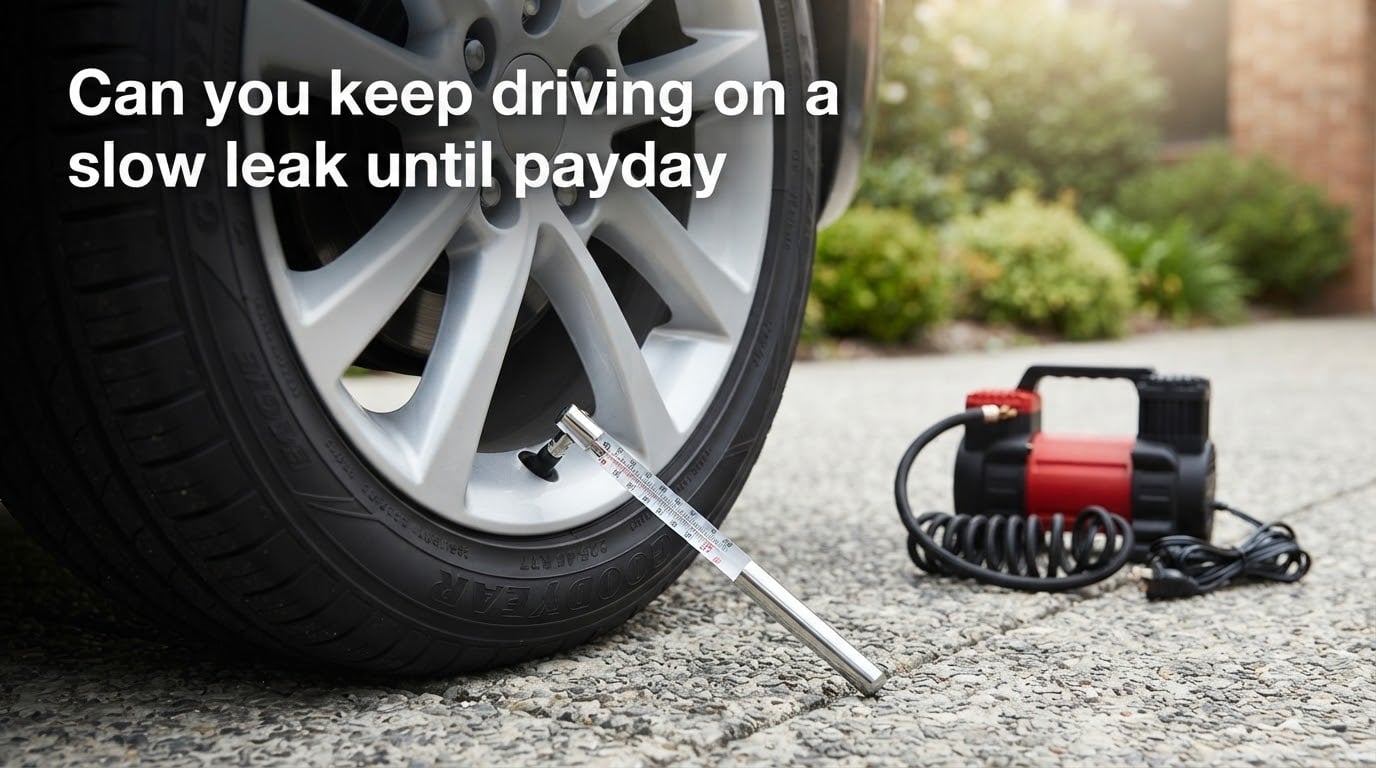
Short answer: Yes, you can keep driving on a slow tire leak until payday—but only if you check your tire pressure daily, never let it drop below 30 PSI, and avoid highway speeds. A slow leak (losing 1–3 PSI per week) is manageable for a few days with regular top-ups. However, if the tire is losing more than 5 PSI overnight or you see visible sidewall damage, stop driving and call a tow.
Getting a flat tire the week before payday is one of those frustrations nobody plans for. You notice the TPMS light flicker on, check the tire, and it’s low—but not flat. The question running through your mind is straightforward: can you keep driving on a slow tire leak until you get paid?
We’ve been there, and the answer depends on a few key factors. In this guide, we’ll break down exactly how long you can safely drive, how to find the leak yourself, what temporary fixes actually work, and when you absolutely need to stop driving. We’ll also cover the real costs so you can plan your repair budget before payday arrives.
Table of Contents
How Long Can You Keep Driving on a Slow Leak?
Most drivers with a slow tire leak can safely drive for one to two weeks, provided they check and top off the pressure every day or two. The key factor is how fast the tire loses air. A leak that drops 1–3 PSI per week is manageable; anything faster demands immediate attention.
Your driving distance matters too. A short 10-mile commute gives you more runway than a 60-mile highway drive, which generates heat and puts extra stress on an underinflated tire. Here’s a general guideline:
Losing 1–2 PSI per week: You can likely drive for 7–14 days with daily pressure checks.
Losing 3–5 PSI per week: Limit driving to short, low-speed trips and top off every 1–2 days.
Losing more than 5 PSI per day: Do not drive. This is not a slow leak—it’s a fast leak and the tire could fail at any time.
The critical threshold is 30 PSI. Most passenger tires are designed to run at 32–36 PSI (check your vehicle’s door placard for the exact number). Once pressure drops below 30 PSI, the tire’s sidewall starts flexing excessively, generating heat that can cause a blowout.
What Causes a Slow Tire Leak?
Understanding what’s causing your slow leak helps you gauge how urgent it is. Some causes are more dangerous than others.
Tread punctures are the most common culprit. A nail, screw, or piece of road debris gets embedded in the tread and creates a tiny channel for air to escape. Tread punctures are usually repairable with a patch-plug.
Valve stem leaks happen when the rubber stem degrades over time or the core loosens. These are cheap to fix—usually under 30 minutes at a shop.
Bead seal leaks occur where the tire meets the wheel rim. Corrosion on alloy rims or a damaged bead can break the seal. A tire shop can clean and re-seal this relatively quickly.
Sidewall damage is the one to worry about. Cuts, bulges, or cracks in the sidewall cannot be safely repaired. If your slow leak comes from the sidewall, you need a new tire—no exceptions.
How to Find a Slow Leak at Home
Before you decide whether to keep driving, you need to know where the air is escaping. You can pinpoint a slow leak at home with nothing more than a spray bottle and some dish soap.
Step 1: Inflate the tire to the recommended PSI. Use a tire pressure gauge (most gas station air pumps have one built in) and fill to your vehicle’s recommended pressure—found on the driver’s door placard or in your owner’s manual.
Step 2: Mix soapy water. Combine a few tablespoons of dish soap with water in a spray bottle. Any dish soap works—you just need something that bubbles.
Step 3: Spray the entire tire. Coat the tread, sidewalls, valve stem, and the bead where the tire meets the rim. Work in sections so you can watch each area.
Step 4: Look for bubbles. Air escaping from the leak will create visible bubbles. A slow leak may take 30–60 seconds to show up, so be patient.
Step 5: Mark the spot. Once you find the leak, mark it with chalk or a piece of tape so the tire shop can find it quickly. This also saves you diagnostic fees.
Pay special attention to the valve stem. Spray it directly and watch for bubbles around the base or at the tip where the core is. Valve leaks are easy to miss and cheap to fix.
Stop-Gap Fixes Until You Can Get It Repaired
If you’re trying to make it to payday, these temporary measures can keep you safely on the road for a few extra days.
Check and Top Off Pressure Daily
This is the simplest and most effective stop-gap. Buy a basic tire pressure gauge (under 10 dollars at any auto parts store) and check your tire every morning before driving. Top off at a gas station air pump or with a portable 12V inflator.
Here’s a rough re-inflation schedule based on your daily commute:
Under 15 miles/day: Top off every 2–3 days.
15–30 miles/day: Top off daily or every other day.
Over 30 miles/day: Top off every morning and consider shortening your route if possible.
Portable Tire Inflator
A portable 12V tire inflator that plugs into your car’s cigarette lighter is worth having on hand. Models from brands like Viair, AstroAI, or EPAuto cost under 40 dollars and can top off a low tire in 5–10 minutes. This lets you check pressure in your own driveway without hunting for a gas station with a working air pump.
Tire Sealant (Use With Caution)
Products like Fix-a-Flat or Slime can temporarily seal small tread punctures by injecting sealant through the valve stem. However, these products have significant downsides:
They can damage TPMS (Tire Pressure Monitoring System) sensors.
Most tire shops charge extra to clean sealant out before a proper repair.
They do not work on sidewall damage, bead leaks, or valve stem issues.
Use tire sealant only as a last resort to get to a shop—not as a week-long fix.
Reduce Speed and Load
While you’re managing a slow leak, keep your speed under 55 MPH and avoid carrying heavy loads. High speed and heavy weight generate heat that accelerates tire wear and increases blowout risk on an underinflated tire.
When to Stop Driving Immediately
There are clear red flags that mean you should pull over and call a tow truck instead of trying to nurse the tire to payday.
The tire is visibly flat or bulging. If you can see the sidewall bulging outward or the tire looks noticeably flat, do not drive on it. Driving on a flat tire destroys the tire within minutes and can damage the wheel rim.
Pressure drops below 26 PSI. At this point, the tire is dangerously underinflated. The sidewall is flexing beyond its design limits and a blowout becomes likely, especially at highway speeds.
You hear thumping or flapping. A rhythmic thumping sound means the tire is deforming as it rotates. Pull over immediately.
Damage is on the sidewall. Sidewall punctures, cuts, or bulges cannot be repaired. Driving on sidewall damage risks catastrophic tire failure.
The TPMS light is flashing. A steady TPMS light means low pressure. A flashing TPMS light means the system itself has a fault—which means you might not get a warning if pressure drops further. Get this checked immediately.
How Much Does It Cost to Fix a Slow Tire Leak?
Knowing the costs ahead of time helps you budget and avoid being upsold at the shop. Here’s what to expect:
Patch-plug repair (tread puncture): 20–45 dollars. This is the gold standard for tread punctures and takes about 30 minutes.
Valve stem replacement: 15–30 dollars. A simple fix that many shops do while you wait.
Bead re-seal: 25–40 dollars. Includes cleaning corrosion off the rim and applying new bead sealer.
New tire (budget option): 80–150 dollars for a standard all-season tire, plus installation.
New tire (premium option): 150–300+ dollars depending on brand and size.
Free repair options many drivers miss:
If you bought your tires from a tire shop, check if they offer free flat repairs. Many national chains patch punctures at no charge for their customers.
Some warehouse clubs (like Costco and Sam’s Club) offer free tire services to members, including flat repairs and pressure checks.
American Tire offers free tire pressure checks and inspections—you can find a location near you and get a professional assessment before committing to a repair.
Talking to the shop on a budget: Tell the technician you have a slow leak and ask them to locate it first. Ask, “Can this be patched, or does it need to be replaced?” A good shop will give you an honest answer. If they say it needs replacement, ask about budget tire options—most shops carry a range of price points.
Frequently Asked Questions
Is it safe to drive on a slow tire leak?
Yes, it is safe to drive on a slow tire leak for a limited time if you check the tire pressure daily and keep it above 30 PSI. Avoid highway speeds and long trips until the tire is repaired. If pressure drops below 26 PSI or you notice sidewall damage, stop driving immediately.
How long can you drive with a slow tire leak?
Most drivers can safely drive for one to two weeks with a slow leak if they top off the pressure regularly. The exact timeframe depends on how fast the tire loses air and how far you drive each day. A leak losing more than 5 PSI per day is too fast to manage and requires immediate repair.
Can a slow tire leak fix itself?
No, a slow tire leak will not fix itself. The puncture or damage that causes the leak will only get worse over time. Driving on it wears the damaged area further and increases the risk of a blowout.
How much does it cost to fix a slow tire leak?
A patch-plug repair for a tread puncture costs 20 to 45 dollars. A valve stem replacement runs 15 to 30 dollars. Many tire shops offer free flat repairs if you purchased your tires from them, so always check with the original installer first.
Can I use Fix-a-Flat on a slow leak?
Fix-a-Flat can temporarily seal small tread punctures, but it is not recommended as a long-term solution. It can damage TPMS sensors and most tire shops charge extra to clean out the sealant before doing a proper repair. Use it only as a last resort to reach a tire shop.
Where can I get a tire patched for free?
Many national tire chains offer free flat repairs for their customers. Warehouse clubs like Costco and Sam’s Club provide free tire services to members. American Tire also offers free tire pressure checks and inspections at their locations.
What PSI is unsafe to drive on?
Driving on a tire with pressure below 30 PSI is generally unsafe for most passenger vehicles. At that level, the sidewall flexes excessively, generating heat that can cause a blowout. Check your vehicle’s door placard for the exact recommended PSI, which is typically between 32 and 36.
Conclusion
So, can you keep driving on a slow tire leak until payday? Yes—if the leak is slow, you check your pressure daily, and you keep it above 30 PSI. The safest approach is to find the leak with the soapy water method, limit your driving to short low-speed trips, and schedule a repair the moment your paycheck hits.
Most slow leak repairs cost less than 50 dollars, and many shops offer free inspections. Don’t let a tight budget push you into ignoring a problem that gets more expensive the longer you wait. A 30-dollar patch today saves you from a 200-dollar tire replacement next week—or worse, a roadside blowout.