
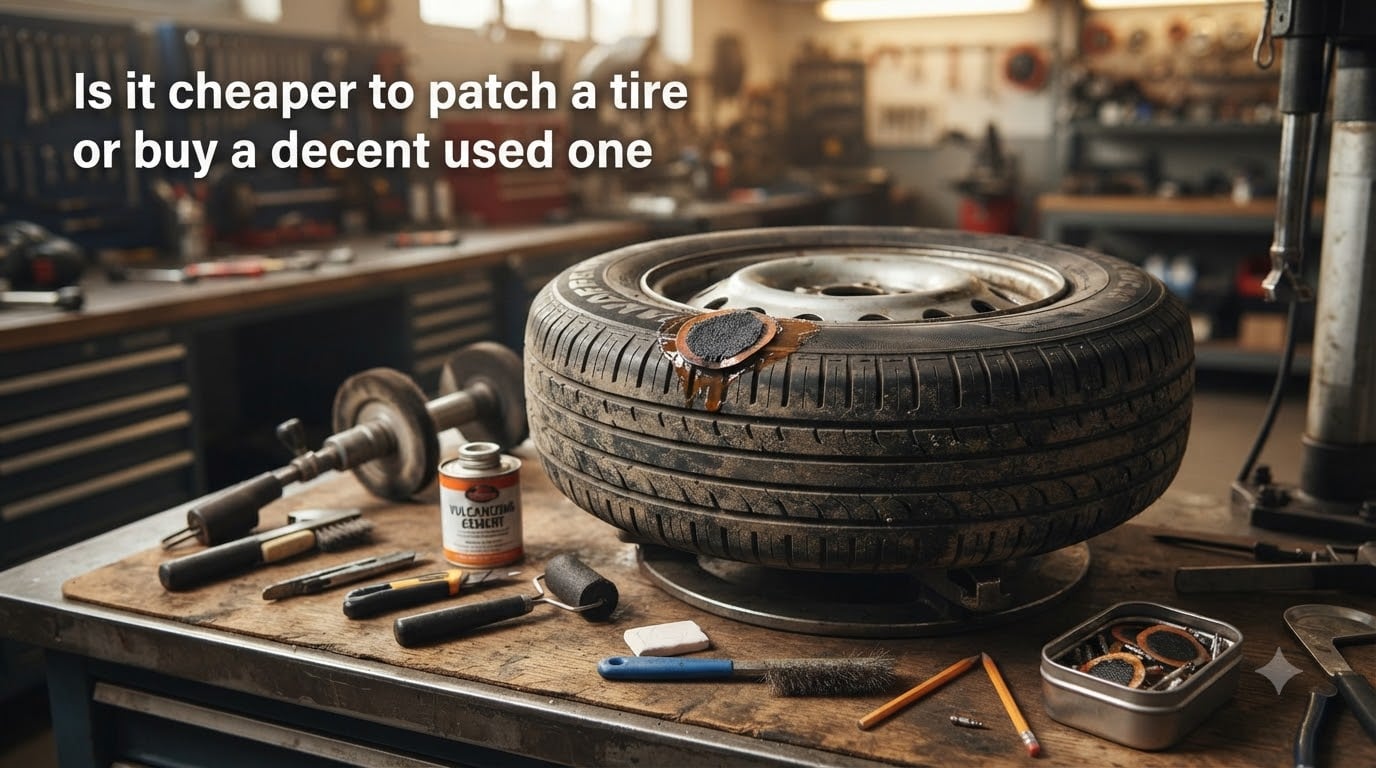
Yes, patching a tire is almost always cheaper than buying a decent used one. A professional tire patch costs $15-$30, while a usable used tire runs $25-$75 before you add mounting, balancing, and disposal fees that push the real total past $80.
But cost is only half the story. Whether is it cheaper to patch a tire or buy a used one depends on three things: where the damage is, how much tread you have left, and whether your vehicle needs matched tires. I’ve talked to mechanics, combed through Reddit threads on r/MechanicAdvice, and reviewed RMA industry guidelines to put together this 2026 breakdown so you can make the right call for your situation.
Table of Contents
Quick Verdict: Patch vs Used Tire at a Glance
Before we dig into the details, here’s the bottom line. Patching wins on price and lifespan for most drivers, but used tires have their place when the damage can’t be repaired.
| Option | Cost (incl. install) | Lifespan | Best For | Biggest Risk |
|---|---|---|---|---|
| Tire Patch (professional) | $15-$40 | 7-10 years or life of tire | Tread-area nail/screw punctures | Won’t fix sidewall or shoulder damage |
| Used Tire (decent) | $80-$130 | 2-5 years depending on age/tread | Unrepairable damage, matching worn sets | Hidden age, prior damage, no warranty |
| New Tire | $150-$300+ | 4-6 years | Worn-out tires, multiple damage, AWD full-set | Highest upfront cost |
The math gets simple fast. A $25 patch that lasts the life of your tire beats a $100 used tire that may only give you another 20,000 miles. But the patch only makes sense if the damage is actually patchable.
How Much Does It Cost to Patch a Tire?
A professional tire patch typically runs $15-$30 for the repair itself, plus $10-$20 for the dismount, remount, and balance. That puts most drivers in the $25-$40 range for a complete job.
Here’s how that breaks down by provider, based on what I found across shop menus and Reddit threads:
- Walmart: $15 per tire patch – often the lowest flat rate in town.
- Discount Tire: Free patches on tires purchased there; $20-$30 otherwise.
- Costco: Free patches for members on most tire purchases.
- Independent tire shops: $20-$40 including balance.
- Dealerships: $35-$60 – usually the priciest option.
Regional pricing matters more than people think. Urban shops tend to charge 30-50% more than rural ones. A patch in Los Angeles might run $40, while the same repair in small-town Iowa can be $20. If price is your main concern, call two or three shops and ask for their patch rate over the phone.
Most shops include a 12-month or lifetime warranty on patch repairs. Discount Tire, for example, warranties patches for the life of the tire. That warranty is one of the strongest arguments for going the patch route when it’s available.
How Much Does a Decent Used Tire Cost?
A decent used tire – one with at least 5/32 inch of remaining tread and under 6 years of age – typically costs $25-$75 per tire by itself. Once you add the hidden fees, the real total climbs quickly.
Here’s what most drivers forget to budget for:
- Mounting and balancing: $15-$25 per tire
- Valve stem replacement: $5-$10 per tire (recommended on used rubber)
- Tire disposal fee: $2-$5 per old tire
- Sales tax: varies by state
Add those up and a “cheap” $40 used tire actually costs $65-$85 once it’s on your car. Buy two, and you’re at $130-$170 – more than many new tire options.
Pricing sources for used tires vary widely:
- Local tire shops with used inventory: $40-$80 – usually inspected
- Pull-A-Part and salvage yards: $20-$50 – require self-inspection
- Facebook Marketplace and Craigslist: $20-$60 – highest risk, no recourse
- Tire-specific used dealers: $50-$100 – often include mounting
The Reddit r/MechanicAdvice crowd consistently warns against the cheapest used tires from online marketplaces. One user summed it up: “I bought four ‘like new’ tires off Craigslist for $80. Two had patched sidewalls I couldn’t see and one blew out on the highway.” When the tire fails, the savings vanish fast.
When Can a Tire Be Patched (and When Can’t It)?
Not every tire with a hole can be patched. The Rubber Manufacturers Association (RMA) publishes the repair limits every professional shop follows, and the rules are stricter than most drivers expect.
A tire can be patched when all of these conditions are met:
- The puncture is in the tread area only (the flat part that touches the road).
- The injury is no larger than 1/4 inch (about 6mm) in diameter.
- There are no other injuries within 16 inches of the damaged spot.
- The tire has not been driven on while flat or severely underinflated (this damages the internal sidewall beyond repair).
- The tire still has more than 2/32 inch of tread depth remaining.
A tire cannot be patched if any of these apply:
- Sidewall damage – bulges, cuts, or punctures on the flexible side panel
- Shoulder damage – the curved transition between tread and sidewall
- Punctures larger than 1/4 inch
- Multiple injuries close together (compromises structural integrity)
- Tire was run flat or underinflated – internal damage is usually hidden
- Tread worn below 2/32 inch – tire is at end of life anyway
The sidewall rule is non-negotiable. Sidewalls flex constantly as you drive, and no patch can hold up to that movement long-term. Mechanics on r/MechanicAdvice are unanimous: sidewall damage means replacement, full stop.
Plug vs Patch vs Patch-Plug Combo
The terms “plug” and “patch” get used interchangeably, but they’re actually three different repair methods. Understanding the difference matters because not all shops offer all three, and prices vary.
| Method | How It Works | Durability | Cost | Industry Standard? |
|---|---|---|---|---|
| Plug only | Sticky rubber cord pushed into the puncture from outside | Poor – temporary fix only | $5-$10 (DIY kit) | No – RMA does not recommend |
| Patch only | Rubber patch bonded to inside of tire over the puncture | Good – vulcanized bond | $20-$30 | Acceptable |
| Patch-Plug Combo | Both a plug through the hole AND a patch on the inside | Best – seals from both sides | $25-$40 | Yes – RMA best practice |
The patch-plug combination is what most professional shops default to and what Tire Rack and the RMA recommend. It seals the hole from both sides – the plug fills the injury, the patch bonds to the inside – making it the most reliable repair.
DIY plug kits from auto parts stores ($5-$15) are technically legal but widely considered inadequate by professionals. They work as emergency roadside fixes but don’t last at highway speeds over time. If you’ve used a plug kit, plan on getting a proper patch-plug combo from a shop as soon as possible.
How Long Does a Patched Tire Last?
A properly installed patch-plug combo typically lasts the remaining life of the tire – often 7-10 years according to industry data. The patch doesn’t weaken the tire when done correctly.
Consumer Reports and Tire Rack both confirm that professionally patched tires perform identically to undamaged tires over their lifespan. There are documented cases of patches holding up for 50,000+ miles without issue.
The lifespan depends on three factors:
- Quality of the original repair – shop patches last longer than DIY plugs
- Location of the damage – center tread patches last longer than shoulder patches
- Driving conditions – highway miles are gentler on repairs than rough roads
If your patch was done professionally and the rest of the tire still has tread, you can expect the patch to outlast the tire itself.
Are Used Tires Worth the Risk?
Used tires aren’t automatically bad, but they carry risks that new or patched tires don’t. Knowing what to check separates a smart used-tire purchase from a disaster waiting to happen.
Here are the five biggest risks of used tires:
- Age – Rubber degrades over time regardless of tread depth. Tires over 6 years old are considered unsafe by most manufacturers.
- Hidden damage – Internal belt separations, repaired sidewalls, and impact damage aren’t visible from outside.
- Mismatched wear – Used tires may have uneven wear that causes vibration and alignment issues.
- No warranty – Most used tire sales are final, even from shops.
- Unknown history – Prior accidents, recalls, or improper storage are impossible to verify.
NHTSA data shows that older tires contribute disproportionately to blowout accidents. A tire with plenty of tread but 8 years of age is still a hazard because the rubber compound hardens and cracks over time.
The safest used tires come from reputable shops that inspect each tire before resale. These shops typically grade used tires (A, B, C) based on tread depth and age. Avoid private sellers who can’t tell you when the tire was made or where it came from.
How to Read a DOT Date Code on a Used Tire
Every tire made after 2000 has a DOT date code stamped on the sidewall that tells you when it was manufactured. This is the single most important thing to check on a used tire, and most buyers don’t know how to read it.
Here’s the 4-step process:
- Find the DOT stamp on the sidewall – it starts with “DOT” followed by letters and numbers.
- Look at the last 4 digits – these are the date code. Earlier codes use 3 digits, but post-2000 tires use 4.
- Read the first 2 digits as the week – “2618” means the 26th week of the year.
- Read the last 2 digits as the year – “2618” means 2018.
So “DOT … 2618” means the tire was made in late June 2018. Any tire with a date code older than 6 years should be avoided, regardless of how much tread it has.
Some manufacturers stamp the date code on the inside of the tire, so you’ll need to look at both sidewalls. If there’s no date code visible at all, walk away – that often means the tire was made before 2000 or the stamp has been deliberately removed.
The AWD and 4WD Caveat: Why Matching Tires Matters
If you drive an all-wheel-drive or four-wheel-drive vehicle, patching becomes even more important – and buying a single used tire becomes almost impossible. Here’s why.
AWD systems use differentials that assume all four tires have nearly identical circumference. The system constantly compares wheel speeds and adjusts power delivery based on tiny differences. If one tire has significantly different tread depth than the others, the AWD system works overtime and can damage the transfer case, differentials, or clutch packs.
Most manufacturers require all four tires to be within 2/32 inch of each other in tread depth. That means:
- If your damaged tire has 8/32 inch tread left and your other three have 4/32, you can’t just buy one used tire at 4/32 – it has to match the 8/32.
- You’ll likely have to replace all four tires, or find a used tire with matching tread depth (very difficult).
- Some AWD vehicles allow two new tires on the rear axle only, with older tires kept on the front.
For AWD owners, patching a damaged tire is almost always the right call. Buying a single used tire often isn’t even an option.
Total Cost-of-Ownership: Patch vs Used Over 3-5 Years
Looking at sticker price alone is misleading. The real comparison is cost per mile over the life of the repair.
Let’s say you drive 12,000 miles per year. Here’s the math over 3 years (36,000 miles):
- Patch ($25): $25 / 36,000 miles = $0.0007 per mile
- Used tire ($85 total): Lasts maybe 30,000 miles if you’re lucky = $0.0028 per mile
- New tire ($200): Lasts 50,000+ miles = $0.0040 per mile
By cost-per-mile, patching wins by 4x over a used tire and 6x over a new tire. The catch: the patch only works if your tire has significant tread left. If your tire is already worn, no amount of patching will help.
Over 5 years, the math shifts because the used tire may need replacing again before then, while the patched tire keeps rolling. The patched option wins even more decisively.
Decision Guide: Should You Patch or Buy Used?
Use this decision tree to figure out your best move based on your specific situation.
Patch the tire if:
- The damage is in the tread area (not sidewall or shoulder)
- The puncture is under 1/4 inch in diameter
- The tire has more than 4/32 inch of tread remaining
- You drive a 2WD vehicle, or your AWD vehicle has matching tread on other tires
- The tire was not driven on while flat
Buy a used tire if:
- The damage is in the sidewall or shoulder (not patchable)
- The puncture is larger than 1/4 inch
- You need to match a specific tread depth for AWD
- You’re replacing a worn-out tire that already needs replacement anyway
- You can verify the DOT date code and inspect it in person
Buy a new tire if:
- The tire is at end-of-life tread depth (under 2/32 inch)
- The damage is severe or there are multiple injuries
- You need a speed-rated or specialty tire not commonly found used
- You want a full warranty and peace of mind
- Your vehicle requires all four tires to match and the others are also worn
For most drivers reading this article – someone with a single nail or screw in an otherwise good tire – patching is the clear winner on both cost and reliability.
Frequently Asked Questions
How much does it cost to patch a tire?
A professional tire patch costs $15-$30 for the repair itself, with another $10-$20 for dismount, mount, and balance. Most drivers pay $25-$40 total at shops like Walmart, Discount Tire, or local independent tire stores.
How long does a patched tire last?
A properly installed patch-plug combo lasts the remaining life of the tire, typically 7-10 years or 50,000+ miles. The patch doesn’t weaken the tire when done professionally and using RMA-approved methods.
Can a tire be patched more than once?
Yes, a tire can be patched multiple times as long as each repair is in the tread area and the injuries are at least 16 inches apart. Most shops will patch a tire up to 2-3 times before recommending replacement due to overall wear.
What is the difference between a tire plug and a tire patch?
A plug is a sticky rubber cord pushed into the puncture from outside – a temporary fix only. A patch is a rubber piece bonded to the inside of the tire over the hole. The patch-plug combo does both and is the RMA-recommended industry standard for permanent repairs.
Are used tires safe?
Used tires can be safe if they’re under 6 years old (check the DOT date code), have at least 5/32 inch of tread remaining, and come from a reputable dealer who inspects them. Avoid used tires older than 6 years, with hidden damage, or sold without inspection history.
When can a tire not be patched?
A tire cannot be patched if the damage is in the sidewall or shoulder, the puncture is larger than 1/4 inch, multiple injuries are close together, the tire was driven on while flat, or tread depth is below 2/32 inch. Any of these conditions means replacement is required.
Final Thoughts
So is it cheaper to patch a tire or buy a decent used one? Patching wins by a wide margin for most drivers – $25-$40 versus $80-$130, with a longer expected lifespan. The math only flips when the damage can’t be repaired (sidewall, shoulder, large puncture) or when your tire is already worn out.
If you have a single nail or screw in the tread of an otherwise healthy tire, head to a shop and get a patch-plug combo. Save the receipt. Most shops warranty the repair for the life of the tire, which is something no used tire dealer can match.