
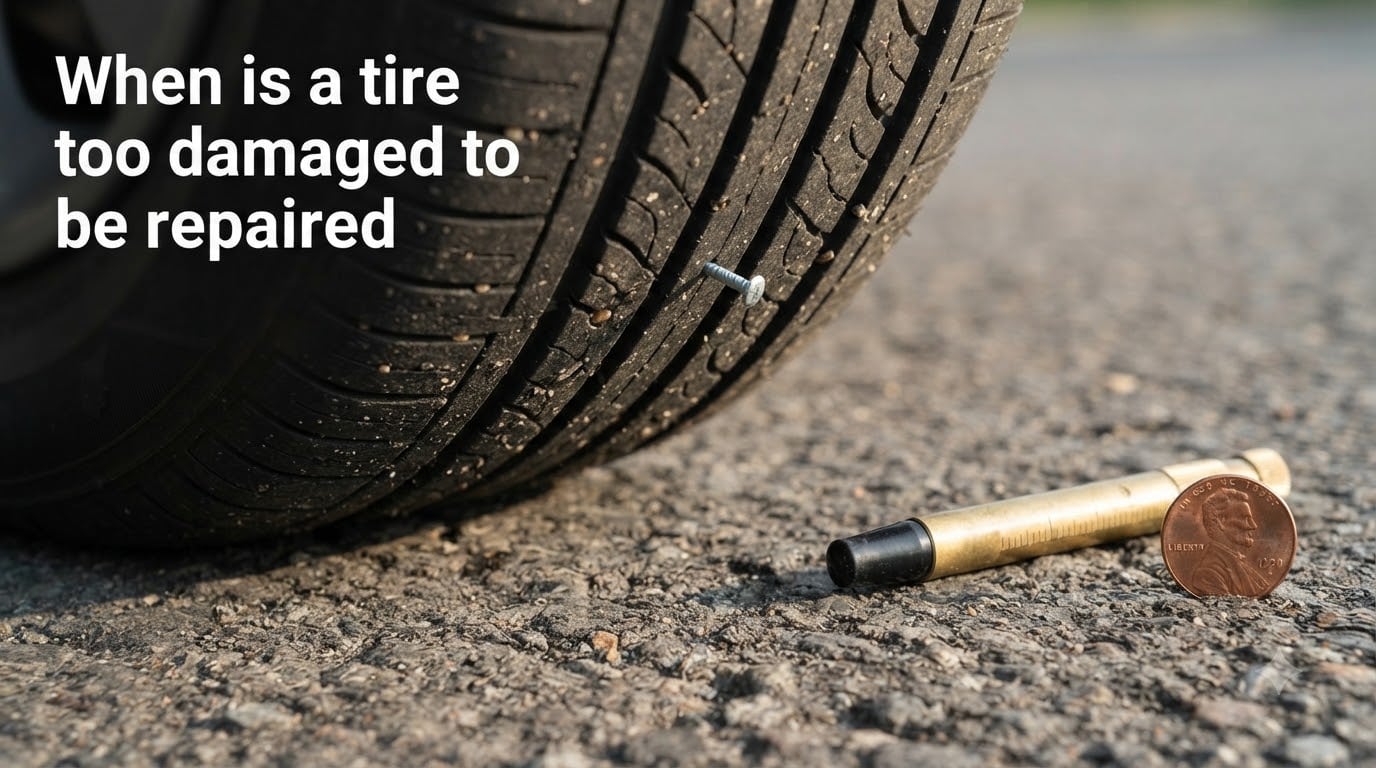
A tire is too damaged to be repaired when the puncture is larger than 1/4 inch in diameter, located in the sidewall or shoulder area, or when you spot a visible bulge, crack, or multiple damages close together. According to the Rubber Manufacturers Association (RMA) and Tire Industry Association guidelines, only tread-area punctures within these limits qualify for a permanent patch-and-plug repair. Everything else means replacement.
If you have recently found a nail in your tire or spotted damage you cannot quite identify, this guide walks you through every scenario. We cover exactly when a tire is too damaged to be repaired, what the industry standards say, and what a professional technician will look for when you bring your tire in.
Table of Contents
The Two Rules That Decide Every Tire Repair
Every tire repair decision comes down to two simple questions. Where is the damage, and how large is it?
Location is the first filter. The tire industry splits a tire into three zones: the tread crown (the flat part that contacts the road), the shoulder (the angled transition between tread and sidewall), and the sidewall (the tall, flexible side of the tire). Only tread-crown punctures are candidates for repair.
Size is the second filter. The puncture must be 1/4 inch (6mm) in diameter or smaller. A standard nail or screw falls well within this limit. A large bolt, piece of rebar, or jagged metal fragment usually exceeds it.
If a puncture fails either rule, the tire is too damaged to be repaired. Full stop.
Where the Damage Is: Tread, Shoulder, and Sidewall
Understanding tire anatomy helps you assess damage before you even get to a shop. Here is how the three zones break down.
Tread Crown — Repairable
The tread crown is the broad, flat surface with grooves that contacts the road. Punctures in this area from nails, screws, or small debris are the classic repairable injury. The rubber here is thick enough to accept an internal patch, and the structure beneath is reinforced with steel belts that maintain integrity after repair.
If you find a nail or screw embedded in the tread grooves, there is a strong chance the tire can be saved — provided the object is 1/4 inch or smaller in diameter.
Shoulder — Usually Not Repairable
The shoulder is the curved transition zone between the tread face and the sidewall. It flexes significantly during cornering and absorbs a lot of stress. Most tire manufacturers and the Tire Industry Association classify shoulder damage as non-repairable because patches do not adhere reliably under that constant flexing.
Some shops will repair a puncture that barely enters the shoulder area, but this is controversial. The conservative and widely recommended approach is to treat shoulder damage as a replacement scenario.
Sidewall — Never Repairable
The sidewall is the tall, smooth area on the side of your tire. It flexes with every rotation, absorbs road impacts, and carries no tread reinforcement. A puncture, cut, or abrasion on the sidewall cannot be patched or plugged safely. The repair material would flex and separate within days.
If you have sidewall damage of any kind, the tire is too damaged to be repaired. There is no exception to this rule under any industry guideline.
The 1/4 Inch Puncture Size Rule
The Rubber Manufacturers Association (RMA) sets the maximum repairable puncture diameter at 1/4 inch, or roughly 6 millimeters. This threshold comes from the size of injury that a properly installed combination patch-and-plug can seal without compromising the tire’s internal structure.
For reference, a standard framing nail is about 1/8 inch in diameter — well within the limit. A 3/8 inch bolt or a piece of road debris with a jagged tear typically exceeds 1/4 inch and disqualifies the tire from repair.
When in doubt, have the technician measure the injury hole after the object is removed. The external puncture may look small, but the internal injury channel can be larger than it appears.
Damage Types That Always Require Replacement
Certain types of tire damage are never repairable regardless of size or location. If you spot any of these, stop driving and start shopping for a replacement tire immediately.
Sidewall bubbles or bulges. A bubble in the sidewall means the internal ply layers have separated or the cords have broken. The structural integrity of the tire is compromised, and the bubble can rupture without warning at highway speed. This is one of the most dangerous forms of tire damage.
Deep sidewall cuts or gashes. Any cut that exposes the cord material beneath the rubber means the tire cannot be driven safely. Even shallow cuts weaken the sidewall’s ability to absorb impacts.
Cracked or weathered sidewalls. Dry rot and UV damage cause the rubber to crack and lose elasticity. These cracks often spread under driving stress and can lead to sudden failure.
Bead damage. The bead is where the tire seals against the wheel rim. Damage here causes persistent air leaks that no plug or patch can fix, and it compromises the tire’s ability to stay seated on the wheel.
Tread separation. If you notice the tread bulging or peeling away from the tire body, the internal bonding has failed. This is an immediate replacement situation.
How Many Times Can a Tire Be Patched?
The RMA allows a maximum of three repairs on a single tire, provided each puncture meets the location and size requirements and the repairs do not overlap. The Tire Industry Association echoes this limit.
If your tire already has three patch-and-plug repairs and gets a fourth puncture, it is time to replace the tire regardless of where the new damage is located. Additional repairs compromise the tire’s internal structure and heat dissipation capacity.
Spacing also matters. Repairs must be separated by at least 16 inches (roughly 40cm) along the tread circumference. Two punctures closer together than that can weaken the belt area between them.
Plug vs Patch vs Patch-and-Plug: What Actually Works
You will hear three terms used when discussing tire repair, and they are not interchangeable. Understanding the difference can save you from an unsafe repair.
A tire plug is a sticky rubber string pushed into the puncture from the outside. It seals the hole temporarily but does not address the inner liner. Many technicians and all major tire manufacturers consider a plug-only repair to be temporary, not permanent.
A tire patch is a rubber patch applied to the inside of the tire after it is removed from the wheel. It seals the inner liner but does not fill the puncture channel itself. A patch alone leaves the injury open to moisture and debris.
A patch-and-plug combination is the industry standard. The technician removes the tire from the wheel, roughs up the inner liner, applies vulcanizing cement, installs a unit that combines a plug through the injury channel with a patch on the inside surface. This is the only method approved by the RMA, Tire Industry Association, and every major tire manufacturer.
Drivers on forums like r/MechanicAdvice and r/Cartalk frequently report that patch-and-plug repairs lasted the remaining life of the tire without issues. String-plug-only repairs, on the other hand, show a much higher failure rate at highway speeds.
Tread Depth: When Even Good Tires Must Be Replaced
Even if the damage is technically repairable, a tire with insufficient tread depth should be replaced rather than repaired. The legal minimum tread depth in most states is 2/32 inch, and most safety organizations recommend replacing tires before they reach that point.
A quick way to check: insert a penny into the tread groove with Lincoln’s head pointing down. If you can see the top of Lincoln’s head, the tread is at or below 2/32 inch and the tire needs replacement regardless of any puncture damage.
New tires typically start with 10/32 inch of tread depth. Spending money to repair a tire that is nearly worn out is rarely worth it from a cost or safety perspective.
What Happens When You Take a Tire to the Shop
Most drivers do not know what the technician actually does during a tire damage inspection. Here is what a proper professional assessment looks like, based on RMA and Tire Industry Association procedures.
Step 1: Visual inspection. The technician examines the entire tire surface for punctures, cuts, bulges, uneven wear, and embedded objects. They pay special attention to the sidewall and shoulder areas.
Step 2: Remove the object. If a nail or screw is present, the technician carefully extracts it and examines the injury channel to determine its angle and depth.
Step 3: Demount the tire. For any potential repair, the tire must come off the wheel. The technician inspects the inside of the tire for internal damage, moisture intrusion, and cord exposure.
Step 4: Measure the puncture. The injury hole is measured with a probe or caliper. If it exceeds 1/4 inch, the technician stops and recommends replacement.
Step 5: Check for multiple injuries. All existing repairs are located and marked. If the tire already has three repairs or if a new injury is too close to an existing one, replacement is recommended.
Step 6: Repair (if applicable). The technician buffs the inner liner, applies vulcanizing cement, and installs a combination patch-and-plug unit from the inside. The tire is then remounted, inflated, and checked for leaks.
If a shop tries to plug your tire without removing it from the wheel, that is not an industry-standard repair. You are within your rights to ask for a proper patch-and-plug or take your business elsewhere.
Repairable vs Replaceable: A Quick Decision Guide
Here is a fast-reference guide to help you decide before you even reach a tire shop.
Repair is likely possible when:
- The puncture is in the tread crown area only
- The hole is 1/4 inch (6mm) or smaller in diameter
- The tire has fewer than three existing repairs
- Tread depth is above 2/32 inch
- No sidewall or shoulder damage is visible
- No bubbles, bulges, or cracks exist anywhere on the tire
Replacement is required when:
- Damage is on the sidewall or shoulder
- The puncture exceeds 1/4 inch in diameter
- A bubble or bulge is visible anywhere on the tire
- There are cracks in the sidewall from age or UV damage
- The tire already has three patch-and-plug repairs
- Tread depth is at or below 2/32 inch
- The tread is separating from the tire body
Safety Risks of Driving on an Unrepairable Tire
Driving on a tire you know is damaged — hoping to get a few more miles out of it — is a gamble that can have serious consequences.
A compromised sidewall can blow out without warning, especially at highway speed. NHTSA data shows that tire-related failures contribute to thousands of crashes annually. A sudden blowout at 65 mph can cause loss of vehicle control before a driver can react.
A tire with a growing bubble is under internal pressure that will eventually find a weak point. When it fails, the rupture is explosive and instantaneous. Multiple forum users describe near-miss experiences with sidewall bubble blowouts that could have been avoided by replacing the tire immediately.
Repairing a tire costs a fraction of replacing one, but that savings is never worth the safety risk when the damage is outside the repairable zone.
Frequently Asked Questions
Is it safe to repair a tire with a nail in it?
Yes, if the nail is in the tread area and the puncture is 1/4 inch or smaller. A combination patch-and-plug repair from the inside of the tire is the industry-approved method. If the nail is in the sidewall or shoulder, the tire must be replaced.
Can a tire sidewall be repaired?
No. The sidewall flexes constantly during driving and cannot hold a patch or plug. Any sidewall puncture, cut, or damage requires tire replacement. There are no exceptions to this rule under RMA or Tire Industry Association guidelines.
How big of a puncture can a tire repair fix?
The maximum repairable puncture size is 1/4 inch (6mm) in diameter, per RMA guidelines. Anything larger compromises the structural integrity of the belt area and cannot be reliably sealed by a patch-and-plug combination.
Can a tire with a bubble be repaired?
No. A bubble or bulge in the sidewall means the internal ply layers have separated or the cord structure has failed. This is extremely dangerous and requires immediate tire replacement. Do not drive on a tire with a visible bubble.
How many times can a tire be patched?
The RMA allows a maximum of three patch-and-plug repairs on a single tire. Each repair must be at least 16 inches apart and meet the standard location and size requirements. A fourth puncture means the tire should be replaced.
Is it better to patch or plug a tire?
Neither alone is ideal. The industry standard is a combination patch-and-plug installed from inside the tire after it is removed from the wheel. A plug-only repair is considered temporary. A patch-only repair does not seal the puncture channel. The combination method is approved by the RMA and Tire Industry Association.
How long can you drive on a plugged tire?
A properly installed patch-and-plug repair can last the remaining life of the tire. Drivers consistently report repaired tires lasting 30,000 to 50,000 additional miles without issues. A string-plug-only repair, however, is temporary and should be replaced with a proper patch-and-plug as soon as possible.
When must a tire be replaced instead of repaired?
A tire must be replaced when the damage is on the sidewall or shoulder, the puncture exceeds 1/4 inch, there is a visible bubble or bulge, tread depth is at or below 2/32 inch, the tire already has three repairs, or the tread is separating from the tire body.
Final Verdict
When is a tire too damaged to be repaired? The answer is straightforward: if the damage is in the sidewall or shoulder, if the puncture exceeds 1/4 inch, or if you see a bubble, bulge, or crack — that tire needs to be replaced. Only tread-area punctures that meet the size limit and pass the multi-repair count qualify for a permanent patch-and-plug fix. When in doubt, bring the tire to a reputable shop, ask them to follow RMA procedures, and do not accept a plug-only repair as a permanent solution.