
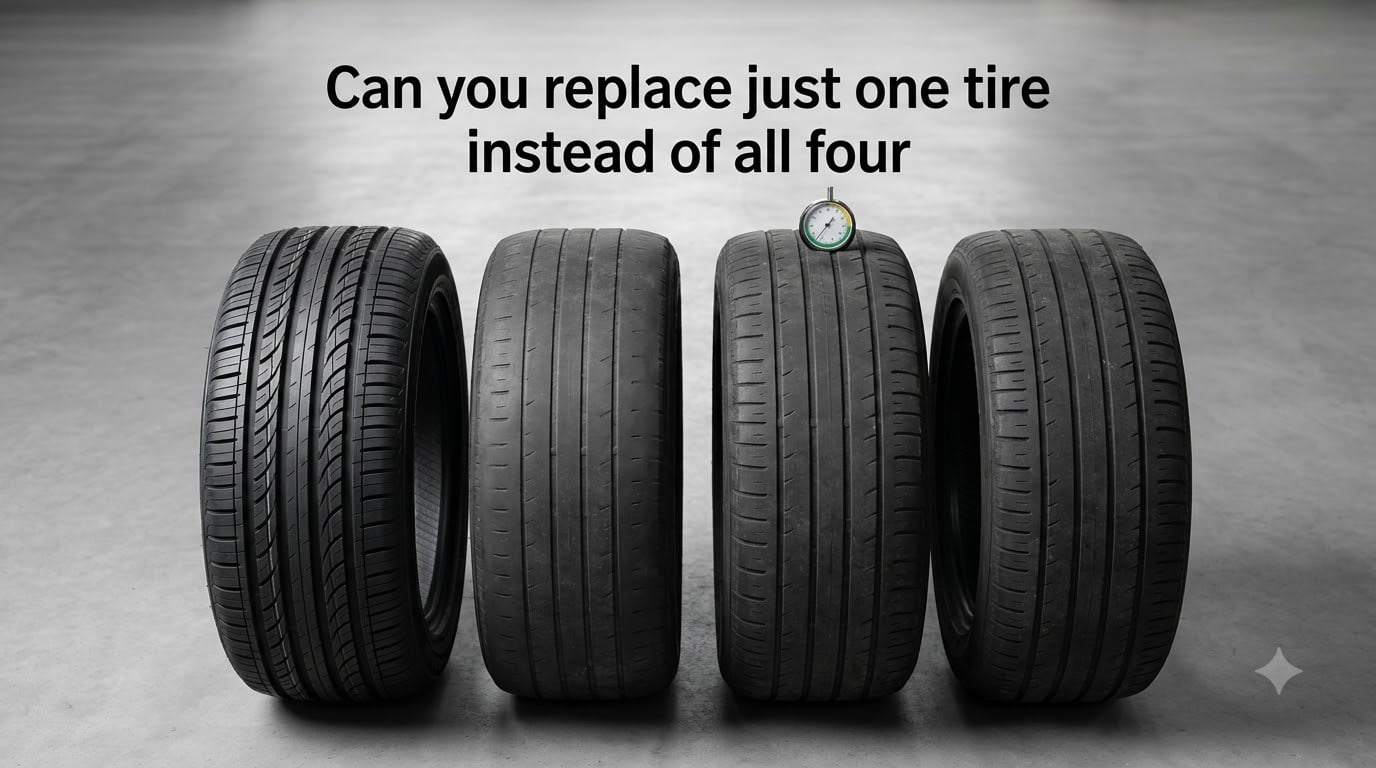
Yes, you can replace just one tire instead of all four, but only when the remaining tires still have at least 70% of their tread depth, the replacement matches the exact brand, model, and size of the others, and your vehicle is a two-wheel-drive car or truck. If you drive an all-wheel-drive vehicle, or if the other tires are more than 30% worn, replacing all four is the safer choice. When you do replace a single tire, mount it on the rear axle to reduce the risk of hydroplaning and loss of control in wet conditions.
This guide walks through the exact rules our team uses when customers ask the same question at the counter. We will cover the tread depth thresholds, the difference between FWD, RWD, and AWD vehicles, and the alternatives that can save you money without compromising safety.
Table of Contents
When You Can Replace Just One Tire
A single tire replacement is acceptable when three conditions line up at once. Get any one of them wrong, and you create a mismatched setup that wears faster, handles worse, and on some vehicles can damage an expensive drivetrain.
The first condition is tread wear. The tires that are staying on the car must have less than 30% wear, which means they still have about 7/32 inch of tread depth or more for a typical new tire that started at 10/32. New all-season tires usually ship between 9/32 and 11/32, so check the actual measurement rather than guessing.
The second condition is exact matching. The new tire must be the same brand, the same model, the same size, and ideally the same production run as the tires staying on the car. Mixing tread patterns, internal constructions, or even the same model from a different generation changes how the tire grips, brakes, and wears.
The third condition is vehicle type. Single-tire replacement works on front-wheel-drive and rear-wheel-drive vehicles when the other criteria are met. On all-wheel-drive vehicles, the rules tighten, and we cover those in the next section.
When a single replacement qualifies, install the new tire on the rear axle, not the front. Tires with deeper tread on the rear prevent the back end from breaking loose in standing water or on slippery surfaces, which is the harder skid to control.
Quick Checklist for Single-Tire Replacement
- Remaining tires show less than 30% wear (above 7/32 tread depth)
- New tire matches brand, model, size, and load rating exactly
- Vehicle is FWD or RWD, not AWD
- New tire gets mounted on the rear axle
- A four-wheel alignment is performed after installation
When You Should Replace Two Tires Instead
Replacing two tires is the most overlooked middle ground. It costs less than a full set, pairs a new tire with a like-aged tire on the same axle, and avoids the awkward situation where your spare or newest tire is sitting on a different axle than its match.
Place the two new tires on the rear axle, regardless of whether your car is front-, rear-, or all-wheel drive. This rule is recommended by every major tire manufacturer, including Michelin, Continental, and Goodyear, because rear-end loss of traction is the hardest for a driver to recover from.
If your vehicle is front-wheel drive and the front tires are the worn ones, replace the two fronts. If the rears are more worn, replace the two rears. The goal is to keep identical pairs on the same axle.
This approach costs about half of a four-tire set and gives you matched circumference, matched grip, and matched wear rate. It is our team’s default recommendation when one tire fails and the others are approaching but have not yet hit the 30% worn mark.
Why AWD Vehicles Usually Need All Four Tires
All-wheel-drive vehicles power all four wheels through a transfer case and differentials that constantly compare wheel speeds. When tires have different circumferences, even small differences from mismatched tread depth, those wheels turn at slightly different rates for the same road speed.
Modern AWD systems react to those signals through the anti-lock brake system, electronic stability control, and wheel speed sensors. A mismatch triggers warning lights, alters handling, and forces the drivetrain to work against itself. Over time, the constant compensation wears out clutches and gears inside the differential.
A Subaru owner on the r/askcarguys subreddit shared that they replaced one tire on their AWD vehicle, then needed a $1,400 differential repair four months later. That single repair cost more than a full set of tires. Stories like this are why the tire industry draws a hard line on AWD.
There are narrow exceptions. Some manufacturers accept a single replacement when the new tire is paired with three tires that have less than 2/32 inch of tread depth difference, and when the new tire is shaved to match the existing circumference. Toyota, Subaru, and Honda all publish specific guidance in the owner’s manual, so check yours before deciding.
If your AWD vehicle has a damaged tire and the others have plenty of tread left, tire shaving is usually the better path. Tire shops use a machine to grind the new tire’s tread down until its overall diameter matches the other three within a fraction of an inch. The shaved tire wears faster but keeps the drivetrain happy.
How to Measure Tire Tread Depth
Tread depth is measured in 32nds of an inch, which is why tire specifications look like fractions rather than decimals. A brand new tire typically has between 9/32 and 12/32 of tread, depending on the type. All-season tires cluster around 10/32, winter tires around 11/32, and high-performance summer tires as low as 7/32.
The legal minimum in most of the United States is 2/32 inch, which is essentially bald and dangerous in rain. Most safety organizations, including the Tire Rack and Consumer Reports, recommend replacing tires at 4/32 inch for all-season use and 5/32 inch for winter driving.
The 3% rule, which often comes up in tire discussions, refers to the maximum acceptable difference in outer diameter between tires on the same axle. If one tire is more than 3% larger or smaller in circumference than the others, drivetrain and stability systems start to react. Three percent works out to roughly 2/32 to 3/32 inch of tread depth difference on a typical passenger tire.
Two Quick Ways to Check Your Tread
- Look for the built-in treadwear indicator bars that run across the tire. When the tread surface is flush with these bars, you are at 2/32 inch.
- Insert a quarter into the tread groove with George Washington’s head down. If you can see the top of his head, the tread is below 4/32 inch.
For an exact number, pick up a tread depth gauge at any auto parts store. They cost less than a fast-food meal, take ten seconds per tire, and remove any guesswork about where you stand on the wear scale.
Alternatives to Buying Four New Tires
A full set of four tires is not your only path. Several alternatives work for specific situations, and each one solves a different problem. Picking the right alternative depends on how worn your current tires are, what you drive, and how long you plan to keep the car.
Tire Shaving Service
Some tire shops offer tire shaving, where they use a specialized machine to reduce the tread depth of a new tire to match the diameter of your existing tires. It runs roughly half the cost of a second tire on average. The shaved tire wears faster than the other three, so plan to replace the shaved tire within a year and pair it with another shaved tire at that time.
Used Tires From a Matching Set
If your other three tires are still relatively young, a used tire with similar remaining tread can be a budget option. The catch is finding a used tire that matches brand, model, size, and tread depth exactly. Local tire shops with used inventories can pull a match from their stock, and that is usually safer than online marketplaces where you cannot verify the tire before buying.
Run-Flat and Spare Tire Considerations
Run-flat tires let you keep driving for a short distance after a puncture, which removes the emergency pressure but adds cost when replacement time arrives. Run-flats must be replaced in pairs at minimum because mixing run-flats and standard tires changes the handling balance. If your car came with run-flats, follow the original equipment guidance closely.
For vehicles with a full-size spare that matches the tires on the ground, you can use the spare as a short-term replacement on the rear axle while you source a matching tire. Just remember that the spare is now wearing at a different rate and should be replaced at the same time as the tire it replaced.
Frequently Asked Questions
Is it a bad idea to replace just one tire?
It is not automatically a bad idea. A single tire replacement is fine when the remaining tires have less than 30% wear, the new tire matches brand, model, and size exactly, the vehicle is FWD or RWD, and the new tire is installed on the rear axle.
Should I replace only one tire or all four tires?
Replace only one tire if the others have less than 30% wear and your car is FWD or RWD. Replace two tires if the older pair is approaching 30% wear, and place both new tires on the rear axle. Replace all four if your vehicle is AWD, if any tire has sidewall damage, or if the remaining tires are more than 50% worn.
Is it safe to replace only one tire on a 4-wheel drive vehicle?
It is generally not safe on a 4-wheel drive or all-wheel drive vehicle because even small differences in tire circumference confuse the drivetrain and can damage the differential. The safer path is either replacing all four tires at once or having the new tire shaved to match the existing tread depth before installation.
Can I buy just a single tire?
Yes, most tire shops and online retailers sell single tires. The challenge is finding an exact match for the three tires already on the car, which is easier through a tire shop that carries your current brand than through general online listings.
What is the 3% rule for tires?
The 3% rule states that the outer circumference of tires on the same axle should not differ by more than 3%, which translates to roughly 2/32 to 3/32 inch of tread depth on a typical passenger tire. Beyond that threshold, drivetrain components and stability systems start reacting to the size difference.
Is it okay to replace one tire on an all-wheel drive car?
Most automakers recommend against replacing a single tire on an AWD vehicle. If you must replace only one, the new tire should be shaved to match the existing tread depth, installed on the rear axle, and paired with a four-wheel alignment. Long term, plan to add a second matching tire on the same axle as soon as possible.
Final Verdict: Should You Replace Just One Tire?
The short answer is that replacing just one tire instead of all four works on FWD and RWD vehicles when the other three tires still have plenty of tread, and the new tire is an exact match installed on the rear axle. On AWD vehicles, plan to replace all four or have the new tire shaved to keep the drivetrain happy.
If you are staring at a single damaged tire and not sure which path forward is right for your car, swing by your local tire shop and ask for a tread depth reading on all four tires. With that one number in hand, the choice between one tire, two tires, or four tires becomes obvious. And if you want to talk through the tradeoffs of tire shaving versus a two-tire replacement versus a full set, our team can walk you through the numbers for your specific vehicle and driving habits.