
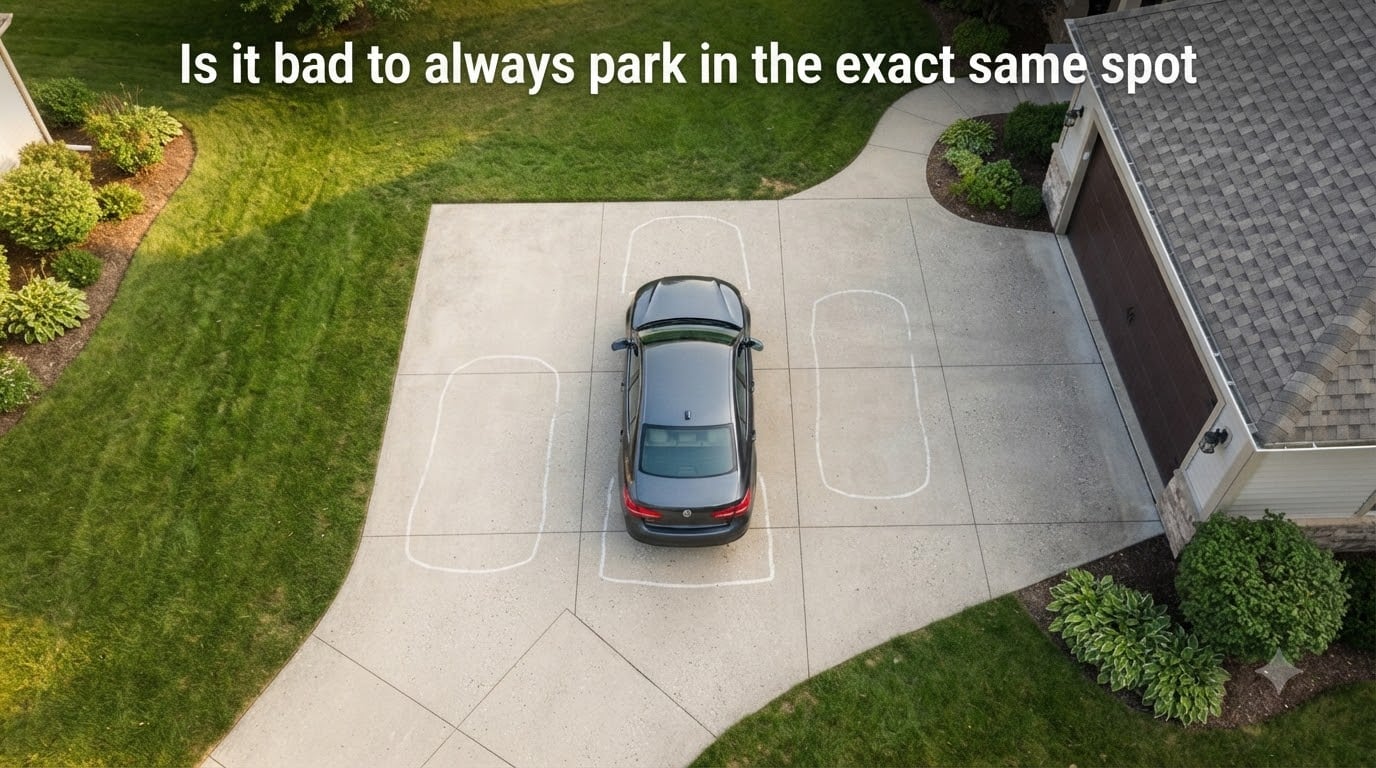
Most drivers never think twice about pulling into the same driveway groove every night. The question “is it bad to always park in the exact same spot” rarely comes up until a tire shows a flat spot or a dark oil stain refuses to come off the concrete. I have spent years looking at tires and undercarriages in our shop, and the answer is not a simple yes or no. It is a qualified “sometimes, depending on how long, on what surface, and under what conditions.”
Modern vehicles are built to handle thousands of stress cycles, but they are built to handle them in a distributed way. Parking in the same position day after day concentrates that stress onto the same tire patch, the same suspension corner, and the same underbody section. Over months and years, this concentration creates wear patterns that a rotation habit could have prevented.
In this guide, I will walk you through what actually happens when a car parks in the same spot for weeks, months, or years. We will cover tire flat spotting, undercarriage rust, suspension stress, wheel alignment drift, rodent attraction, and driveway staining. You will also get a step-by-step plan to rotate your parking spot and a damage severity table to help you decide how urgently you need to act.
Table of Contents
Quick Answer: Is It Bad to Always Park in the Same Spot?
Parking in the exact same spot every day is not catastrophic in the short term, but it quietly concentrates wear on tires, suspension, and the undercarriage over months and years. The three biggest risks are tire flat spotting, localized undercarriage rust from oil and moisture pooling in one zone, and uneven suspension loading on a slope. Minor flat spots usually disappear after a few miles of driving, but permanent damage builds when the same pattern repeats for years.
For most daily drivers, simply rotating your parking position by a few feet every week is enough to prevent the worst outcomes. Drivers who park on sloped driveways, leave a car sitting for more than a week at a time, or live in snow-belt regions with road salt benefit most from changing the routine.
Top 3 Damage Risks at a Glance
- Tire flat spotting: Visible deformation on the contact patch after weeks of stationary load, especially in cold weather.
- Undercarriage rust: Repeated oil drips and moisture pooling in one spot accelerate corrosion on the same underbody panels.
- Suspension and alignment stress: Parking on a slope or against a curb in the same direction every day loads one corner more than the others.
How Localized Tire Wear Develops in the Same Parking Spot
Your tires are designed to wear evenly across the tread as you drive. When a car sits in the exact same position for days, the same small patch of rubber carries the full weight of the vehicle. Over time, that patch compresses more than the rest of the tire, and the sidewall develops a slight memory of the load shape.
This is especially visible on cars that sit for a week or more, such as a second vehicle in the household or a work truck used only on weekends. The most exposed tire is the one parked in direct sunlight with the sun beating down on the same sidewall for hours every afternoon.
Signs Your Tires Are Suffering from Stationary Parking
- Visible flat section on the tread that smooths out after 5 to 10 miles of driving.
- Uneven shoulder wear that matches the direction you always back in or pull in.
- Vibration at highway speeds that appears after the car has been parked for several days without movement.
- One tire consistently losing a small amount of pressure faster than the others.
I have seen tires develop noticeable flat spots in as little as four weeks of non-use, particularly when temperatures drop below freezing. In warm climates, the rubber stays flexible and the spot relaxes sooner, but the wear pattern still adds up over years.
Tire Flat Spotting When a Car Sits Unused for Weeks
Tire flat spotting is one of the most common questions we get from drivers who leave a vehicle parked for weeks at a time. A flat spot forms when the tire cools under load and the contact patch takes a temporary set. The colder the ambient temperature, the faster this set takes hold.
For typical daily drivers who move their car every day, true flat spots are rare. The tire never sits long enough to fully deform, and the heat generated while driving restores the shape. The risk rises sharply when a car sits for more than a week in the same position, especially outdoors in winter.
How Long Does It Take for Flat Spots to Form?
Under normal conditions, minor flat spots can appear in 4 to 6 weeks of stationary parking. In freezing temperatures with the tire inflated to factory pressure, visible flat spots can show up in as little as 7 to 10 days. The good news is that most flat spots are temporary and disappear within the first 10 miles of driving once the tire warms up.
Permanent flat spots are rare and usually only appear after months of neglect combined with low tire pressure. If you store a vehicle for the winter, inflate the tires to the maximum pressure listed on the sidewall, move the car an inch or two every few weeks, and consider putting it on jack stands to take weight off the rubber entirely.
Undercarriage Rust and Oil Stain Concentration
Every car drips a small amount of fluid during normal operation. A few drops of oil, a trickle of coolant, and a splash of AC condensate land on the ground under the engine bay and transmission. When you park in the same driveway spot for years, those drops always land in the same square foot of concrete.
The result is two problems happening at once. The driveway or garage floor develops a permanent dark stain from the oil. At the same time, the same underbody panels sit in that oily, moist patch every day, which accelerates corrosion compared to a vehicle that is moved around and allowed to dry out.
Why Same-Spot Parking Worsens Rust
- Ground moisture and oil combine into a slow-acting chemical bath on one section of the underbody.
- Shadow from the parked car prevents that patch of ground from drying in the sun.
- Leaves, dirt, and road salt accumulate in the same sheltered zone under the chassis.
- The same suspension components and brake lines are repeatedly exposed to the dampest part of the pad.
Drivers in snow-belt states see this effect most clearly. Road salt drips off the undercarriage onto the same driveway square, and the salt concentration in that one spot becomes much higher than anywhere else on the property. Over five to ten years, this is enough to cause visible rust through on floor pans and frame rails in that exact footprint.
Suspension Stress from Uneven Loading on a Slope
If your driveway has even a slight slope, parking in the same direction every night loads one side of the suspension more than the other. The springs, struts, and bushings on the downhill side compress under the vehicle weight, while the uphill side stays in a slightly extended position. Over months and years, the bushings take a permanent set.
Parking on a steep hill is even worse. The parking pawl inside an automatic transmission is designed to hold the car on grades, but it is not designed to hold the car on a steep grade for months at a time without ever being moved. The same transmission components stay engaged while the cooling system never gets a chance to circulate fluid through them evenly.
How Slope Loading Affects Suspension Components
- Spring rate becomes uneven between the two sides of the car.
- Strut mounts develop wear patterns that match the slope angle you park on.
- Tie rod bushings and ball joints sit at the same angle every night, leading to one-sided wear.
- Tire wear becomes uneven on the front axle because camber and toe change as the suspension settles.
A good rule of thumb is to alternate which way you point the car on a slope every week or two. If your driveway only allows one direction because of the garage door, consider parking half on the street when possible, or use a different section of the driveway if you have one.
Wheel Alignment Drift from Repeated Curb Positioning
Wheel alignment is set at the factory to specific camber, caster, and toe angles. Hitting a curb can knock those angles out of spec, but parking close to a curb in the same position every day can also slowly drift alignment over time. The wheels sit at the same slight angle night after night, and the rubber bushings in the suspension take a memory of that angle.
This is one of the most overlooked causes of uneven tire wear that customers bring into our shop. They rotate their tires religiously, check pressure monthly, and still see one front tire wearing faster than the other. The culprit is often that they have parked the same way every night for three years, with the right front tire resting against the curb edge.
Quick Alignment Check You Can Do at Home
- Park on a flat surface and look at the gap between each tire and the fender. The gaps should be roughly equal on the left and right sides.
- Check the tread with a coin. If one tire is significantly more worn on the inside or outside edge, alignment drift is a likely cause.
- Pay attention to steering pull. If the car drifts gently to one side on a flat road, the alignment has shifted.
- Listen for clunks over speed bumps. Worn bushings from consistent slope loading often announce themselves this way.
Rodent and Pest Attraction to a Consistent Parking Spot
This is the angle most articles miss, but it is one of the most expensive problems I have seen come from same-spot parking. When a car sits in the same quiet corner of a driveway for weeks, rodents figure out it is safe. They build nests under the hood, chew through wiring harnesses, and store food in the engine bay.
Mice and rats follow scent trails, and a stationary car builds up scent faster than a moving one. The same oil drips, the same sheltered engine bay, and the same quiet patch of ground all add up to an attractive nesting site. By the time you notice the damage, repair bills often run into four figures.
Why a Stationary Car Attracts Rodents
- The engine bay stays warm long after the car is parked, especially in cooler weather.
- Wiring insulation, cardboard air filters, and soy-based wire coatings smell like food to rodents.
- The same sheltered footprint becomes a known safe zone once a scent trail is established.
- Under-hood spaces provide protection from rain, wind, and most predators.
Rotating your parking spot disrupts the scent trail and forces rodents to rebuild their route. Combining rotation with a weekly visual inspection of the engine bay is the cheapest insurance policy against rodent damage you can buy.
Environmental Exposure: UV, Salt, and Moisture on One Side
If you park facing the same direction every day, the same side of the car takes the brunt of the afternoon sun. UV rays fade paint and clear coat, dry out plastic trim, and weaken rubber weatherstripping. Over five years, you can see the difference between the sunny side and the shaded side on almost any car parked outside.
Road salt in winter follows the same pattern. The same wheel wells, the same rocker panels, and the same lower doors get blasted with salty slush every time you drive home. Parking in a different orientation spreads this exposure across the whole car instead of concentrating it on one section.
Climate-Specific Considerations
- Sun belt states: UV fading and dashboard cracking are the main same-spot concerns.
- Snow belt states: Salt corrosion and ice damage to the undercarriage are the primary risks.
- Coastal areas: Salt air accelerates rust on brake lines and exhaust components even when the car is garaged.
- Humid subtropical regions: Mold and mildew form under floor mats when a car sits in the same damp spot.
Transmission and Parking Pawl Considerations
Automatic transmissions use a small metal pin called a parking pawl to hold the car in Park. The pawl engages a toothed ring inside the transmission and locks the drivetrain. When you park in the same direction on the same slope every day, the pawl always engages the same tooth on the ring.
Over very long periods, this concentrated contact can create a small wear flat on that one tooth. It is not a common failure mode, but it is one more reason to vary your parking direction occasionally. Parking with the wheels turned toward the curb on a hill also reduces the load on the pawl, which is a habit worth keeping.
Manual transmission vehicles avoid this issue entirely because the parking gear is loaded only when you leave the car in gear. The transmission still benefits from being moved periodically so that oil reaches every internal component, but the parking pawl stress is not a factor.
Damage Severity Comparison: What Hurts and How Fast
Not every risk from same-spot parking happens at the same speed. The table below ranks the common damage types by severity and gives a realistic timeline for when symptoms typically appear. Use it to prioritize which habits to change first.
| Damage Type | Severity | Time to Appear | Prevention Method |
|---|---|---|---|
| Tire flat spotting (temporary) | Low | 1 to 6 weeks | Move car weekly, inflate to max pressure in storage |
| Tire flat spotting (permanent) | Medium | Several months with low pressure | Maintain pressure, use jack stands for long storage |
| Undercarriage rust | High | 3 to 10 years | Rotate parking spot, annual underbody wash |
| Suspension bushing set | Medium | 2 to 5 years | Alternate slope direction, vary wheel position |
| Wheel alignment drift | Medium | 1 to 3 years | Alternate curb position, annual alignment check |
| Driveway oil stains | Cosmetic | 6 to 12 months | Use oil drip mat, seal concrete |
| Rodent nesting | High | 2 to 8 weeks in stationary vehicle | Rotate spot, weekly under-hood inspection |
| UV paint fading | Low to medium | 3 to 7 years | Alternate direction, use car cover, garage when possible |
How to Rotate Your Parking Spot: Step-by-Step
Rotating your parking spot does not require any tools and takes less than 30 seconds each time. The goal is to shift the car by a few feet, change the wheel direction relative to the curb, or alternate which way you point the nose on a slope. Doing this once a week is enough to prevent most of the damage patterns described above.
Step 1: Pick Three Parking Positions in Your Driveway
Choose three different spots you can safely use without blocking the sidewalk or hitting a mailbox. A common setup is one position pulled forward, one centered, and one backed up toward the garage. Mark the spots mentally so anyone in the household knows to use them in rotation.
Step 2: Alternate the Direction You Face on Sloped Driveways
If your driveway slopes down toward the street, point the car downhill one week and uphill the next. This spreads the suspension load between the front and rear axles and keeps the parking pawl from always engaging the same tooth.
Step 3: Vary Your Wheel Position Relative to the Curb
Turn the front wheels toward the curb one night and away from the curb the next. On a hill, always turn the wheels toward the curb when facing downhill and away from the curb when facing uphill. This is a defensive habit that pays off if the parking brake ever fails.
Step 4: Move the Car at Least Once a Week
A car that sits in the same position for more than seven days is at much higher risk of flat spotting and rodent nesting. Even pulling forward two feet and reversing back counts as movement and helps redistribute weight across the tire contact patch.
Step 5: Do a Quick Visual Inspection Monthly
Once a month, look under the hood for nesting material, check the driveway for fresh oil spots, and inspect tire wear across all four corners. Catching a problem in month two is far cheaper than catching it in year two.
Driveway and Garage Floor Protection Solutions
If rotating your parking spot is not practical, protecting the surface underneath the car is the next best option. Oil drip mats, also called oil absorbent pads, sit under the engine bay and catch drips before they reach the concrete. A heavy-duty rubber mat designed for garage use can also block moisture from wicking up into the tires.
Sealing a concrete driveway with a quality siloxane or silane sealer adds another layer of protection. The sealer prevents oil from bonding with the concrete, which makes stains easier to clean up if they do happen. Reapply the sealer every two to three years for best results.
Quick Monthly Parking Spot Checklist
- Move car to a new position in the driveway or garage.
- Rotate which way the nose points if the driveway slopes.
- Check tire pressure and look for visible flat spots.
- Inspect the ground for fresh oil or coolant drips.
- Look under the hood for signs of rodent activity.
- Confirm the oil drip mat is still in place and not saturated.
Frequently Asked Questions
How to park correctly every time?
Park on a level surface whenever possible, turn the wheels toward the curb on a downhill slope and away from the curb on an uphill slope, leave enough room for other drivers, and avoid parking directly under trees that drop sap or attract birds.
What is the rule 3 of parking places rules?
The three most common parking place rules are: park within the painted lines, do not block access to other vehicles or fire lanes, and always leave the parking brake engaged on a slope. These rules apply whether you are parking in a public lot, a private driveway, or an assigned garage spot.
How long can a car sit in the same spot?
A car can sit in the same spot for a few days with no real risk, but flat spotting and rodent attraction become likely after 4 to 6 weeks of inactivity. For long-term storage, inflate tires to maximum sidewall pressure, place the car on jack stands, and run the engine to operating temperature every two weeks.
Is constantly parking on a hill bad?
Yes, constantly parking on a hill loads the same suspension corner and engages the same parking pawl tooth every time. Over years, this can cause uneven spring sag, bushing wear, and one-sided tire wear. Alternate the direction you face on the slope whenever possible to spread the load across the suspension and drivetrain.
Final Thoughts on Parking in the Same Spot Every Day
Coming back to the original question: is it bad to always park in the exact same spot? For most drivers, the honest answer is that it is bad slowly, in ways you will not notice until years have passed. The good news is that the fix is cheap and easy. Rotate your parking position by a few feet once a week, alternate which direction you face on a slope, and do a quick monthly inspection under the hood and around the tires.
These small habits prevent tire flat spotting, undercarriage rust, suspension wear, alignment drift, and rodent damage all at once. If you take one thing from this guide, take the rotation habit. It costs nothing, takes seconds, and protects your car in ways that no single repair or product can match over a lifetime of ownership.