
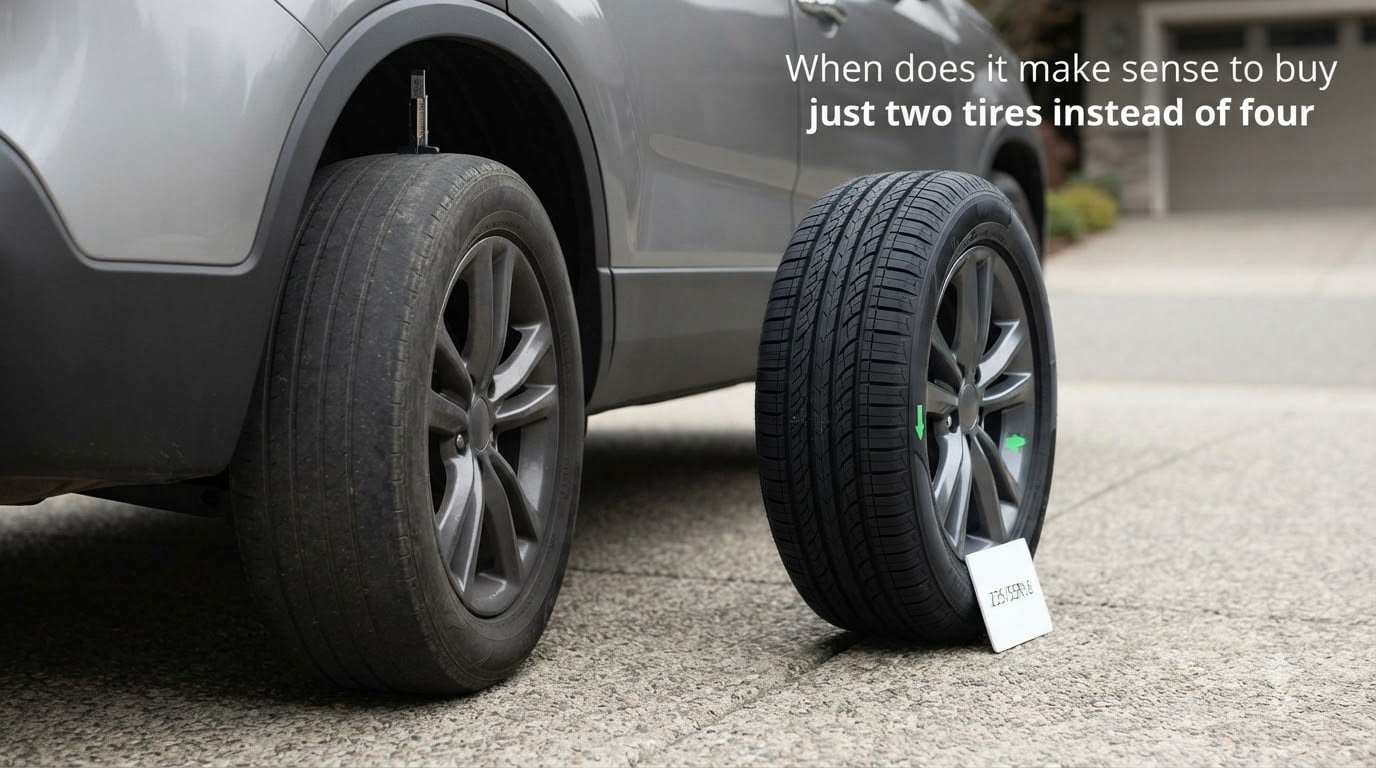
Buying two tires instead of four makes sense when the tires you plan to keep still have usable tread depth, match your vehicle’s exact size, load index, speed rating, and construction, and are the same brand and model as the new pair you are buying. In that case, mount the two new tires on the rear axle for hydroplane resistance and move the older pair to the front. If your vehicle is AWD or 4WD, or if the existing tires are mismatched, aged, or damaged, replace all four instead.
If you have ever stared at two bald tires and wondered whether you really need to spend on a full set of four, you are not alone. Mechanics and tire shops field this question every week, and the answer depends on more than just your wallet. In this guide, I will walk you through the conditions that justify a partial tire replacement, the specs that must match, where to mount the new pair, and the warning signs that mean you should bite the bullet and replace all four.
Table of Contents
When Two Tires Make Sense (and When They Don’t)
The short version is simple. Buy two tires instead of four when your remaining tires are still serviceable and match the new pair on every meaningful spec. Buy four when they are not. Here is the full decision framework that I use when customers ask the same question at our shop.
Buying just two tires is acceptable when all of the following are true:
- Your vehicle is two-wheel drive (FWD or RWD), not AWD or 4WD.
- Both remaining tires have tread depth above 4/32 inch and are not more than 6 years old (check the DOT date code).
- The remaining tires are the same size, load index, speed rating, and construction type as the new pair.
- The remaining tires are the same brand and model as the new pair, or at least share the same tread pattern family.
- There is no visible damage: no sidewall bulges, no cracks from dry rot, no nails, no uneven wear indicating an alignment or suspension issue.
You should replace all four tires when any of these conditions apply:
- Your vehicle is AWD or 4WD. Mismatched tread depth can trigger the differentials and transfer case to work harder, and many AWD systems will void powertrain coverage if rolling diameters differ by more than a few percent.
- The two tires you plan to keep are a different brand, model, or size than the two you are replacing.
- Either remaining tire is below 4/32 inch tread, is older than 6 years, shows dry rot, or has any sidewall damage.
- The wear on the remaining pair is uneven, which usually points to a suspension or alignment problem that will chew up the new tires too.
- The manufacturer of your vehicle requires matching tires across all four positions (some performance and EV models).
| Drive Type | Condition of Remaining Two Tires | Recommendation |
|---|---|---|
| FWD or RWD | Good tread, same size and model, no damage | Replace two, mount new pair on rear axle |
| FWD or RWD | Mismatched size, model, or brand | Replace all four |
| FWD or RWD | One or both below 4/32 inch or visibly aged | Replace all four |
| AWD or 4WD | Any condition | Replace all four (strongly recommended) |
| Any drive type | Uneven wear, alignment symptoms, suspension damage | Diagnose first, then replace all four |
Why Tires Wear in Pairs and Why That Matters
Tires wear in pairs because the drivetrain sends power to them in pairs. On a front-wheel-drive car, the front tires do the steering, accelerating, and most of the braking, so they wear faster than the rears. On a rear-wheel-drive car, the rear tires wear faster because they transmit power to the road. On an AWD or 4WD vehicle, all four tires are working all the time, and even small differences in rolling diameter send the differentials into a constant correction cycle.
That is why tire shops almost always recommend replacing tires in pairs on the same axle. When you replace only one tire on an axle, the rolling circumference differs enough that the differential or brake controller keeps compensating. Over time, that extra stress shows up as premature failure of the drivetrain, uneven wear, and in some cases an activated traction or stability light.
The other reason pairs matter is safety. A vehicle’s handling balance depends on all four tires gripping the road at similar levels. If the rear tires lose grip in a rainstorm before the fronts do, the back of the car can slide sideways. This is what mechanics call oversteer, and it is exactly the kind of surprise that turns a routine commute into a ditch. Tire Rack’s long-running guidance, echoed by every major manufacturer, is to put the tires with the deepest tread on the rear axle regardless of drive type.
This is also the conclusion that dominates the r/AskMechanics thread on the same question: virtually every respondent agreed new tires belong on the rear. One user summed it up by saying the rear of the car is harder to recover when it loses grip, so the best tires always live there.
How to Match New Tires to Your Existing Pair
If you decide to buy only two, the new tires must match the existing ones in five key areas. Get any one of these wrong and the partial replacement is unsafe or will wear out the new tires long before they should.
The matching tire specs checklist:
- Size. Match the tire size printed on the sidewall exactly, including the load range letter if one is shown. P225/65R17 102H is not the same as P225/60R17 102H even though they share a wheel diameter.
- Load index. Match or exceed the load index on your existing tires. Going higher is fine; going lower compromises how much weight each tire can safely carry.
- Speed rating. Match or exceed the speed rating. A tire rated H (130 mph) can replace a pair rated T (118 mph), but not the other way around.
- Construction type. Match radial vs. bias-ply and the internal construction. Mixing radial and bias on the same axle is unsafe.
- Brand and model. Ideally, buy the exact same brand and model. If that is not available, choose a tire with the same tread pattern family and similar wet and dry performance ratings.
Directional and asymmetric tread patterns add another layer. Directional tires have an arrow on the sidewall showing the direction of rotation, and they must always rotate in that direction. If you replace only two directional tires, mount them on the rear axle and never cross-rotate them to the front in the opposite direction. Asymmetric tires have an “outside” marking and can be cross-rotated, but they must always stay on the same side of the vehicle. If your existing tires are directional and you cannot find a matching pair, this is one of those situations where replacing the full set is the cleaner answer.
One more spec the checklist usually misses: tire age. Every tire has a DOT date code on the sidewall, a four-digit number where the last two digits are the year of manufacture. A tire that has been sitting on a shelf for three or four years is already aging out, even if it has never been mounted. Discount Tire and Tire Rack both call this out for buyers who shop for bargains on overstocked inventory. If your existing tires are 6 or more years old, the partial replacement decision usually flips to all four.
The 3% Rule and Tread Depth Difference Explained
The 3% rule is the most commonly cited tread depth guideline in tire advice. It says the new tires should be within 3 percent of the rolling circumference of the existing pair. In real-world terms, that works out to roughly 2/32 inch of tread depth difference between the new and the old pair when measured at the center tread.
This rule matters because rolling circumference is what the differential, ABS sensors, and traction control system see. A new tire with 10/32 inch tread and a worn tire with 3/32 inch tread have very different circumferences, even if they share the same size designation. On a 2WD car that is mostly an annoyance: the car may handle differently in wet weather, and the rear tires will wear out faster than they should. On an AWD vehicle, it can cause persistent warning lights, transfer-case wear, and even damage to the center differential.
To use the rule in practice, measure the tread depth on your two existing tires with a tread depth gauge (a simple tool that costs almost nothing at any auto parts store). Take three measurements per tire: outer edge, center, inner edge. Average them, then compare to the tread depth of the new pair. If the difference is more than 2/32 inch or 3 percent, the safer move is to replace all four.
As a side note, the legal minimum tread depth in most of the United States is 2/32 inch. Anything below that is unsafe and illegal. Tire Rack and most tire makers recommend replacing tires when they reach 4/32 inch, especially on the rear axle, because wet stopping distance climbs sharply once you are below that threshold.
Where to Install the New Pair: Front vs. Rear
If you buy only two tires, mount them on the rear axle. This is the rule that the major tire manufacturers, Tire Rack, Discount Tire, and the National Highway Traffic Safety Administration have all endorsed, and it is the rule that r/AskMechanics and r/MechanicAdvice commenters almost universally agree with.
Why the rear axle first? In wet weather, hydroplaning happens when the tire cannot channel water away from the contact patch fast enough. A new tire with deep grooves is much more resistant to hydroplaning than a worn tire. If the worn tires are on the rear and the new tires on the front, the front tires will still grip in a storm, but the rear can lose grip suddenly. When the rear loses grip before the front, the car spins. When the front loses grip before the rear, the car plows straight and is much easier to recover.
For front-wheel-drive cars, this feels counterintuitive, because the front tires do most of the work in normal driving. The reasoning still holds. The fronts push the car forward and steer, but if the rear lets go, the steering inputs become irrelevant. In a rear-wheel-drive car, the rear tires are already tasked with putting power down, and putting your best tires there only helps.
There are two practical situations where the rule has nuance. If you are driving on a track or autocross course with a front-wheel-drive car, the rule sometimes flips, because oversteer is preferred for handling. For daily driving on public roads, the rear-axle-first guidance stands. The other nuance applies to directional tires: if your new pair is directional, mount them on the rear axle and never rotate them to the front in the wrong direction.
How a Partial Replacement Affects Your Rotation Schedule
A partial replacement changes how you rotate your tires for the life of that set. Once your newer tires are on the rear and the older pair is on the front, the rotation pattern needs to preserve tread wear as evenly as possible while keeping the directional or asymmetric constraints intact.
For non-directional tires on a FWD or RWD car with a two-tire replacement, a common pattern is to rotate the front tires straight back to the rear and cross the rear tires forward to the front. This puts the older pair back on the rear, which is not ideal for wet grip, so many tire shops will instead rotate all four corners in a straight back-and-forth pattern and accept the slightly faster wear on the rear pair. Either way, plan on replacing the next pair earlier than you would have on a matched set.
For directional tires, the rotation pattern is more limited: front-to-back on the same side, never crossing. For asymmetric tires, you can cross-rotate front-to-rear but must keep “outside” facing outside. If your existing tires are already directional and your new pair cannot be the same model, this is one more reason to replace all four.
One question that comes up in our shop regularly is what to do with the two older tires after the swap. Three options work well: keep them as a matched swap set for emergencies, store them properly in a cool dry place away from direct sunlight (ideally in airtight bags), or bring them back to your tire retailer for recycling. Most retailers take old tires for free at the time of purchase, which keeps them out of landfills and saves you a disposal fee.
Cost Considerations and the BOGO Promo Math
Cost is the most common reason drivers ask this question in the first place. The math is straightforward: two tires cost roughly half of a set of four before installation fees, and you still pay mounting, balancing, valve stems, and disposal on each tire you buy. Some retailers charge a flat installation fee per tire, others charge a flat fee per set, and a few charge more for a partial set. Always ask before you commit.
The math changes when retailers run a buy-three-get-one-free or similar promotion. In that scenario, the cost of a full set of four often drops close to the cost of two, because the third tire is essentially priced as a half-priced unit. The r/MechanicAdvice thread on this exact question had several posters land on this conclusion after running the numbers. If a buy-3-get-1 promo is on, replacing all four usually wins on value, not just safety.
Another cost angle worth mentioning is tire road hazard and tread life warranties. Most treadwear warranties are prorated across the full set, so a partial replacement can complicate claims later. If you damage a road-hazard-covered tire after a partial replacement, the warranty may only cover the tread depth on the remaining set, not the new pair. Read the warranty terms before you finalize the purchase, and ask the retailer how a two-tire buy interacts with their warranty program.
The cost question also overlaps with the r/Frugal thread titled “To buy 2 tires or 4?” In that thread, the original poster noted that even though they could technically afford four tires, the “right” way felt financially heavy. The community consensus was that for a two-wheel-drive vehicle with two good tires remaining, two tires is a perfectly reasonable choice. The same logic does not apply to AWD or to a vehicle with aging or mismatched tires.
How to Tell If Your Other Two Tires Are Still ‘Good Enough’
This is the part most buyers skip, and it is where mistakes get made. Before you commit to buying two tires instead of four, walk through this inspection checklist on the tires you plan to keep.
The mechanic’s checklist for evaluating the remaining two tires:
- Tread depth. Measure the center, inner, and outer tread of each tire with a tread depth gauge. Anything below 4/32 inch means the tire is past its safe service life, especially on the rear axle.
- Tread wear pattern. Look at the wear across the tread. Even wear across the full width is healthy. Feathering, cupping, or wear only on one edge points to an alignment, suspension, or balance issue that will eat the new tires too.
- Sidewall condition. Run your hand along the sidewall and look for cracks, bulges, or blisters. Cracks indicate dry rot from age, and bulges indicate internal damage. Either one means replace, not match.
- Tire age. Find the DOT date code on the sidewall. The last four digits are the week and year of manufacture. Anything older than 6 years should be replaced even if the tread looks fine, because the rubber compounds harden over time.
- Damage history. Check for prior plug or patch repairs, especially on the sidewall. A sidewall repair is a permanent weak point, and a tire with one should not be kept on the road.
- Matching spec. Confirm the size, load index, speed rating, and brand/model match what you intend to buy.
If the tires you plan to keep fail any one of these checks, replace all four. If they pass, you are a good candidate for a two-tire replacement.
Frequently Asked Questions
Is it okay to buy only two tires?
Yes, buying only two tires is okay when your vehicle is two-wheel drive, the two you plan to keep still have safe tread depth above 4/32 inch, and the new pair matches the existing pair exactly on size, load index, speed rating, construction, and brand/model. Mount the new tires on the rear axle. If your vehicle is AWD or 4WD, or if the remaining tires are mismatched, aged, or damaged, replace all four instead.
Should I replace all 4 tires or just 2?
Replace all four if your vehicle is AWD or 4WD, if the remaining tires are mismatched, damaged, below 4/32 inch of tread, or more than 6 years old, or if the manufacturer requires matching tires across all four positions. Replace just two if you have a 2WD vehicle with two good tires that match the new pair on every spec and you intend to mount the new pair on the rear axle.
Are you supposed to buy tires in pairs?
Tire makers and mechanics strongly recommend replacing tires in pairs on the same axle whenever possible, because pairs share rolling circumference, grip level, and wear pattern. Buying in pairs keeps handling balanced, prevents drivetrain stress on AWD vehicles, and improves wet-weather stability by keeping your best tires on the rear axle.
What is the 3% rule for tires?
The 3% rule says the new tires should be within about 3 percent of the rolling circumference of the existing pair, which works out to about 2/32 inch of tread depth difference between the new and old tires. Going beyond that threshold stresses the differentials and ABS sensors on AWD vehicles and can trigger warning lights or accelerate drivetrain wear.
If you buy 2 new tires where should I put them?
Mount the two new tires on the rear axle, regardless of whether your car is front-wheel drive, rear-wheel drive, or all-wheel drive. The rear axle needs the deepest tread to resist losing grip in rain, because rear-tire hydroplaning causes the back of the car to slide sideways, and that slide is much harder to recover than front-tire slip.
Can I replace just two tires on an AWD car?
Most AWD manufacturers recommend replacing all four tires at the same time, because even small differences in rolling circumference cause the center differential and transfer case to compensate, which accelerates wear and can trigger warning lights. If cost forces a two-tire replacement on an AWD vehicle, match the new pair to the existing pair as closely as possible and plan to replace the other two soon.
The Bottom Line on Two Tires vs Four
Buying two tires instead of four is a sound, safe choice when your remaining pair is in good shape, matches the new tires on every meaningful spec, and your vehicle is two-wheel drive. It is the wrong choice when your vehicle is AWD or 4WD, when the existing pair is mismatched, aged, or damaged, or when a buy-3-get-1 promotion makes four tires close to the cost of two.
Start by inspecting the two tires you plan to keep. If they pass the checklist above and match your vehicle’s specs, buy the matching pair and put them on the rear axle. If they fail any of the checks, plan on replacing all four. Our team at american-tire.com can help you find the right tire for your vehicle, schedule installation, and handle disposal of your old set. Check our tire finder to see what fits your car, or stop by a location near you for an inspection before you commit.