
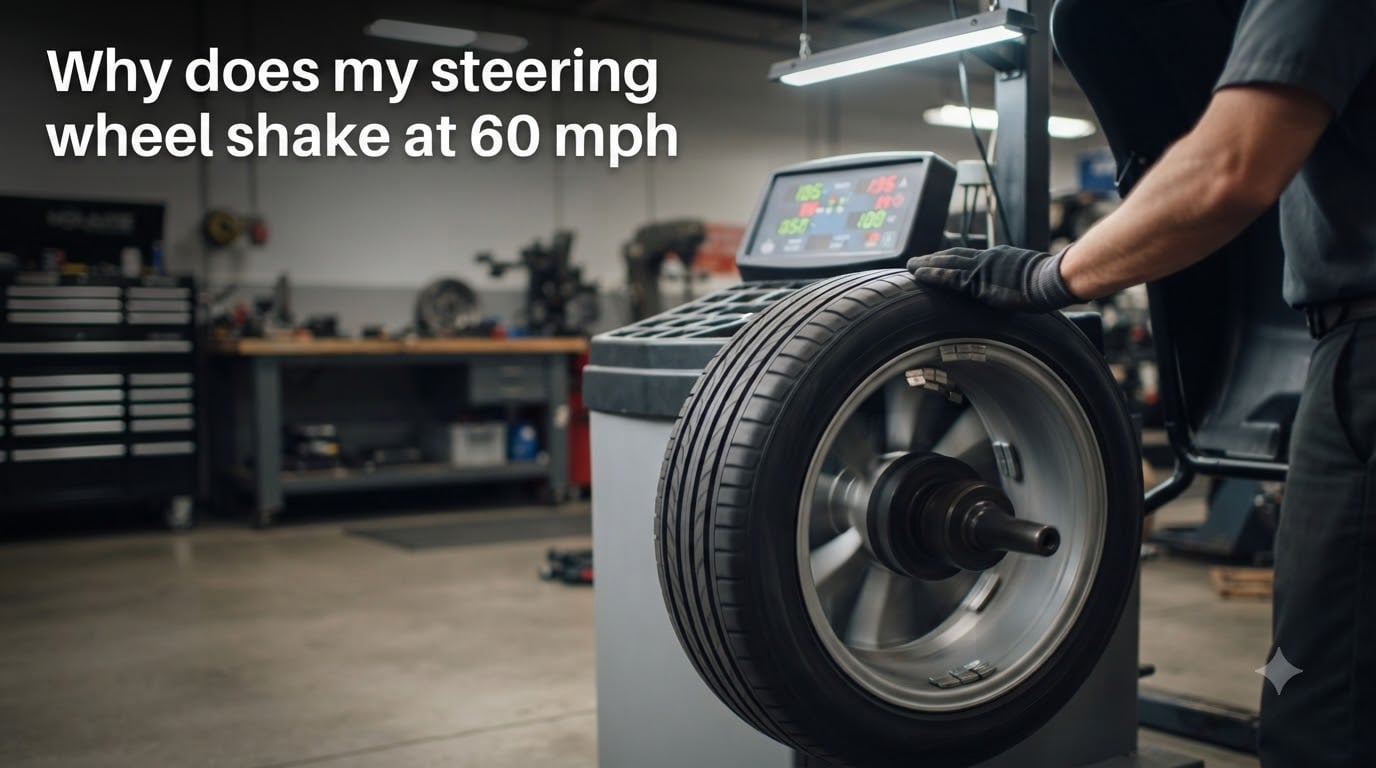
A steering wheel that shakes at 60 mph is most often caused by unbalanced tires, but several other mechanical issues can produce the same symptom. In our experience working on thousands of vehicles, this vibration typically appears in the 55–65 mph window because that is the resonance frequency for most passenger car wheel-tire assemblies.
Here are the seven most common causes of steering wheel shake at highway speed:
- Unbalanced tires
- Wheel alignment problems
- Warped brake rotors
- Worn wheel bearings
- Suspension or steering component wear
- Uneven tire wear or tire damage
- Incorrect lug nut torque or tire pressure
If your steering wheel started shaking recently, the sections below will help you figure out which of these is your problem and what to do about it. We cover every cause in detail, explain what each repair involves, and share a speed-specific diagnosis chart you will not find on most competing articles.
Table of Contents
Common Causes of Steering Wheel Shake at 60 MPH
Steering wheel vibration at highway speed is one of the most frequent complaints drivers bring to tire shops. The good news is that the root cause is usually straightforward to diagnose and inexpensive to fix.
Unbalanced tires account for roughly 60–70% of all steering wheel shake cases we see. The remaining 30% split among alignment issues, brake rotors, wheel bearings, suspension wear, tire damage, and improper lug nut torque. Knowing which one affects your vehicle starts with understanding how the vibration behaves at different speeds.
A key fact most articles skip: the steering wheel is essentially a diagnostic instrument. Shake felt in the steering wheel almost always comes from the front axle. Shake felt in the seat or floorboard usually comes from the rear axle. This distinction alone narrows the cause significantly.
1. Unbalanced Tires
Unbalanced tires are the number one cause of steering wheel shake at 60 mph and the first thing any mechanic will check. Every tire and wheel assembly has slight weight variations around its circumference. When these variations are not corrected with balancing weights, the wheel develops a bouncing pattern that intensifies at certain speeds.
The reason 60 mph is the magic number comes down to physics. Every wheel-tire assembly has a natural resonance frequency. On most passenger cars and light trucks, that resonance lands between 55 and 65 mph. Below that speed, any imbalance is too slow to generate noticeable shake. Above it, the vibration often dampens out again.
If your steering wheel shakes at 60 but smooths out at 70 mph or higher, tire balance is almost certainly the problem. A standard spin balance at most tire shops will fix it in 20–30 minutes.
Road Force Balancing vs Standard Balancing
Standard spin balancing measures weight distribution while the wheel spins freely in the air. It catches most imbalances but misses a critical factor: how the tire deforms under the weight of the vehicle on the road.
Road force balancing uses a large roller that presses against the tire while it spins, simulating actual driving loads. Machines like the Hunter GSP 9700 or Hawk-eye balancer can detect stiff spots, belt shifts, and radial force variation that a standard balancer cannot see.
If your shake persists after a regular balance, ask for a road force balance. Many tire shops offer it for a small upcharge. In our experience, road force balancing resolves about 80% of cases where a standard balance failed.
2. Wheel Alignment Problems
Wheel alignment issues cause steering wheel shake when the angles of the wheels are outside factory specifications. The three alignment angles that matter most are toe, camber, and caster.
Toe misalignment, where the wheels point slightly inward or outward when viewed from above, is the most common cause of vibration from alignment problems. It creates a scuffing pattern that generates shake at highway speeds.
However, alignment problems more often cause the vehicle to pull to one side rather than produce a pure steering wheel shake. If your car drives straight but the wheel shakes, tire balance is still the more likely culprit. If it shakes and pulls, alignment moves up the suspect list.
3. Warped Brake Rotors
Warped brake rotors produce a specific vibration pattern: the shake appears or gets worse when you press the brake pedal, especially at highway speeds. If your steering wheel only shakes during braking and is smooth otherwise, rotors are the prime suspect.
Rotors warp from repeated heat cycling. Heavy braking in mountain driving, towing, or riding the brakes in traffic creates uneven cooling that distorts the rotor surface. Even a few thousandths of an inch of runout translates to noticeable pulsation in the steering wheel.
Front brake rotors connect directly to the steering knuckle, so any irregularity in the rotor face gets transmitted straight to the steering wheel. Rear rotor warping typically shows up as a brake pedal pulse or seat vibration instead.
4. Worn Wheel Bearings
Worn wheel bearings cause a vibration that grows progressively worse as speed increases. Unlike tire balance issues that peak at a specific speed window, bearing-related shake tends to get steadily stronger the faster you drive.
A failing wheel bearing often announces itself with additional symptoms. You might hear a grinding or humming noise that changes when you turn the wheel left or right. The noise gets louder on the side with the bad bearing because turning shifts the vehicle weight onto or off of that bearing.
Wheel bearings are a safety concern. A bearing that is loose enough to cause vibration can eventually seize or separate, which can cause loss of wheel control. If you suspect a bearing problem, have it checked promptly.
5. Suspension and Steering Component Wear
Several suspension and steering parts can cause highway-speed vibration when they wear out. The most common culprits are tie rod ends, ball joints, control arm bushings, and CV joints or axles.
Tie rod ends connect the steering rack to the steering knuckle. When they develop play, the front wheels can oscillate side to side at highway speed, creating a shake or shimmy in the steering wheel. Worn ball joints allow similar movement.
CV joints and CV axles are especially relevant on front-wheel-drive and all-wheel-drive vehicles. A worn CV joint can cause vibration during acceleration that may feel like a steering wheel shake. If the vibration changes when you press or release the accelerator, CV joints deserve a close look.
AWD and 4WD Driveline Vibration
All-wheel-drive and four-wheel-drive vehicles have additional driveline components that can cause highway vibration. The driveshaft, transfer case, and rear differential all rotate at highway speed and can introduce shake if they are out of balance or have worn universal joints.
AWD vehicles from manufacturers like Subaru are known for tight driveline tolerances. Some owners report steering wheel vibration after installing new tires if the shop did not road-force match the tires to the wheels. If you drive an AWD vehicle and experience shake after a tire purchase, road force balancing with match-mounting is worth requesting.
6. Uneven Tire Wear and Tire Damage
Tires that have developed uneven wear patterns can cause steering wheel vibration even if they are properly balanced. Cupping, feathering, and flat spots create irregular contact patches that generate shake at speed.
Cupping appears as scalloped dips around the tire tread, usually caused by worn shocks or struts that allow the tire to bounce on the road. Feathering means the tread ribs are worn smooth on one side and sharp on the other, typically from alignment problems.
Less common but more dangerous is belt separation inside the tire. The internal steel belts can detach from the tire carcass without visible external damage. One forum user reported a shake at 60 mph that turned out to be belt separation — the tire looked normal on the outside but was replaced under warranty. If your tire is relatively new and you notice vibration, have the shop inspect it for internal defects.
Bent wheels from pothole strikes are another frequent cause. A bent rim creates runout, meaning the wheel does not spin perfectly round. The shop can detect this by spinning the wheel on the car and watching for hop or side-to-side wobble.
7. Incorrect Lug Nut Torque and Tire Pressure
This cause is overlooked by almost every competing article, but it matters more than people realize. Over-torqued or unevenly torqued lug nuts can distort the brake rotor and hub surface, introducing vibration that mimics a balance problem.
Most alloy wheels require a specific torque spec, typically between 80 and 100 foot-pounds depending on the vehicle. Using an impact wrench without a torque stick or final hand-torque pass can easily over-tighten one or more lug nuts, warping the rotor face enough to cause shake.
Low tire pressure changes the tire’s contact patch and stiffness, which can also contribute to vibration. If one tire is significantly under-inflated compared to the others, the vehicle may develop a pull or shake. Check your TPMS light and manually verify pressures with a gauge — TPMS sensors do not always trigger until pressure drops 25% below the recommended level.
Speed-Specific Diagnosis: What Your Shake Pattern Tells You
The speed at which your steering wheel shakes and the conditions under which it appears are powerful diagnostic clues. Use this chart to narrow down the cause before visiting a shop:
Shake at 55–65 mph, smooth above 70: Almost always tire balance. The vibration peaks in the resonance window and dampens at higher speeds. A standard or road force balance will fix it.
Shake that grows steadily with speed: Likely a worn wheel bearing or driveline component. The faster you go, the worse it gets, with no specific peak. Have the bearings inspected.
Shake only when braking: Warped front brake rotors. If the shake disappears the moment you release the brake pedal, rotors are the cause. Machining or replacement is the fix.
Shake during acceleration, smooth when coasting: CV joint, CV axle, or driveshaft issue. The shake is load-dependent because these components transmit engine torque. Front-wheel-drive vehicles are especially prone to CV axle vibration.
Shake after hitting a pothole or curb: Bent wheel or damaged tire. The impact bent the rim or broke an internal belt. The vibration appeared suddenly right after the event.
Shake after installing new tires: Installer error or mounting imbalance. The shop may have skipped road force balancing, or the tire was mounted with a heavy spot opposite the valve stem. Return to the shop and request a rebalance with road force matching.
Shake that appeared after a cold snap: Tire pressure dropped with temperature. Cold weather reduces air pressure by about 1 PSI for every 10-degree Fahrenheit drop. Check and adjust pressures. Some tires also stiffen enough in extreme cold to change their balance characteristics.
Is It Safe to Drive When Your Steering Wheel Shakes?
Whether it is safe to drive with a shaking steering wheel depends on the cause and severity. A mild vibration at highway speed that you suspect is tire balance is generally safe for short trips while you arrange a diagnosis appointment.
However, stop driving immediately if you notice any of these warning signs: visible tire bulges or blisters, loud grinding or growling noise from a wheel, the steering feels loose or wanders, or the vibration is so severe it is difficult to maintain your lane. These symptoms can indicate a tire about to separate or a wheel bearing about to fail — both are safety hazards.
If the shake is mild and only appears at highway speed, you can likely drive to the tire shop at lower back-road speeds to avoid the vibration window. But do not ignore it. What starts as a minor balance issue can cause uneven tire wear, stress suspension components, and worsen over time.
When to See a Mechanic
Visit a mechanic or tire shop if the vibration persists after checking tire pressure, if you cannot identify the cause using the speed-diagnosis chart above, or if the shake is getting worse over time. These are signs the problem is beyond a simple rebalance.
When you bring the vehicle in, describe the vibration as precisely as possible: the exact speed range where it appears, whether it changes when braking or accelerating, whether you feel it in the steering wheel or the seat, and when it first started. This information saves diagnostic time and helps the technician zero in on the right cause faster.
If the shop says the tires are balanced and the shake persists, ask specifically about road force balancing, wheel runout measurement, and suspension component inspection. A standard visual check and spin balance do not catch every problem.
Frequently Asked Questions
Why does my steering wheel shake at 60 mph but not 40?
Most passenger car wheel-tire assemblies have a natural resonance frequency between 55 and 65 mph. At 40 mph, the rotational speed is too low for a small tire imbalance to produce noticeable vibration. Once you reach the resonance window around 60 mph, even a few grams of imbalance gets amplified into a shake you can feel through the steering column.
Can bad alignment cause steering wheel to shake at highway speeds?
Alignment problems can cause vibration at highway speed, but they more commonly cause the vehicle to pull to one side. Toe misalignment is the alignment angle most likely to create shake because it causes a scuffing motion. If your car drives straight but the wheel shakes, tire balance is still the more likely cause.
Will balancing tires fix steering wheel shake?
Balancing fixes roughly 60 to 70 percent of steering wheel shake cases at highway speed. If a standard spin balance does not solve the problem, ask for a road force balance, which detects tire deformations under load that a regular balancer misses. If the shake persists after road force balancing, the cause is likely a worn bearing, bent wheel, or suspension component.
Is it safe to drive when steering wheel is shaking?
Mild vibration at highway speed is generally safe for short trips to a tire shop if you suspect a balance issue. However, stop driving immediately if you see tire bulges, hear loud grinding from a wheel, feel the steering go loose, or the shake makes it hard to stay in your lane. These symptoms can indicate a tire about to separate or a bearing about to fail.
How much does it cost to fix a shaking steering wheel?
A standard tire balance costs about 40 to 80 dollars. Road force balancing runs slightly higher. Wheel alignment typically costs 75 to 150 dollars. Brake rotor replacement ranges from 200 to 500 dollars per axle. Wheel bearing replacement can run 250 to 500 dollars per wheel. The cost depends on your vehicle and the shop you visit.
Can a bad wheel bearing cause steering wheel vibration?
Yes. A worn wheel bearing causes vibration that progressively worsens as speed increases, unlike tire balance which peaks at a specific speed. You may also notice a grinding or humming noise that changes when turning left or right. Wheel bearing failure is a safety concern because a severely worn bearing can seize or cause the wheel to separate.
Why does my car shake at high speed but not at low speed?
Vibration that only appears at highway speed is almost always related to rotational components — tires, wheels, brake rotors, or bearings. At low speeds, the forces generated by small imbalances are too weak to feel. Once you exceed about 40 mph, these forces grow with the square of speed and become noticeable, peaking in the 55 to 65 mph resonance window for most cars.
Can worn tires cause steering wheel vibration?
Yes. Uneven tire wear patterns like cupping, feathering, and flat spots create irregular contact patches that generate vibration at highway speed. Cupping is usually caused by worn shocks or struts. Feathering typically indicates alignment problems. If your tires show these wear patterns, replacement and correction of the underlying cause are both needed.
Conclusion
Steering wheel shake at 60 mph is a common problem with a usually simple fix. Start by checking your tire pressure and looking for obvious tire damage. If those check out, a tire balance — ideally a road force balance — resolves the issue for the majority of drivers. Use the speed-diagnosis chart in this article to narrow the cause before you visit a shop, and describe the vibration pattern clearly to your technician.
Ignoring the shake will not make it go away. Unbalanced tires cause uneven wear, alignment problems stress suspension parts, and worn bearings are a genuine safety risk. The sooner you diagnose why does your steering wheel shake at 60 mph, the cheaper and easier the fix will be.