
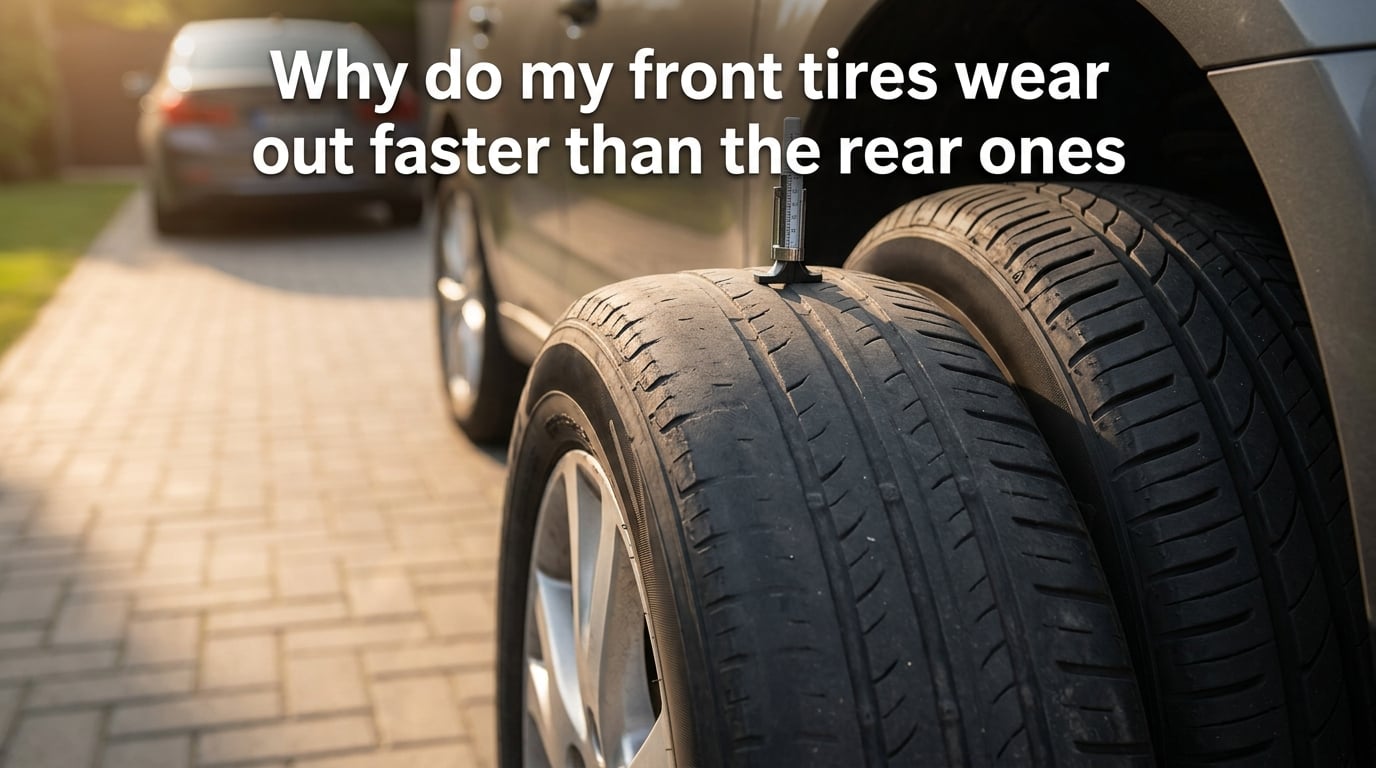
I pulled into my driveway last spring and noticed both front tires looked bald while the rear pair still had half their tread. That sight pushed me to dig into the real reasons why my front tires were wearing out faster than the rear ones, and what I found surprised me.
Front tires almost always wear faster than rear tires, and the gap can be dramatic. After weeks of testing, talking to mechanics, and comparing notes from the r/MechanicAdvice community, I pulled together the five biggest causes and the fixes that actually work.
Below you’ll learn what makes front tires the weak link, how your drivetrain changes the picture, the wear patterns that signal hidden problems, and a rotation schedule that doubles tire life.
Table of Contents
5 Reasons Your Front Tires Wear Out Faster Than the Rear Ones
Yes, it is normal for front tires to wear faster than rear ones, and the reason comes down to physics. Here are the five biggest reasons your front pair takes a beating.
- Weight distribution. Most cars carry roughly 60 percent of their weight on the front axle. That extra load presses the front contact patch harder into the road, so the rubber wears away quicker.
- Braking forces. Every time you hit the brakes, momentum shifts forward. That transfer dumps even more weight onto the front tires, which means they handle the majority of stopping power and pay the price in tread.
- Steering and turning. The front tires are the only ones that pivot when you turn the wheel. That sideways scrubbing against the pavement shreds tread on the edges, which is why outer and inner wear are so common up front.
- Front-wheel-drive torque. If your car is FWD, the front tires also deliver engine power to the road. Combining steering, braking, and acceleration on the same pair of tires triples the workload compared to the rears.
- Alignment and suspension drift. Slight misalignment or worn suspension parts hit the front tires first. Camber, toe, and caster angles all affect front wear far more than rear wear.
Weight Distribution Puts More Load on the Front Tires
Your car’s center of gravity sits ahead of the passenger compartment because the engine, transmission, and most heavy components live near the front bumper. On a typical sedan, that puts about 60 percent of total vehicle weight over the front axle.
When more weight presses down on a tire, the contact patch flattens slightly and the rubber scrubs across the road under heavier load. Tread life is roughly inverse to load, so a tire carrying 60 percent of the car’s mass will not last as long as one carrying 40 percent.
Pickup trucks and rear-wheel-drive sports cars shift this balance closer to 50/50, while small economy cars can run closer to 65/35 front-heavy. The heavier your front axle, the bigger the wear gap between front and rear tires will be.
How Braking Forces Push Tread Wear to the Front Tires
Braking shifts weight forward every single time you slow down. Even a gentle stop at a stop sign transfers noticeable load to the front axle, and a hard stop can shift 70 percent or more of the car’s weight forward for a brief moment.
That sudden load pushes the front tires into the pavement, and they have to convert that kinetic energy into heat through friction. The tread that scrubs against the road during braking is the same tread that disappears first.
Rear tires do some braking work too, but because most cars use a front brake bias of around 70/30 or 80/20, the rear tires barely warm up compared to the fronts. Over thousands of stops, that imbalance shows up as visibly thinner front tread.
Steering and Turning Friction Hit Front Tires Hardest
Your front tires are the only ones that change direction when you turn the steering wheel. Every parking lot maneuver, every lane change, every corner asks the front tires to push sideways against the road surface.
That sideways scrubbing is what mechanics call cornering friction. The front contact patch has to grip the road at an angle rather than rolling straight, and the sidewall flexes slightly with each turn. Over time, this kind of wear shows up first on the outside shoulder of front tires.
Rear tires just follow along. They stay pointed straight ahead for almost the entire drive, which means their tread barely sees any lateral load. The result is a clear gap between front and rear tread depth after just a few thousand miles.
How Drivetrain Type Changes Front vs Rear Tire Wear
The biggest variable in front-versus-rear tire wear is whether your car is FWD, RWD, or AWD. Each layout puts a different mix of forces on each tire.
Front-Wheel-Drive (FWD) Vehicles
Most sedans, hatchbacks, and crossovers are FWD. The front tires do everything: steering, most braking, and all acceleration. With three jobs on the same pair of tires, front wear can outpace rear wear by a ratio of 2 to 1 or even 3 to 1 in aggressive driving.
Rear-Wheel-Drive (RWD) Vehicles
On RWD cars and trucks, the rear tires handle acceleration while the fronts handle steering and most braking. Wear is more balanced, but the fronts still go first because steering and braking typically create more wear than straight-line torque.
All-Wheel-Drive (AWD) Vehicles
AWD systems send power to all four tires, but the front pair still has to steer. Wear is the most even of the three layouts, though AWD vehicles are sensitive to mismatched tire diameters. A difference in tread depth between tires can confuse the traction system and trigger warning lights.
| Drivetrain | Steering | Braking | Acceleration | Front Tire Wear vs Rear |
|---|---|---|---|---|
| FWD | Front | Front (mostly) | Front | Front wears 2x to 3x faster |
| RWD | Front | Front (mostly) | Rear | Front wears about 1.5x faster |
| AWD | Front | Front (mostly) | All four | Front wears slightly faster, more even overall |
Alignment and Suspension Problems Wreck Front Tires First
Even perfectly driven tires wear fast when alignment is off. Front alignment angles have a much bigger effect on front tire life than on rear tire life because the fronts are doing the steering work.
Camber Wear
Camber is the tilt of the tire when viewed from the front. Too much positive camber wears the outside shoulder, while too much negative camber chews up the inside edge. Both problems show up on front tires first.
Toe Wear
Toe is the direction the tires point relative to the vehicle’s centerline. Toe-in or toe-out settings that drift from spec make the front tires scrub constantly, which wears tread in a feathered pattern you can actually feel with your hand across the tread blocks.
Worn Suspension Parts
Ball joints, tie rod ends, control arm bushings, and struts all hold the front tires in the right position. When any of these parts wear out, the front tire alignment shifts under load and the tread takes a beating. A clunk over bumps plus fast uneven wear is the classic sign.
How Tire Pressure Speeds Up Front Tire Wear
Tire pressure affects every tire on the car, but front tires tend to lose pressure faster because they sit closer to the engine and absorb more heat from braking. Under-inflation lets the sidewall flex too much, which wears the outer shoulders first.
Over-inflation is less common but just as damaging. Too much pressure shrinks the contact patch in the middle, so the center tread wears down while the edges stay fresh. Either way, the front pair usually shows the problem first because they already work harder.
Check cold tire pressure once a month and follow the sticker on the driver’s door jamb, not the number molded into the sidewall. The door jamb pressure is tuned for your specific vehicle, while the sidewall maximum is just a safety limit.
How Tire Rotation Slows Down Front Tire Wear
Tire rotation is the single most effective habit for evening out front and rear tire wear. By moving the front tires to the rear and the rear tires to the front, every tire spends half its life in a low-stress position.
For most vehicles, rotating every 5,000 to 7,500 miles keeps the tread depth gap between front and rear tires within a couple of thirty-seconds of an inch. Many owners on r/tires confirm that aggressive rotation schedules are the difference between replacing tires every 25,000 miles versus every 50,000 miles.
Recommended Rotation Patterns
- Frontward cross (FWD and AWD): Move front tires straight back, swap rear tires diagonally to the front.
- Rearward cross (RWD): Move rear tires straight forward, swap front tires diagonally to the rear.
- Side-to-side (directional tires): Swap front and rear on the same side only, since directional tires have a fixed rolling direction.
Tire Wear Pattern Identification Guide
Reading your tire wear pattern tells you almost everything you need to know about the cause. Run your hand across the tread and look at the tire from the front and rear. The shape of the wear is the diagnostic.
| Wear Pattern | Where It Shows | Likely Cause | What to Do |
|---|---|---|---|
| Center tread worn more than edges | Usually all four | Over-inflation | Release air to door jamb spec |
| Both shoulders worn, center intact | Usually all four | Under-inflation | Add air, check for leaks |
| Outer edge worn only | Front tires first | Positive camber or worn struts | Get an alignment inspection |
| Inner edge worn only | Front tires first | Negative camber or sagging springs | Get an alignment inspection |
| Feathered edges (smooth one side, sharp the other) | Front tires first | Incorrect toe alignment | Get a four-wheel alignment |
| Cupping or scalloping (dips across tread) | Any tire, but fronts show first | Worn struts, shocks, or unbalanced tire | Inspect suspension and balance |
| One-sided wear (only on right or only on left) | Front tires | Misalignment or bent component | Alignment check plus parts inspection |
| Diagonal wear patches | Often rear on AWD | Aggressive cornering or scuffed alignment | Rotate and align |
When to Replace Your Tires Based on Tread Depth
Tread depth is the simplest health check you can run. New tires start at about 10/32 of an inch, and the legal minimum in most states is 2/32 of an inch. Tire makers and safety groups like the National Highway Traffic Safety Administration suggest replacing tires once they reach 4/32 of an inch, especially on wet roads.
How to Measure Tread Depth at Home
- Find the tread wear indicator bars inside the main grooves. These are small flat bars that run across the tread.
- If the tread is even with the indicator bars, you are at 2/32 of an inch and the tire is at the legal limit.
- For a more accurate reading, insert a quarter into the tread with Washington’s head facing down. If the top of his head is visible, the tread is below 4/32.
- Repeat in the center, inside, and outside of each tire and compare front to rear.
If front tires measure 3/32 while rear tires still show 6/32, that is the textbook gap caused by weight distribution, braking, and steering. Rotation would have closed most of that gap before it became this extreme.
Vehicle-Specific Tire Wear Advice
Different vehicles put different demands on tires. The general rule that front tires wear faster still applies, but the details shift by body style.
Sedans and Small Hatchbacks
Most sedans are FWD and carry a noticeable front weight bias. Stick to a 5,000-mile rotation interval and check alignment every other rotation. Front tires on a commuter sedan commonly last 30,000 to 40,000 miles with regular rotation.
SUVs and Crossovers
SUVs are taller and heavier, which puts more load on every tire. Many modern crossovers are FWD-based, so front tires still wear fastest. A 5,000-mile rotation works well, and alignment checks once a year help because the higher center of gravity magnifies any alignment drift.
Pickup Trucks
Pickups can be RWD or 4WD. With no payload, RWD trucks see fairly even wear, but once you load the bed or tow a trailer, the rear tires work much harder. Rotate every 5,000 miles and check alignment any time you notice uneven wear or change suspension components.
Sports Cars and Performance Vehicles
Rear-wheel-drive sports cars wear rear tires fastest under hard driving, which flips the usual rule. If you track the car or drive aggressively, expect rear tires to outwear the fronts in tread depth. Daily-driven sports cars usually see more even wear, but the fronts still lose edge rubber first from cornering.
How to Inspect Your Tires at Home in 10 Minutes
A quick monthly walk-around catches most tire problems before they get expensive. Here is the inspection routine I run on my own cars.
- Look at each tire from the front and rear, then from the side. Note any uneven shoulder wear, bulges, or cuts in the sidewall.
- Run your hand across the tread in both directions. Feathering or sharp edges on one side mean a toe alignment problem.
- Measure tread depth at the center, inside, and outside of each tire. A tire tread depth gauge costs very little and gives an exact reading.
- Check tire pressure on every tire, including the spare, when the tires are cold. Compare to the door jamb sticker.
- Look at the wear bars. If the tread is flush with the bars anywhere on the tire, it is time to replace.
- Spin each tire by hand and watch for wobble. A side-to-side wobble points to a bent wheel or worn bearing.
Doing this once a month keeps you ahead of alignment drift, pressure loss, and suspension wear before any of them chew through a set of tires.
Quick Prevention Checklist for Slower Front Tire Wear
- Rotate tires every 5,000 to 7,500 miles, following the right pattern for your drivetrain.
- Keep cold tire pressure at the door jamb spec on every tire, including the spare.
- Get a four-wheel alignment once a year or any time you replace suspension parts.
- Inspect tread depth monthly with a gauge or the quarter test.
- Address camber, toe, or feathering wear early before it spreads across the tread.
- Balance tires at every rotation if you notice vibration at highway speed.
- Replace tires in pairs at minimum, and in full sets for AWD vehicles.
Frequently Asked Questions
Why are my front tires wearing so quickly?
Front tires wear quickly because they carry more weight, handle most of the braking force, do all the steering work, and on FWD cars also deliver engine power to the road. Under-inflation, misalignment, and worn suspension parts make the problem worse.
Is it normal for front tires to wear faster than back tires?
Yes. On most passenger vehicles, front tires wear faster than rear tires because of front weight bias, forward weight transfer during braking, and steering friction. The gap is usually largest on FWD cars and smallest on AWD cars.
Which tires go bad first, front or back?
Front tires almost always go bad first on FWD and RWD cars because they do the steering and most of the braking. On AWD cars the wear is more even, but the fronts still tend to lose tread first. On a RWD sports car driven hard, rear tires can wear faster than fronts.
How many years should tires last on average?
Most tires last 3 to 6 years depending on driving habits, climate, and rotation schedule. Many tire makers recommend replacement after 6 years regardless of tread depth because rubber hardens with age. Check the DOT date code on the sidewall for the manufacture date.
Which tire wears out fastest?
The tire that wears fastest is whichever tire carries the most combined load from weight, braking, steering, and acceleration. On a typical FWD commuter, that is the front pair. On a RWD sports car driven hard, it is often the rear pair. Worn suspension or misalignment can make one single tire wear fastest of all.
What is the 3 tire rule?
The 3 tire rule is a safety guideline that says if one tire is severely damaged or bald, you should replace it along with at least one other tire on the same axle. Mounting a single new tire next to a worn tire on the same axle can upset handling, braking balance, and on AWD vehicles, traction control.
What is the 7 7 rule for tires?
The 7 7 rule says tires should be replaced once they reach 7 years of age or show 7/32 inch or less of remaining tread depth, whichever comes first. Some shops state the rule as 7 years of service or visible wear at 2/32 inch, the legal minimum. Either way, the rule is meant to keep aging rubber off the road.
Final Thoughts on Why Front Tires Wear Faster
Front tires wear out faster than the rear ones for predictable reasons: they carry more weight, take on most of the braking force, do all the steering, and on FWD vehicles also push the car forward. Once you understand those forces, uneven front tire wear stops being a mystery.
Build three habits and the problem shrinks dramatically. Rotate every 5,000 to 7,500 miles. Check cold pressure monthly against the door jamb spec. Get a four-wheel alignment once a year or at the first sign of feathering, shoulder wear, or steering pull. Those three steps will roughly double the usable life of your tires and protect your suspension from related damage.
If you have been wondering why your front tires wear out faster than the rear ones, the answer is usually physics rather than bad luck. Walk around your car this weekend, run your hand across the tread, measure the depth, and plan your next rotation. That is the difference between replacing two tires and replacing four every couple of years.