
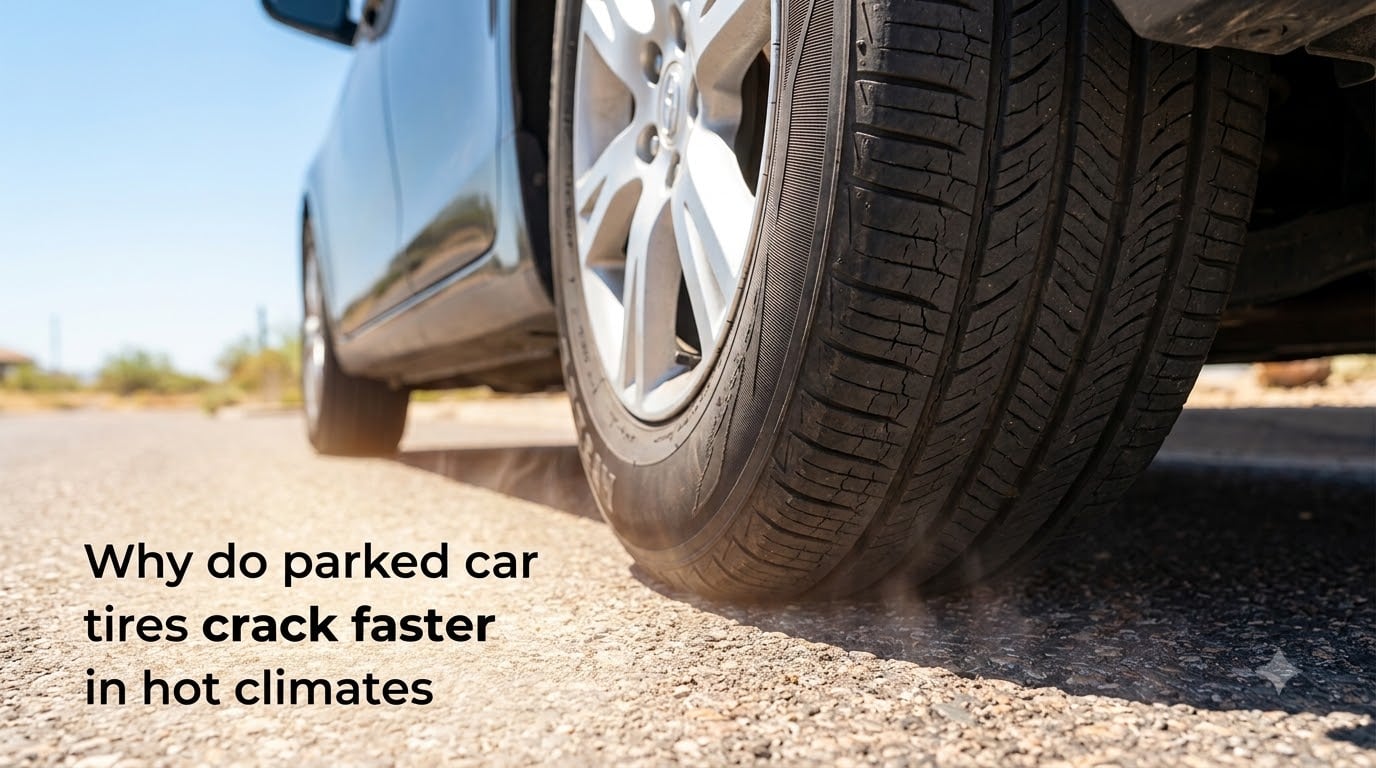
Parked car tires crack faster in hot climates because three forces attack them at once: ultraviolet radiation, ground-level ozone, and asphalt-radiated heat. None of those forces gets interrupted by motion, so the same patch of rubber cooks, oxidizes, and deforms for hours or weeks. Add in constant weight on one footprint and oils that never redistribute, and the rubber hardens, splits, and fails years before a driven tire would.
I have helped owners in Phoenix, Houston, and inland California diagnose cracking that showed up after a single summer of outdoor parking. The pattern is consistent, and so are the fixes. In this guide, I will walk through the science, the parked-specific risks, the three crack types, a climate-zone risk table, a step-by-step inspection routine, and a 7-day heatwave action checklist you can start using right now.
Table of Contents
Why Parked Tires Crack Faster in Hot Climates (The Short Answer)
Heat alone does not crack tires, but heat makes every other aging factor run faster. Here are the six mechanisms that combine when a car sits in the sun.
- UV radiation breaks the long polymer chains in tire rubber, causing the surface to harden and lose elasticity.
- Ground-level ozone attacks the double bonds in those same polymers, producing the cross-cutting cracks people call dry rot.
- Heat expansion raises cold tire PSI by roughly 1 PSI per 10°F, which overloads sidewalls that were never designed for sustained overpressure.
- Stagnant oils and plasticizers evaporate from one spot instead of being redistributed by rolling, leaving that patch dry and brittle.
- Constant weight on one footprint creates a flat spot, and the surrounding rubber flexes around it every time the pavement temperature swings.
- Reflected heat from asphalt and body panels keeps the tire hotter than the ambient air, so it never gets a chance to cool down overnight.
None of those six mechanisms need motion to happen. That is the core answer to why parked car tires crack faster in hot climates: every destructive force keeps working, while none of the protective forces (rolling, flexing, oil redistribution) ever get to start.
The Science: How Heat, UV, and Ozone Break Down Tire Rubber
Tires are not solid chunks of rubber. They are laminated composites of polyester or nylon cords, steel belts, bead wire, and a rubber compound that mixes natural rubber with synthetic polymers like SBR and butyl. The rubber portion contains protective additives called antiozonants and waxes that migrate to the surface and form a sacrificial shield.
That shield is the tire’s first line of defense, and it is slowly consumed by UV light and ozone. When the shield is gone, the underlying polymer chains oxidize, the rubber cross-links unevenly, and the surface develops those characteristic branching cracks mechanics call crazing.
Heat Expansion and the 1 PSI per 10°F Rule
Air is a gas, and gases follow the ideal gas law. When temperature goes up, pressure goes up. For tires, the working rule of thumb is that PSI rises by about 1 for every 10°F increase in air temperature.
If you set your tires to 32 PSI on a 70°F morning and the pavement hits 150°F that afternoon, the tire’s internal air can climb past 42 PSI. That is well above the upper end of the door-sticker recommendation and well above what the sidewall was engineered to handle continuously.
UV and Ozone Work Together
UV and ozone attack the rubber at different depths. UV hits the surface and drives photo-oxidation. Ozone, generated by vehicle exhaust and lightning, hits anywhere air touches rubber and creates those distinctive lateral sidewall cracks that run perpendicular to the bead.
Mechanics in Phoenix have told me they can spot ozone cracking from across the bay because the pattern is so regular. UV cracking looks messier, more like alligator skin.
Why Being Parked Makes It Worse (Not Just Heat Alone)
A driven tire in the same climate would still crack eventually, but much more slowly. Parking multiplies the damage in five specific ways.
Flat spots form and never recover. When a tire sits for weeks under the car’s weight, the bottom of the footprint develops a temporary flat. When you finally drive, the thump-thump-thump lasts for a mile or two and then disappears. That is fine. What is not fine is when the flat spot sits under direct sun for months: the flat zone hardens faster than the rest of the tire, and you end up with a permanent high-low wear band that is structurally weaker.
Protective oils do not redistribute. Rolling motion constantly flexes the rubber and pumps plasticizers and waxes from the inside outward. A parked tire sits still, so the protective oils in one zone deplete while the rest of the tire stays relatively fresh. That is why owners often see cracking concentrated on the sun-facing side of a parked car.
Ozone attack is uninterrupted. Ozone does not take weekends off. A tire that sits outdoors for three months gets three months of continuous ozone exposure. A driven tire gets ozone exposure too, but every mile of rolling flexes the sidewall and sheds the cracked outer layer before it propagates deeper.
Weight stays on one footprint. A tire under load is flexed. A parked tire under load is flexed and held. That held flex is what causes sidewall stress fractures to start at the shoulder and travel inward.
Heat does not dissipate. A rolling tire sheds heat through airflow. A parked tire loses heat only by radiation and conduction into the pavement. Asphalt is a better insulator than people think, which is why a parked tire can be 30°F hotter than the air above it.
Three Types of Cracks: Sidewall, Tread, and Bead
Not all cracks mean the same thing. Here is how to tell what you are looking at.
| Crack Type | Where It Appears | What It Usually Means | Severity |
|---|---|---|---|
| Sidewall cracks | Vertical or branching lines on the outer sidewall | UV and ozone damage, age, chronic heat exposure | Moderate to severe. Hairline is cosmetic; deep cracks reaching the cords mean replace now. |
| Tread cracks | Circumferential or zig-zag cracks between tread blocks | Heat cycling, age, low pressure, infrequent use | Replace when cracks reach the body ply or expose steel belts. |
| Bead cracks | At the very edge where tire meets the rim | Often age or improper mounting, but heat accelerates | High. Bead seal failure can cause sudden air loss. |
| Crazing | Fine, multi-directional network across the surface | Surface-level UV and ozone weathering | Cosmetic if shallow. Monitor closely as a warning sign. |
Definition: Dry Rot
Dry rot is not a fungus. It is the popular name for ozone- and UV-induced polymer breakdown that hardens the rubber and turns it brittle. A tire with dry rot sounds different when you flick it: a healthy tire gives a dull thud, a dry-rotted tire gives a higher-pitched ping.
Definition: Antiozonants
Antiozonants are chemical additives blended into tire rubber that migrate to the surface and react with ozone before it can reach the polymer chains. They are sacrificial. Once consumed, the rubber underneath is exposed. Heat speeds their consumption.
Climate Zone Risk: Arizona vs Florida vs Pacific Northwest
Not every climate is equal. Here is a quick-reference risk ladder for parked-tire cracking based on combined UV index, ambient temperature, ozone exposure, and typical parking duration.
| Climate Zone | Typical Summer Pavement Temp | UV Index Range | Cracking Risk (Outdoor Parking) | Garage-Stored Risk |
|---|---|---|---|---|
| Desert Southwest (Phoenix, Vegas) | 140-160°F | 9-11 (extreme) | High | Low to moderate |
| South / Gulf (Houston, Miami) | 120-140°F | 8-10 (very high) | High | Moderate (humidity helps rubber) |
| Southwest Plateau (Inland CA, AZ high desert) | 130-150°F | 9-10 (very high) | High | Low |
| Mid-Atlantic / Southeast | 110-130°F | 7-9 (high) | Moderate | Low |
| Midwest / Plains | 110-130°F | 7-8 (high) | Moderate | Low |
| Mountain West (high elevation) | 100-120°F | 8-10 (very high) | Moderate | Low |
| Pacific Northwest (Seattle, Portland) | 90-110°F | 5-7 (moderate) | Low | Very low |
| Northeast (Boston, NYC) | 95-115°F | 6-8 (moderate to high) | Low to moderate | Very low |
Owners in Phoenix and Vegas regularly report visible cracking after 1 to 3 years of outdoor parking. Owners in Seattle can park for 5 to 7 years and see the same tire still look healthy.
Asphalt vs Concrete: Why Your Parking Surface Matters
Where you park is almost as important as the climate you live in. Asphalt and concrete behave very differently under direct sun.
| Surface | Heat Retention | Radiated Heat to Tire | Notes for Parked Cars |
|---|---|---|---|
| Black asphalt | High. Absorbs and re-radiates heat for hours. | Significant. Tire sidewall temperature can run 20-40°F above ambient. | Worst-case surface for parked tires. Park elsewhere when possible. |
| Light concrete | Moderate. Reflects more, absorbs less than asphalt. | Lower than asphalt, still measurable. | Better than asphalt but not neutral. |
| Paver stones / brick | Lower. Air gaps underneath provide some insulation. | Low to moderate. | Good middle option if available. |
| Gravel / dirt | Low. No radiated surface heat. | Minimal direct radiation. | Best for long-term parked vehicles. |
| Reflective paint / light-colored coating | Low. | Minimal. | Coating driveways is a real prevention option in desert climates. |
Reflected Heat from Body Panels
Here is something most guides miss: your car itself is part of the heat problem. Dark-colored body panels (hood, roof, trunk lid) absorb solar radiation and re-radiate it downward toward the tires. A black car parked in the sun has tires sitting in a pocket of hot air trapped between the body and the ground.
That is also why cars with dark wheels tend to show sidewall cracking before cars with silver or painted wheels. The wheel itself is acting as a heat sink.
How to Inspect Parked Tires in Hot Weather (Step-by-Step)
Run this inspection every 30 days during summer and every 60 days in milder months. It takes about 8 minutes per car.
- Look at the sidewall in good light. Crouch to tire level. Look for branching cracks, vertical splits, or any crack deeper than a fingernail’s width.
- Run your thumbnail across the crack. If your nail catches, the crack is deeper than the surface and the tire needs professional inspection. If your nail slides over without catching, it is likely cosmetic.
- Check the tread blocks. Look between the blocks for zig-zag cracks or splitting that runs across the tread face.
- Inspect the bead area. Look where the tire meets the rim. Any cracking here is high-priority.
- Read the DOT date code. The last four digits on the sidewall are the week and year of manufacture. Example: 1522 means week 15 of 2022. Tires over 6 years old in hot climates should be replaced regardless of tread depth.
- Measure cold pressure. Set it before the car has been driven that day. Compare against the door-sticker spec, not the tire’s max PSI.
- Flick the sidewall. A healthy tire gives a dull thud. A dry-rotted tire gives a higher-pitched ping.
- Check for flat spots that don’t recover. Drive forward 50 feet. A thumping noise that doesn’t fade within two miles is a permanent flat spot.
Definition: DOT Date Code
The Department of Transportation requires every tire to carry a date code showing when it was manufactured. Since 2000, the code has been four digits: the first two are the week of the year, the last two are the year. A tire marked 0824 was produced in late February 2024.
Warning Signs: Monitor vs Replace Now
Not every crack means scrap the tire tomorrow. Use this framework.
Monitor (cosmetic, not dangerous yet):
- Fine crazing across the sidewall surface that does not catch a fingernail
- Shallow tread-block cracks under 1/16 inch deep
- Tires under 5 years old with no exposed cords
Schedule replacement in the next 30 to 60 days:
- Sidewall cracks deep enough to catch a fingernail
- Cracks reaching into the body ply (you will see a darker layer beneath)
- Tires 6 to 8 years old in hot climates
Replace now (do not drive on highway):
- Any crack exposing cords or steel belts
- Bead cracks visible at the rim interface
- Bulges combined with cracking (sign of internal ply failure)
- Sidewall cracks in tires over 8 years old regardless of depth
Prevention Playbook: 7-Day Heatwave Action Checklist
When a heatwave is forecast for your area, work through this list over seven days. Each step is small; together they cut cracking risk dramatically.
- Day 1: Check cold tire pressure and set to the door-sticker spec. Heat will add the rest.
- Day 2: Move the car to shaded or gravel parking if available. Pavement type matters more than people realize.
- Day 3: Install UV-blocking tire covers on any car sitting more than three days. Reflective vinyl blocks more heat than fabric.
- Day 4: Wash the tires to remove oil and road grime that can hold heat against the rubber.
- Day 5: If you have a garage, ventilate it. A closed garage in 110°F heat hits 140°F+ inside.
- Day 6: Inspect sidewalls visually. Photograph any existing cracks so you can compare over time.
- Day 7: Re-check pressure and plan rotation or replacement for any tire showing new cracks.
Tire Covers: What Actually Works
Tire covers are not all equal. A loose-fitting woven fabric cover blocks some UV but does little for radiated heat. A reflective vinyl cover with foam backing can drop tire surface temperature by 20 to 30°F in direct sun. For a vehicle sitting longer than a week in summer, the reflective cover is the better investment.
Tire Protectants: Shine vs Real Protection
Most spray-on tire shines do exactly what the name says: add shine. They provide minimal UV protection and can actually accelerate cracking if they contain petroleum distillates that strip antiozonants. If you want real protection, use a water-based silicone-free dressing and reapply it monthly. Even then, treat protectants as a supplement, not a substitute, for shade and covers.
Garage-Stored vs Outdoor-Parked Tire Lifespan
Storage environment is the single biggest controllable factor in tire lifespan. Here is what the data and field experience show for a typical passenger tire in a hot climate.
| Storage Condition | Typical Visible Cracking Onset | Expected Service Life | Notes |
|---|---|---|---|
| Outdoor, full sun, hot climate | 1 to 3 years | 3 to 5 years | Replace on age, not tread wear. |
| Outdoor, shaded parking | 3 to 5 years | 5 to 7 years | Better than full sun but still age-limited. |
| Garage, ventilated, cool | 5 to 8 years | 6 to 10 years | Best case for any climate. |
| Garage, unventilated in hot climate | 4 to 6 years | 5 to 8 years | Heat buildup reduces the garage advantage. |
| Climate-controlled storage | 8+ years | 10+ years | Common for classic and collector cars. |
Definition: TPMS and Its Limits
Tire Pressure Monitoring Systems (TPMS) warn you when pressure drops about 25% below target. They do not warn you about cracking, age, heat damage, or any of the issues covered in this guide. For a parked car, TPMS is also often inactive until the car is driven. Do not rely on TPMS as a substitute for visual inspection.
Frequently Asked Questions
How to prevent tires from weather cracking?
Park in shade or a ventilated garage whenever possible. Keep cold tire pressure at the door-sticker spec, wash the tires monthly to remove oil and grime, and use UV-blocking reflective tire covers for any car sitting longer than a few days. Check the DOT date code on the sidewall and replace tires older than 6 years in hot climates regardless of tread depth.
What temperature is too hot for tires?
Ambient temperatures above 100°F start producing measurable pressure rise and accelerated rubber aging. Pavement temperatures in direct sun can hit 140 to 160°F, and tire surface temperature can climb another 20 to 40°F above that from radiated heat. In those conditions, expect visible cracking within 1 to 3 years on outdoor-parked tires.
Is it normal for tires to crack after 3 years?
Some surface crazing after 3 years is common in hot, sunny climates, especially on outdoor-parked vehicles. It is a warning sign, not an automatic failure. The concern is when cracks reach below the surface layer, appear on the sidewall as deep vertical splits, or show up on tires that have been garage-stored. Those cases warrant professional inspection.
How much cracking is okay on tires?
Surface crazing that does not catch a fingernail when you run your thumbnail across it is generally cosmetic and safe to monitor. Any crack deep enough to catch your nail, expose the body ply, or reveal cords or steel belts means the tire should be replaced. When in doubt, have a tire professional inspect the tire in person.
Final Verdict
Parked car tires crack faster in hot climates because every aging force keeps working while none of the protective forces get to start. UV, ozone, radiated heat, and pressure rise all attack the same patch of rubber for hours or weeks at a time, and the rubber hardens and splits years before a driven tire would.
The fix is not a single product. It is a habit: park in the shade or on cooler surfaces when you can, keep cold pressure at spec, run a visual inspection monthly during summer, and replace tires on age once they cross the 6-year mark in any hot climate. Follow the 7-day heatwave checklist above and your tires will outlast the car they are mounted on.